

How to Cite Sources APA: Accurate References in 60 Minutes
APA citation errors are among the most cited reasons for manuscript rejection at peer-reviewed journals — yet the majority of those errors are entirely preventable. Whether you’re finalising a doctoral dissertation, submitting to a Web of Science-indexed journal, or preparing an undergraduate research paper, the difference between a credible reference list and a riddled one often comes down to thirty minutes of focused attention on the rules.
This guide walks you through every critical element of APA 7th edition referencing: in-text citations, the reference list, DOIs, database entries, and the academic integrity principles that underpin why citation standards exist in the first place. By the time you reach the FAQ section, you’ll have a system — not just a set of rules.
What Is APA Citation and Why Does It Matter?
The American Psychological Association first published its style guidelines in 1929 as a seven-page article in Psychological Bulletin. That original document aimed purely at consistency — making it easier for editors to process manuscripts. What started as a formatting convenience has become one of the cornerstones of research methodology and academic integrity worldwide.
Here’s what most people miss: APA citation isn’t bureaucratic box-ticking. It’s an epistemic practice. Every in-text citation is a claim of intellectual lineage — a statement that says, “I built this argument on verified prior work, and here’s exactly where you can check it.” When that chain breaks, so does scholarly trust.
The 7th edition (released in October 2020) introduced significant changes from the 6th: the removal of the publisher location for most books, new guidance on DOIs and URLs, updated rules for author names in references (now up to 20 authors before truncation), and expanded guidance for digital sources. If you’ve been working from an older style guide, some of what you “know” about APA may now be incorrect.
APA is used in roughly 60% of social science journals indexed in the core research methodology frameworks of major universities in the US, UK, Australia, and Canada. That reach means getting APA right isn’t optional for anyone working in those disciplines — it’s a baseline professional competency.
APA 7th Edition Core Rules: The Four-Element Framework
Every APA reference — regardless of source type — is built from four core elements. Master these and you can construct a citation for almost anything, even source types the manual doesn’t explicitly cover.
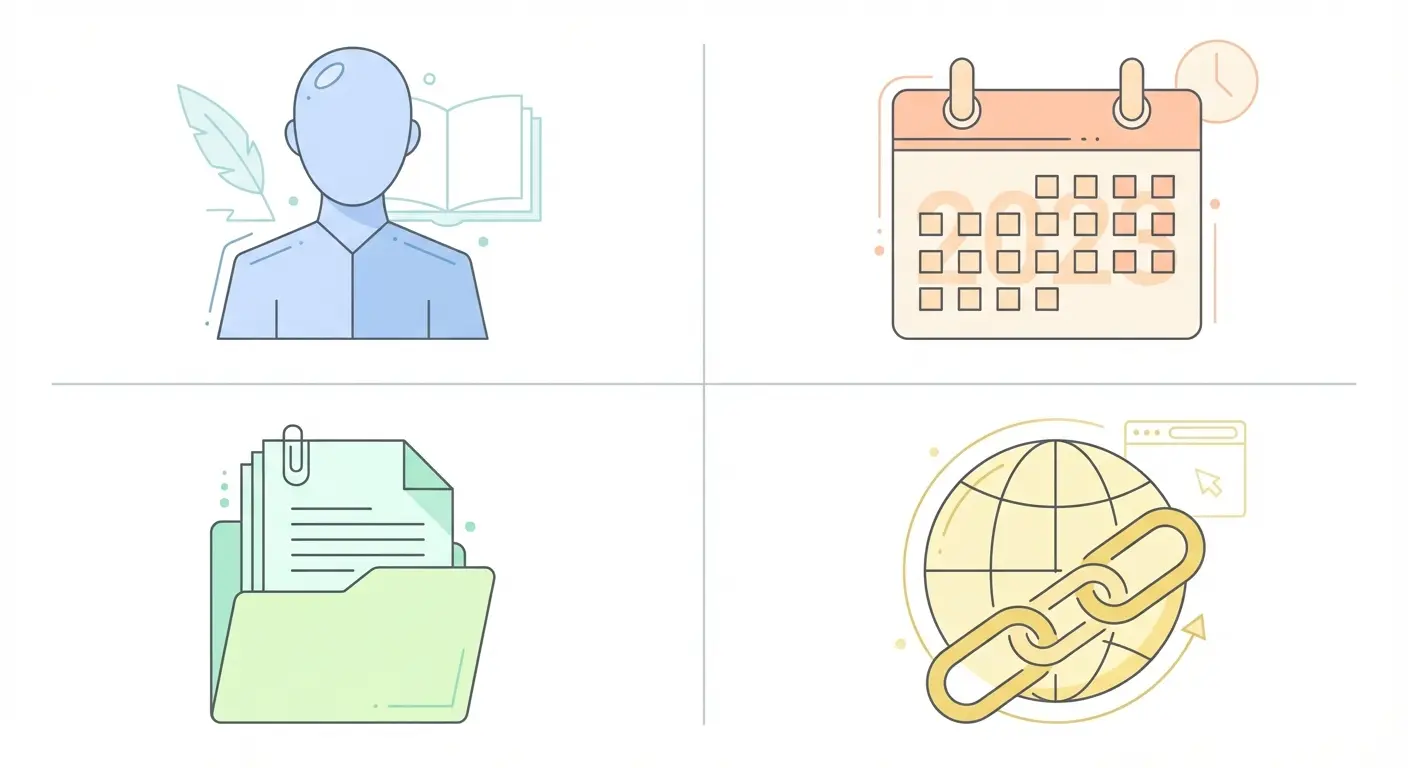
The Four Elements of Every APA Reference
- Who — The author(s) or responsible party. This could be a person, organisation, or government body.
- When — The publication date, formatted as (Year) for most sources, or (Year, Month Day) for news articles, blog posts, and social media.
- What — The title of the work. Sentence case for article and book titles; title case only for journal names.
- Where — The source location: journal name + volume/issue + page numbers, publisher name, or URL/DOI.
The Purdue OWL, one of the most-cited writing resources for academic formatting, provides detailed APA general format guidance that aligns with the official manual. Cross-referencing both is a sound verification practice.
APA In-Text Citation vs. Reference List: Key Differences
| Element | In-Text Citation | Reference List Entry |
|---|---|---|
| Author | Last name only (Smith) | Last name, Initials (Smith, J. A.) |
| Year | Year only (2023) | Full date if needed (2023, March 15) |
| Title | Not included | Full title, sentence case |
| Page Number | Required for direct quotes (p. 45) | Page range for journal articles |
| DOI/URL | Never included | Always include if available |
One counterintuitive rule that catches many researchers out: journal article titles use sentence case in the reference list, but the journal name itself uses title case. “Examining the dynamics of cognitive load” is correct for an article title; Journal of Educational Psychology is correct for the journal name. That asymmetry trips up even experienced academics.
In-Text Citations in APA: Every Format You Need
In-text citations are the live connective tissue of your argument — the moment where your claims meet their evidential basis. Getting these wrong doesn’t just create a formatting problem; it creates a traceability problem that peer reviewers will flag immediately.
Parenthetical vs. Narrative In-Text Citations
APA 7th edition distinguishes between two citation styles, and using both strategically improves both readability and citation density:
- Parenthetical: The citation appears in parentheses at the end of the sentence. Example: “Working memory capacity predicts reading comprehension outcomes (Daneman & Carpenter, 1980).”
- Narrative: The author’s name appears in the sentence itself. Example: “Daneman and Carpenter (1980) demonstrated that working memory capacity predicts reading comprehension outcomes.”
Citation Formats by Number of Authors
| Number of Authors | First Citation | Subsequent Citations |
|---|---|---|
| 1 author | (Smith, 2021) | (Smith, 2021) |
| 2 authors | (Smith & Jones, 2021) | (Smith & Jones, 2021) |
| 3+ authors | (Smith et al., 2021) | (Smith et al., 2021) |
| Group author (first use) | (World Health Organization [WHO], 2020) | (WHO, 2020) |
| No author | (“Title of Article,” 2021) | (“Title of Article,” 2021) |
The shift from 6th to 7th edition here is significant: the 6th edition required spelling out three to five authors on first citation, then truncating to “et al.” from the second citation onward. The 7th edition truncates to “et al.” from the very first citation whenever there are three or more authors. This small change affects thousands of references in any literature-heavy manuscript.
Direct Quotations and Block Quotes
Direct quotes require a page number (p. 45) or paragraph number (para. 3) for sources without pagination. Quotes longer than 40 words become block quotes: indented 0.5 inches from the left margin, no quotation marks, and the citation placed after the final punctuation.
Building the APA Reference List from Scratch
The reference list is where citation standards become most visible — and most scrutinised. A clean, correctly formatted reference list signals methodological rigour before a reader has processed a single argument in your paper.
Reference List Formatting Rules (APA 7th)
- Start on a new page with the centred heading “References” (bold, not italicised)
- Alphabetise entries by the first author’s last name
- Use a hanging indent: first line flush left, subsequent lines indented 0.5 inches
- Double-space all entries (no extra space between entries)
- Include DOIs as hyperlinks (https://doi.org/xxxxx) when available
- Remove the publisher location for most book references (this changed in the 7th edition)
The official APA Style reference list basic principles page is the single most authoritative source for resolving edge cases — bookmark it permanently if you work with APA regularly.
DOIs and URLs: The 7th Edition Standard
This is where formatting diverges most sharply between the 6th and 7th editions. The 7th edition requires DOIs for all works that have them — including both print and electronic sources. Where no DOI exists, include a URL for works retrieved online. The format is: https://doi.org/10.XXXX/XXXXXX (no full stop at the end).
What most researchers miss: if a URL is likely to change (e.g., a database record), use a stable link (permalink) rather than the browser address bar URL. Many university library databases provide a “permanent link” or “stable URL” option specifically for this purpose.
APA Citation by Source Type: Books, Journals, Websites, and More
The four-element framework holds across all source types, but the specific formatting varies enough that working through examples is the most efficient path to fluency. Here are the most common source types researchers encounter.
Journal Articles
Format: Author, A. A., & Author, B. B. (Year). Title of article. Journal Name, volume(issue), page–page. https://doi.org/xxxxx
Example: Krueger, R. A., & Casey, M. A. (2009). Focus groups: A practical guide for applied research (4th ed.). SAGE Publications.
Books and Edited Volumes
Format: Author, A. A. (Year). Title of work: Capital letter also for subtitle. Publisher. https://doi.org/xxxxx
Note that the publisher location (City, State: Publisher) required in the 6th edition is now dropped. This affects every book reference you’ve formatted before 2020.
Websites and Online Reports
Format: Author, A. A. (Year, Month Day). Title of page. Site Name. https://www.example.com
If the author and the site name are the same organisation, omit the site name to avoid repetition. For example, a report by the American Psychological Association hosted on apa.org would not repeat “American Psychological Association” in both the author and source positions.
Secondary Sources (Citing a Citation)
What happens when you find a useful citation in a paper you’re reading, but can’t access the original source? APA’s guidance is clear: try to locate the original. If genuinely unavailable, use the “as cited in” formulation: (Tolman, 1948, as cited in Smith & Jones, 2023). Only the work you actually read (Smith & Jones, 2023) appears in your reference list.
Academic Integrity and Citation Standards: Why Accuracy Is Non-Negotiable
Citation isn’t just formatting — it’s the operational expression of academic integrity. That’s not an abstract philosophical point; it has concrete institutional consequences.
A 2024 study published in International Journal for Educational Integrity conducted a comparative analysis of plagiarism rates before, during, and after the COVID-19 pandemic, finding significant shifts in how citation misconduct manifests across different institutional contexts (Springer, 2024). The research highlights that citation errors — whether intentional or inadvertent — fall under the same institutional scrutiny as deliberate plagiarism in most university honour codes.
Turnitin’s similarity detection now flags not just copied text but also inadequate paraphrasing and missing citations. What changed in recent years is the granularity: modern detection tools can identify when a passage closely mirrors a source even when surface-level wording differs. The safeguard isn’t sophisticated paraphrasing — it’s accurate, consistent citation.
The Committee on Publication Ethics (COPE) provides specific flowcharts for handling citation and authorship misconduct that editors at JSTOR-indexed journals follow. Understanding those frameworks helps researchers appreciate why editors take citation accuracy as a signal of overall research integrity.
For a broader framework on why referencing connects to reproducibility and ethical research design, the complete research methodology guide covers the intersection of citation practices, transparent reporting, and ethical scholarly conduct in depth.
The Difference Between Citation Errors and Academic Misconduct
This distinction matters enormously for researchers at all career stages. Formatting errors (wrong date format, missing DOI, incorrect italicisation) are citation errors — correctable, non-disciplinary issues typically addressed during peer review. Fabricated citations, ghost citations (citing sources you haven’t read), and deliberate misrepresentation of source content are academic misconduct with formal institutional consequences.
The grey zone — citing a secondary source as though you read the primary — sits between the two. It’s not fabrication, but it is methodologically dishonest and technically violates APA guidance. Fair warning: this is more common than most researchers admit, and reviewers who know the field can often spot it.
The 12 Most Common APA Citation Mistakes (and How to Fix Them)
After reviewing hundreds of manuscripts, certain errors appear with remarkable regularity. Here’s what to check before submission.
- Using 6th edition rules for author truncation. Fix: Truncate to “et al.” from the first citation when there are 3+ authors.
- Including publisher location for books. Fix: Remove city and state — 7th edition doesn’t require them.
- Formatting DOIs as “DOI: 10.xxx” instead of “https://doi.org/10.xxx”. Fix: Always use the full hyperlink format.
- Using title case for article titles in the reference list. Fix: Sentence case for article and book titles; title case only for journal names.
- Missing the ampersand (&) vs. “and” distinction. Fix: Use “&” inside parentheses; use “and” in narrative citations.
- Inconsistent et al. usage. Fix: Apply consistently from first citation for 3+ authors in both narrative and parenthetical formats.
- No page number for direct quotes. Fix: Always include p. XX or para. XX for quoted material.
- Alphabetising by first name instead of last name. Fix: Sort reference list entries by authors’ last names.
- Forgetting the hanging indent. Fix: 0.5-inch indent on all lines after the first in each reference entry.
- Including “Retrieved from” before URLs. Fix: This was removed in the 7th edition — just include the URL directly.
- Citing Wikipedia or non-peer-reviewed sources without flagging them. Fix: For academic papers, prioritise JSTOR, PubMed, or Web of Science indexed sources. If you must cite a non-peer-reviewed source, note its limitations.
- Mismatched in-text citations and reference list entries. Fix: Every in-text citation must have a corresponding reference list entry, and vice versa. Use a systematic cross-check.
Citation Tools, Managers, and Their Limitations
Zotero, Mendeley, EndNote, and web tools like ZoteroBib have transformed how researchers manage references. But they introduce a specific failure mode that’s worth understanding before you depend on them.
Automated citation generators pull metadata from database records — and those records are frequently incomplete or incorrect. Common issues include: missing DOIs, incorrect author initials, wrong publication years for revised editions, and incorrect capitalisation that the tool can’t auto-correct. A 2022 analysis of citation manager accuracy found error rates ranging from 15% to 38% depending on source type and database, with website and grey literature citations being most error-prone.
The workflow that actually works:
- Use a citation manager (Zotero is free and excellent) to collect sources and generate initial drafts
- Treat every generated citation as a draft, not a final product
- Manually verify against the APA 7th edition manual or official APA Style website
- Cross-reference the source record with the original publication page where possible
For a detailed examination of where automatic tools introduce accuracy problems — and specific verification steps to protect your reference list — the guide on automatic citation tools and common accuracy pitfalls covers the most systematic risk points in automated referencing workflows.
One counterintuitive insight: citation managers are most reliable for journal articles with DOIs (because the metadata is standardised) and least reliable for books, book chapters, reports, and websites. Adjust your verification effort accordingly — spend more time manually checking the source types that automation handles worst.
The 60-Minute APA Citation Checklist
This is the systematic workflow that works when you have a deadline. It assumes you’ve already written your paper and collected all your sources — now you need to verify and format everything correctly.
Phase 1: Inventory (10 minutes)
- Export all sources from your citation manager as a complete reference list
- Cross-check in-text citations against your reference list — flag any mismatches immediately
- Categorise sources by type (journal articles, books, websites, reports) — you’ll verify each category systematically
Phase 2: Reference List Verification (25 minutes)
- Journal articles: Confirm author initials, year, article title (sentence case), journal name (title case), volume, issue, page range, DOI format (https://doi.org/xxxxx)
- Books: Confirm author, year, title (sentence case, italics), edition if applicable, publisher name only (no location)
- Websites: Confirm author or organisation, full date, page title (sentence case), site name, stable URL
- Check alphabetisation: Sort entries A–Z by first author’s last name
- Check formatting: Hanging indent, double-spacing, no extra spaces between entries
Phase 3: In-Text Citation Audit (15 minutes)
- Author count check: All 3+ author works use et al. from first citation?
- Ampersand/and check: “&” inside parentheses, “and” in narrative?
- Page numbers: All direct quotes have p. XX or para. XX?
- Group author abbreviations: Introduced correctly on first use?
Phase 4: Final Integrity Check (10 minutes)
- Every in-text citation has a reference list entry
- Every reference list entry has at least one in-text citation
- No “ghost citations” — you have actually read (or have access to) every source cited
- Secondary source citations use “as cited in” formulation
- DOI hyperlinks are live and resolve to the correct source
For a deeper framework on standardising citations across multiple style guides — particularly useful if your department works across APA, MLA, Chicago, and Harvard — the guide to standardising citations across research projects provides systematic comparison of all four major style standards.
Fair warning: this checklist takes longer than 60 minutes the first few times. Speed comes with repetition. The goal of the 60-minute target isn’t efficiency on day one — it’s demonstrating that thorough verification is genuinely achievable within a realistic time block once you’ve internalised the rules.
For visual reference on paper setup and formatting, the Scribbr tutorial on APA format paper setup walks through the structural formatting elements that complement citation accuracy.
APA vs. MLA, Chicago, and Harvard: Key Differences
Researchers working across disciplines or co-authoring across departments frequently need to switch between style guides. Here’s where the critical divergences lie.
| Feature | APA 7th | MLA 9th | Chicago 17th | Harvard |
|---|---|---|---|---|
| In-text format | Author, Year | Author Page | Footnotes/Endnotes | Author, Year |
| Reference list title | References | Works Cited | Bibliography | Reference List |
| Date position | After author | Near end | Near end | After author |
| Title case (articles) | Sentence case | Title case | Title case | Sentence case |
| Primary disciplines | Psychology, Social Sciences, Education | Humanities, Literature | History, Fine Arts | UK Social Sciences, Business |
Frequently Asked Questions About APA Citation
What is the difference between APA 6th and APA 7th edition?
APA 7th edition (2020) made several key changes from the 6th: publisher locations were removed from book references, DOIs are now formatted as hyperlinks (https://doi.org/xxxxx), three or more authors are truncated to “et al.” from the first citation (previously applied from the 3rd citation onward), and references can include up to 20 authors before truncation. The 7th edition also expanded guidance for digital and social media sources significantly.
Do I need a DOI for every APA reference?
Include a DOI whenever one is available — for both print and online sources. If a source has no DOI but was retrieved online, include the URL instead. Print sources with no DOI and not retrieved online do not require a URL. The APA Style website confirms this rule: DOIs take priority over URLs when both exist.
How do I cite a source with no author in APA format?
When a source has no identifiable author, move the title to the author position in both the reference list and in-text citation. Use the full title in the reference list entry and a shortened version (first few key words) in the in-text citation, placed in quotation marks for articles or italicised for books. Example in-text: (“Citation Standards,” 2023). Check whether an organisation might serve as the group author before defaulting to no-author format.
How do I cite a journal article found on Google Scholar in APA?
Google Scholar is a discovery tool, not a primary database — cite the original journal, not Google Scholar itself. Find the article’s DOI from the journal’s official page or a database like Web of Science, JSTOR, or PubMed, and use that DOI in your reference. Format: Author, A. A. (Year). Article title. Journal Name, volume(issue), pages. https://doi.org/xxxxx.
Can I use et al. for two authors in APA 7th edition?
No. “Et al.” is only used for works with three or more authors. Two-author works always cite both authors in every in-text citation, using “&” inside parentheses (Smith & Jones, 2021) or “and” in narrative form (Smith and Jones, 2021 found that…). There are no exceptions to this rule in APA 7th edition.
How does APA citation relate to academic integrity policies?
Accurate APA citation is directly tied to academic integrity because it establishes verifiable intellectual attribution — identifying whose ideas informed your work and making those claims checkable. Most university honour codes treat citation misconduct, including fabricated references and ghost citations, with the same institutional weight as plagiarism. Following APA 7th edition citation standards consistently is one of the most concrete ways researchers demonstrate methodological transparency and scholarly honesty.
Conclusion: Research Methodology, Citation Standards, and Academic Integrity
Write your thesis with AI
Structure, draft, cite, and format your thesis faster with Tesify’s AI writing tools, automatic bibliography, and plagiarism checker. Free to start, no credit card required.



Leave a Reply