
How Long Should a Master’s Thesis Be? 5 Common Errors in AI-Assisted Thesis Writing and Citation Integrity
You’ve spent weeks on your master’s thesis, and now — at the final hurdle — you’re not sure whether it’s too short, too long, or whether your AI-assisted drafting has quietly introduced citation errors you haven’t caught yet. These aren’t minor anxieties. Examiners at universities across the UK, US, Australia, Canada, and Ireland have failed theses for exactly these reasons. AI-assisted thesis writing and citation integrity failures are among the most preventable causes of resubmission — and the five errors below are where most students come unstuck.
This article identifies the five errors most commonly made by students who combine AI assistance with academic writing — and shows you exactly how to fix them before submission.

Contents
- Error 1: Ignoring Institutional Word-Count Requirements
- Error 2: Trusting AI-Generated Citations Without Verification
- Error 3: Failing to Disclose AI Use — and Why It Matters
- Error 4: Treating AI Paraphrasing as Original Thought
- Error 5: Submitting Without Running a Proper Plagiarism Check
- Master’s Thesis Length by Discipline: Reference Table
- How Tesify Handles AI-Assisted Writing and Citation Integrity
- Pre-Submission Integrity Checklist
- Frequently Asked Questions
Error 1: Does Thesis Word Count Actually Matter to Examiners?
Yes — and not just marginally. Most UK universities specify word-count limits as a formal regulation, not a guideline. The University of Oxford’s examination regulations, for instance, state that a thesis submitted over the permitted word count may be referred back to the student before it even reaches the examiner’s desk. The same hard limits apply at Cambridge, Edinburgh, and across the Russell Group.
The error most students make isn’t going thousands of words over — it’s not knowing their institution’s actual rule in the first place. Many students rely on department rumour (“our supervisor said 20,000 is fine”) rather than checking the official postgraduate handbook. The two figures frequently diverge.
A master’s thesis word count refers to the total number of words assessed by the examiner, typically excluding the abstract, bibliography, appendices, and footnotes — though this exclusion varies by institution. Always check your postgraduate student handbook for what your word count includes, not just what the target number is.
AI-assisted thesis writing introduces a specific risk here: AI tools write fluently and prolifically. Students who use AI drafting assistants frequently report that their chapters grew faster than expected — and longer than intended. What most people miss is that AI doesn’t have any incentive to be concise. It fills space. Your thesis structure still requires deliberate editorial control from you.
For a detailed breakdown of expected word counts by discipline and institution type, see the master’s thesis word count guide for 2026, which maps actual requirements across UK, US, Australian, and Canadian institutions.
Are AI-Generated Citations Reliable for Academic Thesis Work?
This is where the real danger lives. Large language models — including the most capable ones available in 2025 — hallucinate citations. That’s not a metaphor; it’s the technical term for when an AI generates a reference that doesn’t exist: a plausible-sounding author name, a real journal, a believable volume number, and a page range that leads nowhere.
A 2023 study published in Nature flagged that AI systems produce confident-sounding but factually incorrect academic references at a significant rate. Students who copy AI-generated reference lists into their bibliographies without individual verification are submitting fabricated sources — and examiners do check, particularly for unusual or conveniently perfect citations.
The fix is systematic, not optional. Every citation generated by an AI tool must be verified against a primary database — PubMed, JSTOR, Google Scholar, or your institutional library catalogue — before it enters your reference list. This takes time, but it’s non-negotiable.
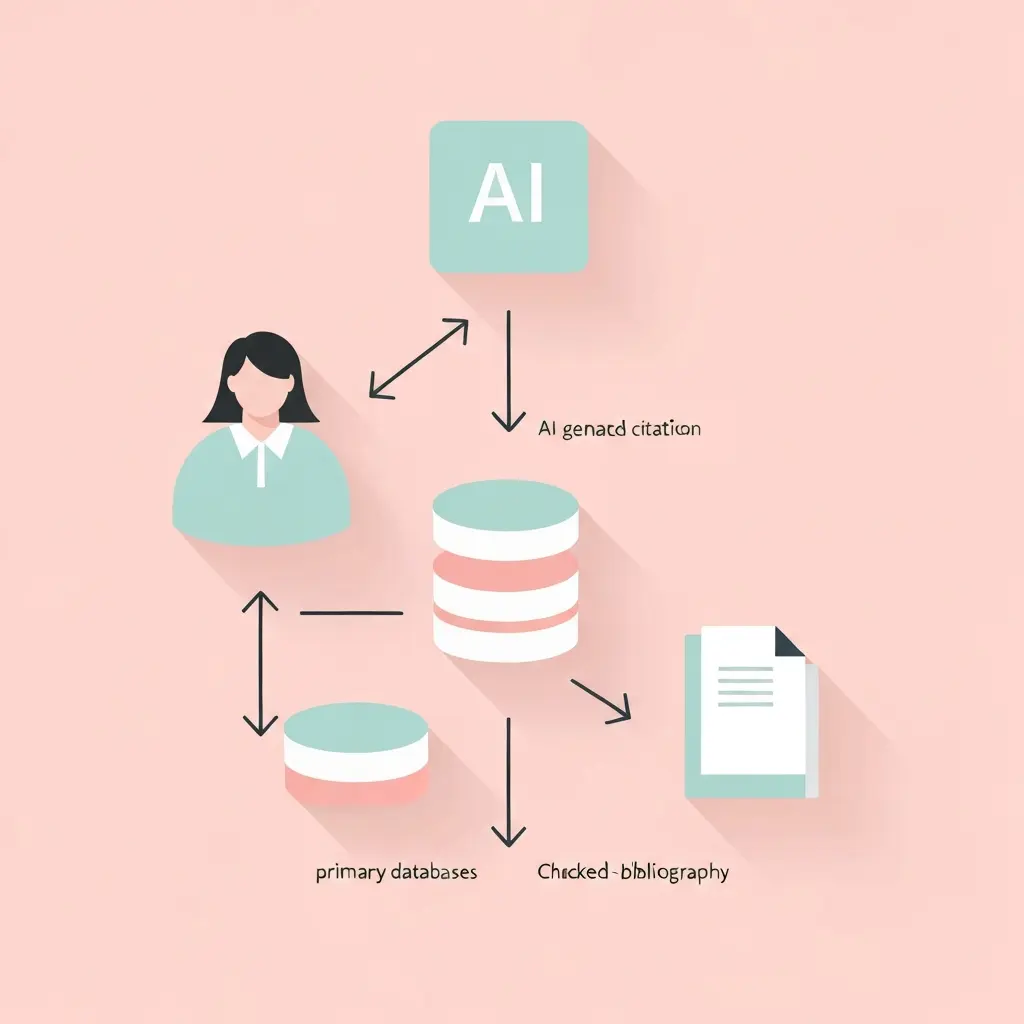
For a practical workflow on managing citations without errors, the guide on citation standards and reference management failures covers the exact steps to audit a bibliography produced with AI assistance, including how to use Zotero and other reference managers to cross-check entries automatically.
Tools like Zotero allow you to import a DOI or URL and auto-generate verified citations — a far safer pipeline than copying AI output directly.
What Happens If You Don’t Disclose AI Use in Your Thesis?
University policies on AI disclosure have moved extraordinarily fast since 2023. What was ambiguous two academic years ago is now, at most major institutions, explicitly codified. Harvard, UCL, the University of Melbourne, and the University of Toronto have all issued specific guidance requiring students to declare if, how, and to what extent they used generative AI in their work.
Non-disclosure isn’t a minor omission. Under most academic integrity frameworks, submitting work without required disclosures is classified as a form of academic dishonesty — even if the AI-assisted content is otherwise original and properly cited. The issue is transparency, not just content quality.
The Poorvu Center for Writing and Learning at Yale has published academic integrity guidance specifically for graduate students navigating AI use — it’s worth reading before you submit. Notre Dame’s resource library also offers practical guidance on navigating AI tools with integrity in academia, covering disclosure templates students can adapt.
The question of whether AI use constitutes plagiarism is nuanced and institution-specific. The full policy breakdown is covered in the article on AI-assisted thesis writing and plagiarism policy for 2026, which maps current university stances across the UK, US, AU, CA, and IE.
Does AI Paraphrasing Count as Original Academic Writing?
Here’s something counterintuitive: AI paraphrasing can make your thesis worse, not better — even when detection tools don’t flag it. The problem isn’t just detection. It’s that paraphrased AI output substitutes the student’s genuine analytical voice with a statistically averaged version of everyone else’s writing.
Examiners notice. Not through AI detection software (though that’s a factor), but because the writing is tonally flat, the transitions are too smooth, and the argumentation is suspiciously generic. This particularly affects the literature review and discussion chapters, where your evaluative voice is supposed to carry intellectual weight.
Student papers estimated to contain AI-written content per year (Wired, 2023)
Accuracy claimed by Turnitin’s AI detection for GPT-4 generated content
Typical false-positive rate for AI detection tools, per independent audits
A 2023 Wired investigation into Turnitin’s AI detection data found that millions of submitted student papers were flagged as likely AI-generated — many from students who’d used AI only for light editing. This matters because the burden of proof typically falls on the student to demonstrate the work is theirs.
Recent peer-reviewed research published in Springer (2025) examined how students attempt to bypass AI detection tools and concluded that paraphrasing tools used to “clean” AI output are largely ineffective against current detection systems — and in some cases increase suspicion by producing statistically unusual sentence structures.
The correct use of AI in thesis writing is as a structural assistant: helping you organise your argument, suggesting sources to investigate, or improving readability after you’ve written the core analysis yourself. AI should sharpen your thinking, not replace it.
Why Skipping a Plagiarism Check Before Submission Is a Gamble
Most students know that originality matters. What they underestimate is how many unintentional similarities accumulate during a long thesis project — especially one that involves AI-assisted drafting, extensive note-taking, and iterative editing over months.
Self-plagiarism is a real risk if you’ve previously submitted related coursework. AI-generated text sometimes mirrors phrasing from training data in ways that don’t feel like copying but still register as similarity. And direct quotations that lost their quotation marks during revision are more common than any student wants to admit.
Tesify’s plagiarism checker compares your work against millions of scholarly sources — including JSTOR, ProQuest, EThOS, ERIC, and Google Scholar — and flags potential AI-generated content alongside textual similarities. It’s built specifically for thesis-length academic documents, not short-form content, which makes a meaningful practical difference in accuracy.
Master’s Thesis Length by Discipline: What Do Institutions Actually Require?
Word-count expectations aren’t arbitrary — they reflect what’s academically sufficient to demonstrate mastery in a given field. The table below summarises typical ranges across disciplines and regions. These are working benchmarks; always verify your institution’s specific handbook.
| Discipline | Typical Word Count Range | UK/AU Benchmark | US/CA Benchmark |
|---|---|---|---|
| Engineering / Computer Science | 15,000 – 30,000 | 20,000 – 25,000 | 15,000 – 25,000 |
| Biology / Life Sciences | 20,000 – 40,000 | 25,000 – 35,000 | 20,000 – 30,000 |
| Psychology / Social Sciences | 20,000 – 45,000 | 25,000 – 40,000 | 20,000 – 35,000 |
| History / Literature / Philosophy | 40,000 – 80,000 | 50,000 – 80,000 | 40,000 – 60,000 |
| Business / Management | 15,000 – 25,000 | 15,000 – 20,000 | 15,000 – 20,000 |
| Law | 25,000 – 50,000 | 30,000 – 50,000 | 25,000 – 40,000 |
| Education | 20,000 – 40,000 | 20,000 – 35,000 | 20,000 – 30,000 |
These figures align with data published by the Quality Assurance Agency for Higher Education (QAA) in the UK and the Council of Graduate Schools in the US. For a more granular breakdown — including specific university requirements and chapter-by-chapter length guidance — the full master’s thesis word count guide is the most current resource available.
Write Your Thesis with AI — Without the Integrity Risks
Tesify is the academic writing platform built specifically for master’s and PhD students who want the efficiency of AI assistance without compromising citation integrity or academic honesty. The platform includes a smart thesis editor, automatic bibliography generation in APA, MLA, Chicago, and Vancouver, and a plagiarism detector that checks against JSTOR, ProQuest, EThOS, ERIC, and millions of scholarly sources.
Over 9,000 students have already used Tesify to complete their thesis — twice as fast, with verified citations and a clean plagiarism report to submit alongside their work. There are professional templates for every discipline, plus export to PDF, Word, and LaTeX. Free to start, no credit card required.
What Does a Pre-Submission Integrity Checklist Look Like?
Fair warning: this takes genuine effort. Working through it systematically — chapter by chapter, not the night before submission — is the difference between a confident submission and one you’re anxious about for three months while awaiting results.
Before You Submit: The AI-Assisted Thesis Integrity Checklist
- Confirm your institution’s exact word-count rule — including what is and isn’t counted — from the official postgraduate handbook
- Verify every AI-generated citation individually against a primary source database (JSTOR, PubMed, your library catalogue)
- Cross-check all reference list entries against in-text citations — missing or extra entries are a red flag for examiners
- Complete and attach your institution’s AI use declaration form, or include a disclosure statement on the title page
- Run a plagiarism check at draft stage and again on the final compiled document
- Review AI-paraphrased sections for genuine analytical contribution — replace generic passages with your own evaluative voice
- Check that AI-assisted formatting matches your institution’s required style (APA 7th, Harvard referencing, Chicago 17th, etc.)
- Confirm your thesis template meets faculty requirements — Overleaf’s LaTeX thesis templates are useful for institutions requiring LaTeX submission
- Ask your supervisor to review a chapter-by-chapter word count before final compilation
- Save a timestamped version history — this can serve as evidence of the writing process if AI use is questioned
How Should You Cite AI Tools in Your Thesis References?
This question has a specific, published answer — and it’s not “you don’t have to.” The MLA Style Center has issued formal guidance on citing generative AI, treating AI-generated content as a source that must be credited. The MLA guidelines for citing generative AI are the clearest publicly available framework for this.
APA 7th Edition also provides guidance: AI-generated text should be cited similarly to a personal communication, with the AI tool named, the version noted, and the date of generation specified. The core principle across all major style guides is the same — if you used it as a source of information or language, it requires attribution.
OpenAI. (2024). ChatGPT (GPT-4, May 2024 version) [Large language model]. https://chat.openai.com
In-text: (OpenAI, 2024)
Note: Include a parenthetical statement explaining what the AI generated and how it was used in your methodology or acknowledgements section.
Frequently Asked Questions About Master’s Thesis Length and AI-Assisted Writing
How long should a master’s thesis be in the UK?
UK master’s theses typically range from 15,000 to 50,000 words, depending on the discipline and university. Humanities and social science theses tend toward the higher end (40,000–80,000 words at some institutions), while STEM and business theses often sit between 15,000 and 30,000 words. The definitive figure is always your institution’s postgraduate regulations — not departmental convention.
Can I use AI to write my master’s thesis?
Yes, at most institutions — but with strict conditions. AI tools are generally permitted for structuring, editing, and improving readability, provided you disclose their use and verify all factual claims independently. Submitting AI-generated text as your own original analysis, without disclosure, typically violates academic integrity policies. Always check your institution’s specific AI use policy before you begin.
Do AI citation generators produce accurate academic references?
Not reliably. Large language models are known to hallucinate citations — generating plausible but non-existent references. Every AI-generated citation must be manually verified against a primary academic database such as JSTOR, PubMed, or your library catalogue before inclusion in your bibliography. Using a reference manager like Zotero alongside your AI writing tool significantly reduces this risk.
Will my university detect AI writing in my thesis?
Increasingly, yes. Turnitin’s AI writing detection tool, now deployed at thousands of universities worldwide, claims 98% accuracy for GPT-4 generated text. Examiners also flag AI-written content through qualitative review — generic argumentation, unusually smooth transitions, and absence of a personal analytical voice are all recognised indicators. AI paraphrasing tools do not reliably evade detection.
What citation style should a master’s thesis use?
This is determined by your institution and discipline, not your personal preference. Sciences and social sciences typically require APA 7th Edition; humanities often use Chicago 17th Edition or MHRA; law favours OSCOLA in the UK; and medical sciences frequently use Vancouver. Your postgraduate handbook will specify which style is required — and inconsistency between chapters is a common examiner complaint.
Does word count include the bibliography and appendices?
Usually not — but this varies significantly between institutions. Most UK universities exclude the abstract, bibliography, appendices, and figure captions from the official word count. Some include footnotes; others don’t. The correct answer is in your institution’s examination regulations, not in general guidance. Getting this wrong in either direction — padding excluded sections or cutting included ones — can cause compliance problems.
How do I cite an AI tool like ChatGPT in my master’s thesis?
The MLA Style Center and APA 7th Edition both provide specific guidance for citing generative AI. In APA format, cite the AI as the author with the tool name, version, and date of use. In MLA, treat it as a source with the prompt you used. Crucially, you must also describe how you used the AI in your methodology or acknowledgements section — a citation alone is insufficient disclosure at most institutions.
What is the most common reason AI-assisted theses fail integrity checks?
The single most common failure is unverified AI-generated citations — references that appear correct but lead to non-existent sources when checked by an examiner. The second most common issue is non-disclosure: students who used AI assistance but didn’t declare it, only for the examiner to identify AI-style writing patterns. Both are avoidable with a systematic pre-submission review process.
Ready to Write Your Thesis With Confidence?
The five errors covered in this article — ignoring word-count rules, trusting AI citations without verification, skipping disclosure, treating paraphrasing as original work, and submitting without a plagiarism check — are all preventable. None of them require you to abandon AI assistance. They require you to use it properly. Getting AI-assisted thesis writing and citation integrity right isn’t a bureaucratic exercise; it’s the difference between a clean pass and a costly resubmission.
If you want an academic writing environment where AI assistance is built with citation integrity as a default — not an afterthought — Tesify is worth exploring. The platform’s automatic bibliography tools, integrated plagiarism checking against scholarly databases, and structured thesis editor are designed to prevent exactly these errors.
For further reading on thesis length by discipline, the 2026 master’s thesis word count guide is the most detailed resource currently available. For the full breakdown of what AI disclosure your university requires, the AI-assisted thesis writing policy article covers current regulations across the UK, US, Australia, Canada, and Ireland.
Your thesis represents years of academic work. The five hours you spend auditing citations and verifying compliance are the best-value hours of the entire project.
Write your thesis with AI
Structure, draft, cite, and format your thesis faster with Tesify’s AI writing tools, automatic bibliography, and plagiarism checker. Free to start, no credit card required.





Leave a Reply