
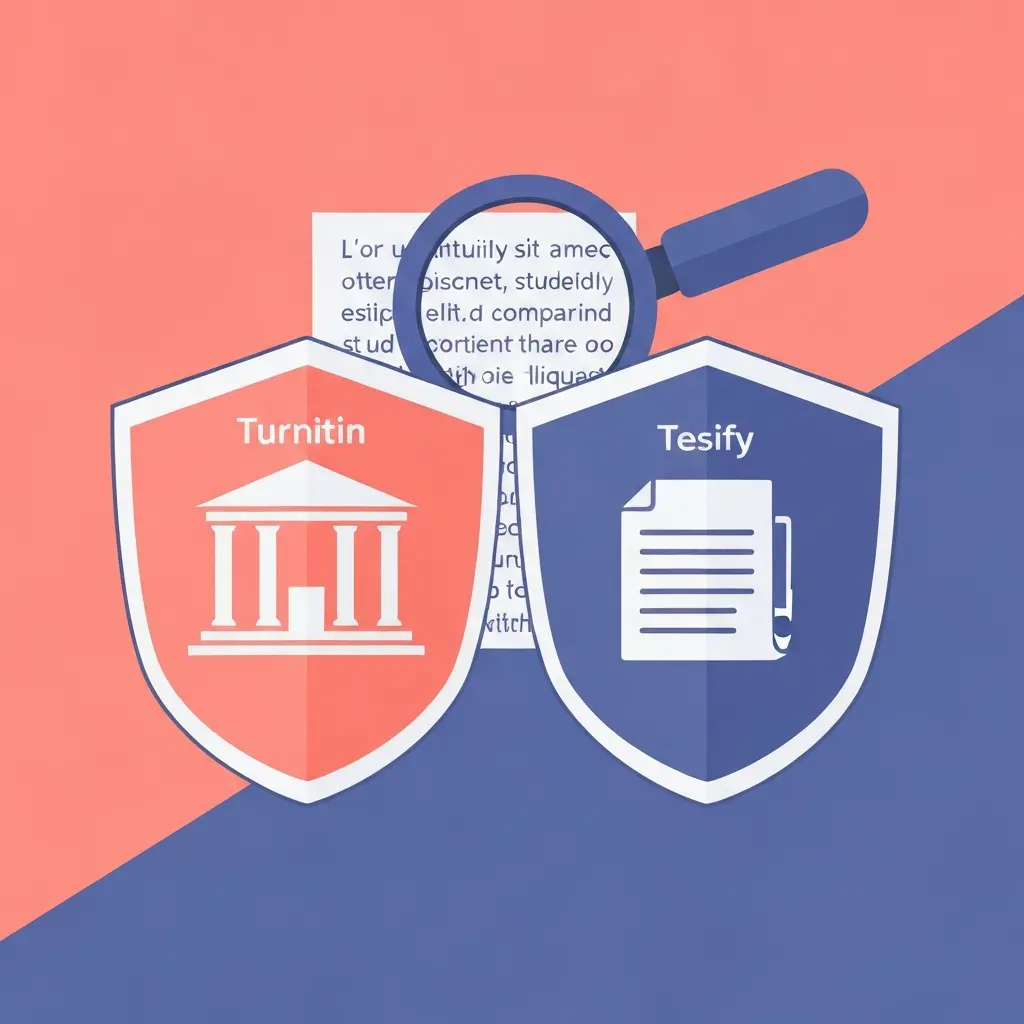
Turnitin vs Tesify Plagiarism Detection: A Direct Comparison for Students 2026
Before you submit your dissertation, you need to know what your university’s plagiarism detection system will find. For most students in the UK, US, Australia, and Canada, that system is Turnitin — and the question they are searching for is whether they can check their own work against the same standard before it reaches their institution. In 2026, students increasingly run a pre-submission check using tools like the Tesify Plagiarism Checker to avoid surprises. But how accurate is that comparison? And what can Tesify catch that Turnitin cannot, or vice versa?
This comparison breaks down the real differences between Turnitin and Tesify plagiarism detection — not the marketing language, but what each tool actually does, what it checks against, and how students should use each one strategically.
How Turnitin Works in 2026
Turnitin is not a plagiarism detector in the strict sense — it is a text similarity detector. When you submit a paper, Turnitin compares it against its database and generates a Similarity Report: a percentage score showing how much of your text matches text in its database, with highlighted passages linking to the sources they match.
Turnitin’s database in 2026 is substantial: over 47 billion current and archived web pages, 1.9 billion student papers submitted through the platform, and more than 190 million academic journal articles from the top 97% of publications. This breadth is precisely why it is the institutional standard — its student paper database is unmatched, which means it catches not just published source plagiarism but also paper mill content and recycled work from previous cohorts.
Critically, Turnitin’s AI detection layer — launched in 2023 and updated through 2025 — now analyses writing patterns to flag content that may have been generated by large language models including ChatGPT, Claude, and Gemini. This is integrated into the standard Turnitin submission at most institutions as of 2026.
How Tesify Plagiarism Checker Works
Tesify’s Plagiarism Checker is built specifically for the student writing workflow rather than for institutional reporting. Where Turnitin produces a similarity report after submission, Tesify integrates originality checking into the active writing process — you see potential issues while drafting, not after you have already committed to a version.
Tesify checks submitted text against published academic sources, books, and web content. Its particular strength is contextual analysis: rather than flagging any text that appears elsewhere (which generates false positives for unavoidable phrases like “this study examines”), it identifies passages that are structurally and semantically close to sources without attribution. This distinction between textual similarity and unattributed content is what makes Tesify’s output actionable for writers rather than alarming.
The tool also includes AI-generated content detection trained on 2025-2026 patterns, covering output from the major LLMs. For students who use AI paraphrasing tools as part of their workflow, this is a meaningful checkpoint before the work reaches Turnitin.
Turnitin vs Tesify: Head-to-Head Comparison 2026
| Feature | Turnitin | Tesify Plagiarism Checker |
|---|---|---|
| Who can access it? | Institutions only (lecturers submit on behalf of students) | Students directly, free tier available |
| Database size | 47B+ web pages, 1.9B student papers, 190M+ articles | Published academic sources, books, web content |
| Student paper database | Yes — 1.9 billion submitted papers | No (published sources only) |
| AI writing detection | Yes (built-in, updated 2025) | Yes (integrated, 2026 patterns) |
| Integration with writing | No — check at submission only | Yes — check during drafting |
| Cost to student | Covered by institution | Free tier available; premium included with Tesify Write |
| Similarity report format | Percentage score + highlighted matches | Originality score + actionable suggestions |
| Stores submitted text? | Yes — added to student paper database | No — checks are private |
Database Size and Source Coverage: Where Turnitin Has the Edge
Turnitin’s database advantage is real and significant. Its 1.9 billion student paper repository is something no student-facing tool can replicate — it catches recycled essays, paper mill content, and paraphrased versions of previously submitted work that would pass any check against published sources alone. If a student in 2018 submitted an essay with the same argument you are making, Turnitin may flag the structural similarity.
This is both the tool’s strength and its source of frustration. Turnitin regularly generates similarity flags on properly cited quotations, standard disciplinary phrases, and common methodological descriptions that appear in many papers. A similarity score of 15% is often entirely appropriate for a well-cited academic paper — the score itself means nothing without examining what is being flagged.
Tesify checks against published academic sources rather than a student paper database. For the most common sources of unintentional similarity — journal articles, books, and websites — it provides reliable detection. For recycled student work, it does not have Turnitin’s coverage. This is a genuine limitation students should understand: Tesify will not tell you if your argument is too similar to another student’s submitted essay.
AI Writing Detection: A Closer Look
In 2026, AI detection is the most actively contested feature in plagiarism detection. Turnitin’s AI detector — which analyses sentence structure, perplexity, and burstiness patterns — was updated in 2025 and claims to identify AI-generated content with high confidence at the document level. It produces a percentage estimate of AI-generated content shown alongside the similarity score.
The well-documented limitation is false positives on non-native English speakers and on highly technical, formulaic writing. Turnitin has stated its tool is intended as one signal among many rather than a definitive finding, but in practice some institutions treat high AI scores with the same seriousness as high similarity scores.
Tesify’s AI detection is calibrated specifically for the writing patterns of 2025-2026 LLMs and focuses on the academic writing context. Because it operates within the writing workflow rather than as a post-submission audit, it allows students to review and address flagged passages before submission — which is the meaningful difference in how the tools function.
For a deeper understanding of how AI detection works and what constitutes appropriate AI use under current university policies, our article on AI thesis writing and plagiarism policies in 2026 covers the institutional position across major universities.
Student Access: The Most Practical Difference
The single most important practical difference between Turnitin and Tesify is who can use them and when.
Turnitin is an institutional tool. Students cannot run their own Turnitin checks in most cases — their institution’s submission portal runs the check at the point of formal submission. Some universities allow draft submissions through Turnitin Draft Coach, but this is not universally available. If your institution does not provide Draft Coach, you have no way to see your Turnitin score before submitting.
Tesify’s Plagiarism Checker is student-facing by design. You can check any passage, any chapter, or the full dissertation at any point during the writing process. This is the use case that matters most: identifying and fixing originality issues while you still have time to address them, not discovering a problem after you have submitted.
Accuracy and False Positives
Both tools generate false positives — flags on text that is not plagiarism. This is unavoidable in similarity detection because unavoidable phrases, block quotes that are correctly attributed, and standard disciplinary terminology will always share text with published sources.
Turnitin’s similarity reports require interpretation. A 12% score with all matches being properly formatted quotations is not a problem. A 12% score with matches to unattributed sources is a serious issue. The number alone is not the finding.
Tesify reduces false positives through contextual analysis — it distinguishes between a correctly attributed quote and text that closely mirrors a source without a citation. This makes its output more immediately actionable for student writers. You do not need to interpret a percentage; you see specific passages that need attention and why.
How to Use Both Tools Strategically
The optimal approach for any serious student in 2026:
- Write and check with Tesify throughout — use the plagiarism checker at the end of each chapter as part of your revision cycle. Address flagged passages by adding citations, improving paraphrasing, or rewriting in your own words before you move on.
- Run a final Tesify check on the complete draft one week before formal submission to catch any cross-chapter issues and confirm your AI-generated content score is within acceptable range.
- Submit through your institution’s Turnitin portal for the formal check. If your university allows draft submissions, use that feature. If not, the work you have done with Tesify means there should be no surprises.
- Understand your similarity score in context. A correctly cited paper should expect some similarity score. What matters is whether the matches are properly attributed — not the raw percentage.
If your Turnitin score is higher than expected, our guide on how to avoid plagiarism in academic writing walks through the specific techniques for reducing textual similarity while maintaining the academic integrity of your argument. For a broader view of plagiarism detection tools, our free plagiarism checker comparison for students covers the full landscape.
Frequently Asked Questions
Can students access Turnitin directly without going through their university?
In most cases, no. Turnitin is licensed to institutions and students access it only through their university’s learning management system at the point of submission. Turnitin offers Draft Coach, a browser extension that integrates with Google Docs and provides similarity checking, but this requires institutional access. If your university has not enabled Draft Coach, you cannot run a Turnitin check on your own work independently. This is why student-facing tools like Tesify’s plagiarism checker are valuable — they provide the pre-submission check that Turnitin does not allow independently.
What similarity score is acceptable in Turnitin for a dissertation?
There is no universal acceptable threshold — it depends on your institution and discipline. As a general guide, a similarity score under 15% is rarely flagged for concern if properly cited. 15-25% is a yellow flag that usually requires review of what is being matched. Above 25% typically triggers investigation, though this depends heavily on what the matches are. A paper with a 20% score where all matches are correctly formatted quotations from literature is academically sound. A paper with a 10% score where matches are unattributed paraphrases is not. Always check with your institution for their specific thresholds and policies.
Does Turnitin detect paraphrasing done with AI tools like QuillBot?
Turnitin’s similarity detection will show a lower score for well-paraphrased text compared to directly copied text — paraphrasing changes the surface text and reduces similarity matches. However, Turnitin’s AI detection layer may flag extensively AI-paraphrased content as having AI-writing patterns, even when it is not directly plagiarised. The risk is not similarity detection catching it, but AI detection flagging the AI-assisted paraphrasing. The safest approach is to use AI paraphrasing as a first draft aid, then edit substantially in your own voice before submission.
Is Tesify as accurate as Turnitin for plagiarism detection?
For published academic sources and web content, Tesify provides comparable accuracy to Turnitin. Where Turnitin has a significant advantage is its student paper database of 1.9 billion submitted papers — no student-facing tool has access to that corpus. This means Tesify will not catch all the same matches as Turnitin, particularly for recycled or previously submitted student work. They serve different purposes: Tesify is the best pre-submission checking tool for published-source originality during writing; Turnitin is the institutional audit tool at submission. Use both as part of your process rather than treating them as alternatives.
What does Turnitin actually check a thesis against?
Turnitin compares submitted text against three main databases: internet content (47 billion+ current and archived web pages), academic publications (190 million+ journal articles from the top 97% of publishers), and the Turnitin student paper repository (1.9 billion papers submitted by students at institutions worldwide). It also includes a database of academic books and some proprietary content sources. The breadth of this comparison is what makes Turnitin the institutional standard — the combination of published sources and submitted student papers is unique.
Does Turnitin store my thesis in its database after submission?
By default, yes — Turnitin adds submitted papers to its student paper repository, where they can be matched against future submissions. Most institutions submit to Turnitin’s standard repository. Some allow students to opt out or request exclusion, and some institutions submit to a non-archiving database option. If you are concerned about your thesis entering the Turnitin database (for example, if you plan to publish it), ask your institution whether they use the standard repository or can exclude your submission. Tesify does not store or archive your submitted text.
Which plagiarism checker should a student use before final dissertation submission?
Use Tesify’s Plagiarism Checker as your working tool throughout the writing process — it integrates with your draft and provides actionable feedback on published-source similarity and AI content detection. If your institution provides Turnitin Draft Coach, run that too for a pre-submission view against the student paper database. At formal submission, your institution’s Turnitin check is the definitive review. The most important protection is building originality checking into your regular writing process rather than treating it as a last-minute risk assessment.
Don’t wait for Turnitin to find the issue
Tesify’s built-in plagiarism checker flags unattributed sources and AI-generated content during writing — so you fix it before it becomes a problem at submission.



Leave a Reply