
What Is the Best AI Tool for Thesis Writing: Academic AI vs ChatGPT
Thesis writing is one of the most demanding academic tasks a student faces — and the rise of AI tools has made the question of which one to actually use far more urgent than it seems at first glance. General-purpose chatbots like ChatGPT can draft paragraphs in seconds, yet they routinely hallucinate citations, ignore APA formatting rules, and have no awareness of your university’s plagiarism policy.
So before you paste your research question into the nearest AI chat window, it’s worth asking: is that tool actually built for thesis writing, or are you fitting a square peg into a round hole?
What Makes an AI Tool Good for Thesis Writing?
Not all AI tools are equal in an academic context — and that gap matters enormously when your degree depends on the output. A good AI tool for thesis writing needs to do more than generate fluent prose; it needs to understand the structural conventions of academic writing, the citation systems universities actually assess, and the ethical boundaries your institution enforces.
Definition: Academic AI Tool
An academic AI tool is a software platform designed specifically to support scholarly writing tasks, including thesis structure, referencing in recognised citation styles (APA, MLA, Chicago, Vancouver), plagiarism detection against academic databases, and compliance with institutional guidelines — as opposed to general-purpose language models trained primarily on web content.
The core requirements break down into four categories. First, structural intelligence: the tool should recognise that a thesis has a specific anatomy — abstract, literature review, methodology, findings, discussion — not just a long essay. Second, citation accuracy: generating a reference list that actually conforms to APA 7th edition or Chicago 17th edition, not a plausible-looking approximation of one.
Third, plagiarism transparency: any AI-assisted text needs to be checked against scholarly repositories — JSTOR, ProQuest, EThOS, ERIC — not just a surface-level web crawl. Fourth, academic integrity compliance: the tool should be aware of disclosure norms. Oxford’s 2024 Human Sciences Handbook, for example, requires explicit declaration of AI assistance in submitted work (University of Oxford, 2024).
The other thing worth recognising: thesis writing isn’t a single task. It’s 40–80 hours of iterative drafting, citation management, structural revision, and integrity checking. A general chatbot handles one interaction at a time. A dedicated academic platform is built to handle the whole workflow.
How Does Academic AI Compare to ChatGPT for Thesis Work?
This is the question nearly every postgraduate student asks — and the honest answer is that they serve different purposes. ChatGPT is a broadly capable language model; academic AI platforms are domain-specific tools built around the actual requirements of scholarly submission.
Here’s where it gets interesting: the gap isn’t primarily about writing quality. It’s about reliability in the contexts that get marked.
| Feature | ChatGPT (GPT-4) | Academic AI (e.g., Tesify) |
|---|---|---|
| Citation Generation (APA, MLA, Chicago) | Unreliable — often fabricates sources | Accurate — formatted automatically from real metadata |
| Plagiarism Detection | None built-in | Checks vs. JSTOR, ProQuest, EThOS, ERIC, Google Scholar |
| Thesis Structure Templates | Generic; requires manual setup | Pre-built for bachelor’s, master’s, and PhD levels |
| Academic Integrity Guidance | Limited; no institutional policy awareness | Built around university disclosure norms |
| Export Formats | Copy/paste only | PDF, Word (.docx), LaTeX |
| Literature Review Support | Can summarise papers; can’t verify sources | Source-aware with verified academic database references |
| Cost for Academic Use | $20/month (ChatGPT Plus) — not thesis-specific | Varies; Tesify offers free sign-up |
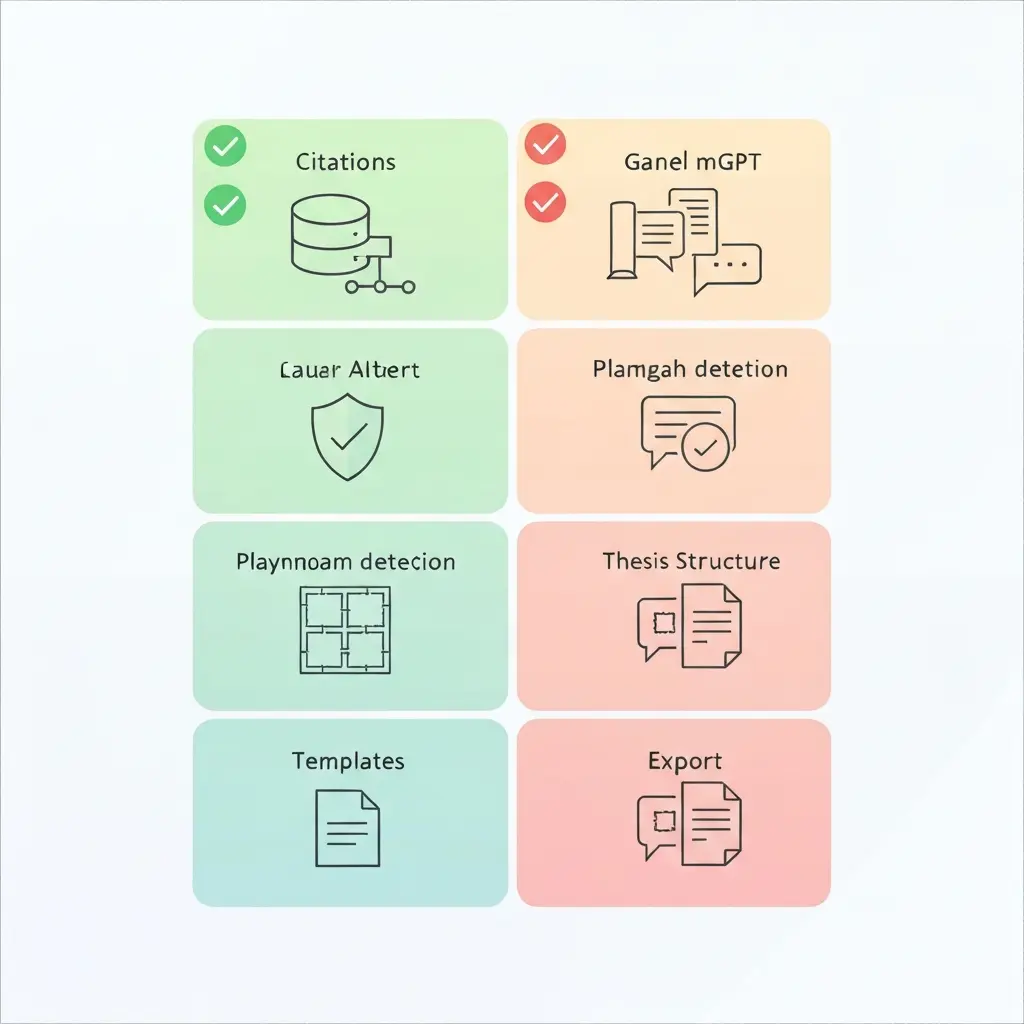
For a direct, feature-by-feature breakdown, the Tesify vs ChatGPT thesis writing comparison tests both tools against real thesis tasks — including citation accuracy, plagiarism risk assessment, and structural coherence — so you can see the performance difference with evidence, not just claims.
The short version: ChatGPT is excellent for ideation, rephrasing passages, and overcoming writer’s block. It’s a poor choice as your primary tool when accurate references, plagiarism compliance, and professional formatting are assessed components of your submission.
What Is the Difference Between a Thesis and a Dissertation?
Students confuse these two terms constantly — and not without reason, since usage varies by country. The distinction matters when you’re choosing the right AI tool and the right structural template.
Thesis vs Dissertation: The Core Distinction
In the United States and Canada, a thesis is typically the written work submitted for a master’s degree, while a dissertation is the book-length original research document required for a doctorate (PhD). In the United Kingdom, Australia, and Ireland, the terminology is often reversed: postgraduate research students write a thesis for their PhD, while a shorter piece for a master’s may be called a dissertation. Both terms appear in Purdue OWL’s official guidance on graduate writing (Purdue OWL, 2024).
Beyond nomenclature, the structural difference is significant. A master’s dissertation (UK usage) typically presents a focused piece of original analysis — usually 10,000–20,000 words — while a PhD thesis involves a substantial, independent contribution to knowledge that can run to 80,000–100,000 words.
This distinction directly affects which AI tool features you need. A PhD candidate writing 80,000 words across 18 months needs version control, chapter-level structure management, and deep integration with citation managers. A master’s student completing a 15,000-word dissertation needs fast citation formatting and solid plagiarism checking before submission day.
How Long Is a Master’s Thesis?
Master’s thesis length is one of the most-searched questions on this topic — and the answer is more variable than most students expect. There’s no universal standard, which is exactly why understanding the range matters before you start writing.
The typical master’s thesis length falls between 15,000 and 50,000 words, depending on discipline, institution, and whether it’s a taught or research master’s programme. Science and engineering theses tend toward the lower end; humanities and social sciences often run longer.
| Degree Level | Typical Word Count | Typical Page Count |
|---|---|---|
| Undergraduate Dissertation | 8,000–12,000 words | 30–50 pages |
| Master’s Thesis (Taught) | 15,000–20,000 words | 60–80 pages |
| Master’s Thesis (Research, MRes) | 25,000–50,000 words | 100–180 pages |
| PhD Dissertation/Thesis | 70,000–100,000 words | 250–350 pages |
This length-awareness also matters for AI tool selection. A tool optimised for short-form blog content will produce prose that reads well in 500-word segments but doesn’t hold structural coherence across 20,000 words. Academic AI platforms are built for long-document consistency — maintaining argument thread, consistent terminology, and uniform citation formatting across dozens of sections.
Which Citation Style Should I Use for My Thesis?
Citation style selection is one of those deceptively important decisions that students often leave until the last week — at which point reformatting 80 references from APA to Chicago becomes a genuine crisis. Here’s the logic for choosing correctly from the start.
The rule of thumb is simple: your department tells you which style to use. It’s not a personal preference. If your supervisor hasn’t specified, check your programme handbook or ask directly. Using the wrong citation style can cost marks on assessed work at most universities.
| Citation Style | Common Disciplines | Format Type |
|---|---|---|
| APA 7th Edition | Psychology, Education, Social Sciences | Author-Date (in-text) |
| MLA 9th Edition | Literature, Humanities, Language Studies | Author-Page (in-text) |
| Chicago 17th (Notes-Bibliography) | History, Arts, Theology | Footnotes + Bibliography |
| Chicago 17th (Author-Date) | Physical, Natural, Social Sciences | Author-Date (in-text) |
| Vancouver | Medicine, Nursing, Biomedical Sciences | Numbered (in-text) |
| Harvard | Wide range; common in UK universities | Author-Date (in-text) |
For practical, error-free citation management across all these formats, tools like Zotero — a free, open-source reference manager — are excellent for storing and organising sources. The limitation is that Zotero doesn’t write your thesis; it manages your library. What most students need is a platform that integrates citation formatting directly into the writing environment.
For a thorough breakdown of how automated bibliography tools handle each format, the automatic bibliography generator guide covers the mechanics of APA, MLA, Chicago, and Vancouver formatting in detail — including the most common errors that AI-generated references make.
How Do You Format APA Citations in a Thesis?
APA 7th edition is the most widely used citation style in social sciences and education — and it’s also the one with the most granular rules that students consistently get wrong. Understanding the logic of APA helps you audit AI-generated references before they land in your submitted thesis.
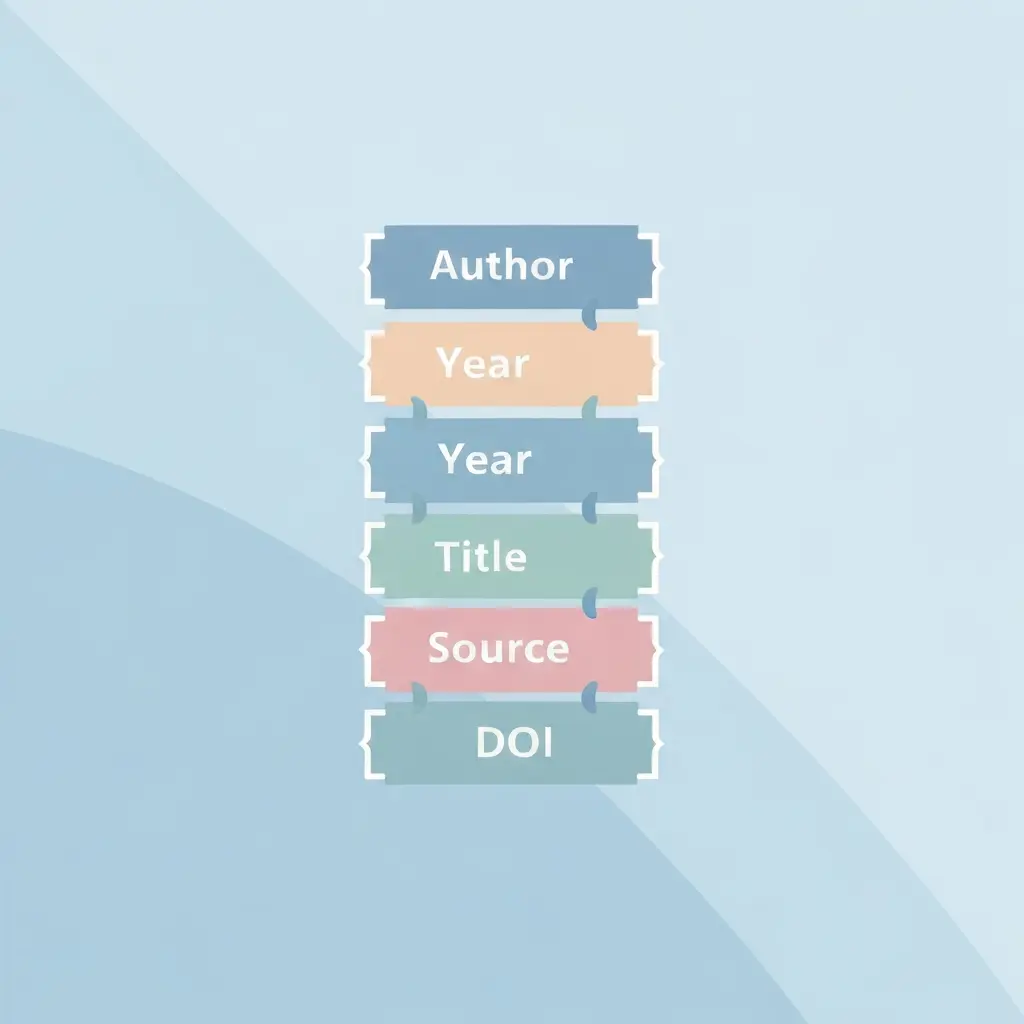
The APA reference entry follows a consistent pattern: Author(s). (Year). Title. Source. DOI or URL. The exact formatting depends on the source type.
APA 7th Edition: Key Formatting Rules
- Journal article: Author, A. A., & Author, B. B. (Year). Title of article. Journal Title, volume(issue), page–page. https://doi.org/xxxxx
- Book: Author, A. A. (Year). Title of work: Capital letter also for subtitle. Publisher.
- Thesis/dissertation: Author, A. A. (Year). Title of thesis [Doctoral dissertation, University Name]. Database Name. URL
- In-text citation: (Author & Author, Year, p. XX) for direct quotes; (Author & Author, Year) for paraphrases
Three APA rules catch most students out. First, the running head requirement was removed in APA 7th edition for student papers (it’s still required for manuscripts submitted for publication). Second, DOIs are formatted as hyperlinks (https://doi.org/…), not as plain text. Third, when citing a work with 21 or more authors, list the first 19, then an ellipsis, then the final author’s name.
ChatGPT will produce something that looks like an APA reference. What it frequently gets wrong is the DOI (fabricated or incorrect), the italicisation rules, and the capitalisation of article titles (APA uses sentence case for titles, not title case). These errors are invisible until a marker specifically checks them — and many do.
Can AI Tools Help Prevent Plagiarism in a Thesis?
Plagiarism in a thesis isn’t always intentional — and that’s exactly what makes AI-assisted writing complicated. A student who uses ChatGPT to paraphrase a source may genuinely believe they’ve rewritten the content sufficiently, while their institution’s plagiarism checker flags the similarity anyway.
The question of whether AI-assisted writing counts as plagiarism is now a live policy debate at most universities. Oxford, Cambridge, Harvard, and the University of Melbourne all published updated AI use policies in 2023–2024, and the consensus position is that undisclosed AI assistance in assessed work constitutes academic misconduct. For a full breakdown of current institutional policies by country, the 2026 university AI plagiarism policy guide covers the most up-to-date rules from UK, US, Australian, and Irish institutions.
There’s an important distinction between two types of plagiarism risk in AI-assisted thesis writing. The first is textual similarity: where AI-generated text too closely resembles a source document. The second is citation fabrication: where an AI-generated reference appears legitimate but cites a paper that doesn’t exist. Both are detectable by academic integrity systems, and both carry serious consequences.
The safest approach is a workflow that combines AI-assisted drafting with verified source citation and real-time similarity checking against scholarly databases — not just a surface-level web scan.
Is There an AI Platform Built Specifically for Thesis Writing?
Yes — and it matters that one exists, because the gap between a general-purpose chatbot and a purpose-built academic writing platform is substantial once you’re 10,000 words into a thesis and need your bibliography to be correct on submission day.
Tesify: Academic AI Built for Thesis Writing
Tesify is the platform specifically designed for bachelor’s dissertations, master’s theses, and PhD dissertations. Over 9,000 students currently use it — and here’s what makes it different from general AI tools:
- Smart academic editor with integrated AI assistance that understands thesis structure (abstract → literature review → methodology → findings → discussion)
- Automatic bibliography in APA 7th, MLA 9th, Chicago 17th, and Vancouver — generated from real source metadata, not hallucinated
- Advanced plagiarism detection comparing against JSTOR, ProQuest, EThOS, ERIC, Google Scholar, and millions of international scholarly sources
- Professional templates at bachelor’s, master’s, and doctoral level
- Export to PDF, Word (.docx), and LaTeX — including the LaTeX template format used by universities including Washington, MIT, and Cambridge
Students using Tesify report finishing their thesis twice as fast as those using unstructured AI tools — primarily because the workflow handles citation formatting and plagiarism checking simultaneously, rather than as separate post-writing tasks.
Start your thesis on Tesify — free, no credit card required →
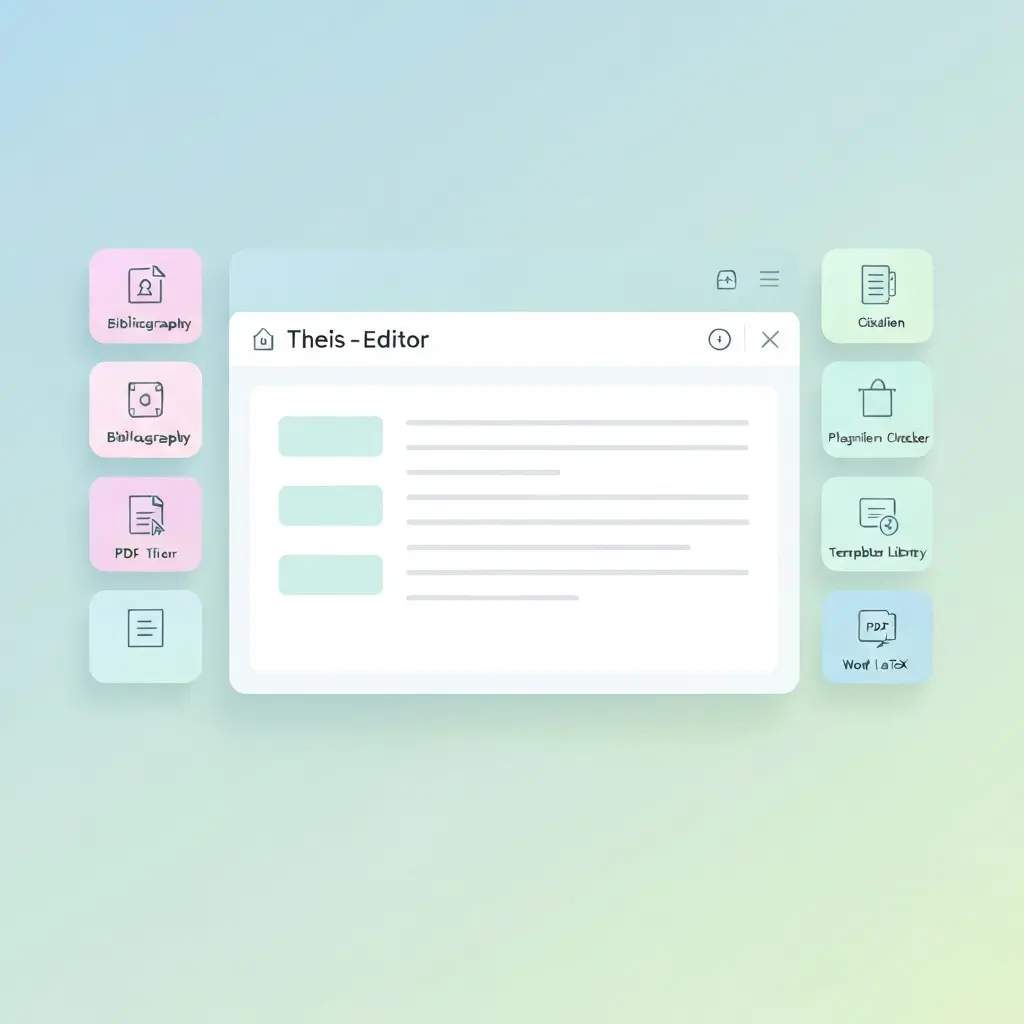
What distinguishes Tesify from simply running your ChatGPT draft through Turnitin afterwards is the integrated nature of the workflow. Citation formatting isn’t a post-draft cleanup; it happens as you write. Plagiarism checking isn’t a final-hour panic; it runs in real time. That integration is the difference between catching an error on day one and catching it the night before submission.
How Do You Choose the Right AI Tool for Your Thesis?
Making this decision well requires an honest assessment of where you are in your thesis process and what problems you actually need to solve. Here’s a practical decision framework built around the four most common student situations.
Step 1: Identify Your Primary Thesis Writing Problem
Most students come to AI tools with one of four specific frustrations: writer’s block, citation formatting errors, plagiarism anxiety, or structural uncertainty. The right tool depends on which of these is your primary obstacle.
🧠 Writer’s Block / Drafting
Any capable language model helps here — ChatGPT, Claude, or an integrated academic AI. The priority is flow, not accuracy at this stage.
📚 Citation Formatting (APA/MLA/Chicago)
You need a tool with verified citation automation — not ChatGPT. Fabricated references are a real risk with general-purpose models.
🔍 Plagiarism Checking
Essential: scholarly database coverage (JSTOR, EThOS, ProQuest). Web-crawl-only checkers miss academic sources entirely.
🏗️ Thesis Structure & Templates
Requires a platform with academic-level structural templates — not a blank chat interface. Pre-built chapter frameworks save significant time.
Step 2: Check Your Institution’s AI Policy
This isn’t optional. Oxford, Cambridge, Harvard, and the University of Sydney all require disclosure of AI tool use in assessed work. Some departments prohibit AI assistance entirely for certain sections — typically the discussion and conclusion, which are assessed for original critical thinking. Using an undisclosed tool, even a good one, creates academic integrity risk that no AI platform can resolve for you.
Step 3: Evaluate Tool Features Against Submission Requirements
- Citation style: Does the tool support your department’s required format (APA, MLA, Chicago, Vancouver, Harvard)?
- Export format: Does your institution require Word (.docx), PDF, or LaTeX? Check the submission portal.
- Plagiarism database coverage: Does the checker access the same databases your institution uses — usually Turnitin or iThenticate, which cover JSTOR, ProQuest, and institutional repositories?
- Word count: Can the tool handle long-form documents (20,000–80,000 words) without structural degradation?
- Data privacy: Does the platform store your thesis content? Check the terms of service — especially important for embargoed or sensitive research.
Step 4: Use a Hybrid Workflow
The most effective approach — used by advanced postgraduate students at research-intensive universities — is a structured hybrid. Use general AI for ideation and rough drafting. Use a dedicated academic platform like Tesify’s plagiarism checker for compliance verification. Use Zotero or a native bibliography manager for source organisation. This isn’t more complicated; it’s more reliable — and reliability is what gets you through a viva voce.
For PhD students specifically, James Hayton’s research writing guidance offers practical advice on sustainable writing habits that complement any AI-assisted workflow — his guide for PhD students and academics is worth the hour. And Grad Coach’s walkthrough on writing a research proposal for a dissertation or thesis is one of the clearest structured introductions available for students starting out.
Ready to Write Your Thesis With Confidence?
Join over 9,000 students who use Tesify to produce accurately cited, plagiarism-checked theses — with professional formatting built in from the first word.
Frequently Asked Questions About AI Tools for Thesis Writing
Can I use ChatGPT to write my thesis?
You can use ChatGPT as a drafting aid, but it’s not designed for complete thesis writing. ChatGPT doesn’t verify citations, cannot check for plagiarism against academic databases, and has no awareness of your institution’s submission requirements. Most universities now require disclosure of AI tool use; undisclosed reliance on ChatGPT for assessed sections typically constitutes academic misconduct. For reliable thesis production, a purpose-built academic AI platform that integrates citation formatting, plagiarism detection, and structured templates is the more appropriate choice.
What is the difference between APA, MLA, and Chicago citation styles?
APA (American Psychological Association) uses an author-date in-text citation system and is standard in social sciences, psychology, and education. MLA (Modern Language Association) uses author-page in-text citations and is dominant in literature and humanities. Chicago style offers two systems: Notes-Bibliography (footnotes, common in history and arts) and Author-Date (used in sciences). Your department handbook specifies which style to use — it’s not a personal choice.
How long should a master’s thesis be?
A master’s thesis typically ranges from 15,000 to 50,000 words, depending on the institution, discipline, and whether the programme is taught or research-based. Taught master’s dissertations in the UK usually fall between 15,000 and 20,000 words. Research master’s (MRes) programmes may require 25,000–50,000 words. Always refer to your specific programme handbook, as institutions including Oxford, Cambridge, and Harvard each set their own precise word count limits.
Is using AI for thesis writing plagiarism?
Using AI for thesis writing is not automatically plagiarism, but it becomes academic misconduct when it is undisclosed, when it substitutes for required original analysis, or when it violates your institution’s specific AI use policy. Most UK, US, Australian, and Irish universities updated their policies in 2023–2024 to require explicit declaration of AI assistance. Submitting
Write your thesis with AI
Structure, draft, cite, and format your thesis faster with Tesify’s AI writing tools, automatic bibliography, and plagiarism checker. Free to start, no credit card required.

Latest Articles
- Self-Determination Theory in an Education or Psychology Thesis: Build the Study Around Autonomy, Competence and Relatedness (2026)

- Thesis on Online Learning: Designs, Instruments and Access for an Education Dissertation (2026)

- Thesis on Academic Self-Efficacy: Bandura’s Theory, the MSLQ and General Self-Efficacy Scale, Hypotheses and 10 Titles (2026)
- Thesis on Transformational Leadership: Bass, Burns, the MLQ and 10 Researchable Titles (2026)
- Why Dental Theses and Research Projects Get Sent Back: The Objections and the Fix for Each (2026)

Leave a Reply