
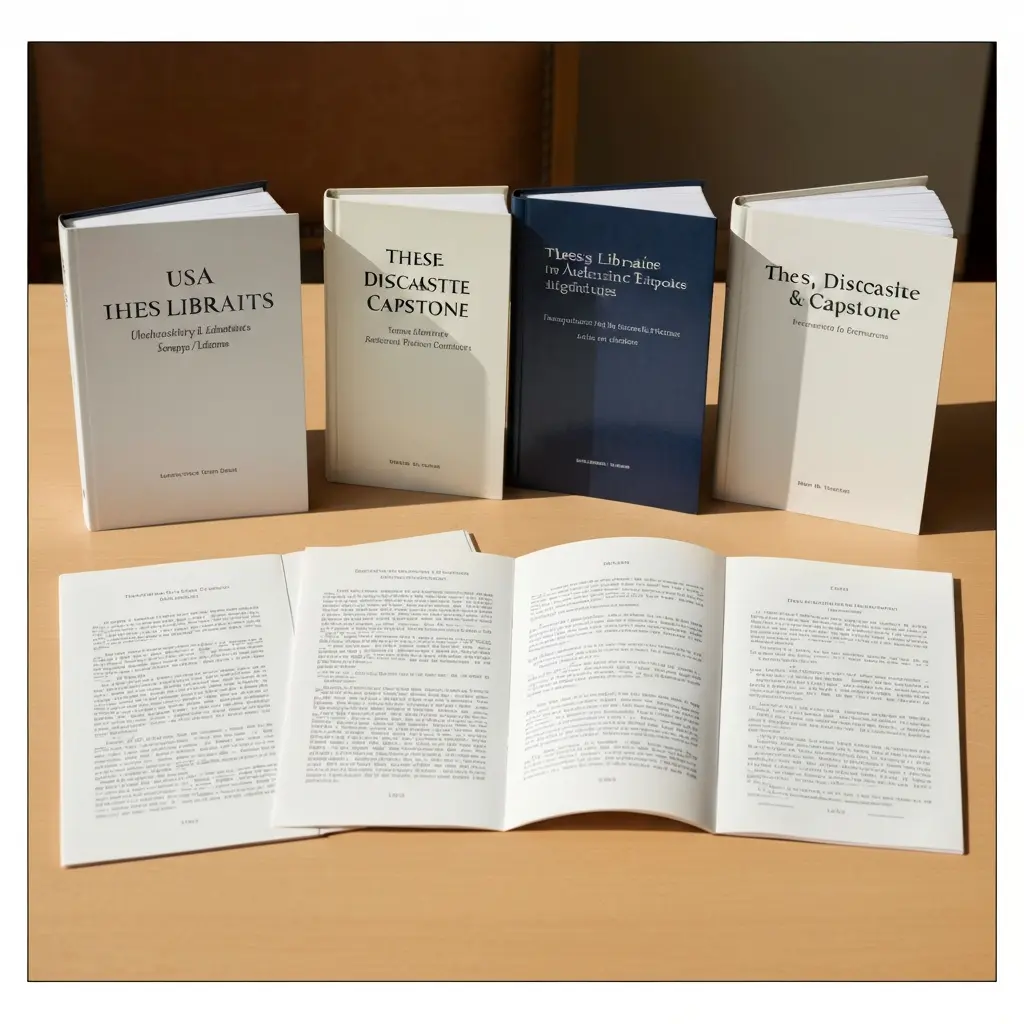
Thesis vs Dissertation vs Capstone: What Is the Difference? (2026 Guide)
What is the difference between a thesis and a dissertation? The answer depends entirely on which country, institution, and degree level you are asking about — and this institutional variation is precisely what creates so much confusion. In the United States, a dissertation is a doctoral document and a thesis is a master’s document; in the United Kingdom, the terms are used in the opposite way for equivalent qualifications. In continental Europe, an entirely different vocabulary applies. Add the capstone project, the treatise, the monograph, and the professional doctorate dissertation, and students face a genuinely complex terminological landscape.
This guide provides a definitive breakdown of every major variation in terminology and requirements — based on guidance from Oxford, Cambridge, Harvard, MIT, and the major European degree-awarding systems — so you know exactly what is expected for your specific qualification.
US Definitions: Thesis vs Dissertation
The United States uses the most institutionally consistent terminology, making it a useful starting point:
| Document Type | Degree Level | Research Requirement | Typical Length |
|---|---|---|---|
| Thesis | Master’s (MA, MS, MEd) | Demonstrates mastery and synthesis | 40–80 pages |
| Dissertation | Doctoral (PhD, EdD, DBA) | Original contribution to knowledge | 150–300+ pages |
| Capstone | Master’s (often professional degrees) | Applied project or analysis | 20–60 pages |
The key intellectual distinction between thesis and dissertation in the US system is the “original contribution” requirement. A master’s thesis typically requires the student to demonstrate mastery of a field — to show they can synthesize, analyze, and apply existing scholarship. A doctoral dissertation requires the student to add something new to human knowledge that did not exist before their research.
Harvard’s Divinity School describes the distinction this way: “A thesis argues a case using existing evidence and scholarship. A dissertation discovers or creates new evidence, develops new theoretical frameworks, or applies existing frameworks to previously unstudied phenomena.” This original contribution requirement is what makes a doctoral dissertation categorically different from a master’s thesis, regardless of their surface similarities in structure.
UK Definitions: The Reverse Convention
The United Kingdom uses terminology that consistently surprises American students encountering it for the first time:
| UK Term | US Equivalent | Degree Level | Typical Length |
|---|---|---|---|
| Dissertation | Thesis | Master’s (MA, MSc, LLM) | 15,000–20,000 words |
| Thesis | Dissertation | Doctoral (PhD, MPhil) | 70,000–100,000 words |
| Research project / report | Capstone | Master’s (MSc, MBA with project component) | 8,000–12,000 words |
Oxford University’s Academic Services states: “The word ‘dissertation’ at Oxford refers to the extended research essay submitted for a taught master’s degree. The word ‘thesis’ refers exclusively to the doctoral submission examined by viva voce. Usage of these terms in the opposite sense — as in American English — will not cause problems in practice, but is formally incorrect within the University.”
Cambridge uses the same convention as Oxford. Cambridge’s Doctoral Degree Committee requires that all doctoral work be submitted as a “thesis” and uses “dissertation” only in the context of master’s-level submissions in certain faculties.
Europe and Beyond: Other Terminology Systems
Continental European systems add further variation:
- Germany: “Dissertation” refers exclusively to doctoral work (equivalent to US dissertation). Master’s research is typically called “Masterarbeit” (master’s work). The traditional German Habilitation — a post-doctoral research qualification — uses the term “Habilitationsschrift” (habilitation thesis).
- France: “Thèse” refers to doctoral work. Master’s research is called “mémoire” — a term that has no direct English equivalent but maps most closely to the UK master’s dissertation. See our French-language guide on how AI tools assist with the mémoire.
- Spain and Latin America: “Tesis” covers both master’s and doctoral research (distinguished by tesis de máster and tesis doctoral). The “Trabajo Fin de Grado” (TFG) is the undergraduate thesis. See our Spanish-language APA guide at tesify.es.
- Portugal and Brazil: “Dissertação” is used for master’s work; “Tese” for doctoral work — the same pattern as UK English but in Portuguese. Our Portuguese guide at tesify.pt covers the specific citation requirements for Portuguese university submissions.
Thesis and Dissertation vs Capstone Project
The capstone project has grown significantly in prevalence as professional master’s degrees have expanded. The distinction from a thesis is primarily one of research type and intellectual purpose:
| Dimension | Thesis | Capstone |
|---|---|---|
| Research type | Academic/scholarly | Applied/professional |
| Primary audience | Academic scholarship | Professional practice |
| Original contribution | Required (doctoral); knowledge synthesis (master’s) | Applied solution or analysis |
| Defense | Committee examination | Presentation (often) |
| Publication expectation | High (doctoral); moderate (master’s) | Low; implementation focus |
An MBA capstone, for instance, typically involves developing a business strategy or conducting a market analysis for a real organization — not producing scholarship that advances business theory. This distinction matters for AI tool use: the academic integrity requirements that apply to thesis and dissertation writing also apply to capstone projects at institutions that define them as assessed academic work.
Length Requirements by Document Type and Institution
Length requirements vary substantially by institution, field, and document type. These ranges represent current institutional guidance from major research universities:
| Document Type | Field | Typical Word Count Range |
|---|---|---|
| US master’s thesis | Sciences | 15,000–30,000 words |
| US master’s thesis | Humanities | 25,000–50,000 words |
| UK master’s dissertation | All fields | 12,000–20,000 words |
| US doctoral dissertation | Sciences | 50,000–80,000 words |
| US doctoral dissertation | Humanities | 80,000–150,000 words |
| UK doctoral thesis | All fields | 70,000–100,000 words (Oxford/Cambridge max) |
Assessment: How Each Is Evaluated
The assessment method differs significantly across document types and countries, with important implications for how students should approach writing:
US doctoral dissertation: Submitted to a supervisory committee (typically 4–6 members); defended in an oral examination (“defense”) that may be public; committee members ask questions during the defense; revisions typically required; degree awarded after approved final submission.
UK doctoral thesis: Submitted to two examiners (one internal, one external to the university); defended in private viva voce examination; possible outcomes include pass, minor corrections, major corrections, resubmission, or fail; the external examiner’s judgment carries significant weight.
Master’s (both systems): Typically assessed by a committee with an oral defense; some institutions use written examination alone; word-count compliance and citation accuracy are formal requirements in addition to intellectual merit.
For help with citation formatting that any thesis examiner will check, our comprehensive guide on APA 7th edition format covers the requirements in detail. Tesify assists with citation management across all these document types, ensuring compliance with the specific format requirements of your institution.
Practical Guide: What You Are Actually Required to Write
With terminology clarified, here is a practical guide to establishing what you need to produce:
- Check your degree title and institution country: US master’s = thesis; US doctoral = dissertation; UK master’s = dissertation; UK doctoral = thesis; French master’s = mémoire; French doctoral = thèse
- Check your specific program requirements: Some US master’s programs offer a non-thesis (coursework-only) option; some professional doctorates use “dissertation” or “capstone” interchangeably
- Check the word count and format requirements: These are set by your specific department or graduate school, not universally standardized
- Confirm the examination format: Public defense, viva, or committee examination — this affects how you prepare the written document as well as the oral defense
Frequently Asked Questions
What is the difference between a thesis and a dissertation?
In the US: a thesis is a master’s-level research document; a dissertation is a doctoral-level document requiring original contribution to knowledge. In the UK: the terms are reversed — a dissertation is the master’s-level document; a thesis is the doctoral document. Both systems share the same intellectual distinction: master’s work synthesizes existing knowledge; doctoral work creates new knowledge.
Is a thesis harder than a dissertation?
A doctoral dissertation (called a thesis in the UK) is more demanding than a master’s thesis (called a dissertation in the UK). This is because a doctoral document requires an original contribution to knowledge, whereas a master’s document requires demonstration of mastery of existing scholarship. The doctoral document is also typically 3–5 times longer and requires a more intensive examination process.
What is the difference between a thesis and a capstone project?
A thesis (or dissertation) is an academic research document that advances scholarly knowledge through review, analysis, and argument. A capstone project is an applied professional document that demonstrates the student’s ability to apply their master’s-level knowledge to a real-world problem. Capstones typically involve consulting projects, strategic analyses, or practical designs rather than scholarly literature review and research methodology.
Do UK and US universities use the terms thesis and dissertation the same way?
No — they use them in opposite ways. In the US, thesis = master’s level and dissertation = doctoral level. In the UK, dissertation = master’s level and thesis = doctoral level. When communicating between US and UK academic contexts, or when researching guides and advice, it is essential to check which system the source is using to avoid acting on conflicting instructions.
How long should a master’s thesis be?
US master’s theses typically range from 15,000–50,000 words depending on the field (sciences tend to be shorter, humanities longer). UK master’s dissertations are typically 12,000–20,000 words, with specific limits set by each institution. Always check your specific program requirements — individual departments frequently set tighter word count limits than institutional maximums.
Can AI help with both a thesis and a dissertation?
Yes — AI tools like Tesify are designed for both master’s thesis writing and doctoral dissertation writing. The type of assistance appropriate differs slightly: for a master’s thesis, AI can assist with literature synthesis and argument structuring; for a doctoral dissertation, AI can help with drafting based on your own research materials while ensuring the original intellectual contribution remains clearly yours.




Leave a Reply