
What Is the Difference Between Thesis & Dissertation? 5 Keys
You’ve been using the words interchangeably for months. Your supervisor hasn’t corrected you — yet. Then you sit down to format your title page and realise: are you writing a thesis or a dissertation? And does it actually matter? It matters more than you think, especially when your institution’s word-count rules, examination process, and even citation requirements depend on getting the thesis vs dissertation difference right.
Key 1: What Is Each Document’s Academic Purpose?
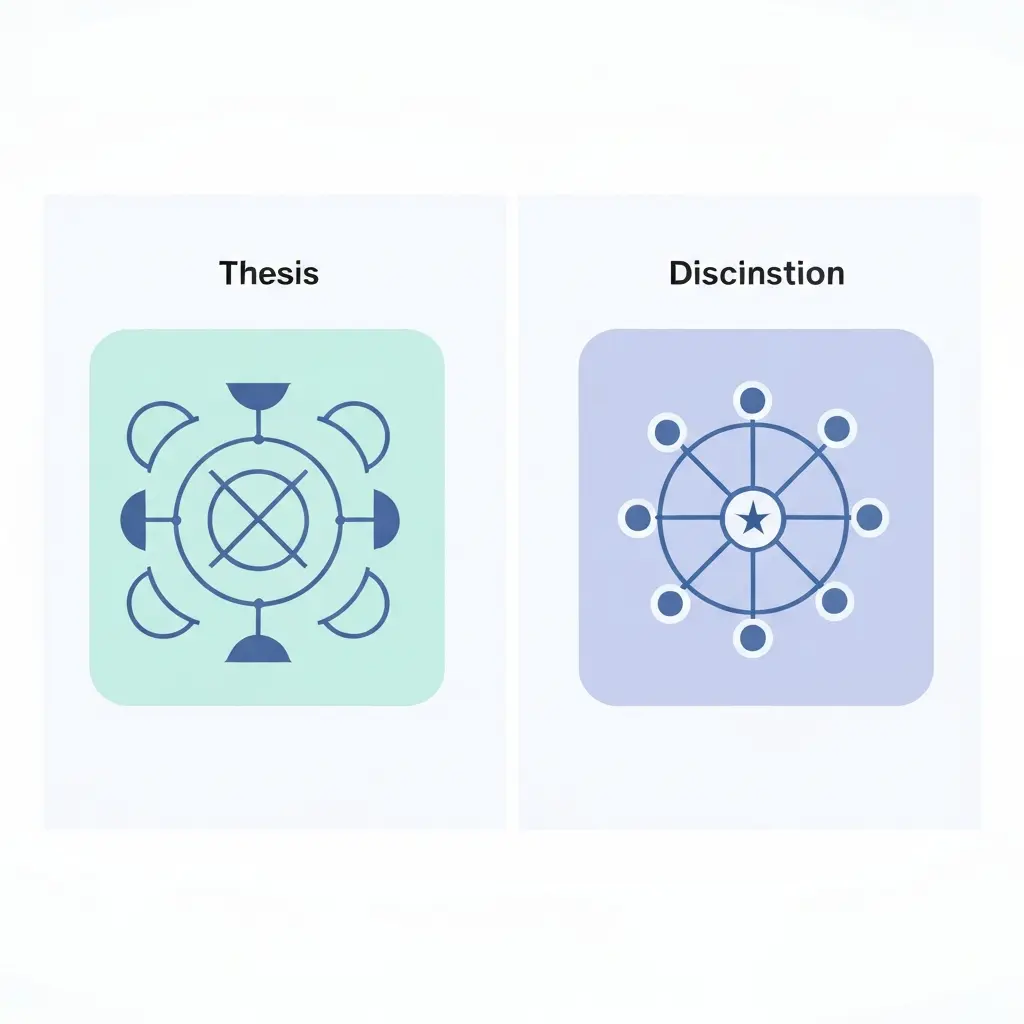
The core distinction starts with purpose. A thesis argues a position — it takes existing scholarship and synthesises it into a coherent, defended argument. A dissertation, at the doctoral level, is expected to generate new knowledge that did not previously exist. That’s a meaningful intellectual difference, not a bureaucratic one.
According to Purdue OWL’s Thesis and Dissertation overview, the master’s thesis demonstrates your ability to conduct research and analyse existing literature, while the doctoral dissertation must make an original contribution to the field. Think of the thesis as proving you can work within knowledge — the dissertation as proving you can extend it.
What most students miss is that this distinction directly affects how you write your introduction. A thesis introduction argues why your synthesis matters. A dissertation introduction must articulate the “gap” in current knowledge that your study fills. Two different rhetorical moves, same document structure on the surface.
Key 2: Which Academic Level Requires a Thesis vs Dissertation?
Here’s where students — and even some early-career academics — get genuinely confused. The same word means different things depending on which country issued your university’s charter.
In the United Kingdom, Australia, Canada, and Ireland, the standard convention is: a master’s student submits a thesis, and a PhD candidate submits a dissertation (sometimes also called a thesis at PhD level in UK institutions). In the United States, the system is inverted: master’s students write a thesis, and doctoral candidates write a dissertation — which aligns more closely with the UK usage than it appears at first glance.
Harvard University’s Graduate School of Arts and Sciences, for instance, uses “dissertation” exclusively for doctoral work and “thesis” for master’s-level capstone projects. Oxford, by contrast, refers to PhD work as a “thesis” in most departments. This isn’t inconsistency — it’s institutional tradition with centuries of precedent behind it.
How Do UK, US, AU, CA, and IE Use These Terms?
| Country | Master’s Document | Doctoral Document | Key Notes |
|---|---|---|---|
| United Kingdom | Thesis | Thesis (PhD) | Both levels often called “thesis”; some institutions use “dissertation” for taught master’s |
| United States | Thesis | Dissertation | Clear two-tier system; undergrad capstone often called a “thesis” too |
| Australia | Thesis | Thesis (PhD) | Doctoral work typically called “thesis”; “dissertation” less common |
| Canada | Thesis | Dissertation or Thesis | Usage varies by university; French-language institutions may use “mémoire” / “thèse” |
| Ireland | Thesis | Thesis (PhD) | Follows UK convention closely; Trinity College Dublin uses “thesis” for doctoral work |
For a full country-by-country breakdown with institution-specific examples, see our guide on the thesis vs dissertation difference explained for every country in 2026 — it covers edge cases that this summary can’t fully address.
Key 3: How Long Should a Thesis or Dissertation Be?
Length is one of the most searched questions on this topic — and one of the most misunderstood. There is no universal word count. Thesis length is dictated by your institution, your discipline, and your degree level. Anyone who tells you a master’s thesis is “always 20,000 words” is oversimplifying.
The University of Cambridge, for example, specifies in its PhD Style Guidelines (Social Anthropology, August 2023) that a doctoral thesis must not exceed 80,000 words excluding bibliography and appendices. Some STEM PhD theses run as short as 40,000 words because the data chapters are dense and accompanied by published papers. Humanities dissertations may push 100,000 words.
The counterintuitive truth? Word count is a ceiling, not a target. Supervisors at research-intensive universities routinely tell students: “Don’t pad it to hit a number. Stop when your argument is complete.” That’s advice worth printing and sticking above your desk.
What Are Typical Word Count Ranges by Level and Country?
| Degree Level | Typical Word Count (UK/AU/IE) | Typical Word Count (US/CA) | Discipline Notes |
|---|---|---|---|
| Undergraduate Thesis | 8,000–15,000 | 5,000–12,000 | Sciences typically shorter; humanities longer |
| Master’s Thesis | 15,000–40,000 | 25,000–50,000 | Taught master’s on lower end; research master’s higher |
| Doctoral Dissertation/Thesis | 60,000–100,000 | 60,000–100,000 | STEM often 40,000–70,000; humanities 80,000–100,000 |
| Professional Doctorate (EdD, DBA) | 40,000–60,000 | 40,000–65,000 | Practice-based focus; often includes portfolio evidence |
Key 4: How Much Originality Is Expected in Each Document?
Originality means something specific in academic writing — and it’s not what pop culture suggests. You don’t need a Eureka moment. You need to do something that hasn’t been done in quite that way before. But the bar differs significantly between thesis and dissertation.
A master’s thesis demonstrates originality through synthesis, framing, or methodology. You might apply an existing theoretical framework to a new dataset, or compare two bodies of literature that haven’t been placed in conversation before. Cambridge’s examination criteria describe this as showing “some capacity for original thought” — notice the qualifier “some.”
A doctoral dissertation must make a “substantial and original contribution to knowledge” — that phrase appears verbatim in examination regulations at UCL, Edinburgh, and most Russell Group universities. The originality is not optional; it’s the fundamental justification for awarding a doctorate. Your external examiner will ask: “What is the original contribution here?” — and you must answer it in 60 seconds or less at your viva voce.
Key 5: How Does Country-Specific Terminology Affect Your Submission?
This is the practical key that affects your title page, your ethics form, and your library deposit form right now. Getting the terminology wrong on official documents can — in rare cases — delay your submission. Institutions have their own controlled vocabularies, and your document metadata must match.
In Ireland, for instance, the National University of Ireland (NUI) uses “thesis” for all research degrees. If you’re at University College Dublin and you submit paperwork labelling your PhD work a “dissertation,” the graduate studies office will flag it. Not because it’s wrong globally — just because it’s wrong institutionally.
In the US, the opposite problem occurs. A master’s student who labels their capstone a “dissertation” on ProQuest submission forms may find it incorrectly indexed, affecting discoverability. Small distinction, real-world consequence. Always check your specific institution’s graduate handbook — not the internet’s general consensus.
How Do AI Tools Fit Into Thesis and Dissertation Writing?
This is the question every student is asking AI assistants in 2025 — and it deserves a genuinely honest answer. AI tools can be legitimate, productivity-enhancing writing aids. They can also be academic integrity violations. The difference is entirely in how you use them.
Legitimate uses include: brainstorming chapter structures, improving sentence clarity after you’ve written a passage, checking grammar and style, generating search queries for literature reviews, and formatting citations. These are tools in service of your thinking — not replacements for it. A research report by Copyleaks (March 2024) found that AI-generated text now appears in a significant proportion of student submissions globally, but detection rates are rising sharply.
Problematic uses include: generating literature review paragraphs verbatim, asking AI to write your methodology section, or submitting AI-drafted arguments as your own analysis. The Quality Assurance Agency for Higher Education (QAA) published guidance in its Reconsidering Assessment for the ChatGPT Era report, advising institutions to design assessments that AI cannot easily replicate — and to treat undisclosed AI use as equivalent to contract cheating in many contexts.
The safest framework? Treat AI as a research assistant who drafts and organises, not as a co-author who thinks. Disclose its use according to your institution’s policy. And always, always verify every claim AI generates against primary sources before including it in your thesis.
For a full breakdown of university policies across GB, US, AU, CA, and IE, the guide on whether AI use constitutes plagiarism in thesis writing covers institutional policies, disclosure frameworks, and what “acceptable use” actually means in practice at Russell Group and Ivy League institutions.
What Are the Plagiarism and Ethics Rules for Thesis Writing?
Plagiarism in thesis writing isn’t just copying someone else’s words — it’s a spectrum that includes self-plagiarism (reusing your own prior submissions), patchwriting (paraphrasing so closely the original is recognisable), and now AI-generated content presented without disclosure. Each carries different institutional penalties.
Most universities run submissions through detection software — Turnitin, iThenticate, or increasingly AI-specific tools — before examination. A similarity score above 15–20% typically triggers manual review. But here’s what catches students off guard: a 6% similarity score can still constitute plagiarism if that 6% includes uncited direct quotations from key sources.
Self-plagiarism is particularly relevant for PhD students who publish chapters as journal articles during their candidature. You must check with your supervisor whether including published work requires a declaration and whether the publisher’s copyright terms affect what you can reproduce. Institutions including UCL, Manchester, and Sydney all have specific policies on this — find yours before your submission date.
Ethical clearance is a separate layer entirely. If your dissertation involves human participants, secondary data sets, or sensitive topics, you’ll need ethics board approval before data collection begins — not after. Submitting without it invalidates your data and can result in the work being failed regardless of quality.
Which APA and Citation Styles Apply to Thesis Writing in GB, US, AU, CA, and IE?
Citation style is not optional decoration — it’s part of your methodology’s transparency. Readers need to locate your sources. Examiners check that your referencing is consistent. And getting it wrong across 80,000 words is a painful, correctable mistake that wastes time you don’t have.
APA 7th edition (published 2019) is standard in psychology, education, social sciences, and many health disciplines across all five target countries. Chicago 17th edition dominates history, some humanities, and theology. Harvard referencing (a generic author-date format, not a single unified standard) is widely used in UK and Australian universities. MLA 9th is the default for literature, language, and cultural studies — and the MLA Style Center has published updated guidance on citing generative AI that’s worth bookmarking. Vancouver style applies to medicine, nursing, and life sciences across all five countries.
The practical problem is that many students choose a citation style and then discover mid-thesis that their department requires a different one. The rule of thumb: check your department’s postgraduate handbook, not the library’s general guide. Departments often override faculty-wide guidance. When in doubt, ask your primary supervisor in writing — that email protects you if there’s a dispute at examination.
For discipline-specific guidance on selecting and applying citation styles — including practical APA formatting examples and Harvard vs Chicago comparisons — the guide on which citation style to use for your thesis provides a country-aware decision framework.
What Citation Style Is Used in Each Country and Discipline?
| Discipline | GB / AU / IE | US / CA | Notes |
|---|---|---|---|
| Psychology / Social Sciences | APA 7 / Harvard | APA 7 | APA 7 increasingly standard globally |
| Humanities / History | Chicago / MHRA | Chicago / MLA | MHRA common in UK humanities |
| Medicine / Nursing | Vancouver / APA | AMA / Vancouver | Superscript number systems common in clinical fields |
| Education | APA 7 / Harvard | APA 7 | Education departments increasingly mandate APA 7 |
| Law | OSCOLA | Bluebook / Chicago | OSCOLA standard across UK and Ireland law schools |
How Can AI Writing Platforms Help You Manage Thesis and Dissertation Complexity?
Writing a thesis or dissertation isn’t just an intellectual challenge — it’s a project management challenge. You’re coordinating literature, data, argument, formatting, citation, and submission deadlines across months or years. The students who finish on time aren’t always the most talented; they’re usually the most organised.
This is where purpose-built academic writing platforms make a tangible difference. Tesify was built specifically for bachelor’s, master’s, and PhD students navigating exactly this complexity. It’s not a general-purpose AI writing tool — it’s designed around the structural and citation demands of academic thesis documents.
Here’s what sets it apart from generic tools: Tesify integrates automatic bibliography generation in APA 7, MLA 9, Chicago, Harvard, and Vancouver — formatted to the style’s current edition, not a cached version from three years ago. It includes a smart editor that assists with structure and argumentation, professional templates aligned with common university formatting requirements, and export to PDF, Word, and LaTeX.
The LaTeX export alone is significant. Many STEM doctoral candidates are required to submit in LaTeX — and building a LaTeX document from scratch is a skill set distinct from doing research. Tesify handles the template architecture so you can focus on the content. You can also explore community-maintained thesis templates through Overleaf’s thesis template gallery if you prefer to work directly in LaTeX.
Tesify’s advanced plagiarism checker compares your work against millions of scholarly sources — including JSTOR, ProQuest, EThOS, ERIC, and Google Scholar — giving you a real-time originality report before you submit to your university’s detection system. Over 9,000 students have already used Tesify to complete their thesis, and the free sign-up requires no credit card. If you’re starting your thesis or dissertation this semester, it’s worth exploring before you’re 30,000 words deep with formatting problems.
Start writing your thesis with Tesify — free, no credit card required →
Quick Decision Checklist: Thesis or Dissertation — Which Term Applies to You?
Use this framework before your title page, ethics form, or library deposit submission. One wrong term in the wrong field causes administrative friction you don’t need at submission time.
- Check your institution’s official postgraduate handbook — search for the exact term used in your degree’s assessment regulations, not the department’s informal guidance.
- Identify your country’s convention — UK/AU/IE typically call doctoral work a “thesis”; US/CA typically call it a “dissertation.” But institution overrides country.
- Confirm your degree level — master’s by research, master’s by coursework, MPhil, PhD, EdD, DBA all have different submission conventions even within the same university.
- Check your word count ceiling — not the floor. Your supervisor or examination office has the authoritative figure. Don’t rely on departmental folklore.
- Verify your required citation style — confirm in writing with your primary supervisor, citing the specific edition (APA 7, not just “APA”).
- Review your institution’s AI use policy — find the most recently updated version, which may be a 2024 or 2025 amendment to the original misconduct policy.
- Confirm ethics clearance requirements — if human participants, secondary data, or sensitive materials are involved, ethics clearance must precede data collection.
Frequently Asked Questions About Thesis vs Dissertation
Is a thesis harder than a dissertation?
Not inherently — they’re different in scope and purpose rather than difficulty. A dissertation (doctoral level in the US; PhD thesis in UK/AU) demands original knowledge generation, which most find more intellectually demanding than a master’s thesis. However, a master’s thesis completed without clear supervision or in an under-resourced environment can be equally challenging in practice. Difficulty is shaped by support structures as much as by the document’s inherent demands.
Can I use ChatGPT or other AI tools to write my thesis?
You can use AI tools to assist with specific tasks — brainstorming, clarity editing, grammar checking, citation formatting — but submitting AI-generated content as your own argument without disclosure violates academic integrity policies at most universities. The QAA’s guidance equates undisclosed AI writing with contract cheating in assessment contexts. Always check your institution’s current AI use policy, which may have been updated in 2024 or 2025.
What is the standard thesis length for a master’s degree in the UK?
A master’s thesis in the UK typically ranges from 15,000 to 40,000 words, depending on the degree type and discipline. A taught master’s with a research component (e.g., MSc or MA dissertation) often falls between 12,000–20,000 words, while a master’s by research (MRes) may reach 40,000 words. Always consult your institution’s specific word limit — these figures are averages, not rules.
Which citation style should I use for my thesis in Australia?
Australian universities most commonly require APA 7 for social sciences, education, and psychology; Harvard (author-date) for business and humanities; and Vancouver for health and medical sciences. The specific requirement is set at department level, not university-wide, so check your postgraduate handbook or ask your supervisor directly. Confirming the required edition (e.g., APA 7th, not 6th) in writing before you start referencing saves significant reformatting time.
Does the difference between thesis and dissertation matter for PhD applications?
Yes — when applying for a PhD programme, using the correct terminology signals academic literacy to admissions committees. UK and Australian PhD applications should reference your master’s “thesis”; US doctoral applications expect you to reference your master’s “thesis” and understand that you will write a “dissertation.” Misusing these terms in personal statements or interviews can — unfairly but realistically — affect how panels perceive your familiarity with research culture.
What plagiarism checker do universities use for thesis submissions?
Most UK and Australian universities use iThenticate or Turnitin for doctoral thesis submissions; undergraduate and master’s submissions more commonly go through Turnitin. US institutions predominantly use Turnitin and ProQuest’s plagiarism detection. Some institutions are now supplementing these with AI-specific detection tools. Students can run a pre-submission check using Tesify’s plagiarism checker, which compares against JSTOR, ProQuest, EThOS, ERIC, and international scholarly databases.
Is a dissertation required for a PhD in all countries?
In most countries, yes — a substantial written thesis or dissertation is the primary assessment for a PhD. However, practice-based doctorates (such as a PhD in Fine Arts or Creative Writing) may accept an artefact (film, exhibition, novel) alongside a shorter critical commentary in place of a full written dissertation. Some European PhD programmes also allow submission of a portfolio of published papers (“publication-based thesis” or “paper-based PhD”) instead of a monograph.
How do I cite AI-generated content in my thesis?
Citation conventions for AI-generated content are still evolving, but major style guides have issued guidance. APA 7 recommends treating the AI tool as a non-retrievable source with a parenthetical note; MLA 9 advises listing the AI as author with the prompt and date in the works cited entry — the MLA Style Center’s AI citation guide is the current reference. Always check whether your institution allows AI citation at all before including it, and disclose any AI assistance in your thesis declaration.
Ready to Write Your Thesis or Dissertation with Confidence?
Understanding the thesis vs dissertation difference is the foundation — but writing one is where theory meets 80,000 words of sustained intellectual effort. The students who succeed aren’t the ones who know the most; they’re the ones who start well, stay organised, and use good tools for the mechanical parts so they can focus on the thinking.
If you’re building your thesis or dissertation this semester, explore the resources below — and consider starting your draft in an environment designed for exactly this kind of work.
- Thesis vs Dissertation Difference Explained for Every Country — 2026 Edition
- Is It Plagiarism to Use AI for Thesis Writing? The Definitive 2026 Guide
- What Citation Style Should I Use for My Thesis? A Complete Guide (2026)
Start Your Thesis on Tesify — Free
Smart AI editor · Automatic citations in APA, MLA, Chicago, Vancouver · Advanced plagiarism detection · Templates for every degree level · PDF, Word & LaTeX export. Over 9,000 students have already finished faster.
Write your thesis with AI
Structure, draft, cite, and format your thesis faster with Tesify’s AI writing tools, automatic bibliography, and plagiarism checker. Free to start, no credit card required.




Leave a Reply