
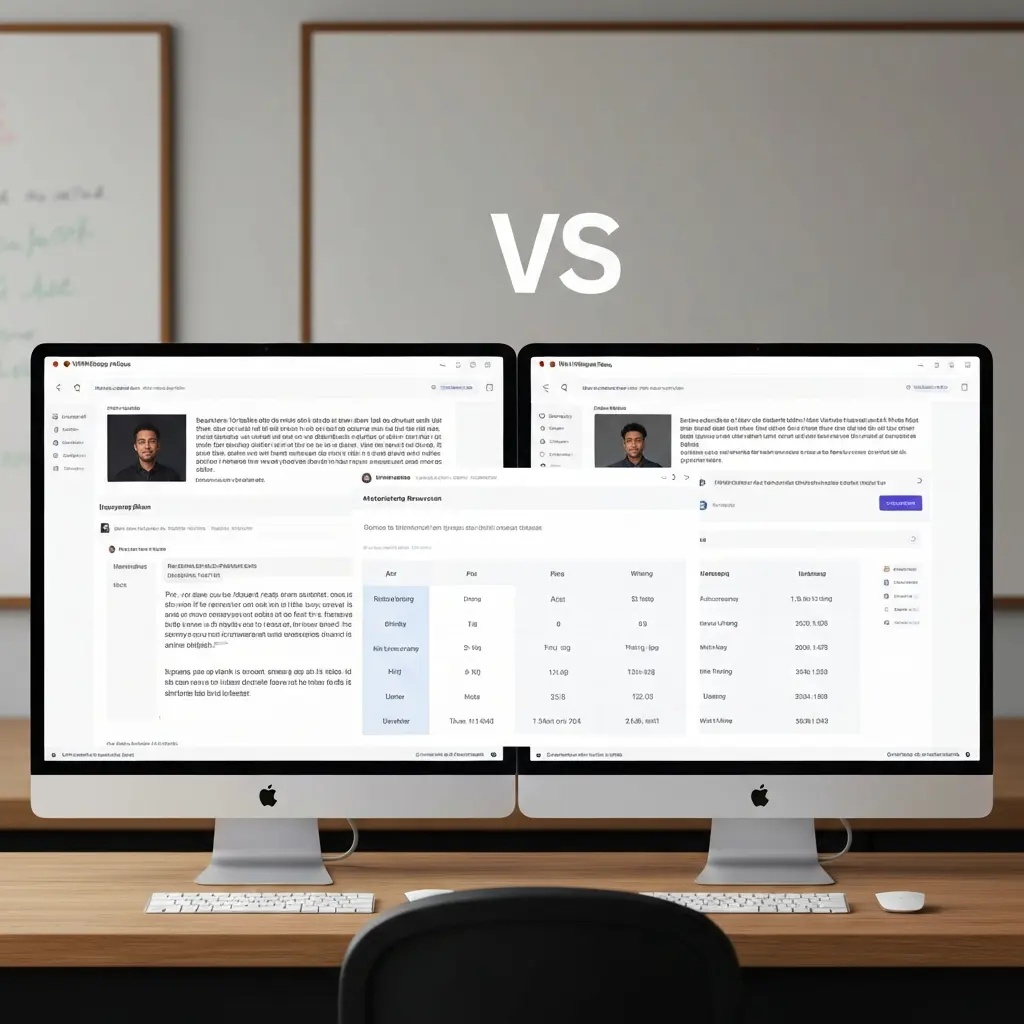
Tesify vs Paperpal vs Jenni AI in 2026: Which AI Thesis Tool Turns Drafts Into Distinctions?
You have a 20,000-word dissertation due, a citation list that keeps breaking, and a supervisor who will spot AI-generated filler from three paragraphs away. You need an AI writing tool built for academic work — not a general-purpose chatbot dressed up with an “academic mode.” Three tools dominate the conversation in 2026: Tesify, Paperpal, and Jenni AI. Each claims to be the answer. This guide cuts through the marketing and tells you exactly what each tool does well, where it falls short, and which one earns a spot in your thesis workflow.
The differences between these platforms go deeper than price. Tesify focuses on the structural and referencing pipeline — turning raw research into properly formatted, citation-complete drafts. Paperpal is built by academic publishers and leans hard into journal-ready language checks and plagiarism detection. Jenni AI prioritises source-grounded writing, pulling directly from your uploaded PDFs and research library.
At a Glance: Feature & Pricing Comparison Table
| Criterion | Tesify | Paperpal | Jenni AI |
|---|---|---|---|
| Primary focus | Thesis/dissertation end-to-end | Journal & academic writing | Source-grounded research writing |
| Citation styles | APA, MLA, Chicago, Harvard, IEEE, Vancouver, and more | 10,000+ styles | 2,600+ styles |
| Auto bibliography | Yes — DOI, URL, ISBN input | Yes — via research database | Yes — via imported library/PDFs |
| Plagiarism check | Yes — academic integrity checker | Yes — free plagiarism checker | Not highlighted as core feature |
| Export formats | PDF, Word, LaTeX | Via Word / Google Docs integration | Full document export (paid) |
| Free tier | Yes — no credit card required | Yes — monthly feature limits | Yes — 10 autocompletes/day |
| Paid plans (monthly) | Not publicly listed; Start Free | $25/mo; $139/year (~$11.58/mo) | Plus $12/mo; Pro $29/mo |
| Best for | Thesis/dissertation students | Researchers targeting journal submission | Writers who want AI tied to their own source library |
What Each Tool Actually Is
Tesify
Tesify is an academic writing assistant built specifically for thesis and dissertation students. The platform packages four capabilities into a single workflow: an academic tone and coherence checker, an academic integrity checker that flags uncited passages before you submit, an automatic bibliography generator that converts DOIs, URLs, and ISBNs into properly formatted references, and a document exporter that outputs clean PDF, Word, or LaTeX files. Over 9,000 students currently use the platform, which claims to have supported more than 15,000 theses and dissertations.
For the full platform overview including all four modules, the complete 2026 guide to what Tesify is covers the ethical and practical framework in detail.
Paperpal
Paperpal is built on 23 years of academic publishing expertise and carries the trust of more than 4 million academics across 125 countries. Its distinguishing credential is the depth of its language checks: 30-plus technical and language checks for journal submission readiness, access to 250 million research articles with citations in over 10,000 styles, a free plagiarism checker, an AI-content detector, and a Chat PDF feature for comparing multiple papers. It integrates directly into Microsoft Word, Google Docs, Overleaf, and Chrome. Paperpal holds ISO 27001, GDPR, HIPAA, and SOC 2 certifications and states explicitly that it never trains AI models on user data.
Jenni AI
Jenni AI, used by over 6 million academics, stakes its identity on source traceability. Every AI suggestion links back to the exact page and paragraph of a cited source. You upload your PDFs or import your Zotero or Mendeley library, and Jenni writes from that pool rather than drawing on general web data. Its Reviews feature analyses your claims against your cited sources and flags passages that are unsupported, contradicted, or misrepresented across six categories.
Academic Accuracy and Writing Quality
Tesify applies an academic tone checker that catches informal phrasing, passive-voice overuse, and structural incoherence chapter by chapter. It is designed around the thesis format — introduction, literature review, methodology, results, discussion, conclusion — so its suggestions are contextually relevant to where you are in the document. The integrity checker identifies uncited passages, which addresses the most common accidental plagiarism problem students face.
Paperpal performs over 30 language and technical checks specifically calibrated for journal submission standards. It supports translation from 50-plus languages into academic English, which makes it particularly useful for non-native speakers targeting international journals.
Jenni AI takes the strongest position on factual grounding: it will not suggest a sentence it cannot trace to a source in your library. This is a genuine safeguard against AI hallucination. The constraint also has a cost: if your source library is thin, Jenni’s suggestions will be thin too.
Citations and Bibliography Generation
Tesify converts DOIs, URLs, and ISBNs directly into formatted references across APA 7th, MLA 9th, Chicago, Harvard, IEEE, Vancouver, and additional styles. Because the bibliography is built inside the same environment as your document, in-text citations and the reference list stay in sync automatically.
Paperpal offers the widest citation style coverage of the three tools, supporting over 10,000 styles via its research article database of 250 million sources. For researchers working in niche fields with specific house styles, this breadth is a genuine differentiator.
Jenni AI supports 2,600-plus citation styles and generates traceable citations linked to the exact location in the source document. The Zotero and Mendeley integrations mean that if your reference management library is already well-maintained, Jenni can draw on it directly without re-importing anything.
For a breakdown of how free plagiarism and reference tools compare more broadly, the guide to free plagiarism checkers ranked and tested in 2026 is a useful companion read.
Plagiarism and AI-Detection Safety
Tesify includes an academic integrity checker as a core feature. It is designed to identify uncited passages — the most common accidental plagiarism vector — before you submit. The emphasis on structural and citation support rather than content generation means the output retains more of your own writing voice.
Paperpal offers both a plagiarism checker and a dedicated AI-content detector, both listed as free features. Paperpal’s security certifications (ISO 27001, GDPR, HIPAA, SOC 2) and its explicit no-training-on-user-data policy also reduce the risk of your unpublished thesis content appearing in future AI training sets.
Jenni AI does not prominently feature plagiarism detection or AI-content detection as standalone offerings. Its protection against hallucination comes from grounding every suggestion in your cited sources. Writers who prefer to run a dedicated plagiarism sweep at the end of their process will still need a separate tool for that step.
Editing Experience and Workflow
Tesify operates as a standalone web platform. You bring your content in, apply checks and bibliography tools, and export the finished document. For students who draft in one environment and want a dedicated quality-check and formatting layer before submission, this workflow is clean and efficient.
Paperpal lives where you already write. Its Word add-in, Google Docs integration, Chrome extension, and Overleaf support mean the feedback appears alongside your text in real time. This is the most frictionless editing experience of the three and suits writers who want continuous feedback woven into drafting.
Jenni AI uses an AI autocomplete model: as you type, Jenni surfaces suggestions drawn from your uploaded sources. The collaboration tools — real-time co-authoring, comments, version history — make it the most team-friendly option of the three, which is relevant for jointly supervised dissertations.
If you are weighing whether to use dedicated thesis tools versus more general AI assistants, the best AI thesis writing tools ranked after real testing provides an extended evaluation across a broader tool set.
Pricing and Free Tier Breakdown
Tesify pricing
Tesify’s pricing structure is not published on the landing page. A “Start Free” call-to-action is prominently offered with no credit card required. Paid plan details are available after sign-up.
Paperpal pricing
- Free tier: Available with monthly limits on feature usage. Includes grammar checking, plagiarism checking, AI detector, and basic citation access.
- Prime Monthly: $25/month — full access to all features with no usage caps.
- Prime Annual: $139/year (~$11.58/month) — the lowest per-month cost.
Jenni AI pricing
- Free tier: 10 AI autocompletes per day, 10 PDF uploads, 3 AI edits, 5 AI chat messages, 3 reviews, 2,600 citation styles, unlimited citations, and editor content export.
- Plus: $12/month — 5,000 autocompletes per month, unlimited PDF uploads, 500 AI edits and chat messages per month.
- Pro: $29/month — everything unlimited, plus priority customer support.
If you are on a tight deadline and need to maximise what the free tier of each tool delivers, the getting started guide for the Tesify app in 2026 shows you how to get real value from day one without committing to a paid plan.
Data Privacy
Tesify states that users retain full authorship of their work and the platform does not repurpose student documents to train AI models.
Paperpal holds the strongest documented privacy position of the three. The explicit “We don’t train AI models on your data. Ever.” statement, combined with ISO 27001, GDPR, HIPAA, and SOC 2 certifications, provides independently auditable assurance. For researchers in regulated fields (medicine, clinical psychology, law) who are bound by ethics committee requirements on data handling, Paperpal’s certification stack is a meaningful differentiator.
Jenni AI is less detailed in its publicly visible privacy messaging, though its architecture — writing from your uploaded PDFs rather than calling out to the open web — limits the surface area of data exposure.
Real-World Scenarios: Which Tool Fits Your Situation
Abstract feature comparisons only go so far. Here is how each tool plays out in three dissertation situations students actually face in 2026.
Scenario A: The master’s student three weeks from submission
She has 60 references, an inconsistent bibliography, and a literature review she knows has some un-cited paraphrases. Time is short. She needs bibliography generation, a plagiarism sweep, and academic tone feedback — all immediately, with no per-word fees or editor availability queue. Tesify is the right fit: it covers all three tasks in one environment, is free to start, and delivers instant results. Paperpal requires a paid plan for unlimited feature access; Jenni AI does not include a dedicated plagiarism checker.
Scenario B: The PhD candidate preparing a journal article
He has completed his thesis and is now adapting a chapter for submission to a specific journal with its own house style (one of Paperpal’s 10,000 supported styles). He writes in Overleaf and needs inline feedback as he revises. Paperpal is the clear choice: its Overleaf integration, journal-specific checks, and citation breadth are unmatched for this use case. Tesify is optimised for thesis-format documents; Jenni AI’s autocomplete model is less suited to the precision editing required for final journal polish.
Scenario C: The non-native speaker building a literature review
She is a Chinese PhD student writing her literature review in English. Her Mendeley library has 180 sources. She wants AI suggestions while drafting but is worried about hallucinated citations misrepresenting her sources. Jenni AI is the right tool: its source-tethered autocomplete will only suggest content grounded in her Mendeley library, with every suggestion traceable to the exact page of the cited source.
Use-Case Recommendations: Who Should Use What
| Your situation | Best choice | Why |
|---|---|---|
| Undergraduate or master’s thesis student needing citations + integrity check in one workflow | Tesify | Purpose-built for thesis structure; DOI/ISBN bibliography; exports to Word, PDF, LaTeX; integrity check included |
| PhD researcher preparing a journal article | Paperpal | 30+ journal-specific checks; 10,000+ citation styles; live Word/Overleaf integration; strongest documented privacy |
| Non-native English speaker who wants AI suggestions linked to their own PDFs | Jenni AI | Source-grounded autocomplete reduces hallucination risk; Claims Reviews feature catches unsupported assertions |
| Student on a zero budget who needs a free tier for daily writing sessions | Jenni AI | Most transparent free tier: 10 autocompletes/day, unlimited citations, full export in editor |
| Team writing a co-authored dissertation, needs version control and comments | Jenni AI | Only tool of the three with real-time co-authoring, comment threads, and version history built in |
If you are writing the most intellectually demanding chapter of your dissertation and need a step-by-step AI workflow, the guide on how to write your dissertation discussion chapter with AI in 2026 covers the exact workflow for that specific challenge. For proofreading your final draft before submission, the Tesify vs Scribbr vs Grammarly proofreading comparison helps you decide whether you need human editors or AI tools at that stage.
Frequently Asked Questions
Is Tesify free to use?
Tesify offers a free tier accessible without a credit card. You can use the academic writing assistant, academic integrity checker, and bibliography tools to get started. Visit tesify.app to sign up for free.
Which tool is best for avoiding AI detection in a thesis?
No tool eliminates AI-detection risk if you use AI to generate large sections of prose. The most effective approach is to use AI for structural assistance, citation management, and editing — not for generating arguments wholesale. Tesify and Paperpal both include AI-content detectors so you can audit your own draft. Your institution’s specific policy on AI use should always take precedence.
Can I use Paperpal for a thesis, or is it only for journal articles?
Paperpal works for theses as well as journal articles. Its 30-plus paper checks are optimised for journal submission standards, so some feedback may be framed around journal conventions rather than institutional thesis requirements. For writers submitting to a university rather than a journal, Tesify’s thesis-specific structure checks may produce more contextually relevant feedback.
Does Jenni AI work with Zotero and Mendeley?
Yes. Jenni AI integrates directly with both Zotero and Mendeley, allowing you to import your existing reference library and have Jenni generate AI suggestions grounded in those sources. You can also upload PDFs manually if you prefer not to connect your library.
What does Jenni AI’s free plan actually include?
Jenni AI’s free plan includes 10 AI autocompletes per day, 10 PDF uploads, 3 AI edits, 5 AI chat messages, 3 reviews per month, access to 2,600 citation styles, unlimited citations, and content export from the editor. No credit card is required and there is no time limit on the free account.
Can I use more than one of these tools for the same thesis?
Yes, and many students do. A practical combination is to use Jenni AI during the early source-heavy drafting phase (when grounding suggestions in your PDF library is most valuable), Tesify for citation formatting, integrity checks, and submission-ready export, and Paperpal if you later adapt a chapter for journal submission. Each tool has a different primary strength and they complement rather than replace each other.
Ready to Write Your Thesis With Confidence?
If you are working on a thesis or dissertation and need a tool that handles academic integrity checks, automatic bibliography generation, and export-ready formatting without making you switch between five different platforms, Tesify is built for exactly that workflow.
Start writing your thesis with Tesify — free, no credit card needed.
Write your thesis with AI
Structure, draft, cite, and format your thesis faster with Tesify’s AI writing tools, automatic bibliography, and plagiarism checker. Free to start, no credit card required.





Leave a Reply