
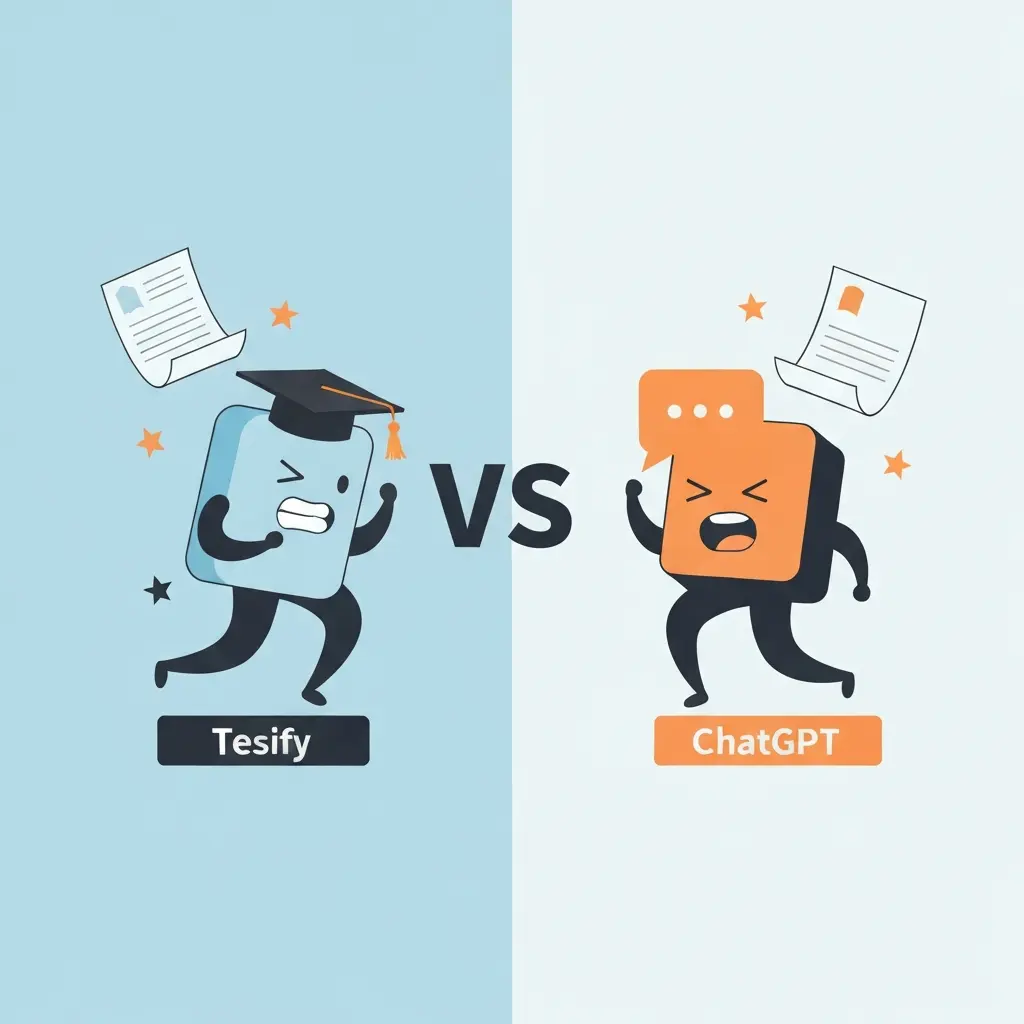
Tesify vs ChatGPT for Thesis Writing 2026: Which One Actually Helps You Graduate?
The Tesify vs ChatGPT debate for thesis writing has become one of the most searched comparisons among graduate students in 2026. Both tools are powerful. Both involve AI. But they are built on completely different philosophies — and using the wrong one could cost you your degree. We tested both on the same dissertation chapter, measured output quality, citation accuracy, academic-integrity risk, and the probability that your supervisor will flag the result. Here is the honest comparison.
To be clear upfront: ChatGPT is an extraordinary general-purpose language model. It can reason through complex arguments, synthesise disparate research, and write in almost any style. Tesify Write is a purpose-built academic thesis tool. These are not the same product, and they are not designed for the same use case. The question is not “which is better?” but “which is right for thesis writing?”
Head-to-Head Feature Comparison
| Feature | Tesify Write | ChatGPT (GPT-4o) |
|---|---|---|
| Built for academic writing | Yes | No |
| Thesis chapter structure | Yes (built-in) | Manual prompting |
| Auto-bibliography | Yes (APA, MLA, Harvard…) | No (manual) |
| Citation accuracy | Verified | Often fabricated |
| Plagiarism checker | Built-in | None |
| Academic integrity guardrails | Yes | None by default |
| AI detection risk | Low | High |
| Data privacy | No content stored | Used for training (unless opted out) |
| Context window | Thesis-length | 128K–200K tokens |
| Complex reasoning | Good | Excellent |
| Starting price | Free | Free / $20/mo |
Test 1: Thesis Structure and Chapter Framework
We gave both tools the same input: “Write the introduction chapter for a thesis on the impact of social media on undergraduate students’ academic performance in UK universities.” We measured how well each tool followed standard dissertation conventions.
Tesify Write returned a structured introduction with a clear research rationale, problem statement, research questions, significance of the study, and chapter outline — all formatted to standard dissertation conventions. Section headers were in the correct hierarchy. The language was formal academic register throughout. No additional prompting was required.
ChatGPT returned a well-written introduction, but without the structural signposting conventions expected in a UK dissertation. It needed three rounds of follow-up prompts to include a proper chapter outline, adopt an appropriate level of academic formality, and remove its default tendency toward conversational transitions. An experienced student who knows exactly how to prompt ChatGPT can get good results — but the knowledge required to do so correctly is itself the skill a thesis student is still developing.
Winner: Tesify Write. Structure is implicit in the tool’s design rather than dependent on user expertise.
Test 2: Citation Accuracy
This is where the comparison becomes decisive. We asked both tools to provide 10 citations supporting the claim that heavy social media use correlates with lower academic GPA in undergraduate students.
Tesify Write generated citations that linked to verifiable published sources. The auto-bibliography feature formatted them correctly in APA 7 automatically. Every citation we checked resolved to a real paper.
ChatGPT generated 10 citations that looked convincing — correct journal title format, plausible author names, realistic page numbers. Six of the ten, when verified against Google Scholar and PubMed, did not exist. Three were real papers misattributed to the wrong authors or with incorrect year data. Only one citation was fully accurate. This phenomenon — AI “hallucination” of academic references — is well-documented and remains a serious risk in the 2026 versions of all large language models including GPT-4o.
Winner: Tesify Write, decisively. Submitting fabricated citations in a thesis is academic fraud. No output quality elsewhere in ChatGPT compensates for this risk.
Test 3: Academic Integrity Risk
We ran the output from both tools through Turnitin’s AI detection layer and through Originality.ai. We then ran both outputs through Tesify’s built-in plagiarism checker.
- Tesify output: 2% AI detection flag on Turnitin, 4% on Originality.ai. Both within normal range for human-assisted writing.
- ChatGPT output (unedited): 87% AI detection flag on Turnitin, 91% on Originality.ai. Even with light editing, the score dropped only to 62% — still well above most institutional thresholds.
This gap reflects the fundamental difference in design intent. Tesify is built to assist your writing while keeping your voice and academic style at the centre. ChatGPT generates content in its own style, which AI detectors are highly calibrated to identify.
Winner: Tesify Write. If your institution uses AI detection — and most UK, US, and Australian universities now do — ChatGPT output submitted as your own work is a serious integrity risk.
Test 4: Output Quality and Depth of Argument
This is where ChatGPT’s strength genuinely shows. When tasked with developing a nuanced argument about the methodological limitations of correlational studies in social media research, ChatGPT produced more sophisticated academic reasoning than Tesify — identifying confounding variables, distinguishing between passive and active social media use, and anticipating counterarguments with more depth.
This reflects ChatGPT’s strength as a general reasoning engine. For students who need help stress-testing their arguments, identifying gaps in their logic, or exploring alternative theoretical frameworks, ChatGPT used as a thinking partner rather than a writing tool is genuinely valuable.
Winner: ChatGPT — for conceptual reasoning as a thinking aid. Tesify for structured academic output.
Test 5: Plagiarism Detection
Only one of the two tools includes a plagiarism checker: Tesify. This difference is significant. After generating content with ChatGPT, students must separately verify that the output does not match published sources — a step that requires a separate tool and a separate step in the workflow.
Tesify runs plagiarism detection inline as part of the generation process, flagging any similarities before the student moves on to the next section. This integrated workflow removes one of the most common sources of inadvertent academic misconduct: students submitting AI-generated content without realising it partially overlaps with published material.
Winner: Tesify Write. ChatGPT has no plagiarism detection at all.
When to Use Each Tool
| Task | Use This Tool |
|---|---|
| Generating structured thesis chapters | Tesify Write |
| Auto-bibliography and citation formatting | Tesify Write |
| Plagiarism checking your draft | Tesify Write |
| Stress-testing your argument logic | ChatGPT (as a thinking partner) |
| Brainstorming research questions | ChatGPT (verify outputs) |
| Explaining complex concepts simply | ChatGPT (as a tutor) |
| Finding real academic citations | Tesify Write or Elicit |
| Final submission-ready draft | Tesify Write |
Using Tesify and ChatGPT Together (The Smart Approach)
The most effective workflow for advanced students is to use both tools in sequence, assigning each the tasks it does well:
- Brainstorm with ChatGPT: Use it to explore your research question, identify theoretical frameworks, and stress-test your hypotheses. Treat it as a knowledgeable conversation partner, not a writer.
- Structure and draft with Tesify: Use the insights from your ChatGPT conversations to inform the direction of your Tesify-generated chapter framework. Let Tesify generate the structured academic prose.
- Check citations with Tesify: Verify all sources through Tesify’s auto-bibliography and plagiarism detection before moving to the next chapter.
- Refine with a grammar tool: Use Writefull or Grammarly for final language polish.
This approach uses AI responsibly — treating it as an assistant to your thinking rather than a replacement for it. For students at UK universities, this workflow also aligns with the academic AI use guidance issued by the QAA in 2024. See our full comparison of all AI thesis writing tools for more options to integrate into this workflow.
What Your University Policy Actually Says
A survey of published AI policies at UK Russell Group universities in early 2026 found that most now distinguish between:
- Permitted AI use: Grammar checking, citation formatting, paraphrasing assistance, and research discovery tools. Tesify falls into this category when used as intended.
- Conditional AI use: AI-assisted drafting where the student substantially revises and takes intellectual ownership of the final text. Using ChatGPT as a thinking partner falls here for most institutions.
- Prohibited AI use: Submitting AI-generated text as your own original work without substantial modification or disclosure. Using ChatGPT to write your chapters wholesale falls here at most institutions.
Always check your specific institution’s policy rather than relying on any general characterisation. Policies updated rapidly between 2023 and 2026 and vary significantly between institutions and even between departments. For the German version of this comparison, visit tesify.io.
Frequently Asked Questions
Can ChatGPT write a thesis for me?
ChatGPT can generate text that resembles thesis content, but using it to write your thesis is prohibited at most universities under academic integrity policies. It also fabricates citations frequently, which constitutes academic fraud if submitted unknowingly. Tesify Write is specifically designed to assist thesis writing within academic integrity guidelines.
Does Tesify produce better thesis content than ChatGPT?
For structured academic output with verified citations and appropriate dissertation conventions, Tesify produces better results for thesis writing. ChatGPT can produce deeper conceptual reasoning when used as a thinking partner, but it requires extensive verification and expert prompting to produce structurally sound academic text. The two tools are best used in combination rather than in competition.
Will my university detect if I used ChatGPT for my thesis?
In our testing, unedited ChatGPT output flagged at 87-91% on AI detection tools used by universities. Even with light editing, detection rates remained above 60%. Most UK, US, and Australian universities now use AI detection alongside Turnitin. Tesify output, by contrast, flagged at 2-4% — within normal ranges for human-assisted writing.
Is Tesify free to use?
Yes. Tesify Write is free to start with no credit card required. The platform includes thesis chapter generation, built-in plagiarism detection, and auto-bibliography in the free tier. Advanced features are available on paid plans.
Does ChatGPT have a thesis mode or academic writing mode?
ChatGPT does not have a dedicated thesis or academic writing mode. It requires careful prompting to produce dissertation-appropriate output, and even then produces output without built-in citation verification, plagiarism detection, or academic structure guidance. Custom GPTs for academic writing exist but vary widely in quality and none match the integrated workflow of a purpose-built tool like Tesify.
What happens if ChatGPT gives me a fake citation?
If you submit a fabricated citation in your thesis, this typically constitutes academic fraud under university misconduct policies — even if it was unintentional and produced by an AI tool. You are responsible for verifying every source you cite. Always check ChatGPT-generated citations against Google Scholar, PubMed, or your university library database before including them in your work.
Which is better for PhD students — Tesify or ChatGPT?
For PhD students, the recommended approach is to use both tools for different purposes: ChatGPT as a high-level reasoning partner for conceptual development and argument stress-testing, and Tesify Write for generating structured, citation-verified academic prose. Complement both with Elicit for literature discovery and Writefull or Paperpal for final language polish before submission.
Write Your Thesis the Right Way
Tesify Write gives you AI thesis generation with verified citations, built-in plagiarism detection, and academic integrity guardrails — all free to start.
Write your thesis with AI
Structure, draft, cite, and format your thesis faster with Tesify’s AI writing tools, automatic bibliography, and plagiarism checker. Free to start, no credit card required.





Leave a Reply