
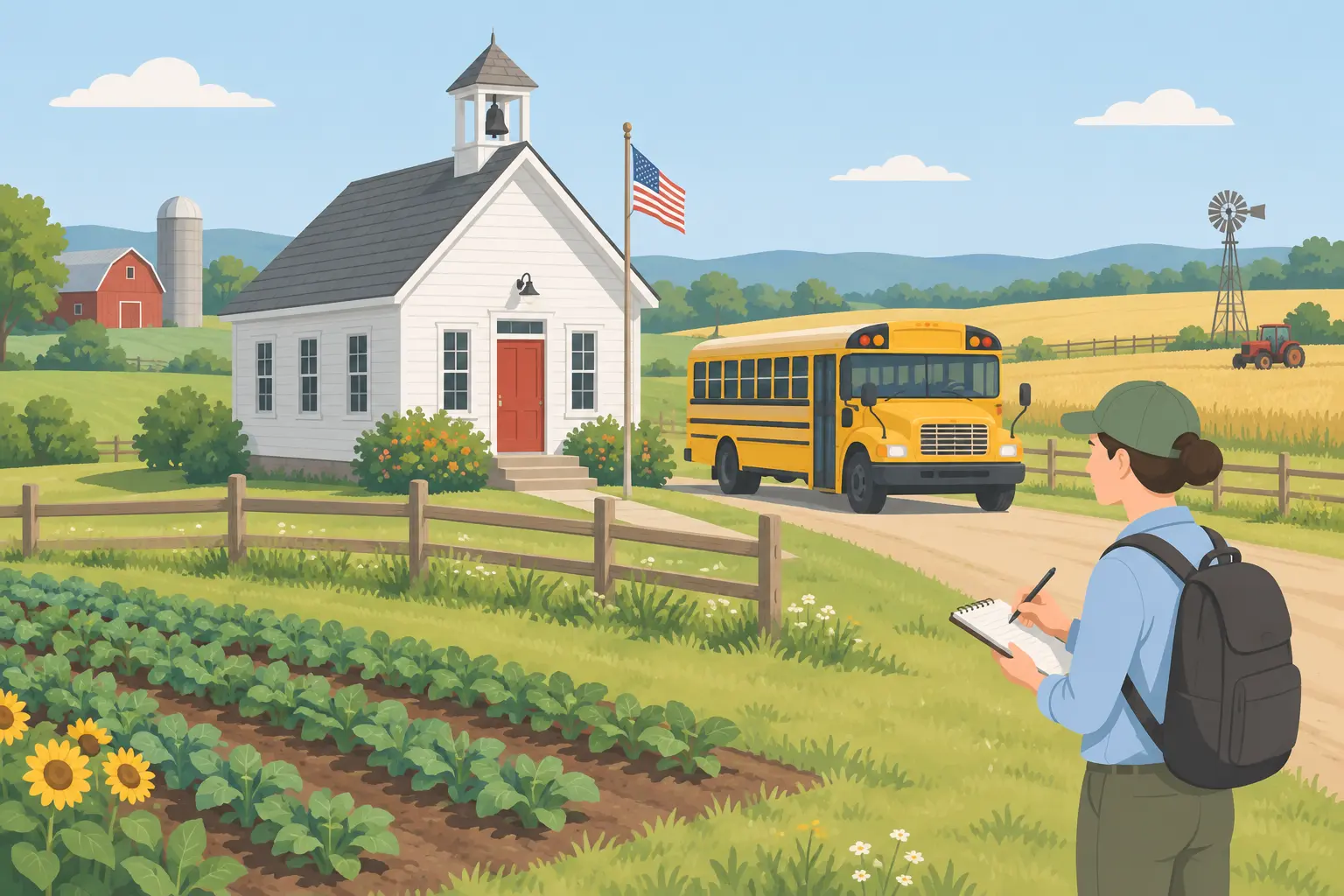
Rural schools are not just “small urban schools with fewer resources” — they are a distinct research setting with their own access rules, data limitations and ethical considerations, and treating them as an undifferentiated backdrop is the single most common reason an education thesis proposal on a rural topic gets sent back for rescoping. This guide sets out how to frame a rural-schools thesis properly: how “rural” is actually defined, the research questions the setting supports well, the access route that works, and the national data you can build a design around.
What “rural” means in education research — it is not a vibe, it is a code
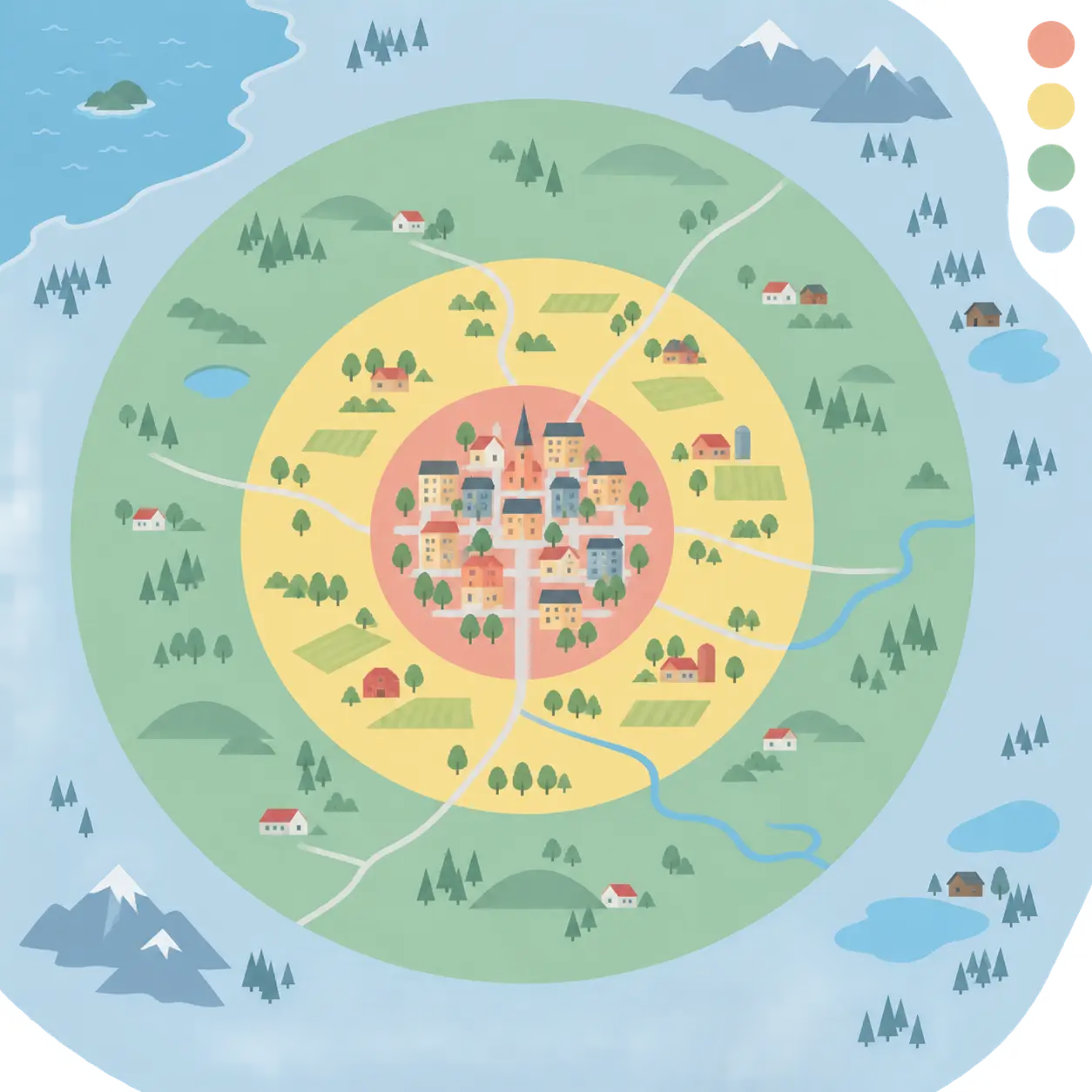
The National Center for Education Statistics (NCES) classifies every U.S. school and district using a 12-category locale system built from four basic types — City, Suburban, Town and Rural — each split into three subtypes by distance from an urbanized area. Within Rural, the subtypes are Fringe (rural territory within 5 miles of an urbanized area, or 2.5 miles of an urban cluster), Distant (5–25 miles from an urbanized area, or 2.5–10 miles from an urban cluster), and Remote (more than 25 miles from an urbanized area and more than 10 miles from an urban cluster). This distinction matters for a thesis because “rural fringe” schools often look statistically closer to suburban schools on broadband access, staffing and funding, while “rural remote” schools face a genuinely different set of constraints — transportation time, teacher recruitment radius, and single-school districts with no comparison site nearby. A proposal that says “I will study rural schools” without picking a locale code is proposing an ill-defined population; a proposal that says “I will study rural-remote elementary schools (NCES locale code 43)” is proposing a researchable one.
Research questions the rural setting actually supports
Four question families recur in strong rural-education theses, each tied to a genuine feature of the setting rather than an assumption about it:
- Teacher recruitment and retention. Rural districts report chronic difficulty filling positions in certain subjects (special education, secondary science and math). A thesis can ask what predicts a teacher’s decision to stay in or leave a rural-remote district, using turnover data the district or state education agency already collects.
- Access and infrastructure. Broadband availability, bus-ride length, and distance to the nearest specialist (school psychologist, speech-language pathologist) shape what a rural school can actually deliver. A thesis can compare service-delivery models (in-person versus teletherapy) against a specific access constraint.
- Consolidation and district structure. Many rural districts have consolidated or are considering it. A thesis can study the effects of a specific consolidation on a measurable outcome (enrollment, extracurricular participation, commute time) using a before/after or comparison-district design.
- Curriculum and course access. Small rural high schools often cannot staff a full slate of AP or elective courses. A thesis can examine how a specific access gap (dual enrollment, online course platforms) is addressed and with what outcome.
Each of these differs from a generic “achievement gap” framing, which tends to treat rurality as a proxy for disadvantage rather than as a setting with its own specific mechanisms — a framing choice examiners increasingly push back on. For the underlying research-question and hypothesis structure once you have picked one of these angles, see our guide to theoretical frameworks for an education dissertation, which covers the theories (including several access- and opportunity-focused ones) that pair well with a rural-setting study.
Access: the part rural research gets wrong most often
Access to a rural district is a different negotiation from access to a large urban or suburban one, for three structural reasons:
- Fewer gatekeepers, more personal relationships. A single superintendent or principal may control access to the entire study population, and that person is far more likely to know your dissertation committee, your program, or your family than in a large urban district. Disclose any prior relationship explicitly in your ethics application and in the thesis itself. This is a distinct issue from the general population/sample access questions every education dissertation has to answer — see our guide to population, sample and access for an education dissertation for the baseline access chapter this section builds on.
- Small numbers mean disclosure risk. A rural-remote district with one high school and forty students in a grade level cannot realistically anonymize a student-level dataset — the school itself is often identifiable even without naming it. Plan your reporting granularity (grade-level aggregates, not individual scores) before you collect anything, not after a reviewer flags it.
- Research fatigue and reciprocity. Rural districts, especially those near universities that run frequent studies, report survey fatigue. A proposal that offers something back — a summary report, a professional development session — often clears access faster than one that only asks.

Where the national data actually is
A rural-schools thesis does not have to start from zero data collection. NCES maintains locale-coded data across its major collections — the Common Core of Data (CCD) for public school universe counts, EDGE (Education Demographic and Geographic Estimates) for locale boundary files, and the Rural Education in America topical reports — all of which let you filter directly to a rural subtype rather than approximating rurality from ZIP codes or county classifications. Our guide to US education datasets for a dissertation covers CCD and the other national collections study by study, including access tier and typical sample sizes, and is the faster route into a secondary-data design if primary data collection in a specific district is not feasible for your timeline.
A worked example
Weak framing: “This study examines the impact of rurality on student achievement.”
Stronger framing: “This study examines whether access to synchronous online Advanced Placement courses is associated with AP enrollment rates in NCES locale-43 (rural remote) high schools, compared to locale-41 (rural fringe) high schools with in-person AP offerings, using three years of state department of education course-enrollment data.”
The second version names the locale codes precisely, states a specific mechanism (course access), names the comparison, and points to an actual, obtainable data source — everything a committee needs to judge feasibility in one sentence.
Sampling and design notes specific to rural settings
Because rural districts and schools are numerically fewer than urban ones in most states, probability sampling at the school level often is not viable — you may be working with the entire population of rural-remote high schools in a state rather than a sample of them. This changes how you report generalizability: state clearly whether your design is a population study of every eligible rural school in a defined area, or a sample drawn from a larger multi-state rural population, since the statistical logic (and the claims you can make) differ. A mixed-methods design is common in this literature precisely because small-N settings limit what quantitative analysis alone can support; qualitative interviews with the handful of available principals or teachers often carry as much of the argument as any statistical test.
Ethics review: what a rural-setting IRB application must address that an urban one often does not
An IRB or ethics committee reviewing a rural-education proposal typically asks for three things a large-district proposal can often skip:
- A specific re-identification risk assessment. Not a general confidentiality statement, but an explanation of how you will prevent a reader who knows the community from working out which school, which grade, or which teacher a finding refers to — because in a district with one high school, “the high school” already identifies the site.
- A plan for dual relationships. Researchers based near the community they study, or who grew up in it, are common in rural education research and are not disqualifying — but the relationship has to be disclosed and its effect on data collection and interpretation addressed directly, not left implicit.
- A community-level consent or notification step beyond individual participant consent, in settings where a school board, tribal council, or community leadership body has a recognized role in approving outside research — this varies significantly by state and by whether the school serves a tribal nation, and needs to be checked with your ethics office rather than assumed either way.
Triangulating more than one rural data source
Because any single rural dataset is often thin (few schools, few years, or both), a stronger design triangulates at least two sources rather than relying on one national collection alone: NCES’s Common Core of Data for the structural facts (enrollment, staffing counts, locale code), a state department of education collection for the specific outcome variable (course enrollment, discipline referrals, graduation data), and, where feasible, a primary qualitative layer (interviews with the small number of available administrators or teachers) to explain patterns the quantitative data can describe but not interpret. This triangulated approach also protects a thesis against a single dataset’s known limitations — NCES locale codes update on a multi-year cycle and can lag a district’s actual current classification if boundaries or urbanized-area definitions have shifted.
Once you have a scoped rural angle, a full topic list can help you see the neighbouring angles you are not taking — our 60 education dissertation topics guide includes several rural-adjacent leadership and equity angles alongside this one.
Mistakes that get a rural-education proposal rescoped
- No locale code named — “rural schools” without specifying fringe, distant or remote, or the NCES/state classification used.
- Rurality treated as a synonym for disadvantage — collapsing a specific access mechanism (broadband, teacher supply, course availability) into a vague deficit narrative.
- No disclosure-risk plan — proposing student-level reporting in a setting too small to support it.
- No named data source — claiming national rural statistics without citing CCD, EDGE, or the specific state education agency collection used.
- Generalizability claims that outrun the design — describing a single-district case as representative of “rural schools” broadly.
Frequently asked questions
How does NCES define a rural school?
NCES uses a locale system with three rural subtypes based on distance from an urbanized area or urban cluster: Fringe (within 5 miles), Distant (5–25 miles), and Remote (more than 25 miles). Every U.S. public school carries one of these codes.
Do I need permission from a whole district to study one rural school?
Usually yes — most rural districts have a single central office that approves all research access, even for a single-school study, because the superintendent or school board typically holds that authority for every school in the district.
Can I anonymize data from a very small rural school?
Only at an aggregate level. A rural-remote school with a small grade-level cohort is often identifiable even without its name attached, so plan to report grade-level or school-level aggregates rather than individual scores, and say so explicitly in your ethics application.
What is the difference between rural-fringe and rural-remote for my design?
Rural-fringe schools are close enough to an urbanized area that they often resemble suburban schools on staffing, broadband and funding; rural-remote schools face materially different constraints (long transportation times, thin teacher-recruitment pools). Naming the specific subtype changes what your findings can credibly claim.
Where can I find national data already coded by rural locale?
NCES’s Common Core of Data (CCD) and EDGE (Education Demographic and Geographic Estimates) collections both carry locale codes at the school level, letting you filter directly to a rural subtype rather than approximating it from ZIP codes.
Should I disclose a personal connection to the rural community I am studying?
Yes, and disclose it in both your ethics application and the thesis itself. A prior relationship to a small community is common in rural education research and is not disqualifying, but its potential effect on access, data collection and interpretation needs to be addressed directly rather than left for a reader to infer.
Frame your rural-education thesis with a data-backed scope
Tesify’s thesis workspace, used by 9,000+ students and 15,000+ chapters, helps you structure a rural-setting thesis around a specific locale code, a feasible access plan and a named national dataset. Every word stays 100% written by you.
Write your thesis with AI
Structure, draft, cite, and format your thesis faster with Tesify’s AI writing tools, automatic bibliography, and plagiarism checker. Free to start, no credit card required.





Leave a Reply