
Reflexivity in Qualitative Research 2026: Types, Importance & How to Practise It
Every qualitative researcher brings a self to the field — a biography, a set of assumptions, disciplinary training, and a body that occupies a particular social location. Reflexivity in qualitative research is the practice of making that self visible and analytically accountable. It is not a peripheral courtesy, an added section at the end of a methodology chapter, or a confession of weakness. It is, as Linda Finlay (2002) argues, a core methodological commitment that shapes the validity, ethics, and interpretive depth of an entire study.
Understanding reflexivity at a conceptual level matters before you can practise it well. Researchers who treat reflexivity as a box-ticking exercise — writing one paragraph about their identity, then proceeding as though it changes nothing — miss its deeper purpose. This guide untangles what reflexivity actually means, maps its principal types, clarifies how it differs from (and relates to) bias, and shows how it operates across grounded theory, phenomenology, ethnography, and other traditions. For the practical task of drafting your own statement, see our companion guide on how to write a reflexivity statement in qualitative research.
What is reflexivity in qualitative research?
The term derives from the Latin reflectere — to bend back. In a methodological context, reflexivity means bending attention back onto the researcher and the research process itself, examining not just the phenomenon under study but the conditions under which knowledge about it is being produced. This is a fundamentally different orientation from positivist science, where the researcher is expected to stand outside the data, neutrally observing and measuring. In qualitative inquiry, that separation is recognised as neither achievable nor, in many paradigms, desirable.
What reflexivity means in qualitative inquiry and how to practise it well. Source: Research Methods and Statistics (FMG, UvA) — University of Amsterdam official channel.
The philosophical underpinning matters here. Whether a researcher operates from a constructivist, interpretivist, critical, or feminist standpoint shapes what reflexivity demands of them. Within constructivism, for example, knowledge is understood as co-constructed between researcher and participant, which means the researcher’s framing is not noise to be minimised but a constitutive part of the data. Understanding these foundations — paradigm, ontology, epistemology — is essential context; see our guide to research paradigms, positivism, constructivism, ontology, epistemology, and axiology for that grounding.
Reflexivity operates at every stage of a study. Before entering the field, a researcher’s choice of topic, theoretical lens, and sampling strategy already encodes assumptions. During data collection — particularly in interviews — the researcher’s social identity (race, gender, class, professional status) shapes what participants disclose and how they frame it. In analysis, reflexivity concerns the interpretive moves made in coding, theme-building, and deciding what counts as evidence. In write-up, it involves decisions about whose voice is centred and how conclusions are framed. As Roni Berger (2015) demonstrates, a researcher who shares a social position with their participants — an immigrant studying immigrants, for instance — faces a specific kind of reflexive challenge: familiarity can yield rapport and insight, but it can also make the unfamiliar invisible.
Reflexivity vs bias: a crucial distinction
One of the most persistent confusions in qualitative methodology is the conflation of reflexivity with bias management. They are related but not identical.
| Concept | Definition | Goal |
|---|---|---|
| Bias | A systematic distortion introduced by the researcher’s perspective, often operating unconsciously | Traditionally: minimise or eliminate it |
| Reflexivity | A conscious, critical examination of how the researcher’s subjectivity shapes the inquiry | Turn subjectivity into a named, theorised, analytically productive position |
The positivist tradition treats researcher subjectivity as a threat to objectivity — a bias to be controlled through blind procedures, standardised instruments, and statistical techniques. Qualitative paradigms largely reject this framing. They do not deny that researchers bring perspectives; they insist that those perspectives be made legible. Reflexivity does not claim to eliminate subjectivity; it claims to account for it transparently, allowing readers to assess how it shaped the study.
This is why reflexivity strengthens rather than undermines qualitative rigour. A study that declares the researcher’s social location, theoretical commitments, and interpretive moves is more trustworthy — in the qualitative sense — than one that presents its findings as though they emerged from nowhere. Reflexivity is a component of what Lincoln and Guba term credibility and what others frame as confirmability or transparency.
Types of reflexivity: personal, epistemic, and methodological
Scholars have proposed several typologies. The most useful for dissertation researchers distinguishes three overlapping but analytically separable types.
Personal reflexivity
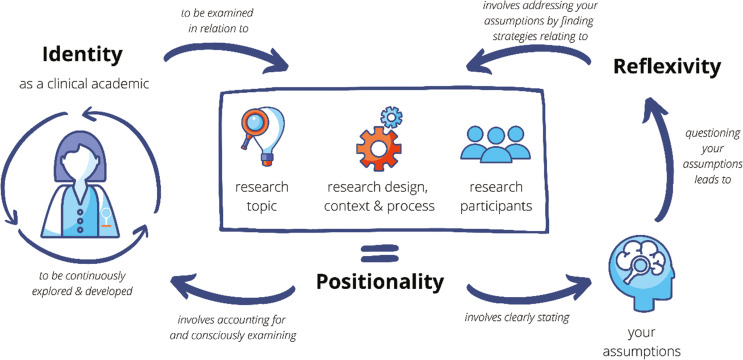
Personal reflexivity concerns the researcher as a biographical subject. It asks: who are you, and how does that shape what you see? This includes social identities (gender, ethnicity, class, age, sexuality, religion, disability status), personal history, and emotional responses to the research. A social worker studying burnout in social care, who has herself experienced burnout, carries a personal reflexive dimension that both enables interpretive depth and demands careful management. Berger’s (2015) insider/outsider framework is particularly useful here: insider researchers often generate richer, more nuanced data, but they must work harder to bracket assumptions so naturalised they have become invisible.
Personal reflexivity is closely related to, but not identical with, positionality. Positionality situates the researcher in relation to structural categories of power; personal reflexivity is broader, encompassing emotional and experiential dimensions as well. For a detailed treatment of the positionality side, see our guide on what a positionality statement is, with examples.
Epistemic reflexivity
Epistemic reflexivity operates at the level of knowledge claims. It asks: what assumptions does your theoretical or disciplinary framework carry, and how do those assumptions predispose you toward certain interpretations? A researcher drawing on feminist standpoint theory, for example, is committed to the view that marginalised perspectives generate distinctive forms of knowledge. That commitment is not a bias in the pejorative sense — it is an epistemological position that should be named and examined, not hidden.
Epistemic reflexivity also requires scrutinising the concepts you import from theory. If you code participants’ talk using a specific theoretical vocabulary — say, Foucauldian discourse categories — you should ask what that vocabulary occludes as well as what it illuminates. This kind of reflexivity is demanding precisely because it requires stepping outside the theoretical home that gives your analysis its coherence.
Methodological reflexivity
Methodological reflexivity examines the research design and methods as social practices that produce particular kinds of data. Semi-structured interviews, for example, are relational events: the power dynamics between interviewer and interviewee, the setting, the recording device, and even the language used all shape what gets said. A focus group produces different data from one-to-one interviews not simply because of the format, but because the intersubjective dynamics in a group are qualitatively different. Methodological reflexivity asks researchers to theorise these production conditions explicitly.
This type also attends to what was not possible to know given the method chosen. Every design has epistemological limits, and naming those limits is itself a reflexive act — one that overlaps with writing a research limitations section, though it goes further by connecting limitations to the knowledge-production process.
Finlay’s five variants of reflexivity
Linda Finlay’s (2002) taxonomy remains one of the most cited and pedagogically useful frameworks in the literature. In her landmark article “Negotiating the Swamp: The Opportunity and Challenge of Reflexivity in Research Practice”, she identifies five distinct variants:
- Introspection — the researcher uses their own inner experience, particularly emotional responses in the field, as a data source. Associated with heuristic research and feminist autobiography.
- Intersubjective reflection — focuses on the researcher–participant relationship as a site of knowledge production, examining how the encounter itself shapes understanding. Common in phenomenological and psychoanalytically informed research.
- Mutual collaboration — researchers and participants jointly examine assumptions and interpretations, often in participatory action research. The researcher’s authority is explicitly challenged and renegotiated.
- Social critique — foregrounds power relations, examining how broader structural forces (race, class, gender) are reproduced or resisted in the research encounter. Dominant in critical and emancipatory paradigms.
- Discursive deconstruction — analyses the researcher’s own text as a discursive product, attending to what rhetorical and representational strategies are used to authorise knowledge claims.
Finlay’s point — and it is crucial — is that these are not interchangeable options from which you pick the most convenient. Each variant aligns with specific epistemological commitments and methodological traditions. Choosing introspection when your paradigm is post-positivist creates an internal incoherence; choosing social critique within a tightly individualist phenomenological tradition does the same. The variant of reflexivity you practise must be consistent with your overall research design.
Reflexivity across qualitative traditions
Reflexivity looks and functions differently depending on which methodological tradition a study inhabits.
Grounded theory
In classic Glaserian grounded theory, the expectation was that researchers would approach the field with minimal preconceptions, allowing theory to emerge inductively. Reflexivity in this tradition often took the form of memos — informal records of the researcher’s interpretive decisions, emerging hunches, and conceptual movements. Constructivist grounded theory, developed by Kathy Charmaz, makes the researcher’s constructive role far more explicit: the theory is co-produced, and reflexivity about that co-production is built into the analytical process. See our guide to grounded theory methodology and coding for the methodological detail.
Phenomenology
Husserlian phenomenology introduced the concept of epoché (bracketing) — a deliberate suspension of the researcher’s prior assumptions in order to encounter the phenomenon afresh. Reflexivity in this context involves the disciplined, documented process of surfacing assumptions before data collection and setting them aside. Interpretive Phenomenological Analysis (IPA), by contrast, does not require complete bracketing but asks the researcher to document their interpretive moves as they proceed, making the hermeneutic circle visible and auditable.
Ethnography
Ethnographic reflexivity is perhaps the most extensive and varied, given that the researcher’s presence in the field is sustained, embodied, and often years long. Classic ethnographic reflexivity emerged from postcolonial critique — the recognition that ethnographers were not neutral recorders but agents embedded in power relations with their research communities. Contemporary ethnography embeds reflexivity in fieldnotes, in decisions about representation and member checking, and increasingly in autoethnographic threads that make the researcher’s subjectivity a substantive object of analysis.
Thematic analysis
Braun and Clarke’s reflexive thematic analysis — now the most widely used form of TA — explicitly names reflexivity as a defining characteristic, distinguishing it from codebook or template TA. The analyst’s perspective is understood as generating, not merely finding, themes. This means that the researcher’s positionality, theoretical commitments, and interpretive choices are considered constitutive of the analysis rather than noise within it. For the procedural steps of TA, see our complete guide to thematic analysis.
How to practise reflexivity: strategies and tools
Reflexivity is not a one-time act of self-disclosure. It is a practice — recursive, iterative, and embedded in every phase of the research process. The following strategies are grounded in established qualitative methodology.
Reflexive journaling
Keeping a research journal from the first days of the project allows the researcher to track the evolution of their thinking, record emotional reactions to data, and document the micro-decisions that cumulatively shape the analysis. Entries need not be long; a few sentences after each interview noting your reactions, what surprised you, what felt too familiar — all of this constitutes reflexive data. Review the journal periodically to identify patterns in your responses.
Memo-writing
In grounded theory traditions, memos serve partly as reflexive documents — recording the analytical rationale for coding decisions, the moment when a theoretical category crystallised, and the researcher’s awareness of how prior reading shaped initial codes. Memos can be shared with supervisors as a transparency mechanism.
Peer debriefing
Regular conversations with a colleague or supervisor who is not involved in the study provide an external reference point. A peer debriefer’s role is not to validate interpretations but to probe them — asking why you coded something as you did, whether an alternative reading was considered, and what assumptions seem naturalised in your account.
Member checking as a reflexive practice
Returning interpretations to participants is often discussed under trustworthiness criteria, but it can also function reflexively — the participant’s response to your reading reveals something about the gap between insider and outsider perspectives, and that gap is itself analytically meaningful.
The reflexivity audit trail
An audit trail is a documented record of all methodological decisions — sampling, instrument design, analytical procedures — and the reasoning behind them. Making this trail available (in appendices, supplementary material, or methods-reporting standards) is one of the strongest forms of epistemic and methodological reflexivity, as it allows readers to assess whether the conclusions are coherent with the process.
Reflexivity and ethics: Guillemin & Gillam’s ethically important moments
One of the most generative expansions of reflexivity as a concept comes from Guillemin and Gillam (2004), whose paper in Qualitative Inquiry distinguishes procedural ethics (ethics committee approvals, informed consent forms) from ethics in practice — the real-time, often unanticipated ethical decisions that arise during fieldwork.
They term the latter “ethically important moments” — the points in research where something unexpected or morally charged happens: a participant breaks down during an interview and discloses past trauma; a researcher in an organisational study overhears something that implicates a manager in wrongdoing; a participant asks the researcher to keep something off-record that the researcher considers analytically central. Guillemin and Gillam argue that reflexivity is the primary resource for navigating these moments, because procedural ethics cannot anticipate them. A reflexively prepared researcher has the analytical vocabulary and self-awareness to recognise an ethically important moment when it occurs and to respond thoughtfully rather than reflexively.
Social work research is especially prone to ethically important moments — interviews routinely surface disclosures about poverty, trauma, institutional harm, and safeguarding concerns that no consent form can fully anticipate. Researchers in this field should review how methodology and ethics intersect in practice; the dedicated guide on social work dissertation methodology and research ethics covers these dynamics in depth, including IRB requirements and participant protection strategies specific to vulnerable populations.
This integration of reflexivity and ethics is increasingly recognised as central to qualitative methodology, not least because it moves beyond the compliance model — ticking IRB boxes — to an ongoing, practice-based ethical orientation. It connects directly to questions researchers face in areas like qualitative research design, where ethics and epistemology are intertwined from the outset.
Frequently asked questions
Is reflexivity the same as positionality?
Not quite. Positionality refers to a researcher’s location within structures of power — their social identities and the standpoint those identities produce. Reflexivity is the active, ongoing practice of examining how that position, along with theoretical commitments and emotional responses, shapes the research. Positionality is a starting point; reflexivity is the continuous process of working with it analytically.
Does reflexivity apply to quantitative research?
While reflexivity is most extensively theorised in qualitative inquiry, a growing number of methodologists argue that quantitative researchers also make reflexive choices — in how they operationalise constructs, choose statistical models, frame hypotheses, and interpret p-values. Reflexivity in quantitative contexts tends to focus on theoretical and methodological assumptions rather than personal subjectivity, but the principle of making knowledge-production conditions transparent is broadly applicable.
How much reflexivity is enough in a dissertation?
There is no universal word count or section length. The right amount is whatever allows a reader to understand how your identity, assumptions, and interpretive choices shaped the study, and to assess whether your conclusions are plausible given those conditions. At minimum, most dissertations include a positionality paragraph in the methodology chapter. More thorough treatments integrate reflexive commentary throughout the analysis and discussion. Over-long reflexivity sections that displace substantive analysis are also a risk.
Can reflexivity be done too much?
Yes — researchers sometimes fall into what Finlay calls “navel-gazing,” where the researcher’s subjectivity becomes so dominant that the participants’ perspectives are overwhelmed. The goal of reflexivity is not to centre the researcher but to make their influence analytically visible and accountable. Reflexivity should illuminate the phenomenon under study, not redirect attention entirely to the researcher.
What is the difference between reflexive and reflective?
Reflection is a broad cognitive process — thinking carefully about experience and learning from it. Reflexivity adds an analytical and critical dimension: it involves theorising the conditions that produce knowledge, examining power relations, and making the researcher’s constructive role explicit. All reflexivity involves reflection, but not all reflection rises to the level of reflexivity in the methodological sense.
Where does a reflexivity statement go in a thesis?
Most commonly in the methodology chapter, after the research philosophy and before or within the research design section. Some traditions — particularly ethnography and feminist research — integrate reflexive passages throughout the thesis, including in analysis and discussion chapters. For step-by-step guidance on writing and placing a reflexivity statement, see our companion piece on how to write a reflexivity statement in qualitative research.
Write your thesis with AI
Structure, draft, cite, and format your thesis faster with Tesify’s AI writing tools, automatic bibliography, and plagiarism checker. Free to start, no credit card required.





Leave a Reply