
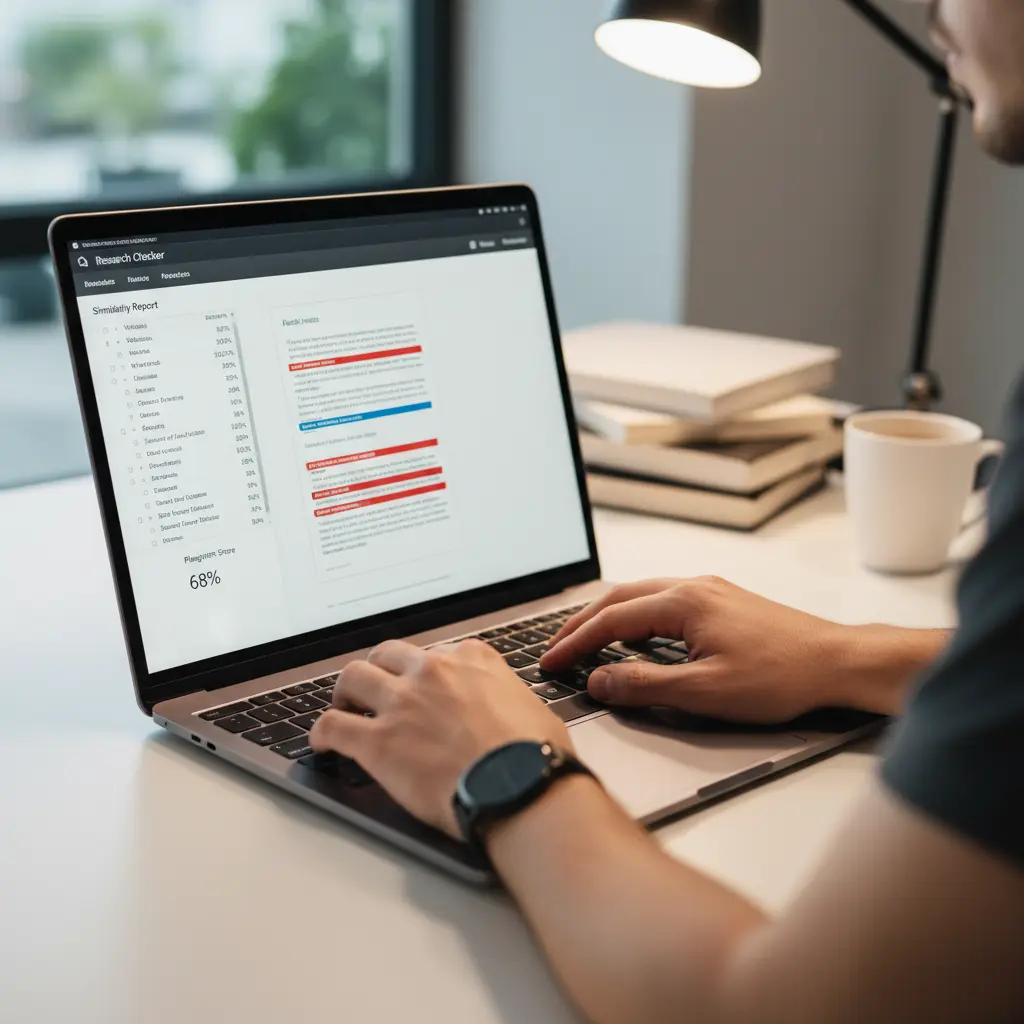
Plagiarism Detector Online: Accuracy Comparison for Students 2026
When you run your dissertation through a plagiarism detector online, you are trying to answer one question: will my university’s system show the same result? The gap between what a free detector shows and what Turnitin actually reports can be 10, 15, even 20 percentage points — because they are checking against fundamentally different databases. If you submit after seeing a green light from a low-quality tool, that gap can cost you your degree.
This guide is a systematic accuracy comparison of the major plagiarism detectors available to students in 2026. We cover database size, academic coverage, AI detection capability, and critically — how closely each tool’s results correlate with institutional systems. We also explain exactly what drives the gaps so you can use these tools intelligently rather than just trusting the percentage.
What Determines Plagiarism Detector Accuracy
Plagiarism detection accuracy has three independent dimensions that are often conflated:
1. Database Size and Composition
The larger and more academically relevant the database, the more matches the tool will find. Turnitin’s database contains over 1.8 billion student papers, 98 million academic works, millions of books, and billions of web pages. A free tool checking against 10 million web pages will miss the majority of academically relevant matches.
2. Algorithm Sensitivity
More sophisticated detectors identify near-matches — paraphrased text that closely follows a source’s structure and vocabulary without direct copying. Basic tools match only exact or near-exact strings. Advanced tools identify structural similarity and unusual phrasing patterns that indicate close paraphrasing.
3. AI Writing Detection
A separate analytical layer that identifies text as likely AI-generated based on linguistic properties (low perplexity, high predictability, uniform sentence structure). This is independent of similarity matching — you can have 2% text similarity but 85% AI writing probability.
Top Plagiarism Detectors Ranked by Accuracy 2026
Tier 1: Academic-Grade Accuracy
Turnitin (institutional access)
The benchmark. Database: 1.8B+ documents including paywalled academic journals, student paper repository, and global web index. Includes AI writing detection. Not directly accessible by students as a standalone tool — only through institutional submission portals. Some universities provide pre-submission access; check your institution.
iThenticate
The researcher-grade version of Turnitin, with broader academic database access. Used by publishers and researchers. Available for individual purchase but expensive. The closest non-institutional comparison to what your examiner will see.
Tesify Plagiarism Checker
Purpose-built for academic submissions. Academic database coverage focused on the sources dissertation students actually cite. Includes AI writing pattern analysis alongside similarity scoring. Integrated into the dissertation writing workflow so you can check and revise in context. Free plan available.
Tier 2: Good Accuracy with Caveats
Copyleaks
Strong academic database coverage and a dedicated AI detection mode. Claims 99.1% accuracy on GPT-4 text. Integration with Canvas and Moodle makes it the institutional alternative to Turnitin for many universities. The free tier is limited in word count but the accuracy on academic content is solid.
Quetext
DeepSearch technology with reasonable academic paper coverage. Clear similarity highlighting with source attribution. Free tier limited to 2,500 words per check — requires chapter-by-chapter checking for dissertations but produces reliable results.
Tier 3: Web Coverage Only
Grammarly Plagiarism Checker (free)
Checks against web content and some published works. Will catch content copied from websites, blogs, and freely available articles. Will miss paywalled journal matches and student paper database matches. Useful as a web-source check but not sufficient for academic pre-submission review.
Duplichecker
Web index only. Fast and free, no account required. Completely insufficient for academic work as a pre-submission check — the database does not include the sources that matter for dissertation similarity.
PaperRater
Open web and publicly available academic content. Useful for catching obvious web-sourced content. Similar limitations to Duplichecker for paywalled academic literature.
Academic Database Coverage vs Web Coverage
This table shows why database composition is the critical variable:
| Source Type | Turnitin | Tesify | Copyleaks | Grammarly Free | Duplichecker |
|---|---|---|---|---|---|
| Paywalled journals | Yes | Yes | Partial | No | No |
| Student paper repository | Yes (1.8B papers) | Partial | Partial | No | No |
| Open web content | Yes | Yes | Yes | Yes | Yes |
| University thesis repositories | Yes | Partial | Partial | No | No |
| AI writing detection | Yes | Yes | Yes | Limited | No |
AI Content Detection: Which Tools Include It
AI detection has become as important as plagiarism detection for 2026 dissertation submissions. Here is the current state of AI detection capability across tools:
- Turnitin AI Detector: Produces a separate AI writing percentage score. Available to institutions with the AI writing module (now included in most contracts). Threshold for concern varies by institution but scores above 20% typically trigger manual review.
- Tesify: Integrates AI writing pattern analysis alongside similarity scoring. Flags sections with AI-typical linguistic patterns. Particularly valuable because it is integrated with the writing workflow — you can see which sections are triggering concerns and edit them in context.
- Copyleaks AI Detector: Standalone AI detection mode available separately or combined with plagiarism checking. Claims high accuracy on GPT-3.5 and GPT-4 generated text.
- GPTZero: Dedicated AI detection tool available free online. Produces perplexity and burstiness scores. Useful as a supplementary check. The free tier is limited but functional for smaller documents.
- Grammarly: Limited AI detection in basic plan; more in premium. Not as forensically detailed as dedicated tools.
Why Free Detectors Underreport: The Gap Analysis
The single most important thing to understand about free plagiarism detectors is the database gap. When a free tool shows you 3% similarity and Turnitin shows 18%, you have not been misled — both tools are reporting accurately based on what they can see. The difference is in what they can see.
The typical gap between a free web-only checker and Turnitin for a postgraduate dissertation is 8–15 percentage points, driven by three sources:
- Paywalled journal matches (5–8%): Your literature review is sourced from journals your university subscribes to. These are behind paywalls, invisible to free tools. Turnitin has licensed access and sees them all.
- Student paper repository matches (2–5%): Turnitin’s database of 1.8 billion previously submitted papers catches matches to dissertations from previous years at any Turnitin-using institution globally. No free tool has access to this.
- Self-plagiarism from previous submissions (1–3%): If you submitted seminar papers through Turnitin, those are in the database. Free tools have no visibility of your submission history.
For more context on what plagiarism rates look like across universities, see: Plagiarism Rates in Universities: 2026 Statistics.
How to Use Plagiarism Detectors Effectively Pre-Submission
- Use an academic-grade tool, not just a web checker: Tesify or Copyleaks for the pre-submission check — not Duplichecker.
- Check early: Run individual chapters as you complete them, not just the full document at the end. Fixing a 20% similarity rate in your literature review at month three is manageable; fixing it at month eleven is not.
- Distinguish cited from uncited matches: Similarity in properly cited, quoted material is expected. Focus your revisions on matches that are paraphrases without citation.
- Run a separate AI detection pass: Treat the AI detection score as a distinct review from similarity. Even if you wrote the text yourself, heavy AI editing may require revision.
- Accept that no external tool will exactly match Turnitin: Even the best external checker will show somewhat different results. The goal is to get close enough to be confident before submission, not to get an identical number.
The Right Detector for Dissertation Submissions
For a dissertation pre-submission check, the non-negotiable requirements are: academic database coverage, full-document length support, and ideally AI detection included. Tesify’s plagiarism checker was built to meet exactly this need — it is designed for dissertation-length documents, checks against academic sources rather than just the web, and integrates AI detection in the same workflow.
Know your real plagiarism score before your university does
Tesify’s plagiarism checker is built for dissertation submissions — academic database coverage, full document support, AI detection included. Free to start.
Also see: Best Plagiarism Checkers for Students Compared 2026 for a full ranked list.
Frequently Asked Questions
Which online plagiarism detector is most accurate for university students?
For students, Tesify’s plagiarism checker offers the best combination of academic database coverage, full-document support, and AI detection in a free-to-start plan. Among commercial tools, Copyleaks also provides strong academic coverage. Both produce results significantly closer to institutional Turnitin reports than general web-based checkers like Duplichecker or Grammarly basic.
Why does my free plagiarism checker show lower similarity than Turnitin?
Free plagiarism checkers typically check only against open web content and some publicly available academic work. Turnitin checks against 1.8 billion student papers, paywalled journal articles, and institutional thesis repositories that free tools cannot access. The gap between a free tool and Turnitin for a dissertation is typically 8–15 percentage points because of this database difference.
Does Turnitin detect AI-generated text?
Yes. Turnitin’s AI writing detection module is included in most institutional contracts as of 2025–26. It produces a separate AI writing percentage score alongside the similarity report. A score above roughly 20% typically triggers manual review by an examiner. The module analyses linguistic patterns distinct to AI-generated text rather than matching text against a database.
Is there a free plagiarism detector that checks academic papers?
Tesify offers a free plan that includes academic database coverage for plagiarism checking, making it the most accessible free option for dissertation-grade pre-submission checks. Quetext also has a free tier with some academic coverage (limited to 2,500 words). Most other free tools check only against open web content and lack the academic database access needed for dissertation pre-submission validation.
Can plagiarism detectors tell the difference between paraphrasing and plagiarism?
Detection tools flag both direct copying and close paraphrasing as similarity. They cannot automatically distinguish between proper paraphrasing with citation (acceptable) and close paraphrasing without citation (plagiarism). Human examiners review the flagged passages to make this determination. When you run a pre-submission check, your job is to review every highlighted match to ensure it either has a proper citation or is sufficiently paraphrased in your own words.
Write your thesis with AI
Structure, draft, cite, and format your thesis faster with Tesify’s AI writing tools, automatic bibliography, and plagiarism checker. Free to start, no credit card required.





Leave a Reply