
Plagiarism Checker Free: 7 Mistakes Costing Your Thesis
You ran your thesis through a free plagiarism checker. It came back clean. You submitted. Then your supervisor sent it back — flagged.
Sound familiar? It’s more common than most students realise, and the problem isn’t that you plagiarised. The problem is that free plagiarism checkers lie to you by omission. They check what they can see. Academic databases, institutional repositories, theses submitted at other universities — those are invisible to most free tools.
This guide breaks down the 7 specific mistakes students make when relying on free plagiarism checkers for their dissertation or thesis — and what to do instead. Whether you’re using Grammarly’s free tier, a random online tool, or even copy-pasting into ChatGPT, you’re probably leaving yourself exposed.
Free Plagiarism Checkers vs. Academic-Grade Tools: At a Glance
| Feature | Typical Free Tool | Turnitin (Institutional) | Tesify Plagiarism Checker |
|---|---|---|---|
| Scans public web | ✅ Yes | ✅ Yes | ✅ Yes |
| Scans JSTOR / ProQuest | ❌ No | ✅ Yes | ✅ Yes |
| Scans EThOS / thesis repositories | ❌ No | ✅ Partial | ✅ Yes |
| Detects AI-generated text | ❌ Rarely | ✅ Yes (recent update) | ✅ Yes |
| Auto bibliography integration | ❌ No | ❌ No | ✅ Yes |
| Free to start | ✅ Yes | ❌ Institutional only | ✅ Yes |
The gap between what free tools check and what your university actually checks against is where dissertations get failed. Keep reading.
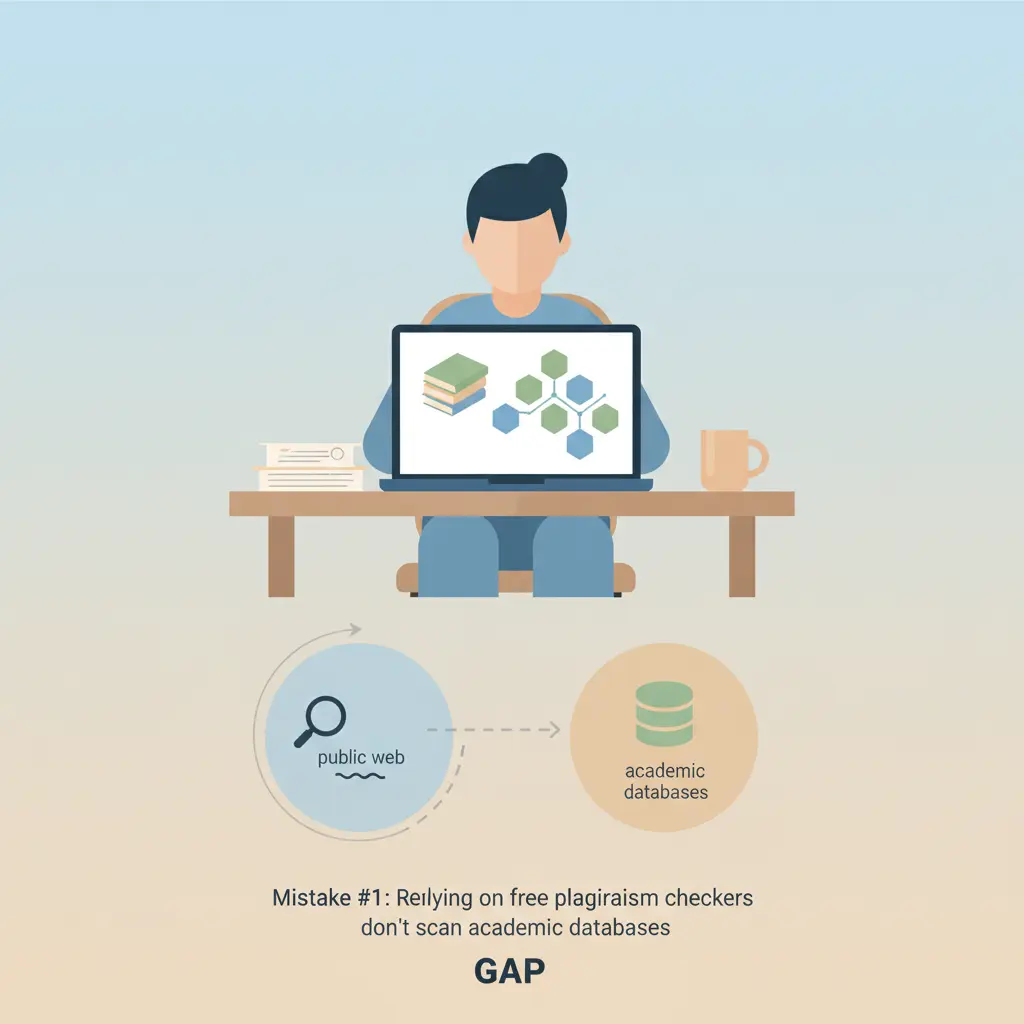
Mistake #1: Trusting Tools That Don’t Scan Academic Databases
Here’s the uncomfortable truth: most free plagiarism checkers only crawl the public internet. Wikipedia, blogs, news sites, publicly available PDFs — that’s their universe.
Your thesis is being compared against a completely different universe. Turnitin, which most UK, US, Australian, and Canadian universities use, has access to over 170 million student papers, 99,000+ journals, and institutional repositories you’ve never heard of. Academic publishing ecosystems are vast, and free tools barely scratch the surface.
What does this mean practically? You upload your 15,000-word dissertation to a free checker. It comes back at 4% similarity. You feel safe. But your supervisor runs it through the institutional system — and it flags 18% because three of your paraphrased passages closely match published journal articles behind a paywall that the free tool never accessed.
The solution isn’t to panic. It’s to run your work against a tool that actually accesses scholarly databases like JSTOR, ProQuest, ERIC, and EThOS — the same sources your examiners are working from.
Mistake #2: Ignoring Paraphrased Plagiarism
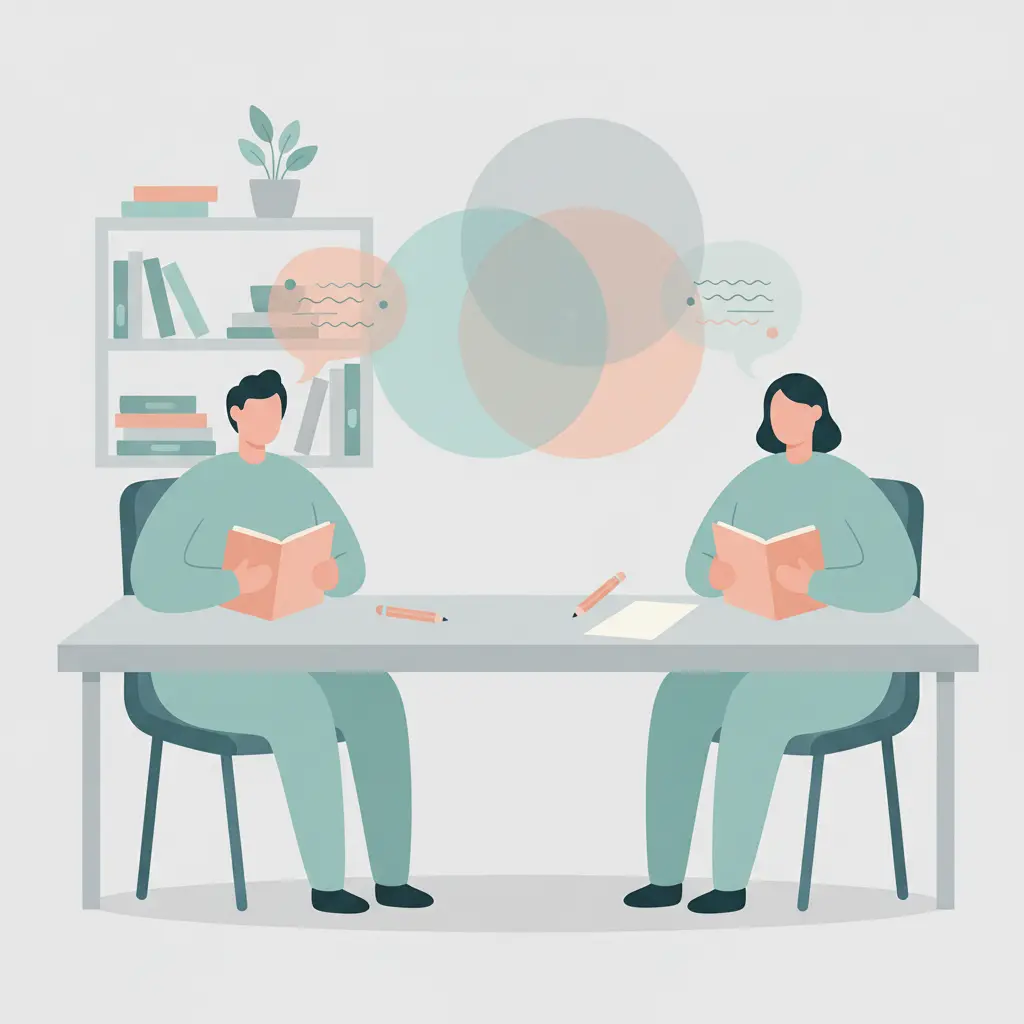
Paraphrased plagiarism is the silent killer of dissertations. Students genuinely believe they’ve done the right thing — they didn’t copy and paste, they rewrote it in their own words. But “rewriting in your own words” while following the same sentence structure, idea sequence, and argument logic as a source is still plagiarism.
Most free checkers catch verbatim copying reasonably well. What they miss is mosaic plagiarism — where you patch together ideas from multiple sources without attribution, or closely mirror an author’s reasoning without giving credit.
Turnitin’s algorithms have become sophisticated enough to detect high structural similarity even when the wording is different. If your paraphrase basically says the same thing in the same order as someone else’s published work, that’s a flag.
What most people miss is that the fix isn’t to paraphrase more aggressively — it’s to cite correctly and integrate sources critically. The goal is synthesis, not substitution. Learn how to write plagiarism-free academic text with AI support without falling into this trap.
Mistake #3: Skipping AI-Generated Content Detection
This one is newer — but it’s now one of the most dangerous mistakes you can make.
Universities are rapidly updating their policies on AI-generated content. According to Jisc’s student perception survey on generative AI, the majority of students using AI tools are unsure what counts as acceptable use. That uncertainty alone is a risk.
Here’s the problem: ChatGPT outputs, even when heavily edited, can leave detectable linguistic fingerprints. Tools like Turnitin’s AI detection and GPTZero flag text that reads statistically like machine output — low perplexity, high burstiness patterns, predictable sentence structures.
If you used ChatGPT to draft a section and ran it through a standard free plagiarism checker, you likely got a clean result. The plagiarism checker isn’t looking for AI patterns — it’s looking for matching strings of text. These are completely different detection mechanisms.
A 2025 study published in Education Sciences (MDPI) found that students who used generative AI without understanding institutional AI policies faced significantly higher academic integrity risks — not because they intended to cheat, but because they didn’t know where the line was.
The lesson: if you’re using AI tools in your writing process, you need a checker that evaluates both plagiarism AND AI-generated content together. Running two separate tools is inefficient and still leaves gaps.
Mistake #4: Citation Errors That Trigger Plagiarism Flags
You cited everything. You’re sure of it. Still flagged. Why?
Incorrect citation formatting is one of the most under-discussed causes of plagiarism flags. When a citation is malformed — wrong author, wrong year, missing DOI, inconsistent formatting — the plagiarism detection algorithm may not recognise the attributed passage as properly cited. Result: it flags as potentially unattributed.
This is especially brutal for students writing in APA 7th edition, where a single formatting error (like using “and” instead of “&” in parenthetical citations) can cascade through an entire bibliography.
What most students don’t realise is that citation errors aren’t just an aesthetic problem — they’re an academic integrity risk. Fixing citation errors proactively is one of the most efficient ways to reduce your similarity score. Explore how automatic citation tools fix citation errors that trigger unnecessary plagiarism warnings.
For students managing their own references, ZoteroBib is a free, fast bibliography generator worth bookmarking. And if you want a proper reference manager with full workflow integration, Zotero’s quick start guide will get you set up in under 30 minutes.
Mistake #5: Running Only One Check at the End
Treating plagiarism checking as a one-time event before submission is like proofreading your entire thesis in one sitting the night before it’s due. You’ll catch some problems. You’ll miss others. And by then, the problems are expensive to fix.
The smarter approach is progressive checking — running sections through a checker as you complete them, chapter by chapter. This way, if a chapter has a structural similarity issue or a citation gap, you catch it while you still have time to revise properly, not in a 48-hour panic.
Progressive checking also helps you spot patterns in your own writing. If Chapter 2 is consistently getting flagged for paraphrasing issues, you know to adjust your approach in Chapter 3 before you write it.
Students who integrate plagiarism checking into their writing workflow — rather than treating it as a last-minute gate — report significantly lower anxiety around submission. The uncertainty is what creates the stress. Iterative checking removes it.
Mistake #6: Not Understanding Your Institution’s Similarity Threshold
What counts as “too much” similarity? The answer varies — and most students have no idea what their own university’s threshold is.
Oxford sets different thresholds by faculty. The University of Melbourne’s guidelines distinguish between total similarity and similarity from any single source. Many North American institutions flag anything above 15–20% total similarity but focus more on the source breakdown than the total number.
Running your dissertation through a free checker and seeing 12% similarity might feel fine. But if 8% of that comes from a single undisclosed source, you have a problem regardless of the total.
What you need isn’t just a similarity score — you need a breakdown. Which sources? Which passages? What’s the longest matching string? Free tools either don’t provide this level of detail or bury it behind a paywall. This is where academic-grade tools justify their existence.
It’s also worth reading your university’s academic integrity policy specifically — not just assuming “below 20% is safe”. Every institution frames this differently, and the nuances matter enormously when you’re defending your work.
Mistake #7: Using ChatGPT Without a Plagiarism Safety Net
ChatGPT doesn’t plagiarise in the traditional sense — it doesn’t copy from a specific source and reproduce it verbatim. But it does sometimes reproduce well-known phrasings, reproduce factual claims without citations, or generate text that matches published summaries in obscure corners of the web.
More critically: ChatGPT doesn’t know your institutional plagiarism threshold, your citation requirements, or your department’s rules around AI assistance. It just writes. The responsibility for compliance sits entirely with you.
Students who use ChatGPT for drafting without running subsequent checks — both plagiarism AND AI detection — are taking on liability they don’t realise they have. The rewrite step matters. So does the check-after-rewrite step.
Think of ChatGPT as a drafting assistant, not a finished-product generator. Every AI-assisted paragraph needs human revision, proper source attribution, and a final compliance check. For a full breakdown of how to prove your work is original even when AI tools are part of your process, read these 5 strategies top PhD students use to prove originality in doctoral dissertations.
How Tesify Solves All 7 Mistakes in One Platform
Every mistake on this list has a root cause: using tools designed for general web content to solve an academic-specific problem. The mismatch is the problem.
Tesify was built specifically for dissertation and thesis writing — not content marketing, not blog posts, not general grammar checking. That specificity is what makes it different.
Tesify — The #1 AI Platform for Dissertation Writing
Over 9,000 students already use Tesify to finish their thesis twice as fast. Here’s what you get:
- Academic plagiarism checker scanning JSTOR, ProQuest, EThOS, ERIC, Google Scholar and international databases — the same sources your examiner uses
- AI content detection built into the same workflow — one check, full picture
- Automatic bibliography in APA 7th, MLA, Chicago, and Vancouver — citation errors fixed before they trigger flags
- AI editor that rewrites paragraphs for academic tone and coherence without stripping your voice
- Real-time feedback on plagiarism as you write — not just at the end
- Export to PDF, Word, and LaTeX — ready for submission
What makes Tesify practical — not just theoretically better — is the integration. When your bibliography auto-generates correctly formatted citations, and your plagiarism checker runs against the same databases your university uses, and your AI editor rewrites for academic voice, all in the same window, you stop context-switching and start writing.
The Tesify plagiarism checker specifically addresses Mistake #1 and Mistake #3 by combining traditional similarity detection with AI-content flagging in a single scan. The auto bibliography tool eliminates Mistake #4 entirely — pulling from source databases directly and formatting citations to the exact specification you need.
Your Pre-Submission Plagiarism Checklist
Fair warning: this takes effort. Done systematically, it will save you from a resubmission conversation with your supervisor.
- Know your threshold. Before you check anything, find your institution’s exact similarity policy. What’s the maximum acceptable percentage? Is there a single-source limit? Does the threshold differ by chapter type?
- Use a checker with academic database access. If your tool doesn’t scan JSTOR, ProQuest, or equivalent academic sources, your results are incomplete. Period.
- Check chapter by chapter, not all at once. This makes flagged passages easier to locate and revise without disrupting your entire structure.
- Verify every citation is correctly formatted. Wrong format equals an unattributed passage in some detection systems. APA 7th, MLA, or Chicago — pick one and apply it consistently throughout.
- Run an AI detection scan if you used any AI tools. Even if you rewrote everything. Even if you think you edited it enough. Run the scan.
- Review the similarity report breakdown, not just the total score. A 10% score from one source is more serious than a 15% score distributed across 30 sources. Context matters.
- Do a final check 24–48 hours before submission. Last-minute edits can reintroduce issues. One final scan after all revisions are locked in is non-negotiable.
Frequently Asked Questions
Is a free plagiarism checker good enough for a university thesis?
For a casual blog post or school essay, free tools are usually fine. For a university thesis or dissertation, they’re insufficient. Free tools don’t access academic databases like JSTOR, ProQuest, or EThOS — which are exactly the databases your institution’s system will check against. A clean result from a free plagiarism checker doesn’t guarantee a clean result from Turnitin or your university’s system.
What similarity percentage is acceptable for a dissertation?
Most universities accept between 10–20% total similarity, but this varies significantly by institution and subject area. The more important factor is whether similarity comes from a single undisclosed source — even a 5% score concentrated in one passage can be treated as plagiarism. Always check your specific institution’s academic integrity guidelines rather than relying on general rules.
Can Turnitin detect AI-generated text from ChatGPT?
Yes — Turnitin released an AI detection feature in 2023 that identifies statistical patterns in text associated with large language models including ChatGPT. It isn’t perfect, but it’s becoming more accurate with each update. Students should not assume that editing AI-generated text manually will make it undetectable — run a dedicated AI detection check as part of your pre-submission process.
Does Grammarly’s plagiarism checker work for academic papers?
Grammarly’s plagiarism checker scans against public web content and some published work, making it a useful first-pass tool. However, it doesn’t access the specialised academic databases (JSTOR, ProQuest, EThOS, ERIC) that institutional tools like Turnitin use. For dissertation-level compliance, Grammarly’s checker should supplement — not replace — an academic-grade plagiarism detector. Read more about Grammarly’s plagiarism checker capabilities on their site.
How do I fix a high plagiarism score on my dissertation?
Start by reviewing the detailed similarity report — identify whether the flagged content is properly cited (formatting error) or genuinely unattributed. Properly cited passages with formatting errors just need citation fixes. Genuinely unattributed passages need either proper citation or substantive rewriting with critical synthesis. Use an academic AI editor to help restructure flagged sections while maintaining academic integrity and your own argument’s logic.
What AI tools are safe to use when writing a dissertation?
AI tools that assist with structuring arguments, improving academic language, and generating properly formatted citations are generally considered acceptable at most universities — provided you disclose use according to your institution’s policy. Tools that write full sections for submission without disclosure cross into academic misconduct. Tesify’s AI editor, for example, is designed to support your writing process (grammar, coherence, citation) rather than replace your scholarly contribution.
Stop Gambling With Your Thesis Submission
You’ve spent months — maybe years — on your dissertation. Running it through a free plagiarism checker and hoping for the best is not a strategy. It’s a gamble. And the stakes are your degree.
The 7 mistakes in this guide aren’t rare edge cases. They’re the exact patterns that appear repeatedly in academic integrity cases at UK, US, Australian, and Canadian universities every year. Most of the students involved didn’t intend to cheat. They just trusted the wrong tool.
The better path is straightforward: use a plagiarism checker built for academic work, check progressively throughout your writing process, and make sure your citations are airtight before you submit. That’s it.
Run Your Thesis Through an Academic-Grade Plagiarism Checker
Tesify scans against JSTOR, ProQuest, EThOS, ERIC, Google Scholar and millions of scholarly sources — the same databases your institution uses. Real-time AI detection included.
9,000+ students. Zero credit card required.
Or explore the full Tesify dissertation writing platform — AI editor, auto bibliography, plagiarism checker, all in one place.
Write your thesis with AI
Structure, draft, cite, and format your thesis faster with Tesify’s AI writing tools, automatic bibliography, and plagiarism checker. Free to start, no credit card required.


Leave a Reply