

PhD Funding UK 2026: The Complete Guide for Applicants
PhD funding in the UK is genuinely competitive — and the process is less transparent than most universities let on. Stipends vary wildly, deadlines arrive earlier than expected, and the difference between a funded place and a self-funded one often comes down to knowing which scheme to target. This guide cuts through the noise and gives you a clear picture of every major PhD funding UK route available for 2026 entry, along with the practical steps that actually move applications forward.
1. What Is PhD Funding in the UK?
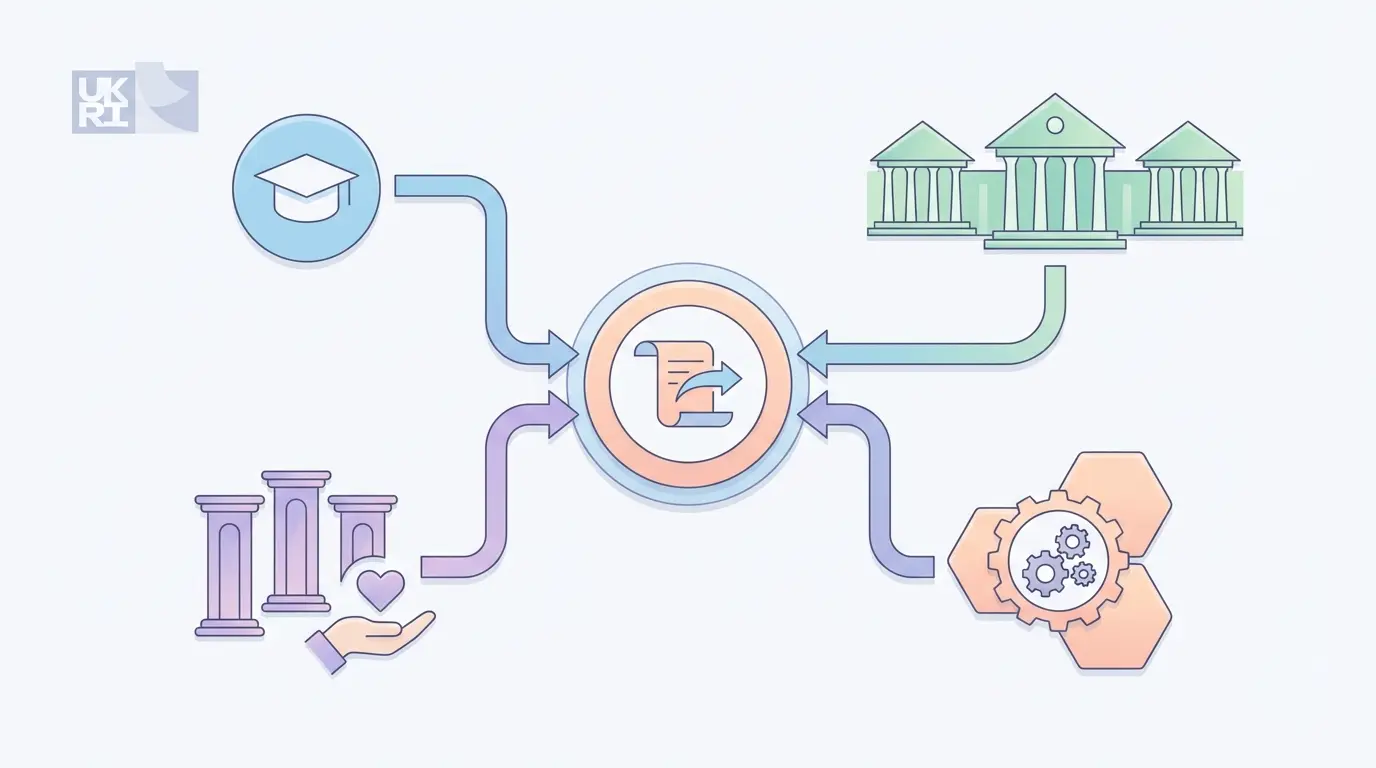
The hard truth: most applicants underestimate how many distinct funding streams exist. The UK has one of the most varied doctoral funding ecosystems in the world, with UKRI alone distributing billions of pounds in research studentships each year through nine disciplinary research councils. That’s before you factor in university-specific awards, external charities, and government-backed partnership schemes.
What most people miss is the difference between project studentships (where the research question is predefined) and open competition studentships (where you propose your own topic). Each requires a different application strategy — and mixing them up wastes months of effort.
In 2024, the UK government announced over 4,700 newly funded postgraduate places, with a clear focus on STEM disciplines. That’s significant — but it also means competition for places outside STEM remains fierce and requires sharper positioning.
2. UKRI Research Council Studentships
UKRI (UK Research and Innovation) is the single largest source of PhD funding in the country. It operates through nine research councils, each covering a distinct disciplinary area — and knowing which one aligns with your research is the first real decision you’ll make.
Studentships are usually distributed through Doctoral Training Partnerships (DTPs) and Centres for Doctoral Training (CDTs) — consortia of universities that pool UKRI funding and run structured PhD programmes. You apply to the DTP or CDT, not directly to UKRI.
Here’s where it gets interesting: CDTs often offer a cohort-based experience, with taught elements in year one and shared training. DTPs are more traditional, pairing you with an individual supervisor from the start. Neither is objectively better — it depends entirely on how you work.
The Nine UKRI Research Councils at a Glance
- AHRC (Arts and Humanities Research Council) — Covers literature, history, languages, philosophy, and creative arts. Funding is competitive and volumes are lower than STEM councils.
- BBSRC (Biotechnology and Biological Sciences Research Council) — Life sciences, agriculture, food security. Strong CDT presence.
- EPSRC (Engineering and Physical Sciences Research Council) — The largest funder by volume. Engineering, maths, chemistry, physics, computing.
- ESRC (Economic and Social Research Council) — Social sciences, economics, psychology, geography. Offers +3 studentships for interdisciplinary work.
- MRC (Medical Research Council) — Biomedical sciences, clinical research, public health.
- NERC (Natural Environment Research Council) — Environmental sciences, earth sciences, ecology, oceanography.
- STFC (Science and Technology Facilities Council) — Astronomy, particle physics, accelerator science.
- Innovate UK — Industry-collaborative doctorate schemes, often linked to KTPs.
- UKRI cross-council programmes — Interdisciplinary themes including AI, climate, and health data.
Practical tip: Use the FindAPhD studentship guide to search funded opportunities by research council and discipline. It’s updated regularly and lets you filter by funding status — which saves significant time over browsing individual university pages.
3. University-Funded Scholarships and Fellowships
Beyond UKRI, universities fund a substantial number of PhD places directly — sometimes at stipend levels that match or exceed the national rate. These awards are less visible because they’re scattered across institutional websites, faculty pages, and departmental notices.
The most competitive university-funded routes in the UK include:
- Vice-Chancellor’s Scholarships — Flagship institutional awards, usually open to all disciplines. Oxford, Cambridge, UCL, Manchester, and Edinburgh all run versions. Highly competitive; expect to be in the top 1–3% of applicants.
- Departmental Studentships — Funded from departmental research grants or individual professor grants. Often not advertised publicly — a direct conversation with a potential supervisor is how most people find out about them.
- President’s and Excellence Awards — Imperial College, King’s, and several Russell Group institutions use this naming convention for their top doctoral scholarships.
- Graduate Teaching Assistantships (GTAs) — Funding in exchange for undergraduate teaching duties (typically 6–8 hours per week). Common in arts, humanities, and social sciences. Stipends are at or near the national rate.
- Collaborative Doctoral Awards (CDAs) — Jointly funded by a university and an external partner (museum, archive, NGO). Particularly common in arts and humanities.
What most guides don’t tell you: many of these awards aren’t posted on the university’s scholarship page — they’re listed on the departmental website or sent only to applicants who’ve already been offered an informal place. Getting an academic supervisor on board before the formal application cycle opens is often what unlocks these opportunities.

4. Charity, Trust, and Foundation Awards
This funding stream is consistently underused — which makes it one of the best opportunities for applicants who do their research. Charities and private trusts fund hundreds of PhD studentships every year, often with less competition than UKRI routes.
- Wellcome Trust — One of the largest medical research charities globally. Funds PhD studentships in biomedical science, public health, and medical humanities. Awards are prestigious and include a competitive stipend above the national minimum.
- Leverhulme Trust — Broad disciplinary scope. Doctoral scholarships through the Leverhulme Doctoral Scholarships programme at selected universities. Check participating institutions directly.
- Nuffield Foundation — Social sciences and education. Funds research that influences policy. Strong preference for projects with demonstrable societal impact.
- Cancer Research UK — Studentships in oncology, cancer biology, and related clinical sciences. Funded through university partnerships.
- British Heart Foundation — Cardiovascular research studentships. Four-year awards with fees and stipend covered.
- Gatsby Charitable Foundation — Plant science and neuroscience. Relatively small number of awards but generous funding packages.
- Newton Fund and British Council — For students from specific partner countries, funding bilateral research collaboration with UK institutions.
Fair warning: charity award deadlines vary considerably and don’t align with the academic year. Some open in September, others in January or March. Set calendar reminders six months before each deadline — you’ll need time to tailor applications properly.
5. Industry-Collaborative and CASE PhD Funding
Industry-funded PhDs have grown significantly over the past five years, driven by government policy pushing for academic-industry knowledge transfer. The UK Parliament’s POST Note on STEM skills pipeline flags this trend explicitly — industry PhDs are seen as a strategic tool for workforce development.
- CASE Studentships (Collaborative Awards in Science and Engineering) — Co-funded by UKRI and an industry partner. The industry partner provides a top-up stipend (minimum £1,000 per year above the standard rate) and the student spends time working with the partner organisation. Strong in engineering, computing, and life sciences.
- Innovate UK KTP Doctoral Programmes — Knowledge Transfer Partnerships extended to PhD level. The student is embedded partly in a company, solving a real business problem as their research focus.
- Industrial CASE (iCASE) — A specific EPSRC designation for industry-partnered studentships with a more substantial placement component than standard CASE awards.
- Company-Sponsored PhD Positions — Large employers (GSK, Rolls-Royce, BT, BAE Systems, Unilever) sponsor PhD students directly, often at universities near their R&D facilities. These are usually advertised on company career pages, not university portals.
The counterintuitive advantage of industry PhDs: the stipend is often higher (sometimes £22,000–£28,000 annually), and the project has a built-in end-user — which matters when you’re writing up impact statements for REF-aligned university evaluations. The trade-off is less intellectual freedom over the research direction.
6. PhD Funding for International Applicants in the UK
International students face an additional challenge: most UKRI studentships are restricted to UK-domiciled students (or, in some cases, EU students who have settled status). That narrows the field — but it doesn’t close it.
- Commonwealth Scholarships — Full PhD funding for citizens of Commonwealth countries. Covers fees, stipend, and travel. Highly competitive, administered by the Commonwealth Scholarship Commission.
- Chevening Scholarships — UK government flagship award. Master’s-level by design, but some recipients use it as a bridge to a funded PhD through connections made during study.
- British Council Scholarships — Country-specific schemes with varying eligibility. Check the British Council page for your home country.
- University Global Scholarships — Most Russell Group and mid-tier universities run dedicated international PhD scholarships that cover the fee differential between home and international rates. Oxford’s Clarendon Fund and Cambridge’s Gates Cambridge Scholarship are the most well-known.
- Home Country Government Scholarships — Many governments fund citizens to study abroad (China Scholarship Council, Saudi Cultural Bureau, Brazilian CAPES, etc.). These pair with a UK university’s own award to create a full package.
- UKRI International eligibility — Some CDTs and specific research projects have received dispensation to fund international students. Always check the small print on individual studentship listings.
7. PhD Stipend and Funding Comparison Table 2026
The standard UKRI stipend for 2024/25 is £19,237 per year, tax-free. For 2026 entry, this figure is expected to increase in line with inflation — a pattern that’s held for the past five years. Some schemes pay considerably more.
| Funding Source | Annual Stipend (approx.) | Fees Covered? | Duration |
|---|---|---|---|
| UKRI Standard Studentship | ~£19,237 (2024/25 rate) | Yes (home rate) | 3–4 years |
| CASE / iCASE Studentship | £20,237–£28,000+ | Yes | 3.5–4 years |
| Wellcome Trust Studentship | Above UKRI rate + London weighting | Yes | 4 years |
| University Vice-Chancellor Award | £17,000–£22,000 (varies) | Yes (often full int’l fees) | 3–4 years |
| Gates Cambridge Scholarship | Full cost of study + allowances | Yes (full int’l fees) | 3–4 years |
| Commonwealth PhD Scholarship | £1,236/month (approx.) | Yes (full int’l fees) | 3 years |
| Graduate Teaching Assistantship | At national rate | Yes (home rate) | 3–4 years |
Note: Stipend figures are approximate and subject to annual review. International fee rates can reach £25,000–£50,000 per year for some STEM programmes. Always verify current rates directly with the awarding body.
8. How to Apply for PhD Funding: Step-by-Step
The application process differs by funding route, but the underlying structure is consistent. Here’s what a well-sequenced approach looks like — the kind that actually gets results.
-
Identify your research area and potential supervisors (12–18 months before start)
Use this practical video guide on finding your perfect PhD position to understand how to approach supervisor selection. Read recent publications, attend departmental seminars online, and reach out with a focused, one-page research summary — not a generic “I’d like to do a PhD with you” email. -
Map funding deadlines before writing anything
Create a spreadsheet. Column headers: Scheme name, Eligibility, Deadline, Stipend, Restrictions, Status. Most January deadlines are for September starts; November deadlines are often for competitive early-round selections. Missing a deadline by one day means waiting a full year. -
Write your research proposal
This document does more work than any other part of the application. It signals your intellectual maturity, your awareness of the existing literature, and your ability to design feasible research. Our Research Methodology Guide 2026 covers the exact components funders look for — from epistemological positioning to sampling strategy to ethical approval considerations. -
Demonstrate originality explicitly
Funders — particularly UKRI and research charities — want to see that your project fills a genuine gap, not a gap you’ve invented. Read how top PhD students prove originality in doctoral dissertations before you write your gap analysis. The strategies outlined there translate directly into funding applications. -
Secure references early
Most schemes require two or three academic references. Ask at least two months before the deadline. Provide your referees with a copy of your research proposal, your CV, and a short brief on why this particular scheme matters. Vague references from people who barely know you are application killers. -
Apply to multiple schemes simultaneously
Target at least four to six funding routes per application cycle. Funded places are scarce — even strong candidates are rejected from their first-choice scheme. Parallel applications increase your odds significantly. -
Prepare for interviews
Many competitive schemes (UKRI CDTs, Wellcome, Gates Cambridge) include an interview stage. Be ready to discuss your research proposal in depth, explain why this institution and this supervisor, and articulate the potential impact of your work in plain language.
For a deeper look at how PhD studentship applications work in the UK, Prospects.ac.uk maintains an up-to-date breakdown of the major routes — particularly useful for first-generation doctoral applicants who don’t have an academic network to draw on.
9. Writing a Strong Research Proposal Funders Actually Fund
Here’s where most applications fall apart. A research proposal that reads like a literature review summary — competent but inert — won’t win competitive PhD funding in the UK. Funders are reading fifty to a hundred proposals per cycle. They’re looking for three things: a clear problem, a credible method, and a believable argument for why this research matters now.
-
Open with the problem, not the background
The first paragraph of your proposal should name the specific gap or contradiction in the literature you’re addressing. Don’t spend three paragraphs contextualising the broad field — get to the problem fast. Reviewers decide in the first 90 seconds whether a proposal has potential. -
Make your research questions do real work
Good research questions are specific enough to be answerable within a three-to-four-year PhD. If your question could take a decade to answer, narrow it. See our guide on proving originality in doctoral dissertations for strategies to position your questions against existing literature. -
Be concrete about method
“Qualitative methods will be used” is not a methodology section — it’s a placeholder. Name your specific approach (grounded theory, ethnography, systematic review, agent-based modelling), explain why it suits your research questions, and acknowledge its limitations. Understanding the difference between methodology and method is, surprisingly, still rare at application stage. -
State your contribution in one sentence
If you can’t summarise what your PhD will add to knowledge in one clear sentence, neither can the review panel. Practice this until it’s sharp. The contribution statement is often what reviewers quote when making funding decisions. -
Show awareness of feasibility
Mention access to data, archives, field sites, lab equipment, or clinical populations — whatever your project depends on. Proposals that ignore feasibility read as naive. Proposals that address it directly signal a candidate who’s thought through the practicalities.
When you move from the proposal stage to actually writing your thesis, tools matter. Tesify is used by over 9,000 students writing dissertations and doctoral theses — it combines an AI-assisted smart editor with automatic bibliography generation in APA, MLA, Chicago, and Vancouver formats, plus advanced plagiarism detection against JSTOR, ProQuest, EThOS, ERIC, and millions of scholarly sources. If you’re already thinking about the writing stage (and you should be — funded PhD students are expected to produce outputs quickly), it’s worth setting up your thesis structure early.
One thing that doesn’t get talked about enough: funded PhD students face institutional pressure to publish and demonstrate progress within the first eighteen months. Having your writing environment sorted from day one — citation management, a structured document, a clear sense of the dissertation format — removes one significant source of anxiety. If you’re unsure about the structural differences between a thesis and a dissertation, the dissertation vs. thesis writing guide clarifies expectations across different institutions and funding bodies.
For reference management during the application phase itself, Zotero remains the gold standard free tool for organising literature. And if your target programme expects LaTeX submissions (common in STEM CDTs), Overleaf’s thesis template library has institutional-specific templates for most major UK universities.
Academic integrity is non-negotiable from the application stage onward. The Tesify Plagiarism Checker cross-references your writing against international academic databases in real time — useful not just for the final thesis, but for any published writing samples or portfolio pieces you submit as part of a funding application.
Frequently Asked Questions
How much is the PhD stipend in the UK for 2026?
The standard UKRI doctoral stipend for 2024/25 is £19,237 per year, tax-free. For 2026 entry, this is expected to increase modestly in line with inflation — the annual uplift has averaged around 3–5% over recent years. Some schemes, including CASE studentships and charity-funded awards, pay above the standard rate.
Can international students get PhD funding in the UK?
Yes, though most UKRI studentships are restricted to UK-domiciled applicants. International students should target the Gates Cambridge Scholarship, Commonwealth Scholarships, university global scholarship schemes, and home-country government awards that partner with UK institutions. Some CDTs have been granted permission to fund international candidates — always check eligibility carefully on individual listings.
What is the deadline for PhD funding applications in the UK for 2026?
Deadlines vary by scheme. Most UKRI DTP and CDT applications close between January and March for September 2026 starts. Charity awards (Wellcome, Leverhulme) often have earlier autumn deadlines. University-specific scholarships may open in October and close in December. You should begin researching deadlines at least 12 months before your intended start date.
Do I need a supervisor before applying for PhD funding?
For most UKRI studentships and university-funded awards, yes — having a named supervisor significantly strengthens your application and is often a formal requirement. For predefined project studentships (where the topic is already fixed), the supervisor is usually already attached to the project. For open competition studentships, you’ll typically need to identify and informally agree with a supervisor before the deadline.
What is a CASE studentship and is it worth it?
A CASE (Collaborative Awards in Science and Engineering) studentship is co-funded by a UKRI research council and an industry partner. The student receives a top-up stipend above the standard UKRI rate and spends time working with the partner organisation. It’s worth it if you want industry exposure, a higher stipend, and a project with a clear end-user — but you’ll have less freedom over the research direction than in a standard academic studentship.
What is the difference between a DTP and a CDT?
A Doctoral Training Partnership (DTP) is a consortium of universities funded by UKRI to offer individual PhD studentships across disciplines, with students working closely with their supervisor from the outset. A Centre for Doctoral Training (CDT) is a themed programme with a cohort model — students go through shared training, often including a taught component in year one, before specialising. CDTs are more structured; DTPs offer more independence from day one.
Build Your PhD Application on Solid Ground
A funded PhD place is competitive — but the gap between applicants who succeed and those who don’t is rarely about raw ability. It’s about preparation: a sharper proposal, a clearer contribution statement, and the ability to write and document research to a high standard from day one.
If this guide was useful, share it with a colleague who’s navigating the same process. Explore the resources below to strengthen every part of your application:
- Research Methodology Guide 2026 — build a proposal structure that funders respect
- Proving Originality in Doctoral Dissertations — make your contribution statement undeniable
- Dissertation vs. Thesis: What Funders and Supervisors Expect — plan your output from the start
And when you’re ready to write: Tesify’s AI-assisted thesis platform gives you the writing environment, citation tools, and plagiarism detection you’ll need for the whole doctoral journey — free to start, no credit card required.
Write your thesis with AI
Structure, draft, cite, and format your thesis faster with Tesify’s AI writing tools, automatic bibliography, and plagiarism checker. Free to start, no credit card required.






Leave a Reply