
Do You Need Parental Consent to Research in a School? Gatekeepers, Child Assent and Opt-Out for an Education Thesis (2026)
An education thesis that involves pupils is not like a survey of adult volunteers. Before you can collect a single questionnaire in a classroom, you generally need permission at three separate levels — the school as gatekeeper, the parent or guardian, and, in most frameworks, the child themselves — and getting any one of them wrong is the single most common reason an education ethics application is sent back for revision.
1. The Three Layers of Permission
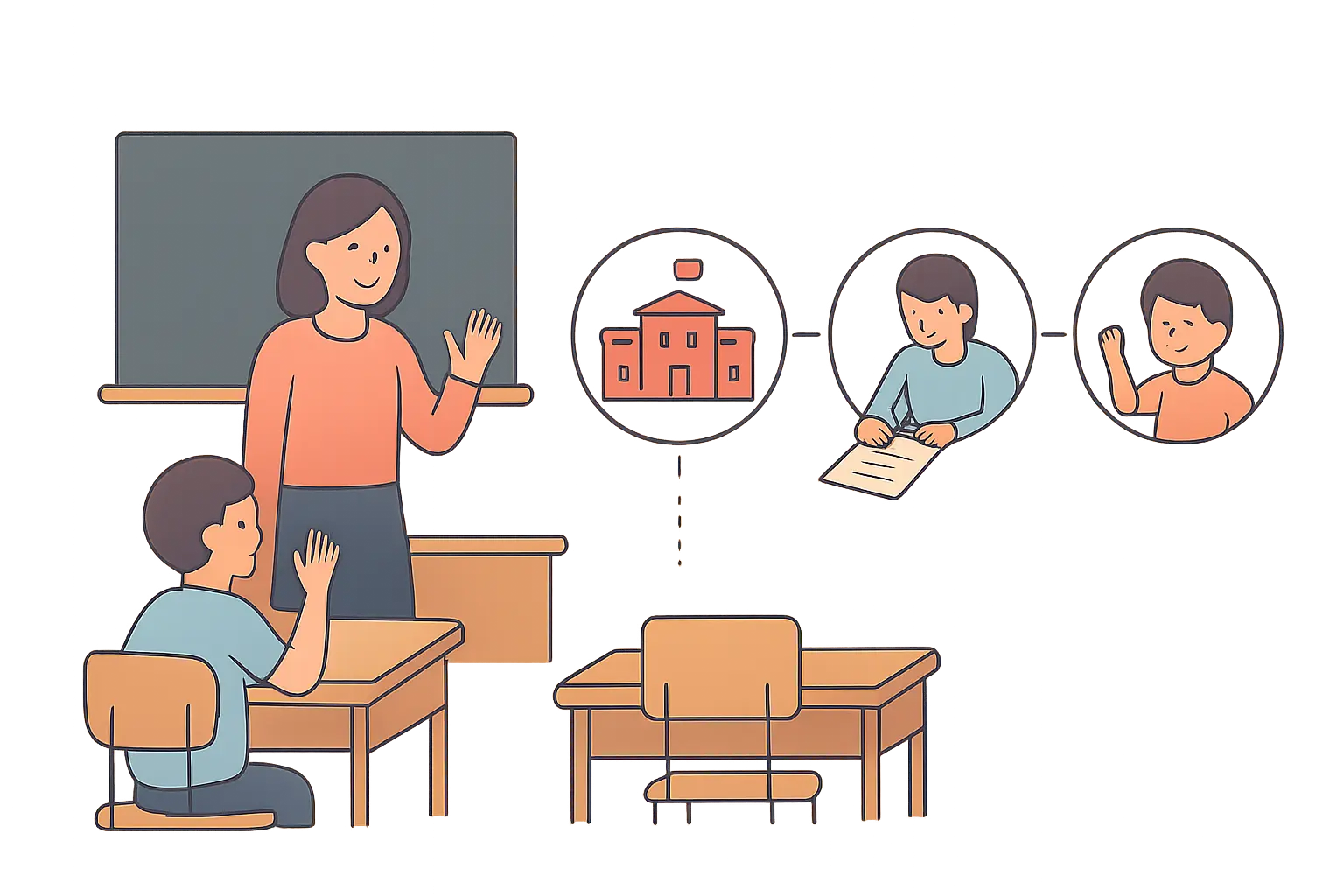
Most education ethics frameworks — whether your institution follows a US IRB model under the Common Rule or a UK-style institutional research ethics committee — separate school-based research into three distinct permission layers, and treat them as additive, not substitutable:
- Institutional gatekeeper permission — the headteacher, principal or district research office agreeing that the study can take place on school premises and during school time.
- Parental or guardian permission — the legal decision-maker for a minor consenting to their child’s participation.
- Child assent — the child’s own agreement to take part, sought in age-appropriate language, in addition to (never instead of) parental permission.
A thesis proposal that secures only the headteacher’s agreement and treats that as sufficient is the single most common design flaw ethics committees flag in school-based education research — gatekeeper access is a precondition for parental and child consent processes to happen, not a substitute for them.
2. The School as Gatekeeper
A headteacher or principal controls physical and organisational access — classroom time, staff cooperation, and whether the school’s own safeguarding policy permits the study at all — but this gatekeeper role is organisational, not a legal proxy for parental consent. Secure it early and in writing, since most parental consent processes cannot begin until the school has formally agreed, and many schools have their own internal review step (a governing board, a research request form) that runs on its own timeline separate from your university’s ethics committee.
Many education students research the school where they themselves work or trained, which adds a dual-role problem on top of the standard gatekeeper question: a headteacher who is also your line manager, or colleagues you will keep working alongside after data collection ends, can complicate both genuine voluntariness and the anonymity you can credibly promise. Our guide on researching your own workplace covers the insider-research conditions ethics committees specifically look for, which apply directly if your school-based study is also your own employer.
3. Parental Permission: One Parent or Both?
Under the US Common Rule’s additional protections for children (45 CFR 46.408), the number of parents whose permission is required depends on the risk category of the research. For research that falls under the minimal-risk categories (§46.404 and §46.405), permission from one parent is sufficient. For research involving greater than minimal risk with no prospect of direct benefit to the child, or research not otherwise approvable but presenting an opportunity to understand a serious problem (§46.406 and §46.407), both parents must provide permission — unless one parent is deceased, unknown, incompetent, not reasonably available, or holds sole legal custody of the child.
Most classroom-based education theses — a survey on study habits, an observation of a teaching method already in normal use, an anonymous questionnaire on attitudes to reading — sit comfortably within the minimal-risk category, so one-parent permission is typically what your ethics committee will require. Confirm this classification with your supervisor and ethics committee rather than assuming it; the determination is theirs to make, not yours to self-certify.
4. Child Assent, and When It Can Be Waived
The Common Rule requires IRBs to ensure “adequate provisions are made for soliciting the assent of the children” whenever they are judged developmentally capable of it, with that judgment based on the children’s ages, maturity and psychological state — not a single fixed age cutoff applied uniformly. Assent has to be sought in language and format a child can actually understand: a simplified information sheet, a verbal explanation with a chance to ask questions, and a clear statement that saying no carries no consequence for them at school.
Assent is not required in only two circumstances under the federal framework: when the children involved lack the capability to be meaningfully consulted at all (very young children, or children with certain cognitive impairments), or when the research offers a prospect of direct benefit that is important to the child’s health or well-being and is available only within the context of the research. Outside those two narrow exceptions, a thesis that collects parental consent but skips child assent has not completed the consent process, whatever the parent agreed to.
5. Opt-Out vs Opt-In Consent
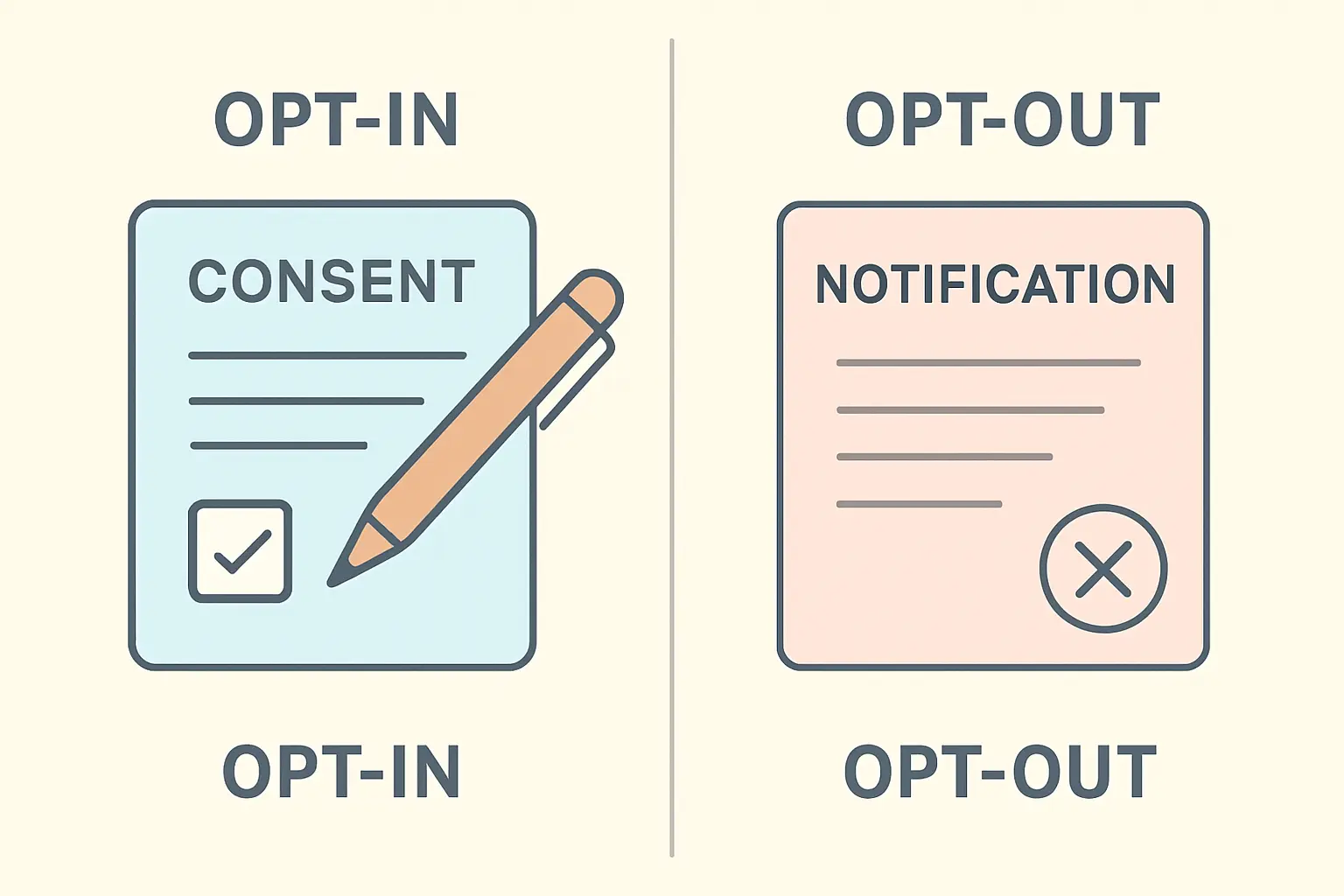
Two models dominate school-based consent design, and the choice has real consequences for both your response rate and your ethics application.
| Model | How it works | When it is typically accepted |
|---|---|---|
| Opt-in | Parents actively return a signed form agreeing to participation | The default expectation for anything beyond minimal-risk observation |
| Opt-out | Parents are notified and must actively object to withdraw their child; silence is treated as permission | Sometimes accepted for genuinely minimal-risk, anonymous, curriculum-embedded activities — never assume it without your committee’s explicit sign-off |
Opt-out consent is attractive because it produces far higher participation rates than opt-in forms that many parents simply never return, but committees scrutinise it heavily precisely because passive non-response is a weaker signal of genuine agreement than an active signature. Never default to opt-out because it is convenient; propose it only where the research genuinely is minimal-risk and justify the choice explicitly in your ethics application rather than assuming it will be waved through.
6. Looked-After and Vulnerable Children
Children in care, children subject to a child protection plan, or others in already-vulnerable circumstances raise the consent question further: who legally holds parental responsibility may not be a biological parent at all, and a local authority, foster carer or other legal guardian may need to be identified and consulted instead. The federal framework also allows an IRB to waive the parental-permission requirement itself for certain vulnerable populations — including neglected or abused children — where an appropriate alternative mechanism for protecting the children is substituted and the waiver is consistent with applicable law. This is a determination for your ethics committee, made case by case, not a default you can assume applies to your study.
7. Background Checks Are a Separate Requirement
A DBS check (UK) or equivalent background screening is an entirely separate safeguarding requirement from consent, and clearing one does nothing toward satisfying the other — a researcher can hold a valid DBS certificate and still have no legal basis to collect data from a child without the parental and child consent described above. For the practicalities of when a check is triggered and how the certification and timeline work, see our guide on whether you need a DBS check for your dissertation research.
8. Writing This Up in Your Methodology Chapter
Report all three consent layers explicitly and separately in your ethics sub-section: how gatekeeper agreement was secured and from whom, the parental permission model used (opt-in or opt-out, one parent or both, and why), and how child assent was sought and recorded, including the age-appropriate materials used. Attach your information sheets and consent forms as appendices — a plain-language version for parents and a simplified, illustrated version for the assent conversation with children are usually expected as separate documents, not one form doing both jobs. For the general standard your whole methodology chapter needs to meet on ethics reporting, see our guide on writing a research methodology chapter for your thesis, and for the wider landscape of what counts as informed consent, data protection and committee review across disciplines, see our guide to research ethics guidelines every student must know. If your ethics committee ultimately requires full board review rather than an expedited pathway, our guide on writing a research limitations section covers how to frame a reduced or delayed sample honestly if consent timelines run long.
9. Building the Timeline
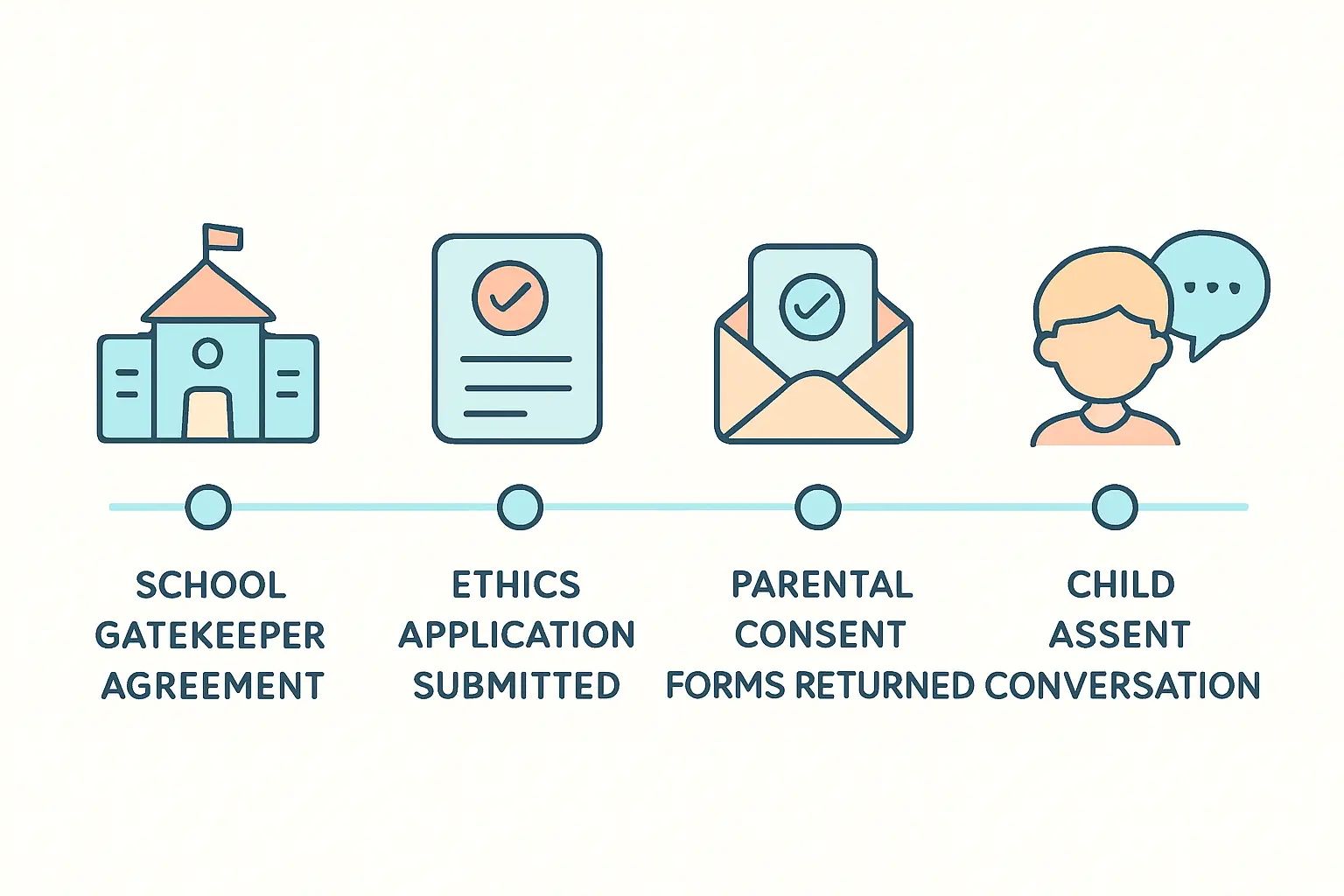
Consent with minors is one of the slowest-moving parts of an education thesis, and it is worth planning backwards from your data-collection window rather than treating it as a formality. A realistic sequence: secure gatekeeper agreement first, since parental consent processes typically cannot start without it; submit your ethics application with draft parent information sheets, child-friendly assent materials, and your proposed opt-in or opt-out model attached; distribute parental consent forms with a reminder cycle, since return rates on opt-in forms from busy parents are often well below 100% on the first request; and hold the child assent conversation as a distinct final step, immediately before data collection, so a child’s right to decline on the day is genuinely live rather than a formality rushed alongside the parental form.
Frequently Asked Questions
Do I need both parents’ consent to research a child in school?
Not usually. Under the US Common Rule (45 CFR 46.408), one parent’s permission is sufficient for minimal-risk research — which covers most classroom-based education theses. Both parents must consent only for research involving greater than minimal risk with no direct benefit to the child, unless one parent is unavailable, incompetent, or holds sole legal custody.
Is a headteacher’s permission enough to research pupils?
No. A headteacher or principal’s agreement grants organisational access to the school but is not a substitute for parental permission or, in most frameworks, the child’s own assent. All three layers are required, not any one on its own.
Can I use opt-out consent for my education thesis?
Sometimes, for genuinely minimal-risk, anonymous, curriculum-embedded activities, but never assume it is acceptable without your ethics committee’s explicit approval. Opt-in consent — an active signed form — remains the default expectation for most school-based research.
When can child assent be waived?
Only in two situations under the US federal framework: when the children involved lack the capability to be meaningfully consulted at all, or when the research offers a prospect of direct benefit important to the child’s health or well-being that is available only within the study. Outside those cases, assent is required in addition to parental permission.
Does a DBS check replace the need for parental consent?
No. A background check like the DBS is a safeguarding screen on the researcher, entirely separate from the legal consent process. Holding a valid check does not give you permission to collect data from a child — parental permission and, in most frameworks, child assent are still required.
Who gives consent for a looked-after child in a school-based study?
Whoever legally holds parental responsibility, which for a looked-after child may be a local authority or foster carer rather than a biological parent. Identify and confirm this with the school and, where relevant, the local authority before treating any consent as valid — a signature from the wrong adult does not satisfy the requirement.
Write Your Ethics Section With Confidence
Tesify’s AI-powered academic writing tool helps you structure and draft your methodology chapter’s ethics sub-section clearly, so gatekeeper approval, parental permission and child assent are each documented the way your committee expects.
Write your thesis with AI
Structure, draft, cite, and format your thesis faster with Tesify’s AI writing tools, automatic bibliography, and plagiarism checker. Free to start, no credit card required.






Leave a Reply