
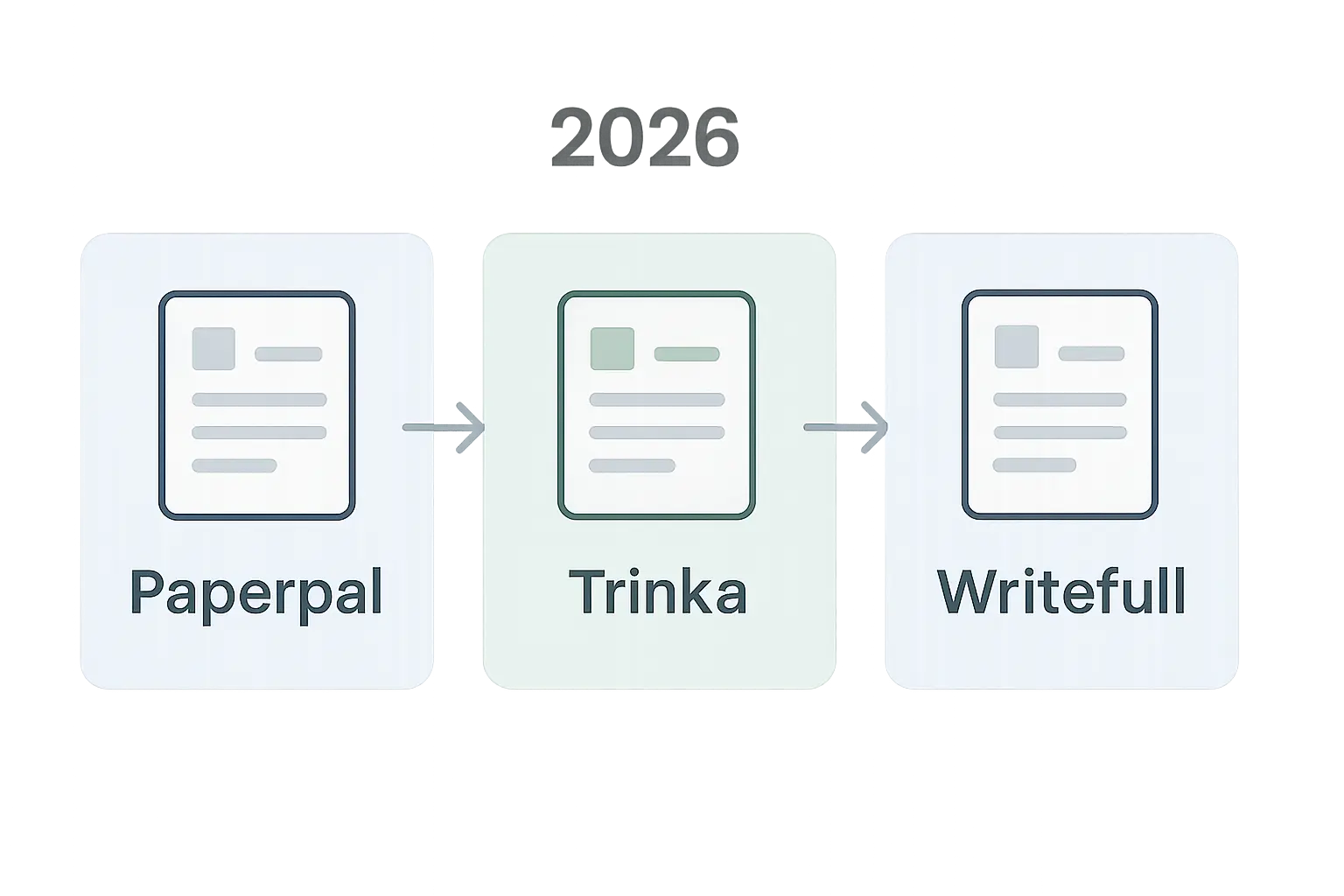
Paperpal vs Trinka vs Writefull 2026: Best AI Editor for Academic Manuscripts Compared
Your thesis draft is ready — but you know it needs a language polish before submission. You’re weighing three of the most-recommended academic AI editors: Paperpal vs Trinka vs Writefull. All three are purpose-built for researchers; all three are genuinely useful. But their strengths diverge sharply, and choosing the wrong one wastes both time and money. This head-to-head comparison covers features, Overleaf and Word integration, privacy policies, 2026 pricing, and a clear recommendation for each researcher profile.
Writefull is the best choice for Overleaf and LaTeX-heavy workflows — its language model is trained on published journal articles, making suggestions feel genuinely academic. Trinka leads on privacy, with a Confidential Data Plan that stores nothing server-side. Paperpal offers the most comprehensive all-in-one platform: editing, plagiarism check, and a 250M+ article citation database in one place. None of the three draft your thesis from scratch — for that earlier stage, Tesify handles structure, referencing, and originality self-check.
What Makes an Academic AI Editor Different?
General grammar tools like Grammarly are trained on everyday English — blog posts, emails, marketing copy. They flag passive voice and suggest contractions that are perfectly appropriate for casual writing but actively wrong in a dissertation. Academic AI editors solve a different problem: they understand disciplinary conventions, enforce APA/MLA/IEEE style at the sentence level, and flag hedging language, citation inconsistencies, and vocabulary that sits outside the published literature in your field.
The three tools in this comparison occupy the top tier of that academic-specific category. Each has a different founding story and a different core strength, which is why they appeal to different researcher profiles. If you’re writing in English as an additional language, the considerations tilt further — our dedicated guide to AI editors for non-native English researchers covers all three alongside Wordvice and Tesify in a side-by-side format.
Paperpal 2026: Full Review
What Is Paperpal?
Paperpal is built by Cactus Communications, the parent company of Editage — one of the largest academic editing and publication support firms globally. That publishing-industry origin matters: Paperpal’s grammar and style checks reflect knowledge of what journal reviewers actually flag. Its language model has been refined on feedback from professional academic editors, producing suggestions that target submission-readiness rather than generic correctness.
Key Features
- Grammar and style: Detects and corrects academic grammar errors, passive voice overuse, hedging issues, and unclear sentence structure
- Consistency checks: Catches inconsistencies in formatting, references, equations, and technical terminology across a full manuscript
- Plagiarism detection: Integrated plagiarism checker included on paid plans
- Research database: Instant search across 250M+ research articles with citation generation in 10,000+ styles
- Journal pre-submission checks: 30+ checks tailored to language quality and technical compliance requirements of target journals
- AI paraphrasing and tone adjustment: Rewrites sections with academic register maintained
- Chat with PDF: Query uploaded papers in 50+ languages
Integrations
Paperpal integrates with Microsoft Word (Add-in), Google Docs, and Overleaf via a Chrome extension. Importantly, all integrations are available across all plan tiers at no extra platform fee — a genuine differentiator from competitors that restrict integrations to higher-paid tiers.
2026 Pricing
| Plan | Price | Key Limits / Inclusions |
|---|---|---|
| Free | $0 | 200 language suggestions/month, 5 AI uses/day, 7,000-word plagiarism check |
| Prime (Monthly) | $25/month | Unlimited language suggestions, full plagiarism check, all integrations |
| Prime (Annual) | $139/year (~$11.60/month) | Same as monthly — 53% annual saving |
| Teams | From $107 for 2–5 members | Shared workspace, consolidated billing, admin dashboard |
Best For
Researchers submitting frequently to peer-reviewed journals who want a single platform covering editing, plagiarism checking, and pre-submission compliance checks. Particularly strong in life sciences and medicine where Editage’s editorial relationships run deep.
Weaknesses
At $25/month billed monthly, Paperpal is the most expensive of the three. The free plan is limited enough that sustained use across a full dissertation chapter requires a paid subscription. Overleaf access runs via Chrome extension rather than a native plugin — some LaTeX-heavy researchers find this less seamless than Writefull’s built-in editor experience.
Trinka 2026: Full Review
What Is Trinka?
Trinka, developed by Enago (another major academic editing firm), is purpose-built for formal academic and technical writing. It identifies over 3,000 error types specific to academic prose — a considerably broader taxonomy than general grammar tools can manage. Its strongest differentiator in 2026 is its privacy architecture, which makes it the default recommendation for researchers handling sensitive or proprietary data.
Key Features
- Academic grammar: Flags 3,000+ academic-specific error categories — subject-verb disagreement in complex noun phrases, misused technical hedges, inappropriate colloquialisms
- Style guide compliance: Supports APA, AMA, ACS, AGU, and IEEE at the prose level — not just citation format, but sentence-level style conventions within each guide
- Consistency checker: One-click fixes for hyphenation, date formats, numerical representations, and spelling variants across a full document
- DocuMark: Authorship verification and content originality tracking built into the platform
- Citation validation: Flags problematic citations and validates references in bulk across all major citation styles
- Confidential Data Plan: Zero server-side storage, instant deletion, and optional offline grammar processing for sensitive research
Privacy Architecture
Trinka uses 256-bit encryption by default and auto-deletes uploaded documents after 90 days on standard plans. For researchers working with clinical trial data, proprietary industrial research, or government-funded sensitive projects, the Confidential Data Plan ($500/year) offers immediate server-side deletion and optional offline grammar processing — a level of data control unavailable in Paperpal or Writefull at any price tier.
2026 Pricing
Trinka’s free plan covers 5,000 words per month — enough for lighter editing sessions but tight for a full dissertation chapter. Annual plans save approximately 67% versus monthly billing. A 20% student discount applies to all paid plans. The standard paid annual plan starts at approximately $6.67/month (around $80/year), making it the most budget-friendly paid option in this three-way comparison. The Confidential Data Plan at $500/year targets institutional and enterprise research teams.
Best For
Researchers in medicine, law, defence, or any field where data privacy is a compliance requirement. Also strong for STEM researchers writing to ACS or AGU style standards, and for conference paper preparation — the IEEE prose style compliance pairs directly with our IEEE citation style guide for complete formatting coverage. The student discount and budget-friendliest annual plan make Trinka the practical choice when cost is the deciding variable.
Weaknesses
Trinka has no native Overleaf integration — it operates as a standalone web editor and Word add-in. Researchers who work primarily in LaTeX will find the workflow notably less seamless than Writefull’s built-in approach. Trinka also does not publicly display standard paid pricing without account creation, which frustrates comparison shoppers.
Writefull 2026: Full Review
What Is Writefull?
Writefull takes a fundamentally different technical approach: its language model is trained on millions of published peer-reviewed journal articles rather than general internet text. The result is suggestions that reflect how researchers in specific fields actually write — not just formal English, but the precise vocabulary and phrasing patterns found in the published literature of your discipline. This academic-native training is Writefull’s defining advantage.
Key Features
- Academic-native language model: Suggestions drawn from a journal article corpus, not general web text — surfaces field-appropriate vocabulary and phrasing
- Native Overleaf integration: A purpose-built Overleaf plugin (not a browser extension) with real-time in-editor suggestions for LaTeX documents
- Word add-in: Full-featured Microsoft Word integration across all plan tiers
- TeXGPT (Premium): AI-assisted generation features specifically designed for LaTeX users — table generation, equation assistance, inline rewrites
- Paraphrase and style change: Rewrites passages to shift register while maintaining academic formality
- Abstract and title generation: Generates publication-ready abstracts and titles from uploaded manuscript content
- Privacy: Does not store texts or use submitted content for model training
Overleaf Integration in Depth
Writefull’s Overleaf integration is the deepest of the three tools. It operates as a native plugin inside the Overleaf editor rather than a browser overlay, offering real-time language feedback on LaTeX source as you type. Suggestions are context-aware at the paragraph level rather than sentence-by-sentence, which is essential for maintaining coherence across a methodology or results section. For researchers already working in Overleaf, Writefull is the most natural upgrade — zero workflow disruption required.
2026 Pricing
| Plan | Price | Notes |
|---|---|---|
| Free | $0 | Daily credits that reset; basic language feedback only — runs out quickly on a chapter |
| Premium (Monthly) | $21/month | Unlimited usage, all features including TeXGPT and abstract generator |
| Premium (Annual) | $150/year (~$12.50/month) | 40% saving versus monthly; full access to all features |
| Group / Institution | Custom (annual only) | Up to 100 users; university licensing available on request |
Best For
STEM PhD students and researchers who write in LaTeX and Overleaf. Also strong for any researcher who wants language suggestions that genuinely reflect disciplinary norms — the journal-trained model surfaces vocabulary that feels native to an academic register rather than generically formal. Writefull has no plagiarism checker or citation database, so it pairs best with a separate reference manager.
Weaknesses
No integrated plagiarism checker or citation database — Writefull focuses entirely on language quality. Researchers who need those features alongside prose editing will need a separate tool. The daily free quota runs out quickly when editing a full chapter, pushing most sustained users toward a paid plan. See our comparison of AI reference managers including Paperpile and Zotero if you need citation management alongside your editing workflow.
Paperpal vs Trinka vs Writefull: Full Comparison Table 2026
| Feature | Paperpal | Trinka | Writefull |
|---|---|---|---|
| Parent company | Cactus Communications / Editage | Enago | Writefull B.V. |
| Language model training | Professional editor feedback + journal text | Academic & technical writing corpus | Millions of published journal articles |
| Microsoft Word | Yes (Add-in) | Yes (Add-in) | Yes (Add-in) |
| Overleaf integration | Chrome extension | None | Native plugin |
| Google Docs | Yes | No | Chrome extension |
| Plagiarism checker | Yes (built-in) | Yes (integrated) | No |
| Citation database | 250M+ articles, 10,000+ styles | Bulk citation validation (all major styles) | None |
| Style guide support | APA, MLA, Chicago, Vancouver | APA, AMA, ACS, AGU, IEEE | General academic (no style-specific modes) |
| Privacy | Standard encryption; no training use | 256-bit; Confidential Data Plan (zero retention) | No storage; no training use |
| Free plan | 200 suggestions/month, 5 AI uses/day | 5,000 words/month | Daily credits (limited volume) |
| Paid (annual) | $139/year | ~$80/year | $150/year |
| Journal submission checks | 30+ pre-submission checks | Citation validation | None |
| Student discount | Not advertised | 20% off all paid plans | Not advertised |
| Best for | Journal submissions; all-in-one platform | Privacy-sensitive research; budget users; STEM style | LaTeX / Overleaf workflows; disciplinary language precision |
Where Tesify Fits in the Academic Writing Workflow
Paperpal, Trinka, and Writefull are all editing tools — they operate on finished or near-finished prose. They polish what you have already written. Tesify is a different kind of tool: it helps you write the thesis in the first place.
Tesify structures your dissertation chapter by chapter, generates drafts grounded in your research question and methodology, auto-generates references in APA, MLA, Chicago, or IEEE format, and runs an originality self-check before you submit — so you arrive at the editing stage with a clean, structured document rather than a collection of disjointed notes.
The intended workflow is sequential, not competitive:
- Draft with Tesify — structured chapters, referenced argument, originality self-check
- Polish with Paperpal, Trinka, or Writefull — language quality, style compliance, journal-specific checks
If your institution requires a formal AI use statement alongside your submission, our guide on how to write an AI use declaration for your thesis covers exactly what examiners expect to see. For context on what counts as permissible AI assistance in the first place, tesify.pro’s article on whether AI assistance is allowed for your thesis walks through current institutional policies across UK, US, and Australian universities.
Start Your Thesis With Tesify — Free
Structure your dissertation, generate referenced drafts chapter by chapter, and run an originality self-check before handing off to a language editor. Tesify is free to sign up — no subscription required to start.
How to Choose: Decision Framework
Choose Writefull if:
- You write primarily in LaTeX and Overleaf and want inline editing without leaving your environment
- Disciplinary vocabulary precision matters more than plagiarism checking or citation features
- You are in STEM and want suggestions drawn from published papers in your field’s actual journal literature
- You are already using Overleaf — adding Writefull requires no workflow change at all
Choose Trinka if:
- Your research involves sensitive, proprietary, or clinical data and you need a zero-retention data option
- You are writing to ACS, AGU, or IEEE prose style standards — not just citation format, but sentence conventions
- Budget is a priority — the standard annual plan is the most affordable paid tier in this comparison
- Your institution uses an exclusively Word-based writing environment
Choose Paperpal if:
- You are actively submitting to peer-reviewed journals and need pre-submission compliance checks
- You want a single platform for editing, plagiarism checking, and citation search — with no tool-switching
- You write across Word, Google Docs, and Overleaf and need consistent cross-platform access
- You are in life sciences, medicine, or a publishing-adjacent field where Editage’s editorial network is relevant
None of these three tools are the right choice for writing your thesis from scratch. They assume you already have a draft. If you are still working through a specific chapter and struggling with structure, our guide to writing your results chapter faster with AI addresses that stage directly. For the research synthesis and reading phase that precedes writing, our comparison of NotebookLM, ChatPDF, and Tesify for thesis research maps out where each tool delivers the most value.
Frequently Asked Questions
Which is better for non-native English speakers — Paperpal, Trinka, or Writefull?
All three are substantially better than general grammar tools for non-native researchers. Paperpal tends to produce the most natural English rewriting suggestions because of its professional editor training data. Writefull excels at vocabulary precision — it surfaces phrases used in your specific field’s published literature, which helps with field-specific terminology and register. Trinka is the most rules-based, identifying the widest range of academic error categories. Our full guide to AI editors for non-native English researchers compares all three in depth.
Does Writefull work natively inside Overleaf?
Yes. Writefull offers a native Overleaf plugin — not a browser extension overlay — that provides real-time language feedback on your LaTeX source as you write. This is Writefull’s clearest advantage over both Paperpal (which accesses Overleaf via Chrome extension) and Trinka (which has no Overleaf integration at all).
Is Trinka better than Paperpal for data privacy?
Yes, for high-sensitivity research scenarios. Trinka’s Confidential Data Plan ($500/year) provides zero server-side storage, instant deletion, and an option for offline grammar processing. Writefull also has strong privacy defaults — no storage, no use for model training — but without an offline-processing option. Paperpal does not offer equivalent enterprise-grade zero-retention data handling.
Which is cheapest for PhD students on a budget?
Trinka is the most affordable paid option at approximately $6.67/month billed annually (around $80/year), with a 20% student discount available on top of that. Paperpal’s annual plan works out to ~$11.60/month ($139/year) and Writefull’s to ~$12.50/month ($150/year). All three have free plans, though their limits make sustained thesis-length editing require an upgrade.
Can Paperpal, Trinka, or Writefull write my thesis for me?
No — and this distinction matters. All three are language editing tools. They improve prose you have already written; they do not generate structured academic arguments, draft full chapters, or create referenced content from your research question. Paperpal includes AI rewriting features, but these operate at the sentence or paragraph level. For drafting a full thesis with academic integrity built in from the start, Tesify is designed for that earlier stage of the writing workflow.
How does Tesify differ from Paperpal, Trinka, and Writefull?
Tesify operates at a different stage of the academic writing process: it helps you draft and structure a thesis from scratch, generates citations automatically in APA, MLA, Chicago, or IEEE format, and runs an originality self-check before submission. Paperpal, Trinka, and Writefull then handle language polishing — improving style compliance and flagging pre-submission issues. The tools are complementary in sequence, not competing for the same task.
Write your thesis with AI
Structure, draft, cite, and format your thesis faster with Tesify’s AI writing tools, automatic bibliography, and plagiarism checker. Free to start, no credit card required.




Leave a Reply