

Direct answer: A complete organizational psychology thesis proposal runs through five sections in order — title and abstract, introduction and problem statement, literature review and theoretical framework, research questions and hypotheses, and methodology with a timeline — each doing one clearly defined job. Below is a fully written, illustrative example proposal on remote-work autonomy and turnover intention, section by section, so you can see the register and level of detail each part actually needs.
Note: the proposal below is an illustrative, fictional example built to demonstrate structure and phrasing. It is not a real study, and its “results expected” language should never be copied into a completed thesis, where results are reported, not predicted.
What goes in the title and abstract?
The title should name the population, the key variables, and ideally the mechanism, in one line. The abstract (150–250 words at proposal stage) states the problem, the gap, the research question, the planned method, and the anticipated contribution — in that order, without results, since none exist yet.
Illustrative title: “Autonomy, Manager Trust and Turnover Intention Among Remote Knowledge Workers: A Moderated Mediation Model.”
Illustrative abstract: “Voluntary turnover among remote knowledge workers remains high despite widespread adoption of flexible-autonomy policies, suggesting that autonomy alone may not explain retention. Drawing on self-determination theory, this study proposes that perceived autonomy reduces turnover intention primarily through increased work engagement, and that this indirect effect is stronger when employees report high trust in their direct manager. A cross-sectional survey of remote employees (planned N = 250) across three technology firms will test this moderated mediation model using validated measures of autonomy, engagement, manager trust and turnover intention. Findings are expected to clarify a boundary condition on autonomy’s protective effect and to inform manager-trust-building interventions as a retention lever distinct from policy-level flexibility.”
How do you write the introduction and problem statement?
Open with the applied problem (why an organization should care), narrow to what theory would predict, then name the specific gap your study fills. Keep the funnel tight — most proposal introductions run 800–1,200 words, not several pages.
Illustrative excerpt: “Remote and hybrid arrangements are now standard across the knowledge-work sector, typically justified in part by their expected retention benefits. Yet turnover among fully remote employees has not uniformly declined, and several organizations report turnover rates comparable to pre-pandemic, office-based baselines. Self-determination theory predicts that autonomy should reduce turnover intention by satisfying a basic psychological need, but this prediction has been tested almost exclusively in office-based samples, and rarely alongside the quality of the employee’s relationship with their direct manager — the person who, in a remote arrangement, is often the employee’s only regular point of organizational contact.”
What does the literature review section need?
A proposal-stage literature review is shorter than a full dissertation chapter but must still demonstrate command of the field: the established relationship (autonomy → engagement → retention outcomes), the theoretical mechanism claimed to explain it, and — most importantly — the specific gap. Organize by construct, not by individual study, and end each subsection with a sentence stating what remains unresolved.
Illustrative excerpt (theoretical framework subsection): “Self-determination theory (Deci and Ryan) positions autonomy as one of three basic psychological needs whose satisfaction predicts intrinsic motivation and well-being outcomes, including reduced turnover intention. Job Demands-Resources theory offers a complementary lens, treating manager trust as a resource that can buffer the demands of remote isolation. This study integrates both frameworks: autonomy operates through the SDT pathway (via engagement), while manager trust is modeled as a JD-R-style resource that moderates the strength of that pathway.”
How do you write the research questions and hypotheses?
State the overall research question first, then the specific, testable hypotheses in numbered form, each mapped explicitly onto a path in your model.
Illustrative research question: Does perceived manager trust moderate the indirect effect of job autonomy on turnover intention through work engagement, among remote knowledge workers?
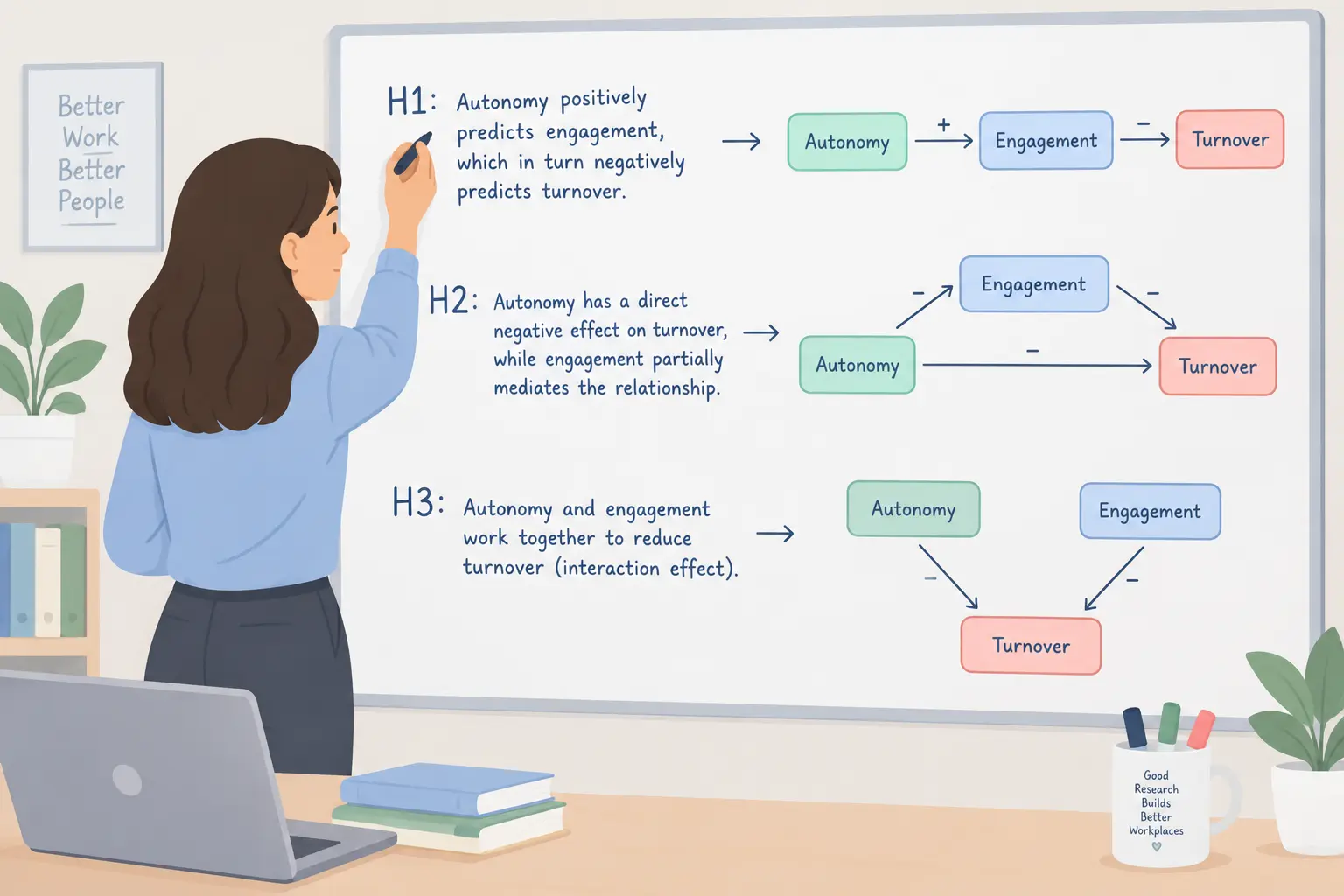
- H1: Perceived job autonomy is negatively associated with turnover intention.
- H2: Work engagement mediates the relationship between job autonomy and turnover intention.
- H3: Manager trust moderates the indirect effect described in H2, such that the mediated effect is stronger at higher levels of manager trust.
What does the methodology section include?
Name the design, the population and sampling plan, the instruments (with their published reliability figures if you have them from the original validation studies), and the planned analysis, in that order.
Illustrative excerpt: “A cross-sectional, single-time-point survey design will be used, distributed to remote employees (working from home at least 4 days per week) across three participating technology firms. Autonomy will be measured with the Work Design Questionnaire’s autonomy subscale; engagement with the Utrecht Work Engagement Scale (UWES-9); manager trust with McAllister’s cognition- and affect-based trust scale; and turnover intention with a standard 3-item intention-to-quit measure. Moderated mediation will be tested using Hayes’ PROCESS macro, Model 7, with 5,000 bootstrap resamples for the indirect effect’s confidence interval.”
What goes in the timeline and budget?
A proposal-stage timeline breaks the remaining work into stages with target dates, and a budget (even a modest one) lists any costs — survey platform fees, participant incentives, transcription — with a source of funds if one is required by your programme.
| Stage (illustrative) | Target window |
|---|---|
| IRB submission and approval | Weeks 1–6 |
| Employer partnership agreements and survey deployment | Weeks 7–10 |
| Data collection window | Weeks 11–16 |
| Analysis | Weeks 17–20 |
| Write-up and defense preparation | Weeks 21–26 |
What does the expected contribution section say?
This short closing section (usually 150–300 words) states, in advance, what the study will add regardless of which direction the results go — a genuine contribution should be defensible whether H1–H3 are supported or not.
Illustrative excerpt: “If manager trust is found to moderate the autonomy–engagement–turnover pathway as hypothesized, this study would identify a specific, actionable lever — manager trust-building — that organizations can pursue independently of broader autonomy policy, which is often slower and more costly to change. If no moderation is found, the study would still contribute evidence that autonomy’s protective effect on turnover generalizes robustly across levels of manager trust in remote settings, a boundary condition that has not previously been tested directly.”
How do you handle ethics approval in the proposal?
State which category of review you expect (exempt, expedited, or full board) and why, name the specific risks (however minor) and your mitigation plan, and describe your informed consent and data storage procedures. For a survey of adult employees on non-sensitive workplace attitudes, expedited or exempt review is typical, but the determination belongs to your institution’s ethics committee, not to you. See how to write a psychology dissertation for how the ethics section fits into the wider proposal-to-defense pipeline.
How do you defend a proposal like this at a committee meeting?
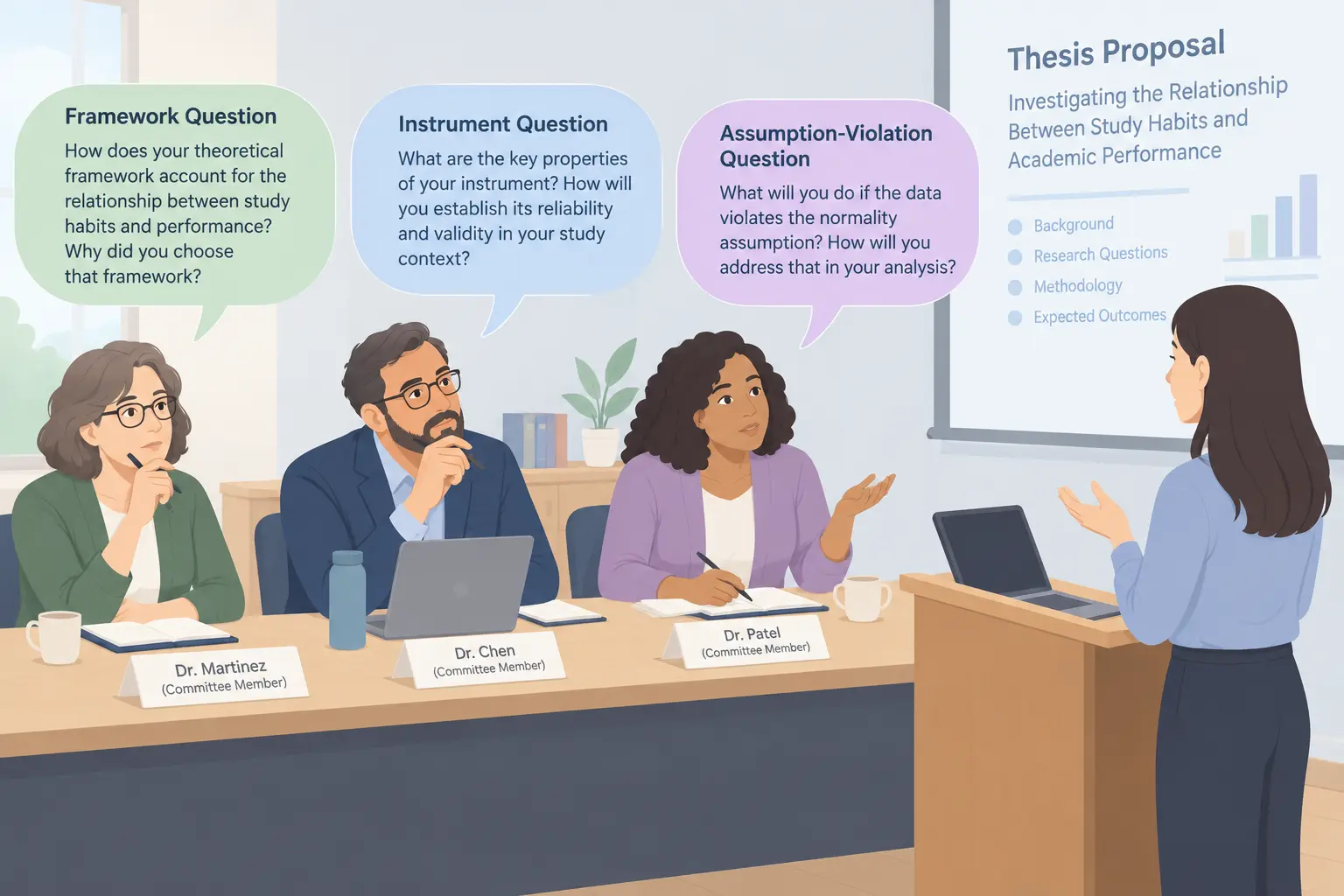
Expect three kinds of questions: why this theoretical framework rather than an obvious alternative (be ready to name at least one framework you considered and rejected, and why), why these specific instruments (cite each instrument’s original validation study and reliability coefficient), and what you will do if your assumptions are violated (for example, if manager trust shows a ceiling effect with little variance in your sample). Rehearsing answers to all three before the meeting, rather than only rehearsing your slides, is what separates a smooth defense from a rocky one. If a committee member questions your choice of measure specifically, be ready to explain not just that the instrument is validated but why it fits your construct better than a close alternative — see how to choose a validated psychology scale for your dissertation for the reliability, permission and reporting checks a good answer draws on.
How is this different from a research gap statement or a topics list?
A gap statement identifies what is missing in the literature in a paragraph; a topics list offers many possible studies at a glance. A full proposal, by contrast, commits to one specific design, one set of hypotheses and one methodology, written in enough detail that a committee could approve it as-is. See the field-agnostic research proposal template for the generic version of this structure, and the worked research questions, hypotheses and variables examples across six psychology sub-fields for more hypothesis-writing patterns across the discipline.
Where does Tesify fit in writing a proposal like this?
Tesify’s thesis workspace, used by 9,000+ students and 15,000+ chapters, helps you structure the proposal once you already know your model, your instruments and your hypotheses. Every word stays 100% written by you, and Tesify should not be used to invent the model or select instruments for you, because those choices depend on your own reading of the literature.
Frequently asked questions
How long should an organizational psychology thesis proposal be?
Typically 3,000–6,000 words depending on programme requirements, considerably shorter than the eventual literature review and methodology chapters of the finished thesis, which expand substantially on each proposal section.
Do I need pilot data before writing the proposal?
Not usually for a survey-based design using established instruments, though some committees expect a brief pilot (10–20 respondents) to check survey length and item clarity before full deployment.
Can I change my hypotheses after the proposal is approved?
Minor refinements are normal as you finalize measures, but a substantive change to your model typically requires a formal amendment to your approved proposal and sometimes a new or amended IRB submission.
What if my target organizations will not grant access?
Build a fallback recruitment plan into your proposal (a general remote-worker panel via a survey platform, for example) rather than making the whole design contingent on a single employer partnership.
Should I include statistical power analysis in the proposal?
Yes — a brief a priori power analysis justifying your target sample size given your planned analysis (moderated mediation typically needs a larger sample than a simple correlation) strengthens the methodology section considerably.
Is a cross-sectional design acceptable, or do I need longitudinal data?
Cross-sectional designs are common and acceptable for this kind of model, but you must acknowledge in your limitations that mediation claims from cross-sectional data are about statistical pathways, not proven causal sequence — a longitudinal or experimental design would be needed to establish that more strongly.
How do I choose between competing theoretical frameworks?
Choose the framework whose mechanism most directly predicts the specific pathway in your hypotheses, and briefly justify why a plausible alternative (for example, social exchange theory instead of self-determination theory) was not used, since committees expect this comparison rather than an unexamined default choice.
What reliability coefficient counts as acceptable for my chosen instruments?
Cronbach’s alpha at or above .70 is the commonly cited minimum for research use, though many well-established organizational psychology scales report alphas in the .80s or above in their original validation studies; report the coefficient from the original validation paper and, ideally, recompute it in your own sample once data collection is complete.
Can I use an existing company dataset instead of collecting new survey data?
Yes, if the organization is willing to share de-identified HR or engagement-survey data and the variables map onto your model, though you will need a data-sharing agreement and should address in your proposal how you will handle variables the company measured differently from your intended instruments.
What is the difference between a moderator and a mediator in this kind of model?
A mediator explains the mechanism through which one variable affects another (engagement is the “how” between autonomy and turnover intention); a moderator changes the strength of that relationship depending on its own level (manager trust changes how strong the autonomy-to-engagement-to-turnover pathway is). Confusing the two is one of the most common errors committees flag in a proposal’s hypotheses section.
Write your thesis with AI
Structure, draft, cite, and format your thesis faster with Tesify’s AI writing tools, automatic bibliography, and plagiarism checker. Free to start, no credit card required.






Leave a Reply