
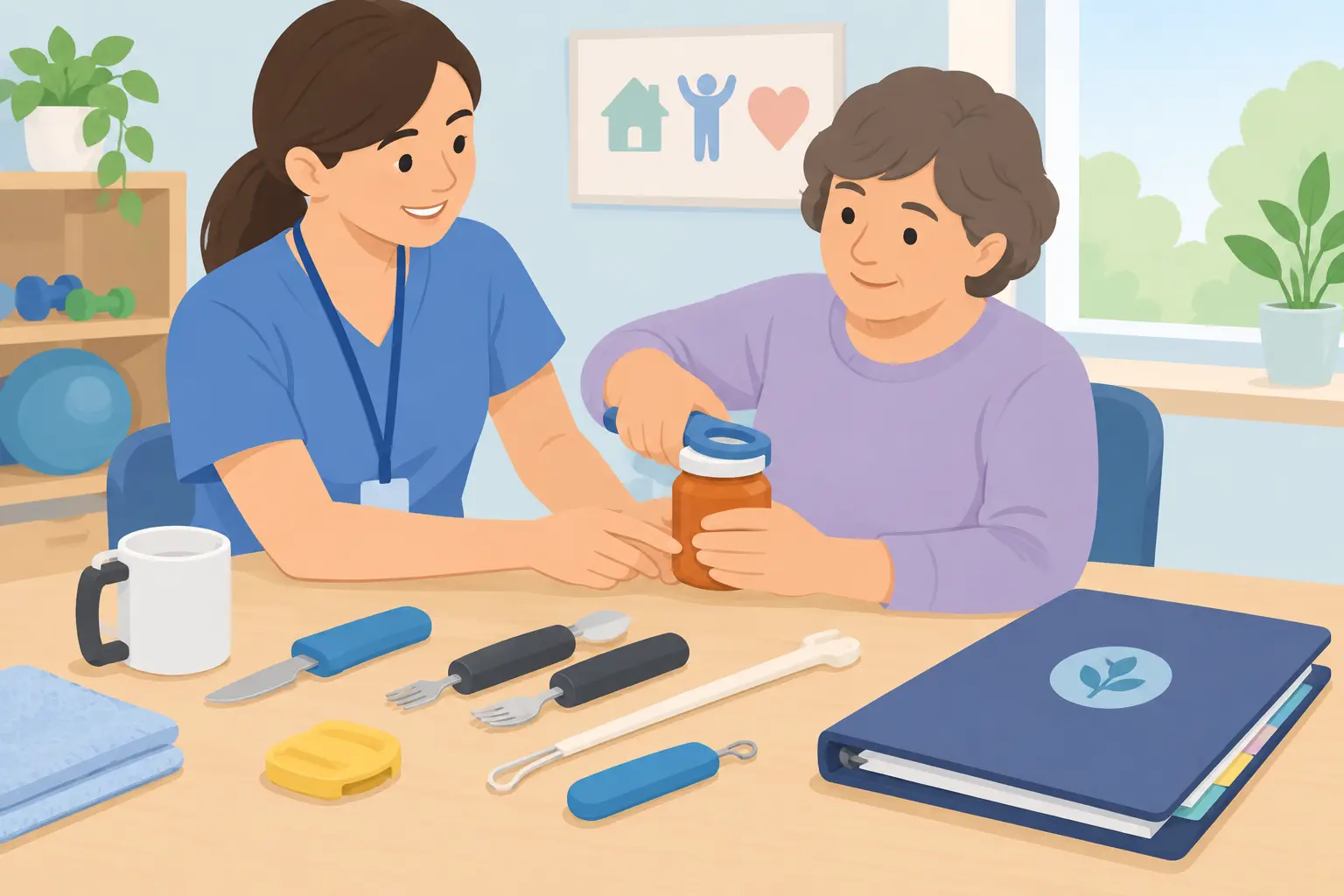
Forty OTD capstone topics for 2026, organized by practice area, each with a research or evaluation question and a note on the kind of capstone experience it fits. An occupational therapy doctorate capstone combines an individualized, mentored doctoral experience with a final capstone project, and programmes typically ask you to place the project in a defined focus area — for example clinical practice skills, research, administration, leadership, program and policy development, advocacy, education or theory development. Each topic below names the focus area it fits most naturally, since your site mentor and faculty advisor will expect that framing from the start; confirm the exact list in your own programme handbook.
Pediatric practice topics
1. Sensory-integration-based intervention fidelity in school settings. How consistently is a sensory-integration protocol implemented across therapists at a school-based practice, and what predicts fidelity? (Focus area: research/program evaluation.)
2. Parent coaching models in early-intervention OT. Does a parent-coaching delivery model change caregiver-reported confidence in carrying over strategies between sessions? (Focus area: clinical practice skills.)
3. Assistive technology adoption for children with cerebral palsy in mainstream classrooms. What barriers do classroom teachers report to sustained use of a recommended assistive technology device? (Focus area: advocacy/program development.)
4. Handwriting intervention approaches compared in a single school district. How do two commonly used handwriting curricula compare on a standardized handwriting-legibility measure within one district? (Focus area: research.)
5. Telehealth OT for rural pediatric caseloads. What is the caregiver-reported acceptability of telehealth-delivered pediatric OT compared to in-person sessions in a rural service area? (Focus area: clinical practice skills/technology.)
6. Feeding-therapy protocol standardization in a pediatric outpatient clinic. Does introducing a standardized feeding-therapy protocol reduce variability in caregiver home-programme adherence? (Focus area: program development.)
7. School re-entry programming after a pediatric traumatic brain injury. What does a structured school re-entry OT protocol need to include, based on a needs assessment with school staff and families? (Focus area: program development.)
8. Occupational therapy’s role in autism-inclusive playground design. What playground design features do OT practitioners and autistic children’s caregivers identify as most supportive of sensory regulation during play? (Focus area: advocacy.)
Mental health practice topics
9. Occupation-based groups on an acute inpatient psychiatric unit. Does introducing a structured occupation-based group programme change patient-reported engagement compared to the unit’s existing activity programming? (Focus area: program development.)
10. OT-led vocational readiness programming for adults with serious mental illness. What outcomes does a short-term vocational readiness group produce on a standardized work-readiness measure? (Focus area: research.)
11. Sensory modulation rooms in psychiatric emergency settings. How do staff and patients describe the use and impact of a sensory modulation room introduced to a psychiatric emergency department? (Focus area: program evaluation.)
12. Peer-support integration into OT mental health groups. What is the feasibility of co-facilitating an OT group with a certified peer specialist, evaluated through staff and participant feedback? (Focus area: program development.)
13. OT contribution to a college campus mental health service. What unmet occupational needs do college counseling-center staff identify that an embedded OT role could address? (Focus area: advocacy/needs assessment.)
14. Trauma-informed care training for OT staff on a substance-use recovery unit. Does a trauma-informed care training module change staff-reported confidence in de-escalation situations? (Focus area: education.)
Geriatric and gerontology practice topics
15. Fall-prevention home-modification recommendations and follow-through. What proportion of OT-recommended home modifications are actually implemented by older adults within three months, and what predicts follow-through? (Focus area: research.)
16. Dementia-capable driving-cessation counseling protocols. What does a structured driving-cessation counseling protocol need to include, based on caregiver and clinician needs assessment? (Focus area: program development.)
17. OT-led caregiver training for dementia behavioral symptoms. Does a short caregiver-training programme change caregiver-reported burden on a validated burden scale? (Focus area: research.)
18. Low-vision rehabilitation access in skilled nursing facilities. What proportion of residents with a documented low-vision diagnosis actually receive a low-vision OT referral at a given facility? (Focus area: program evaluation/advocacy.)
19. Restorative dining programs and independence in long-term care. Does implementing a restorative dining program change residents’ independence scores on a standardized ADL measure? (Focus area: program development.)
20. Technology-based cognitive stimulation for early-stage dementia. What is the feasibility and acceptability of a tablet-based cognitive stimulation program in an assisted-living setting? (Focus area: clinical practice skills/technology.)
Physical rehabilitation and hand therapy topics
21. Return-to-work outcomes after a hand-therapy protocol for distal radius fracture. What proportion of patients following a specific hand-therapy protocol return to their prior occupation within an expected timeframe? (Focus area: research.)
22. Home exercise program adherence tracking with wearable sensors. Does adding a wearable-sensor adherence-tracking component change home exercise program completion rates compared to a paper log? (Focus area: technology/research.)
23. Upper-limb spasticity management protocol standardization post-stroke. How consistent is upper-limb spasticity management across therapists in one outpatient neuro-rehabilitation clinic? (Focus area: program evaluation.)
24. Return-to-driving evaluation protocols after traumatic brain injury. What does a structured, OT-led return-to-driving evaluation protocol need to include, based on a review of current site practice and a stakeholder needs assessment? (Focus area: program development.)
25. Ergonomic assessment and injury-recurrence rates in a manufacturing workforce. Does an OT-led workplace ergonomic assessment programme change repeat musculoskeletal-injury rates over a defined follow-up period? (Focus area: research/occupational health.)
26. Constraint-induced movement therapy adherence outside the clinic. What barriers do patients report to completing the constrained-use component of CIMT at home? (Focus area: clinical practice skills.)
Community and population-health practice topics
27. OT-led fall-prevention programming in senior community centers. Does a community-based, OT-facilitated fall-prevention class change participants’ scores on a standardized balance-confidence measure? (Focus area: program development.)
28. Occupational therapy’s role in a homeless-shelter reintegration program. What occupational barriers to housing stability do shelter staff and residents identify that an OT consultation role could address? (Focus area: advocacy/needs assessment.)
29. Lifestyle Redesign-informed programming for chronic-pain self-management. Does a Lifestyle Redesign-based group program change participant-reported pain self-efficacy? (Focus area: research.)
30. OT contribution to a refugee resettlement agency’s intake process. What unmet occupational needs among newly resettled refugees do agency case workers identify that OT screening at intake could catch earlier? (Focus area: advocacy.)
31. Driving rehabilitation access disparities by insurance type. Does insurance type predict whether a patient referred for driving rehabilitation actually completes the evaluation? (Focus area: research/health equity.)
32. Community reintegration programming after incarceration. What occupational needs do formerly incarcerated individuals identify as most pressing in the first month after release, and how could OT-informed programming address them? (Focus area: program development/advocacy.)
Technology, telehealth and program/leadership topics
33. Telehealth OT documentation efficiency compared to in-person visits. Does telehealth delivery change the average documentation time per OT visit compared to matched in-person visits? (Focus area: administration.)
34. Virtual reality-based upper-limb rehabilitation acceptability. How do patients and therapists rate the usability and engagement of a VR-based upper-limb rehabilitation tool in an outpatient setting? (Focus area: technology/clinical practice.)
35. New-graduate OT residency program development. What does a structured, mentored residency program for new-graduate OTs need to include, based on new-graduate and supervisor needs assessment? (Focus area: leadership/education.)
36. Interprofessional education module on OT’s scope of practice. Does a short interprofessional education session change other health professions students’ understanding of OT’s scope of practice, measured pre-post? (Focus area: education.)
37. Productivity-standard policy and burnout among staff OTs. How do staff OTs describe the relationship between a facility’s productivity-standard policy and their own reported burnout? (Focus area: administration/leadership.)
38. OT advocacy toolkit for state-level scope-of-practice legislation. What does an effective advocacy toolkit for state-level OT scope-of-practice legislation need to include, based on a review of successful campaigns in comparable states? (Focus area: advocacy.)
39. Occupational justice framework application in a program-development capstone. How can an occupational justice framework be operationalized into concrete program-design criteria for a new community OT service? (Focus area: theory development.)
40. Billing and reimbursement literacy training for OT students. Does a structured billing and reimbursement training module change OT students’ confidence and accuracy on a coding-knowledge assessment? (Focus area: education/administration.)
Choosing and scoping your capstone topic

Match your topic to your site mentor’s expertise and your programme’s specific capstone-focus-area requirements before you invest time in a literature review — a strong topic with no available mentor in that practice area, or that does not map onto one of your programme’s recognized focus areas, will need reworking regardless of how good the underlying question is. Confirm early whether your programme expects a traditional research design, a program-evaluation design, or a program-development deliverable, since the three require different IRB pathways and different final-product expectations. If you are still deciding what kind of doctoral deliverable you are writing, thesis vs dissertation vs capstone: what is the difference lays out the three side by side.
How common capstone focus areas map onto these topics
Clinical practice skills topics (2, 5, 8, 26) ask you to refine and document a specific intervention approach with a defined population. Research-focused topics (1, 4, 10, 15, 17, 21, 25, 31) require the strongest methodological grounding and typically the fullest IRB review. Program and policy development topics (3, 6, 7, 9, 12, 16, 19, 24, 27, 32) ask you to design or redesign a service, often evaluated through a needs assessment and stakeholder feedback rather than a controlled trial. Administration and leadership topics (33, 35, 37) look at how a service or workforce is organized and managed. Advocacy topics (8, 13, 28, 30, 38) build a case for policy or resource change aimed at an external audience such as a legislature or funder. Education topics (14, 36, 40) build and evaluate a training intervention aimed at students or staff rather than clients. Theory development topics (39) are the least common at the OTD level but appropriate when your capstone genuinely extends or operationalizes an existing conceptual framework rather than applying it as-is.
Where this fits with the wider capstone process
Once you have a topic and a mentor, the capstone moves through the same proposal-to-defense structure most doctoral projects follow — see 40 DNP project ideas, each with a PICOT-style question for how a closely related doctoral-capstone process in nursing frames the same kind of practice-based question, and how to write the methodology chapter of a nursing dissertation or DNP project for how that neighbouring profession structures the research-versus-program-improvement decision your OTD capstone also has to make.
Where Tesify fits
Once your topic, mentor and focus area are confirmed, Tesify’s thesis workspace, used by 9,000+ students and 15,000+ chapters, helps you structure your capstone proposal: problem statement, objectives and literature outline. Every word stays 100% written by you, and Tesify cannot secure a site mentor or run your needs assessment, both of which have to happen first.
Frequently asked questions
Do all OTD capstones require IRB approval?
Not all — a pure program-development or quality-improvement-style capstone may be classified as non-research by your institution’s IRB, but this determination has to come from your IRB or its designated reviewer, not from your own assumption, and should be confirmed in writing early in your planning.
Does my capstone topic have to fit a recognized focus area?
Most programmes expect the capstone to sit in a defined focus area such as clinical practice skills, research, leadership, program development, advocacy or education, so confirm your programme’s list before you scope the topic and frame the topic explicitly within one of them from the start.
How is an OTD capstone different from a traditional master’s thesis?
An OTD capstone combines a mentored, individualized doctoral experience with a final project or deliverable, and is often practice- or program-focused rather than a traditional hypothesis-testing research thesis, though a research-focused capstone is a common option.
Can two students work on related capstone topics at the same site?
Yes, provided each student’s individual contribution, research question and deliverable are clearly distinguished — check your programme’s policy on concurrent or sequential capstones at the same site.
What if my site mentor’s expertise does not match any of these topics exactly?
Use the closest topic above as a starting template and adapt it to your mentor’s specific population and setting — the research question structure transfers even when the exact clinical population changes.
How long does a typical OTD capstone take from topic selection to defense?
Programmes vary, but the mentored experience component is commonly at least 14 weeks of full-time-equivalent engagement, on top of the planning, IRB approval (if needed) and final project write-up, so most students begin serious topic scoping two to three semesters before their planned defense; check your own programme handbook for the exact requirement.
Write your thesis with AI
Structure, draft, cite, and format your thesis faster with Tesify’s AI writing tools, automatic bibliography, and plagiarism checker. Free to start, no credit card required.





Leave a Reply