
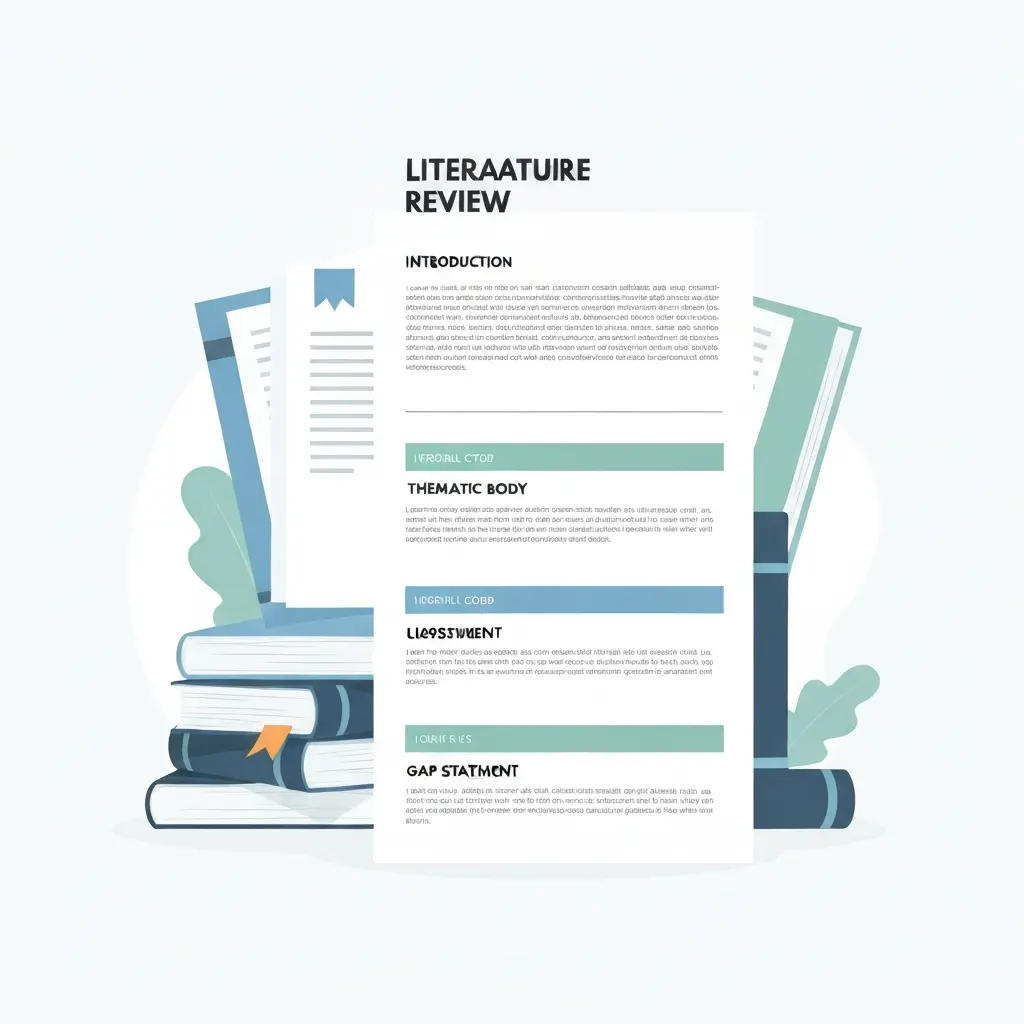
Literature Review Example & Template: Structure, Approaches, and Annotated Samples (2026)
The literature review is the chapter most students dread — and most frequently get wrong. Not because the research is hard, but because the writing task is misunderstood. A literature review is not a summary of every paper you have read; it is a structured argument that maps the existing knowledge in your field, identifies its limitations, and builds the intellectual case for why your research is necessary. This guide gives you concrete examples, a reusable template, and annotated samples across three disciplines so you can see exactly what strong literature review writing looks like in practice.
Whether you are writing a dissertation, master’s thesis, or standalone review article, the principles are the same: synthesise, evaluate, and point the way forward.
What a Literature Review Actually Does
Think of the literature review as a map, not a list. You are not telling the examiner “here is what Scholar A said, and here is what Scholar B said” — you are drawing the intellectual terrain of your field: where the major roads are, where researchers have explored, where the unexplored territory lies, and why your study is going to venture there.
A literature review that merely summarises sources will typically receive a passing grade. A literature review that synthesises, evaluates, and builds toward a clear gap will receive a distinction. The difference comes down to one word: so what? After every section, the examiner should be able to see why it matters to your argument.
The Three Organisational Approaches
You have three main options for organising the body of your literature review:
| Approach | Best For | Risk |
|---|---|---|
| Thematic | Most dissertations and theses; shows breadth of understanding | Can become a list of themes without analytical connections between them |
| Chronological | Fields with a clear history of development; historical studies | Can read like a timeline rather than an argument |
| Methodological | Meta-analyses; studies comparing what different methods have found | Can feel too technical; may lose non-specialist readers |
Most well-executed literature reviews combine approaches — a chronological introduction (showing how the field has evolved) followed by a thematic body (exploring the key debates in depth) is a particularly effective structure.
Literature Review Template
Use this framework as a starting point, then adapt it to your discipline and word count:
Section 1 — Introduction (5–10% of total review)
- Define the scope: what topics/time period/disciplines are included and why
- Announce the organisational approach (“This review is organised thematically…”)
- Provide a brief narrative of how the field has developed
Section 2 — Theme/Period A (20–30%)
- Open with a topic sentence stating what this section argues
- Group and compare relevant sources; do not describe them individually
- Evaluate: what do these studies agree on? Where do they diverge? What are their weaknesses?
- Close with a synthesis sentence linking to the next section
Section 3 — Theme/Period B (20–30%)
- Same structure as above
- Use transition language to connect explicitly to the previous section
Section 4 — Theme/Period C (20–30%)
- Same structure; by this point the gap should be becoming visible
Section 5 — Conclusion and Gap Statement (10–15%)
- Synthesise the key findings from the whole review
- Identify the gap explicitly: “However, no study has yet examined X in the context of Y”
- State how your research will address this gap
Annotated Example: Social Sciences
Here is a passage from a sociological literature review on housing inequality, with annotations:
“The relationship between housing tenure and social mobility has been examined extensively since the 1980s, with initial studies characterising homeownership as a straightforward pathway to wealth accumulation (Saunders, 1990; Forrest & Murie, 1995). This position was substantially complicated by the post-2008 housing market collapse, which revealed that homeownership could be a source of negative equity and financial vulnerability as easily as asset accumulation (Stephens & Fitzpatrick, 2017). More recent scholarship has taken an intersectional turn, arguing that the relationship between housing and mobility is mediated by race, gender, and locality in ways that aggregate statistics obscure (Watt, 2021; Tyler, 2023). Notably, however, this body of work has focused predominantly on England, leaving Scottish housing dynamics — the focus of the present study — largely absent from the debate.”
Annotations:
- “examined extensively since the 1980s” — situates the field historically without a full chronological review
- “This position was substantially complicated” — evaluative language showing intellectual development
- “More recent scholarship has taken an intersectional turn” — tracks a methodological shift
- “Notably, however” — signals the gap statement; highly effective sentence structure
Annotated Example: STEM
STEM literature reviews tend to be more methodologically focused. Here is a passage from a biomedical engineering dissertation:
“Three principal scaffold architectures have been explored for cartilage tissue engineering: hydrogels, electrospun fibrous scaffolds, and three-dimensionally printed constructs. Hydrogel-based approaches offer excellent biocompatibility and tuneable mechanical properties but suffer from poor structural integrity under load-bearing conditions (O’Brien, 2011; Levato et al., 2022). Electrospun scaffolds more closely mimic the fibrillar architecture of native extracellular matrix and demonstrate superior mechanical performance, yet current fabrication techniques produce fibre diameters an order of magnitude larger than native collagen fibres, limiting cellular infiltration (Kishan & Cosgriff-Hernandez, 2017). 3D-printed constructs offer unmatched geometric precision but remain constrained by the cytotoxic solvents involved in current bioink formulations (Murphy & Atala, 2014). To date, no scaffold system has successfully balanced all three requirements simultaneously — a gap this study addresses through a hybrid hydrogel-electrospun composite approach.”
Annotations:
- Methodological organisation — compares three approaches rather than surveying the field chronologically
- “offer…but suffer” structure — concise strength/weakness evaluation for each approach
- Final sentence states the gap and previews the study’s innovation
Annotated Example: Humanities
Humanities literature reviews are often more integrated into the argument. Here is a passage from a literary studies dissertation:
“Woolf scholarship has long been preoccupied with questions of consciousness and form, from early feminist recuperations of her writing as proto-poststructuralist (Showalter, 1977; Kristeva, 1981) to more recent materialist readings that situate her aesthetics within the specific conditions of 1920s literary production (Cuddy-Keane, 2003; Fernald, 2022). These materialist approaches have productively defamiliarised Woolf’s style by anchoring it in historical context; yet they have, by and large, treated her essays as secondary documents — illustrative footnotes to the novels. This is a notable omission, given that Woolf’s essays constitute both a substantial body of work in their own right and, as this dissertation argues, an intellectual laboratory in which she first developed the argumentative strategies that would shape her fiction.”
Annotations:
- Engages with two competing camps within the field (feminist vs materialist) rather than summarising individual scholars
- “productively defamiliarised…yet they have” — concedes value before identifying limitation
- “notable omission” — clear gap statement; “as this dissertation argues” signals the original contribution
Synthesis Language: Phrases to Use
One of the clearest signals that a literature review is descriptive rather than analytical is the absence of evaluative and connective language. Here are phrases that indicate synthesis:
- Agreement across sources: “This view is shared by…”, “A consensus has emerged that…”, “Both X and Y conclude that…”
- Contrasting positions: “In contrast to X, Y argues that…”, “While X emphasises…, Y focuses instead on…”
- Evaluating weaknesses: “This approach is limited by…”, “A significant criticism of…is that…”, “These studies share the methodological limitation of…”
- Identifying gaps: “To date, no study has examined…”, “Notably absent from this literature is…”, “Existing research has focused primarily on X, leaving Y underexplored”
- Signalling your contribution: “The present study addresses this gap by…”, “This dissertation contributes to the debate by…”
For the full thesis context around literature reviews, see our complete thesis writing masterclass. For step-by-step process guidance, our how to do a literature review guide covers database searching through thematic synthesis.
Common Errors and How to Fix Them
These are the four most frequent literature review mistakes, with specific fixes:
-
The “book report” format. Summarising each source separately: “Smith (2020) found that… Jones (2021) argued that… Brown (2022) showed that…”
Fix: Group sources that share a position and discuss them together: “Several studies confirm that X (Smith, 2020; Jones, 2021; Brown, 2022)…” -
No gap statement. Ending the review without identifying what is missing from the literature.
Fix: Write your gap statement first, then work backwards to build the argument that makes it feel inevitable. -
Over-reliance on secondary sources. Citing textbooks or review articles rather than primary research.
Fix: Use Google Scholar, your library’s database, and JSTOR to access original empirical studies and theoretical texts. -
Missing evaluation. Describing what studies found without assessing how well they found it.
Fix: For each key source, ask: What was the sample size? What was the methodological approach? What are the acknowledged limitations?
Frequently Asked Questions
How long should a literature review be?
For a dissertation, the literature review typically accounts for 20–30% of the total word count. In a 10,000-word undergraduate dissertation, that is 2,000–3,000 words. In a 20,000-word master’s thesis, 4,000–6,000 words. Standalone literature review articles for journals are typically 6,000–12,000 words. Always check your institution’s specific guidelines — some departments set explicit word count ranges for each chapter.
How many sources should a literature review include?
Quality and relevance matter more than number. As a rough guide: undergraduate dissertation literature reviews typically draw on 20–40 sources; master’s theses 40–80; PhD theses 100+. Include only sources that directly contribute to your argument. Padding with tangentially related sources weakens rather than strengthens your review.
What is the difference between a literature review and an annotated bibliography?
An annotated bibliography lists sources with brief summaries of each one — it is a research tool, not a piece of academic writing. A literature review synthesises those sources into a coherent argument about the state of the field. If your literature review reads like a list of summaries, it is functioning as an annotated bibliography — which is not what examiners want.
Can I use a literature review template?
Yes — templates are useful for structuring your writing and ensuring you cover all required elements. The template in this guide provides a solid starting framework. However, templates must be adapted to your specific discipline and research question; a social sciences literature review will look structurally different from a STEM one. Use templates as scaffolding, not a script to fill in.
Should I include very old sources in my literature review?
Yes, if they are foundational. Seminal works — even decades-old ones — should be included because they establish the intellectual foundations your research builds on. What you should avoid is relying only on old sources; you need to demonstrate awareness of current debates. A typical well-balanced review combines foundational texts (no matter how old) with recent empirical studies (ideally from the last 5–7 years).
Write your thesis with AI
Structure, draft, cite, and format your thesis faster with Tesify’s AI writing tools, automatic bibliography, and plagiarism checker. Free to start, no credit card required.






Leave a Reply