
How to Write a Journalism Practice-Based Project and Critical Reflection (2026)
A journalism practice-based project has two assessed components: a piece of publishable journalism and a critical reflection situating it in professional practice and scholarship. Most marks are lost in the second, where students write a making-of diary instead of a critical analysis.
What the two components are actually for
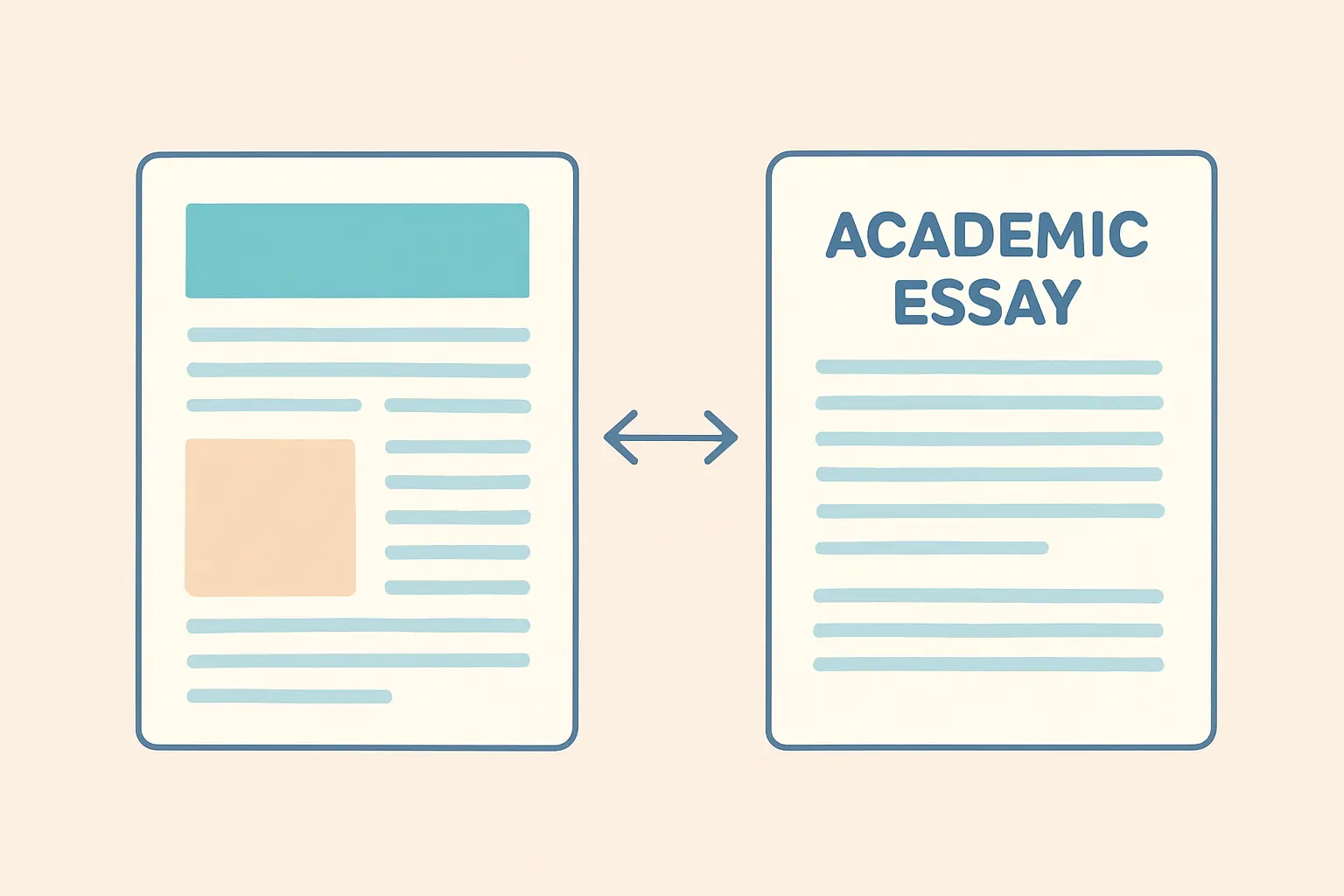
The practice output proves you can do journalism to a professional standard. The reflection proves you understand why you made the choices you did, and can defend them against professional norms, ethical codes and the scholarly literature on the field.
Departments weight these differently — a common split gives more weight to the practice on undergraduate programmes and more to the reflection at master’s level — so check your handbook. What is consistent is that the reflection is where the academic marks concentrate, and where students underperform.
Choosing a practice output that can actually be assessed
| Output | What it demonstrates | Main risk |
|---|---|---|
| Long-form feature | Structure, sourcing, narrative control | Access to enough sources |
| Investigation | Document work, verification, public interest reasoning | Story may not stand up in time |
| Podcast or audio documentary | Interviewing, scripting, production | Post-production time is always underestimated |
| Video documentary | Visual storytelling, access, editing | Highest technical and logistical risk |
| Data journalism piece | Sourcing, cleaning, analysis, visualisation | Dataset may not contain the story |
| Multimedia package | Format judgement across media | Breadth at the cost of depth in any one part |
Two selection rules save projects. Choose a story where you have already confirmed access to at least one central source, because a project premised on an interview you have not secured is a project with a single point of failure. And choose a subject that is not moving so fast that it resolves before your deadline.
Accredited programmes add a further constraint. Where your course carries NCTJ or broadcast accreditation, the practice element may need to satisfy specific professional requirements alongside the academic ones. Confirm both sets before committing.
Legal and ethical clearance is part of the assessment
This is the clearest difference between a journalism project and a conventional dissertation. Your work is designed to be published, so it must survive the checks a publisher would apply.
Address these before you file, and document that you did:
- Defamation. Can every damaging factual claim be substantiated from evidence you hold? Have you offered a right of reply, and recorded that you did?
- Contempt of court. Are any proceedings active? Reporting restrictions apply regardless of student status.
- Privacy and data protection. Is there a reasonable expectation of privacy, and if you are overriding it, what is the public interest justification?
- Regulatory codes. Print and online work is measured against the Editors’ Code administered by IPSO; broadcast work against the Ofcom Broadcasting Code. Know which applies to your output.
- Source protection. If you promised confidentiality, is your material stored so the promise can be kept?
- Vulnerable interviewees. Children, bereaved people and those in distress require additional care, and your university ethics process will look for it.
- Subterfuge. Recording covertly or misrepresenting yourself requires a public interest justification that could not be met by open means. Argue it in advance, not afterwards.
Most journalism programmes require university ethics approval as well. Build that into the timeline — it gates your fieldwork.
The critical reflection: what separates analysis from a diary
The failure is consistent and easy to describe. A weak reflection narrates production chronologically: how the idea arose, who was contacted, what was difficult, how it was edited. A strong reflection makes an argument about the work.
| Diary writing | Critical analysis |
|---|---|
| “I decided to open with the interview because it was the strongest quote.” | “I opened with personal testimony rather than the statistics, accepting the risk of individualising a structural problem — a tension well documented in critiques of episodic framing in news.” |
| “I couldn’t get the council to comment.” | “The council’s non-response left an accountability gap. I addressed it through documentary evidence rather than dropping the claim, and recorded the approaches made to satisfy the right-of-reply requirement.” |
| “I chose podcast format because I enjoy audio.” | “Audio suited a story carried by testimony rather than documents, where tone conveyed information transcription would lose — though it limited my ability to present the financial data.” |
Practically, the reflection should do five things: state what you were trying to achieve and for which audience; situate the work against comparable published journalism; justify your craft decisions with reference to practice literature or journalism studies scholarship; account for your ethical and legal reasoning at the points where it was contested; and evaluate honestly what did not work.
That last point carries disproportionate weight. Examiners reward candidates who identify a genuine weakness in their own work and analyse why it happened, and the same instinct that produces a good research limitations section applies here.
Cite journalism scholarship, not just style guides
The most common reason a reflection reads as unacademic is that it cites nothing except the outlets the student admires. A reflection is an academic essay and needs an evidence base.
Draw on the fields that actually theorise what you did — framing and news values, source relations and access, verification and open-source methods, the ethics of representing vulnerable subjects, and the practice literature on your specific form. Comparable published work is also legitimate evidence: analysing how an established investigation handled a problem you faced is scholarly if you analyse rather than admire.
Documenting the practice for someone who was not there
Examiners assess the process as well as the output, and can only assess what you show them. Keep from the start:
- A contact and approach log, including refusals and non-responses — evidence of right of reply.
- Signed consent forms where your programme requires them.
- Interview recordings and transcripts, stored according to your data plan.
- A note of significant editorial decisions with dates, which becomes the backbone of your reflection.
- Drafts or edits showing how the piece changed.
Present these as labelled appendices, referenced from the reflection. Anonymise or redact anything a confidentiality promise covers, and say in the reflection that you have done so and why.
How this differs from a practice-based doctorate
Undergraduate and master’s journalism projects are assessed primarily on professional competence and on informed critical judgement about your own practice. The output needs to be good journalism; it does not need to be original research.
At doctoral level the bar changes: the creative or professional output must itself constitute an original contribution to knowledge, paired with a substantial critical component. Our guide to the creative practice PhD covers that model, including the practice-based and practice-led distinction. If you are considering doctoral study after a practice master’s, the difference in what the written component must achieve is the thing to understand first.
Where a journalism project sits among other capstone formats is set out in our catalogue of final-year deliverables, and if your programme asks you to use a named reflective framework, our comparison of reflective practice models covers which suits practice-based work.
Frequently asked questions
Does my journalism project have to be published?
Usually not. Most programmes assess whether the work is of publishable standard rather than whether it was actually published. Genuine publication is often credited and is worth pursuing, but do not let a publication decision outside your control jeopardise your deadline.
How long is the critical reflection?
Set by your programme, and it varies widely with the weighting given to the practice component. Master’s reflections are typically substantially longer than undergraduate ones. Your handbook is the only authority; what matters more than length is that the reflection analyses rather than narrates.
Can I use work I produced on placement or for a real outlet?
Sometimes, but check first. Programmes vary on whether previously published or professionally commissioned work is admissible, and there may be conditions about how much of it can count. There are also rights questions if the outlet holds copyright.
What if my main source withdraws?
Speak to your supervisor immediately. Losing central access is a recognised risk in practice projects, and departments generally have contingency routes — reframing the story around available sources, or shifting the angle. Analysing that pivot in your reflection turns a setback into assessable material.
Do I need ethics approval for a journalism project?
Almost always, from your university, in addition to complying with the relevant industry code. Journalism ethics and research ethics are separate frameworks with different requirements, and your project has to satisfy both. Build approval into your timeline before fieldwork.
How do I reference journalism in an academic reflection?
Cite published journalism as you would any source, in your programme’s required style, with author, outlet and date. Cite scholarship on journalism practice as academic sources. Your own practice output is normally an appendix, referenced in the text rather than listed in the bibliography.
Tesify helps you build the scaffolding around the written component — a section outline for your critical reflection, a formatted bibliography for the scholarship you cite, and an AI-use declaration for submission.
Write your thesis with AI
Structure, draft, cite, and format your thesis faster with Tesify’s AI writing tools, automatic bibliography, and plagiarism checker. Free to start, no credit card required.



Leave a Reply