
How to Write a Systematic Literature Review: Step-by-Step Guide for Thesis Students 2026
A systematic literature review (SLR) is fundamentally different from a traditional narrative literature review: where a narrative review synthesises the literature selectively, a systematic review follows a pre-specified, replicable protocol to identify, select, and synthesise all relevant evidence on a research question. Used widely in health sciences, education, psychology, and social policy research, the systematic review is increasingly expected in PhD theses and master’s dissertations in empirically oriented disciplines. This step-by-step guide walks you through the PRISMA-guided process from search strategy to final synthesis.
SLR vs Narrative Review: When to Use Each
Not every thesis requires a systematic review. Use a systematic review when:
- Your research question asks “what is the evidence for…?” or “what is the effect of X on Y across studies?”
- You are working in health, social care, education, or policy where evidence synthesis is expected
- Your supervisor or department explicitly requires it
Use a narrative (traditional) review when:
- Your research is exploratory or theoretical
- You are working in humanities or interpretive social sciences
- The literature is too sparse, heterogeneous, or context-dependent for systematic synthesis
The standard literature review guide is at how to do a literature review for your thesis. This article covers only the systematic variant.
Step 1: Formulate Your Review Question Using PICO or SPIDER
PICO (for clinical and health sciences):
- Population: Who is being studied? (e.g., postgraduate students)
- Intervention: What is the exposure/intervention? (e.g., structured AI writing tools)
- Comparison: What is it compared to? (e.g., unassisted writing)
- Outcome: What is measured? (e.g., thesis completion rates)
SPIDER (for qualitative and mixed methods):
- Sample, Phenomenon of Interest, Design, Evaluation, Research type
Using a structured framework ensures your search terms are comprehensive and your inclusion criteria logically derived.
Step 2: Develop Your Search Strategy
A systematic search strategy must be documented, reproducible, and comprehensive. The key elements:
- Identify all relevant databases: A minimum of three for most topics — typically one general (Web of Science or Scopus), one discipline-specific (PsycINFO for psychology, ERIC for education, MEDLINE for health), and one grey literature source (PROQUEST dissertations, government databases)
- Develop your search string: Using Boolean operators (AND, OR, NOT) and truncation (*)
Example: (thesis* OR dissertation* OR “postgraduate research”) AND (“artificial intelligence” OR “AI” OR “large language model”) AND (“academic writing” OR “academic integrity” OR “plagiarism”) - Test and refine: Run a preliminary search; if you get 50,000 results, narrow; if you get 50, broaden
- Document everything: Date of search, database, exact search string, number of results — this goes in your methodology and PRISMA diagram
For advanced database search techniques, see our guide to Google Scholar advanced search. For AI-assisted literature discovery, see best AI tools for literature reviews.
Step 3: Screen Studies Systematically
Screening happens in two stages:
- Title and abstract screening: Apply your pre-specified inclusion/exclusion criteria to each title/abstract. Document how many are included/excluded and why.
- Full-text screening: For included abstracts, obtain the full text and apply criteria again. Document reasons for exclusion.
Inclusion/exclusion criteria must be pre-specified before you screen. Common criteria categories:
- Publication language (e.g., English only)
- Date range (e.g., 2015–2026)
- Study design (e.g., primary empirical studies only, no opinion pieces)
- Population (e.g., postgraduate students at degree-awarding institutions)
- Outcome (e.g., must report thesis completion data)
For PhD systematic reviews, dual independent screening (two reviewers screening independently) is usually required for methodological rigour. For master’s theses, single screening with documented decision criteria is typically acceptable — check with your supervisor.
Step 4: Extract Data Systematically
Create a data extraction form before you start — a table capturing the same information from every study. Minimum fields:
- Author(s), year, country, publication type
- Study design and sample size
- Population characteristics
- Intervention/exposure details
- Outcome measures and results
- Key limitations noted by authors
Tools for systematic data extraction: Covidence (paid, the standard for clinical reviews), Rayyan (free, good for title/abstract screening), Elicit (AI-assisted extraction — see AI literature review tools), or Microsoft Excel.
Step 5: Assess Study Quality
Quality assessment tools by study design:
- Randomised controlled trials: Cochrane Risk of Bias 2.0 (RoB2)
- Observational studies: ROBINS-I or Newcastle-Ottawa Scale
- Qualitative studies: CASP Qualitative Checklist
- Mixed methods: Mixed Methods Appraisal Tool (MMAT)
Report quality assessment in a table. Studies of low quality are not necessarily excluded — they may be included with their limitations noted in your synthesis.
Step 6: Synthesise and Write Up with PRISMA
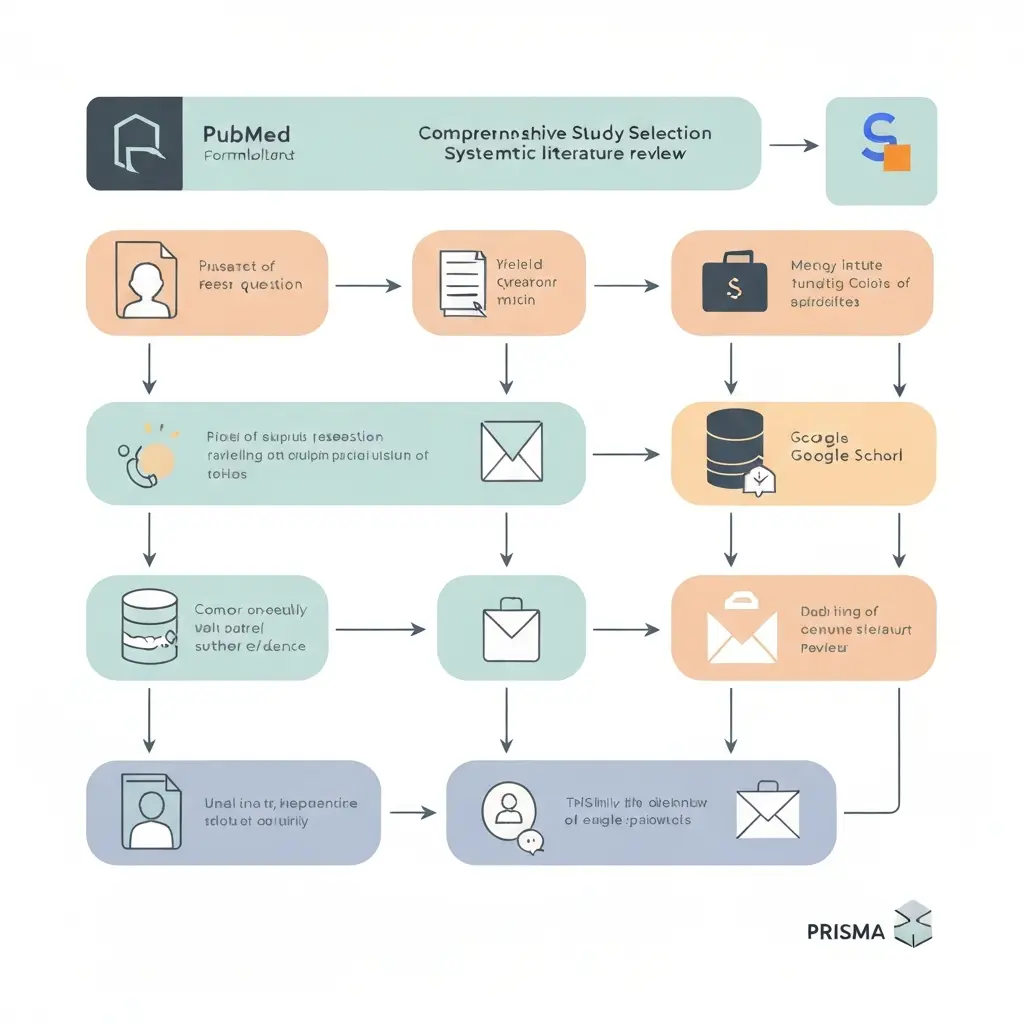
The PRISMA (Preferred Reporting Items for Systematic Reviews and Meta-Analyses) 2020 flow diagram must appear in your thesis to show the screening process:
- Records identified through database searching
- Records after duplicates removed
- Records screened (title/abstract)
- Records excluded (with reasons)
- Full-text articles assessed
- Full-text articles excluded (with reasons)
- Studies included in synthesis
PRISMA diagrams can be generated free at prisma-statement.org. Pre-register your review protocol on PROSPERO (prospero.york.ac.uk) before starting — this demonstrates rigour and prevents duplication.
For writing up your synthesis, narrative synthesis (grouped by theme or outcome) is appropriate when studies are too heterogeneous for statistical meta-analysis. Meta-analysis (statistical pooling of effect sizes) requires comparable outcome measures across studies and is typically reserved for PhD theses.
When writing up all stages of your systematic review, Tesify can help you structure the methodology and results write-up with academic clarity, ensuring your systematic review documentation meets examiner expectations.
Frequently Asked Questions
What is the difference between a systematic and a narrative literature review?
A systematic review follows a pre-specified, transparent, and replicable protocol to identify and synthesise all relevant evidence on a question, minimising bias through documented inclusion/exclusion criteria, comprehensive search strategies, and quality assessment. A narrative review synthesises the literature selectively, guided by the author’s expertise and argument, with no requirement for comprehensiveness. Systematic reviews are required in health sciences and evidence-based disciplines; narrative reviews are standard in humanities and interpretive social sciences.
Do I need to use PRISMA for my thesis systematic review?
Yes, for any thesis claiming to be a systematic review. PRISMA (Preferred Reporting Items for Systematic Reviews and Meta-Analyses) 2020 provides the reporting standard that examiners and journal reviewers expect. The PRISMA flow diagram documenting your screening stages is a required component. If your review is a scoping review rather than a systematic review, use the PRISMA-ScR extension. Download the PRISMA checklist free at prisma-statement.org.
How many studies should be included in a systematic review?
There is no minimum number. Systematic reviews have been published with as few as 3–5 included studies (when the literature is genuinely sparse) and as many as 500+. What matters is comprehensiveness (you have searched systematically and included all eligible studies) and transparency (you have documented why each excluded study did not meet your criteria). For a master’s dissertation systematic review, 8–25 included studies is typical; for a PhD, 20–50+ is more common.
What is PROSPERO and should I register my review?
PROSPERO (prospero.york.ac.uk) is the international prospective register of systematic reviews, run by the Centre for Reviews and Dissemination at the University of York. Pre-registering your systematic review protocol before conducting it demonstrates rigour, prevents inadvertent duplication, and provides a citeable record that your protocol was pre-specified (not adapted post-hoc to fit your results). For health and social care systematic reviews, registration is now standard practice. For master’s students, pre-registration is best practice but not always required — check with your supervisor.
Write Up Your Systematic Review with Tesify
From search strategy to PRISMA flow diagram write-up, Tesify provides the structural framework and AI-assisted writing support to produce a rigorous, well-documented systematic review chapter — with auto-bibliography for every included study in your required citation format.






Leave a Reply