
How to Write a Pharmacy (PharmD) Thesis: Structure and Methods (2026)
Writing a pharmacy thesis is one of the most demanding — and most rewarding — milestones of a PharmD, MPharm, or pharmacy master’s programme. Unlike essays or coursework, your thesis asks you to make an original contribution to pharmaceutical knowledge: to design a study, collect and analyse data, apply the right reporting guidelines, and write up your findings in a way that would satisfy a journal editor or viva panel. If you have just been handed a project title and a supervisor’s email address and are wondering where to start, this guide walks you through every stage — from choosing your project type and planning your chapters to navigating NHS ethics and citing correctly using Vancouver. Knowing how to write a pharmacy thesis in 2026 means understanding not just structure but also the specific methodological conventions that distinguish pharmacy research from other health disciplines.
Pharmacy research spans a remarkably wide territory: the same department might host a student running cell-viability assays on anticancer compounds in a pharmacology lab and another student mining 10 million electronic prescription records to study antibiotic prescribing trends. That breadth is exciting — it also means there is no single template that fits every project. This guide identifies the four main pharmacy thesis project types, maps the appropriate chapter structure for each, and explains the statistical and reporting norms that examiners expect you to apply.
The Four Main Pharmacy Thesis Project Types
Before you can plan a single chapter, you need to understand which category your project falls into — because structure, methods, and the reporting guideline you append to your appendices all flow from that decision.
1. Clinical / Pharmacy Practice Research
This is the most common project type for UK MPharm final-year students and many PharmD programmes in the US and Australia. Projects typically examine how pharmacists deliver care — medicines reconciliation, adherence interventions, clinical audit of prescribing, or patient satisfaction surveys. Data collection usually involves questionnaires, semi-structured interviews, or retrospective review of clinical records. Studies may be quantitative, qualitative, or mixed methods. The central concern is real-world pharmacy practice, and findings are often directly translatable into service improvement.
Representative topics: evaluating an anticoagulation monitoring service, comparing pharmacist-led versus GP-led hypertension reviews, exploring patient perceptions of pharmacy-based smoking cessation support.
2. Pharmacoepidemiology and Drug Utilisation Research
Pharmacoepidemiological projects use routinely collected healthcare data — electronic health records, prescribing databases, hospital admissions, national registries — to study how medicines are used and what outcomes they produce at a population level. UK students often access primary-care data via the Clinical Practice Research Datalink (CPRD) or Secure Anonymised Information Linkage (SAIL). US students may use CPRD’s global arm, Medicare/Medicaid claims, or state-level pharmacy dispensing data. These projects tend to be observational (cohort, case-control, or cross-sectional in design) and require a solid understanding of confounding, time-varying exposures, and database-specific coding conventions.
The University of Manchester’s Centre for Pharmacoepidemiology and Drug Safety, UCL School of Pharmacy, and the University of Strathclyde are among the leading UK academic centres in this field.
3. Laboratory / Pharmacology Research
Bench-based projects sit within pharmaceutical sciences: formulation development and characterisation, drug delivery systems (nanoparticles, lipid-based carriers, hydrogels), in-vitro pharmacology (receptor binding, cell-viability assays, enzyme inhibition), or analytical chemistry (HPLC, mass spectrometry). These projects follow the IMRAD structure most closely and apply inferential statistics (ANOVA, dose-response modelling) to experimental data generated in the lab. Reproducibility and reporting of materials, instruments, and analytical conditions are especially scrutinised.
4. Systematic Review (and Meta-Analysis)
A systematic review project is an excellent choice for students who lack access to clinical or laboratory facilities, or whose question is better answered by synthesising existing evidence than generating new primary data. A well-conducted PRISMA-adherent systematic review — with a pre-registered PROSPERO protocol, a comprehensive multi-database search strategy, dual independent screening, and transparent risk-of-bias assessment — is academically rigorous and highly valued by examiners. Many pharmacy systematic reviews are themselves publishable. For guidance on managing the screening and data-extraction workflow, see our overview of the best AI tools for systematic reviews and meta-analysis in 2026.
Choosing Your Topic and Research Question
A strong pharmacy thesis topic has four properties: it addresses a genuine knowledge gap, it is feasible within your time and resources, it interests you enough to sustain six to twelve months of work, and it aligns with your supervisor’s expertise (so they can actually guide you). Start by reading the five most recent review articles in your area — not original papers, but reviews — to map what is known and what remains contested.
Frame your research question using PICO for clinical or pharmacoepidemiology projects: Population, Intervention or Exposure, Comparator, Outcome. For laboratory projects, use PICO in a modified form (Population = biological system or cell line; Intervention = compound or formulation). For qualitative research, the Sample-Phenomenon of Interest-Design-Evaluation-Research type (SPIDER) framework is often more appropriate.
If your project involves quantitative data analysis — as most pharmacy theses do — you will also need a plan for statistical reporting. Our step-by-step guide to running multiple regression in SPSS and reporting it in APA is a practical reference for students whose pharmacy practice project includes multivariate analyses.
Chapter-by-Chapter Structure
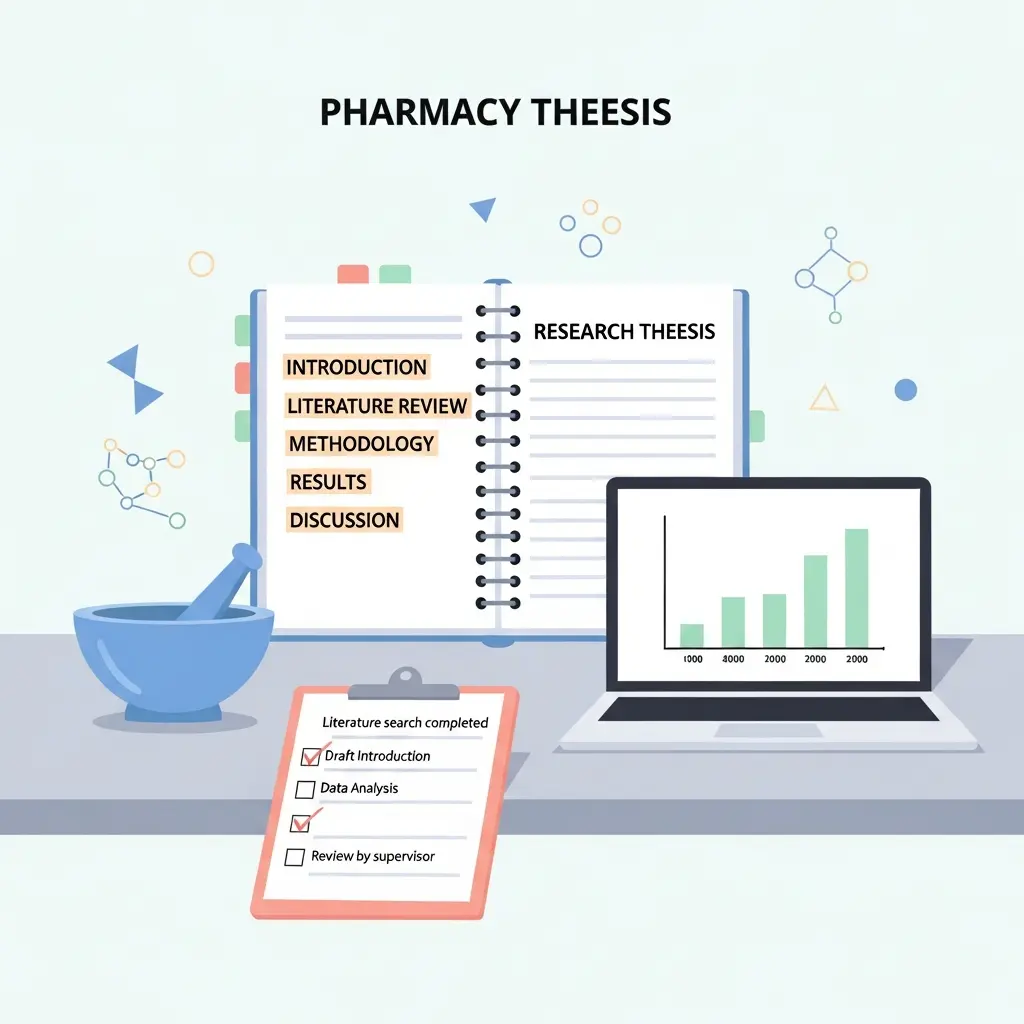
Most pharmacy theses follow either a traditional monograph structure or an IMRAD journal-article structure embedded within a longer document. The table below shows typical word-count allocations for a final-year dissertation of roughly 10,000–15,000 words. Adjust proportionally for an MPhil (20,000–40,000 words) or PhD (60,000–80,000 words).
| Chapter | Approximate word count (10,000-word project) | Core function |
|---|---|---|
| Abstract | 200–300 | Structured summary (background, aims, methods, results, conclusions) |
| Introduction | 600–800 | Context, significance, knowledge gap, aims and objectives |
| Literature Review | 2,000–2,500 | Critical synthesis of existing evidence; justify the gap |
| Methods | 1,500–2,000 | Study design, data sources, analysis plan, ethics |
| Results | 1,500–2,000 | Factual reporting of findings; tables and figures |
| Discussion | 1,800–2,200 | Interpretation, comparison with literature, strengths/limitations |
| Conclusion | 300–500 | Direct answer to research question; implications; future research |
| References | Not counted | Vancouver-numbered reference list (see citation section below) |
| Appendices | Not counted | Ethics approval letter, questionnaires, PRISMA/CONSORT/STROBE checklist |
Abstract
Use a structured abstract with clearly labelled headings: Background, Aims/Objectives, Methods, Results, and Conclusions. This mirrors the format required by journals such as the British Journal of Clinical Pharmacology and the American Journal of Health-System Pharmacy. Write the abstract last — it is a précis of the completed work, not a plan. Keep it within your institution’s word limit (usually 250–350 words). For a systematic review, also report the PROSPERO registration number in the abstract.
Introduction
The introduction establishes why your question matters. Open with the clinical or public-health burden: the prevalence of the condition, the scale of the prescribing problem, or the therapeutic gap you are investigating. Narrow progressively from the broad epidemiological context to the specific unresolved question. Close the introduction with a clear statement of your aims and specific objectives (usually two to four objectives that together answer the overarching aim). Do not pre-empt your results here — the introduction sets up the question, not the answer.
For context on how this approach applies across health disciplines, the structure closely parallels that described in our guide to writing a public health dissertation.
Literature Review
A pharmacy literature review is not a catalogue of papers — it is a critical synthesis. Group the literature thematically, not chronologically or by author. For clinical and pharmacoepidemiology projects, cover: (a) disease burden and current treatment landscape, (b) the evidence base for the intervention or exposure of interest, (c) methodological approaches used in previous studies, and (d) gaps in the literature that your study addresses. For lab projects, review: (a) the pharmacological target, (b) existing compounds or formulations, and (c) in-vitro or in-vivo models used previously.
Use primary sources wherever possible — original trial reports, cohort studies, guideline documents — rather than relying on textbooks. In pharmacy, PubMed/MEDLINE, EMBASE, Cochrane Library, and the British National Formulary (BNF) or AHFS Drug Information are the core references. Show your examiner that you can distinguish a well-designed study from a poorly designed one: explicitly critique sample sizes, follow-up periods, potential biases, and generalisability.
Methods
This is often the chapter that determines whether your work can be replicated — and examiners weigh it heavily. Write it in sufficient detail that a competent colleague could reproduce your study without asking you any questions. The methods section should specify:
- Study design: State it explicitly (e.g., “This was a retrospective cohort study using routinely collected primary-care data”).
- Setting and participants: Eligibility criteria (inclusion and exclusion), source of participants, recruitment period.
- Data collection: Instruments (questionnaires, interview schedules, database fields, assay protocols), validation, piloting.
- Outcome measures: Primary and secondary outcomes, how they were defined and measured.
- Statistical analysis plan: Specify every analysis you performed before you performed it — no post-hoc fishing.
- Ethics and governance: State the level of approval obtained (university ethics committee, NHS REC, HRA) and any data-sharing agreements.
- Software: Name the version of R, Stata, SPSS, GraphPad Prism, or other tools used.
For a deeper treatment of structuring this chapter, see our dedicated guide to the dissertation methodology chapter.
Results
Report your findings objectively and in the past tense. Structure the results to mirror your methods: if you had three objectives, present results for objective one, then objective two, then objective three. Use tables for large volumes of numerical data and figures for trends, distributions, and comparisons — but never duplicate the same data in both a table and a figure. Every table and figure must have a standalone descriptive title and must be referenced in the text (e.g., “Table 2 shows the baseline characteristics of the study cohort…”).
For quantitative studies, report effect sizes with 95% confidence intervals alongside p-values — reporting the p-value alone is no longer considered sufficient. For qualitative results, present themes with representative direct quotations; anonymise participants using participant codes (e.g., P1, P2). For systematic reviews, the PRISMA flow diagram showing database hits, screening decisions, and included studies belongs at the start of the results section.
Discussion
The discussion interprets your results; it does not repeat them. Open with a one-paragraph summary of the key finding in plain language. Then move systematically through three layers:
- Contextualise: How do your findings compare with those of previous studies? Explain agreements and disagreements, not just agreements.
- Explain mechanisms or reasons: Why might you have found what you found? Draw on pharmacological mechanisms, patient behaviour, healthcare system factors, or methodological reasons.
- Evaluate strengths and limitations: Be specific and honest. Every study has limitations; the skill is acknowledging them without fatally undermining your conclusions. Common pharmacy-research limitations include selection bias, information bias from coding errors in administrative data, short follow-up in drug safety studies, and limited generalisability from single-site designs.
Close the discussion with a brief section on the implications of your findings for pharmacy practice, policy, or future research. Avoid over-claiming: “Our findings suggest that community pharmacist-led reviews could reduce potentially inappropriate polypharmacy” is appropriate; “Our findings prove that pharmacists should replace GPs in medicines management” is not.
Conclusion
The conclusion is a direct answer to the research question you stated in the introduction, written in three to five sentences. It should not introduce new evidence or arguments. State what you found, what it means for practice or science, and what the highest-priority next steps are. A strong conclusion sounds like a final verdict, not an open question.
Methods and Statistics for Each Project Type
Clinical and Pharmacy Practice Research
The choice of statistical test depends on the outcome type and the study design:
- Categorical outcomes (e.g., proportion of patients counselled correctly): chi-square test or Fisher’s exact test (for small cells).
- Continuous outcomes, two groups (e.g., mean systolic BP before vs after pharmacist review): independent-samples t-test (normally distributed) or Mann-Whitney U (non-normal).
- Continuous outcomes, paired measurements: paired t-test or Wilcoxon signed-rank test.
- Multiple predictors: logistic regression (binary outcome) or linear regression (continuous outcome). Always report the model’s goodness-of-fit.
- Qualitative data: thematic analysis using Braun and Clarke’s six-phase framework, or framework analysis for policy-relevant applied projects.
For mixed-methods projects, describe how you will integrate the quantitative and qualitative strands — most pharmacy students use a convergent parallel design where both strands are collected simultaneously and results are compared in the discussion.
Pharmacoepidemiology
Pharmacoepidemiology projects live or die on the quality of their exposure and outcome definitions. Key considerations:
- Defining drug exposure: Use incident new-user designs where possible (exclude prevalent users at cohort entry) to reduce confounding by indication and protopathic bias.
- Defining outcomes: Use validated algorithms published in the literature for your database and outcome of interest. CPRD Aurum, for example, has published code lists for hundreds of outcomes.
- Confounding control: Multivariable Cox proportional hazards models or logistic regression with adjustment for age, sex, comorbidities, and co-medications are standard. Propensity score methods (matching, inverse probability weighting) are increasingly used in student projects.
- Reporting: Use the RECORD-PE checklist, an extension of STROBE developed specifically for pharmacoepidemiological studies using routinely collected data (see the next section).
Laboratory / Pharmacology Research
Experimental pharmacy projects typically use ANOVA (one-way or two-way depending on the number of factors) with post-hoc multiple comparison tests (Tukey, Bonferroni, or Dunnett’s for dose-response). Report the number of independent replicates (n) separately from technical replicates — reviewers and examiners will ask. Dose-response curves are typically fitted using a four-parameter logistic model, and IC50 values are calculated from this fit. For characterisation experiments (particle size, zeta potential, entrapment efficiency), report mean ± standard deviation from at least three independent batches.
Statistical software options include GraphPad Prism (widely used in pharmacy labs for dose-response modelling), R (for custom analyses), and SPSS (common in practice-based research). State the exact version in your methods section.
Systematic Review and Meta-Analysis
For meta-analyses, report the measure of effect (odds ratio, relative risk, hazard ratio, mean difference) with 95% confidence intervals for each included study, and the pooled estimate using a random-effects model (DerSimonian-Laird method) if between-study heterogeneity is expected (which it almost always is in pharmacy). Quantify heterogeneity using I² and Cochran’s Q. If I² exceeds 75%, consider meta-regression or subgroup analyses to explore sources of heterogeneity rather than presenting a pooled estimate uncritically. Use funnel plots and Egger’s test to assess publication bias if at least ten studies are included. Pre-register your protocol on PROSPERO before beginning data extraction — this is now considered mandatory by most journals and many examiners.
Reporting Guidelines: CONSORT, STROBE, PRISMA, and RECORD-PE
Reporting guidelines are structured checklists that specify exactly what information must be reported for each study design. Following them is not optional — they are mandatory for journal submission and increasingly required by pharmacy thesis examiners at the leading UK and US programmes. The EQUATOR Network hosts the complete, freely searchable database of over 500 reporting guidelines. The four you need to know for pharmacy research are:
| Guideline | Full name | When to use | Key output |
|---|---|---|---|
| CONSORT | Consolidated Standards Of Reporting Trials | Randomised controlled trials and any interventional study with random allocation | 25-item checklist + participant flow diagram |
| STROBE | STrengthening the Reporting of Observational Studies in Epidemiology | Cohort, case-control, and cross-sectional observational studies | 22-item checklist (design-specific versions available) |
| PRISMA | Preferred Reporting Items for Systematic Reviews and Meta-Analyses | Systematic reviews, scoping reviews, and meta-analyses | 27-item checklist (PRISMA 2020) + flow diagram |
| RECORD-PE | REporting of studies Conducted using Observational Routinely-collected health Data — Pharmacoepidemiology | Pharmacoepidemiology studies using routinely collected electronic health data (EHR, claims, prescribing databases) | STROBE + 13 additional items specific to administrative/claims data |
Quick Reference: Which Reporting Guideline for Your Pharmacy Thesis?
| Your study design | Use this guideline | Pre-register on |
|---|---|---|
| Randomised controlled trial | CONSORT | ISRCTN or ClinicalTrials.gov |
| Cohort / case-control / cross-sectional | STROBE | OSF or PROSPERO |
| Systematic review / meta-analysis | PRISMA 2020 | PROSPERO (mandatory) |
| Pharmacoepidemiology (EHR/claims data) | RECORD-PE (STROBE extension) | ISAC (for CPRD) + OSF |
| Lab / pharmacology experiment | ARRIVE (animal) or IMRAD + MIQE | OSF |
All checklists freely available at equator-network.org. Templates under CC BY 4.0.
Whichever guideline applies, download the checklist from the EQUATOR Network, complete it item by item, note the page or section of your thesis where each item is addressed, and submit it as an appendix. This demonstrates methodological rigour and significantly reduces the risk of a revise-and-resubmit on technical reporting grounds. For systematic reviews, also pre-register your protocol on PROSPERO before you begin screening.
Ethics and Research Governance
Ethics approval is not a bureaucratic afterthought — it is a condition of conducting and publishing your research. Pharmacy students routinely underestimate the time required to obtain approval and fail to factor it into their project timeline. Build in at least eight weeks for university ethics review; NHS Research Ethics Committee (REC) review via the IRAS system can take twelve to sixteen weeks or longer.
What level of ethics approval do you need?
The answer depends on your study design:
- University ethics only: Fully anonymised data analysis, literature reviews, systematic reviews, surveys of healthcare professionals (not patients), and audit projects (where data are collected for service evaluation, not generalisation) typically require university-level ethics approval only.
- HRA approval + NHS REC review: Any project that recruits NHS patients directly, accesses identifiable patient data, or involves any procedure (even a questionnaire administered in an NHS setting) requires Health Research Authority (HRA) approval and a favourable opinion from an NHS REC, applied for through the IRAS online system.
- Institutional Review Board (IRB) review (US, Canada, Australia): Any project involving human subjects at a US university requires IRB review. The level of review (exempt, expedited, or full board) depends on the risk level and whether participants are part of a vulnerable population.
For pharmacoepidemiology projects using existing anonymised databases such as CPRD, you will need approval from the CPRD Independent Scientific Advisory Committee (ISAC) — a separate process from NHS REC that typically runs concurrently.
Consent and GDPR / HIPAA
If you are collecting primary data from patients or service users, you need a written participant information sheet and a signed informed consent form. These must be approved as part of your ethics application and submitted as appendices in your thesis. In the UK, ensure your handling of personal data complies with the UK GDPR. In the US, ensure HIPAA compliance for any study involving protected health information. In your methods section, state explicitly how data were anonymised or pseudonymised and where they are stored, for how long, and who has access.
Citation and Referencing in Pharmacy
Most pharmacy and biomedical programmes use the Vancouver citation style — numbered superscript references in the order they appear in the text, with a corresponding numbered reference list at the end. This is the style used by journals such as the Lancet, BMJ, BJCP, and IJCP, making it the natural choice for pharmacy students who aim to eventually publish their work. For a complete guide to formatting Vancouver references for different source types (journal articles, guidelines, databases, conference abstracts), see our article on Vancouver citation style.
A minority of programmes — particularly in the US — require APA 7th edition. Check your thesis handbook before you write a single reference, because reformatting a 150-reference list after submission is painful.
Health science students whose programmes overlap with medicine — including those writing a midwifery dissertation — will encounter citation requirements that vary by institution and may span both Vancouver and APA conventions. Confirm your required style with your supervisor before you begin.
Use reference management software from day one. Zotero (free, open-source), Mendeley (free, Elsevier-owned), and EndNote (licensed — often free via your university library) all support Vancouver and APA output and integrate with Word and Google Docs. Import references directly from PubMed or EMBASE using the database’s export function to avoid transcription errors.
Practical Writing Tips for Pharmacy Students
Start writing before you have all your results
One of the most effective things you can do is write your introduction and literature review while your data collection or lab work is still running. These sections do not require results, and writing them early forces you to engage deeply with the literature at the point when you most need that understanding. Many students make the mistake of treating writing as a single phase that happens after all the science is done — this creates a bottleneck that leads to rushed, under-polished final chapters.
Use a consistent tense
The conventions for tense in scientific writing are: past tense for what you did and what you found (Methods and Results), present tense for established facts from the literature and for your interpretation of results in the Discussion, and future tense only in the Conclusion when discussing next steps. Inconsistent tense use is a common marker of a first draft — fix it before submission.
Write your methods as if for a journal
Most pharmacy research projects are publishable — especially systematic reviews and well-designed observational studies. If you write your methods section at journal-article level of precision from the start, you will both impress your examiner and have a near-complete manuscript ready to submit post-graduation. Look up the author guidelines for your target journal early and keep them open while you write. The complete step-by-step thesis writing guide covers how to manage this process across all your chapters without losing momentum.
Use AI tools strategically and ethically
AI writing assistants are now part of the toolkit for many pharmacy students. They are most useful for tasks like generating a first-pass outline, checking sentence-level clarity, and suggesting synonyms — not for generating content that you submit as original analysis. For screening thousands of abstracts in a systematic review, tools such as Rayyan, Elicit, and ASReview have been shown to reduce screening time significantly. Be transparent about any AI tool use according to your institution’s academic integrity policy, and ensure that all factual claims, data interpretations, and citations in your thesis are your own verified work.
Plan your appendices from the start
Pharmacy theses almost always require detailed appendices: the ethics approval letter, the full questionnaire or interview schedule, the database search strings, the completed CONSORT/STROBE/PRISMA checklist, and any additional tables that are too long for the main body. Create an appendices folder early and drop documents into it as you go. A well-organised set of appendices signals methodological care to your examiner and prevents a last-minute scramble. For guidance on structuring appendices, see our article on how to write a thesis appendix.
Build in adequate time for ethics and data access
The single most common reason pharmacy students fail to complete their research on time is underestimating how long ethics approval and data access take. Create a Gantt chart at the start of your project with all key milestones and work backwards from your submission date. If NHS REC review is needed, submit your IRAS application in month one — not month four.
Frequently Asked Questions
How long should a PharmD thesis or research project be?
A PharmD final-year research project typically runs 8,000–15,000 words for an undergraduate or integrated master’s dissertation. A standalone MPharm or MPhil thesis is usually 20,000–40,000 words, while a PhD thesis in pharmacy or pharmaceutical sciences is 60,000–80,000 words. Always confirm the exact word limit with your institution’s thesis handbook — there is meaningful variation between programmes and countries.
What reporting guideline should I use for my pharmacy thesis?
The guideline depends on your study design. Use CONSORT for randomised controlled trials or interventional studies, STROBE for observational designs (cohort, case-control, cross-sectional), PRISMA for systematic reviews and meta-analyses, and RECORD-PE for pharmacoepidemiology studies using routinely collected health data. All checklists are freely available on the EQUATOR Network website at equator-network.org.
Do I need NHS Research Ethics Committee approval for my pharmacy project?
Not always. If your project uses fully anonymised, routinely collected data or involves only healthcare staff (not patients) and carries minimal risk, university-level ethics approval may be sufficient. If your project recruits NHS patients, accesses identifiable data, or involves any intervention, you will need HRA approval and NHS REC review via the IRAS online system. When in doubt, use the HRA’s decision tool on the IRAS website to determine the appropriate pathway.
What statistics are most common in pharmacy research?
Common statistical methods in pharmacy research include descriptive statistics (means, medians, frequencies), chi-square and Fisher’s exact tests for categorical outcomes, independent-samples t-tests and Mann-Whitney U for comparing two groups, logistic regression and Cox proportional hazards models for clinical endpoints, and meta-analytic pooling (fixed/random effects) for systematic reviews. For experimental pharmacology, ANOVA with post-hoc tests is standard for comparing multiple treatment groups or dose levels.
Can a pharmacy thesis be a systematic review?
Yes — and systematic reviews are increasingly popular pharmacy thesis projects, especially for students with limited access to laboratory or clinical sites. A well-executed PRISMA-adherent systematic review with a pre-registered protocol on PROSPERO is academically rigorous and highly valued. Ensure you have a clearly defined PICO question, a comprehensive search strategy across multiple databases (MEDLINE, EMBASE, Cochrane), dual independent screening, and transparent risk-of-bias assessment.
What citation style should pharmacy students use in their thesis?
Most pharmacy and medical programmes use the Vancouver citation style — numbered superscript references in the order they appear in the text. This is the standard for biomedical journals including the Lancet, BMJ, and BJCP. Some US institutions require APA 7th edition. Always confirm the required style with your university’s thesis guidelines or supervisor before you begin writing.
Ready to start writing your pharmacy thesis?
Tesify’s AI-assisted thesis writing platform helps pharmacy and health sciences students structure their research project, draft individual chapters, and keep track of their literature — all in one place. Thousands of students at UK and US universities have used Tesify to go from a blank page to a submission-ready thesis faster and with less stress.
Write your thesis with AI
Structure, draft, cite, and format your thesis faster with Tesify’s AI writing tools, automatic bibliography, and plagiarism checker. Free to start, no credit card required.






Leave a Reply