

How to Write an Education Dissertation Faster with AI (2026)
Learning how to write an education dissertation with AI comes down to knowing exactly which chapters benefit from AI assistance and which ones still demand your own judgement. Education dissertations — whether an MEd, EdD, or PhD in Education — combine a dense literature review, a methodology chapter that must satisfy ethics committees, and a data chapter that often includes both quantitative and qualitative evidence. That combination is exactly where the wrong AI habits (asking a chatbot to “write my lit review”) get students into trouble, and where the right ones save weeks of formatting and synthesis work.
This guide breaks the process down chapter by chapter: where AI tools like Tesify genuinely compress the timeline, where BERA ethics and your supervisor’s expectations mean you must stay in the driver’s seat, and how to avoid the plagiarism and AI-detection risks that trip up education students specifically, given how heavily the field relies on paraphrasing published frameworks and theories.
Why education dissertations are harder to speed up with AI
Education research sits at the intersection of theory, policy, and practice, which means your literature review typically has to cover pedagogical theory, prior empirical studies, and policy documents simultaneously — three different citation styles of source in one chapter. Ethics review is also usually mandatory if you are researching in a school or with minors, governed in the UK by BERA’s Ethical Guidelines for Educational Research (fifth edition, 2024). That combination means a generic AI chatbot, which cannot verify sources or apply discipline-specific ethical reasoning, is a poor fit for entire-chapter drafting. It works far better as a targeted assistant for specific, bounded tasks.

Chapter 1-2: Literature review and theoretical framework
The literature review is usually the longest chapter in an education dissertation, and the one where AI saves the most real time — if you use it correctly. The productive use is not “write my literature review,” it is: paste in your own reading notes and ask AI to group them by theme, identify where sources agree or conflict, and draft a rough thematic outline you then rewrite in your own analytical voice. This turns a disorganised pile of notes into a structured first draft skeleton in minutes rather than days, while keeping the actual argument — which studies matter and why — under your control.
What AI should not do here: generate citations from memory. General-purpose chatbots are known to fabricate plausible-looking references, which is catastrophic in a chapter examiners check line by line. Use a tool that pulls from your own verified source list, not the model’s training data.
Chapter 3: Methodology and BERA ethics
Your methodology chapter has to justify your philosophical stance (positivist, interpretivist, pragmatist), your research design, your sampling strategy, and your ethical safeguards — and every one of those choices needs to be defensible to an ethics committee before you collect data. AI can help you draft comparison tables of methodological options (survey vs. interview vs. mixed methods) and generate a clean first pass of your ethics section structure, but the actual justification of why your specific design fits your specific research question has to come from you, because examiners test this reasoning directly at viva or defence.
Chapter 4: Coding and analysing your data
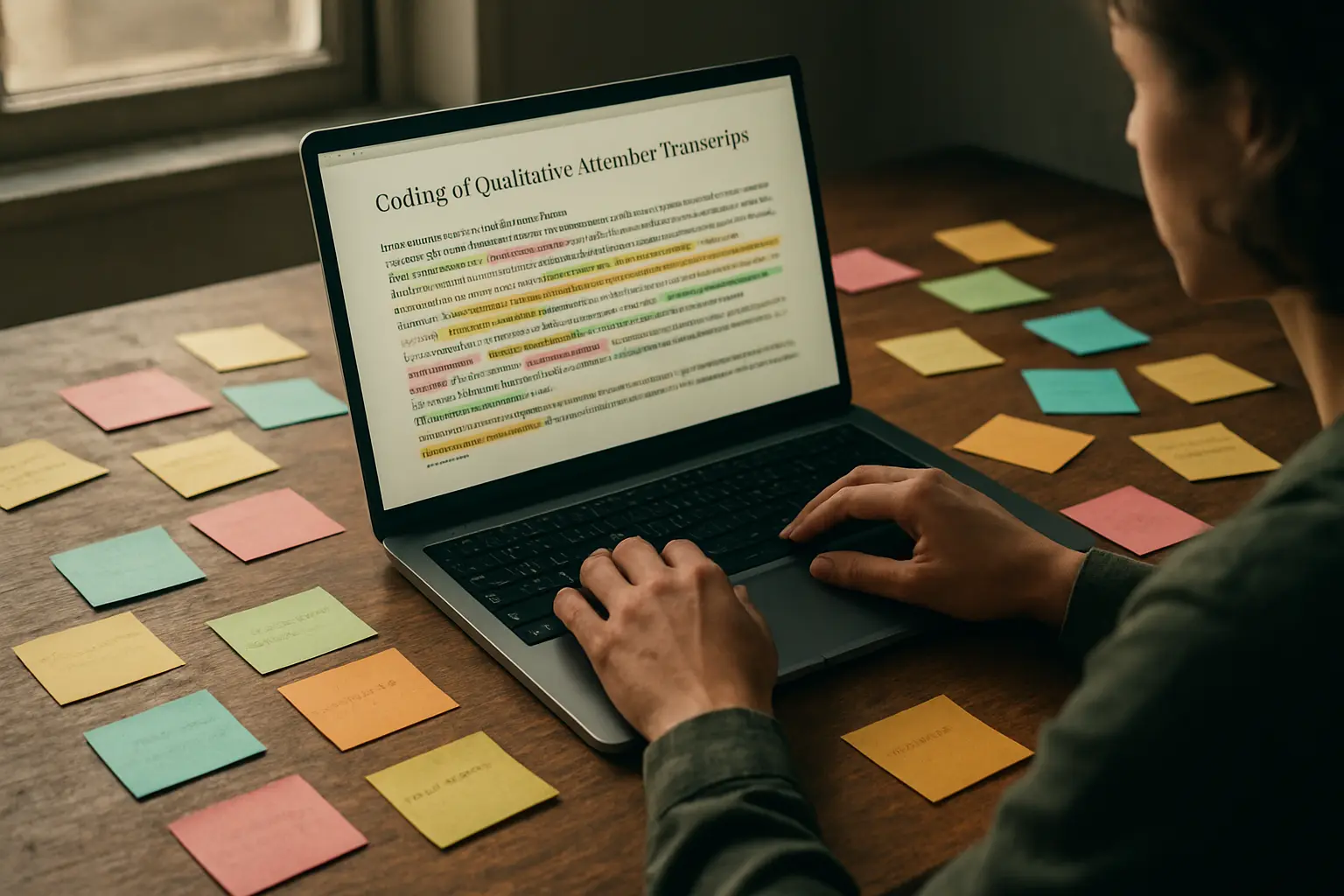
If you are running qualitative interviews or focus groups with teachers, students, or school leaders, AI can generate an initial set of candidate codes from your transcripts far faster than manual first-pass coding. Treat this exactly as a first pass: refine, merge, rename, and theorise those codes yourself, because your interpretive judgement — not the AI’s pattern-matching — is what the analysis chapter is graded on. For quantitative data (test scores, survey results, attendance data), AI is more useful for explaining and writing up statistical output in plain academic English than for choosing the test itself, which should follow your supervisor’s or a stats consultant’s guidance.
Chapter 5: Discussion and conclusion
This is the chapter AI should touch the least. The discussion chapter is where you connect your findings back to your literature review and theoretical framework, and it is the section examiners scrutinise most closely for original thinking. AI can help you check that you have addressed every research question you posed in Chapter 1, and can suggest a logical paragraph order, but the interpretation — what your findings actually mean for practice or policy — has to be your own argument.
Where AI actually saves time: a chapter breakdown
| Chapter | Good AI use | Keep this yours |
|---|---|---|
| Literature review | Thematic clustering, outline drafting, gap identification | Which studies matter and why |
| Methodology | Comparison tables, ethics section structure | Design justification, ethical reasoning |
| Data analysis | First-pass coding, statistical write-up language | Interpretation, theming, theorising |
| Discussion | Coverage checks, structural logic | Original argument and implications |
| References | Automatic formatting, in-text tracking | Verifying every source is real and accurate |
How Tesify fits into an education dissertation workflow
Tesify — built for exactly this workflow
Instead of a general chatbot that fabricates citations and drafts entire chapters with no accountability, Tesify is built around the chapter-by-chapter reality of dissertation writing. You keep control of your argument and analysis while Tesify handles the parts that eat the most time without adding academic value: structuring your literature notes into a working outline, tracking every citation as you write, and generating a formatted APA reference list automatically as your source list grows — critical for education dissertations, where APA is the near-universal standard.
Two features matter specifically for education students working under a BERA ethics deadline: the built-in plagiarism checker lets you verify originality on any chapter before you submit for ethics approval or supervisor review, and Auto Bibliography removes the single most tedious task in the final weeks — manually cross-checking every in-text citation against your reference list.
If you want a broader, discipline-agnostic view of the AI rules universities are actually enforcing, our guide to using AI to write your dissertation covers what Oxford, Cambridge, Harvard, and MIT currently permit. For the mechanics of structuring your whole timeline, see the 12-month dissertation roadmap, and for a deeper look at converting scattered notes into a drafted chapter, our notes-to-chapter AI workflow guide walks through the process step by step. Once your citation style is locked in, our guide on how to reformat a whole thesis to a new citation style is useful if your department switches referencing conventions mid-project.
FAQ
Can I use AI to write my education dissertation?
Most UK and US education faculties allow AI as a drafting and organisational aid but require you to disclose its use and retain full authorship of the analysis and argument. Always check your specific programme’s AI policy before you start, since rules differ by institution and even by module.
Will Turnitin flag AI-assisted writing in my education dissertation?
Turnitin’s AI-detection indicator can flag heavily AI-generated passages, and unedited AI text is detected with meaningfully higher accuracy than text you have substantially rewritten in your own voice. The safest approach is to use AI for structure, synthesis, and citation management, then write and revise the analytical prose yourself.
How long should an EdD or MEd dissertation literature review be?
There is no single fixed length, but literature reviews are typically one of the longest chapters in an education dissertation. Full EdD theses are commonly in the 125-150 page range overall, with the literature review often running 30-50 pages depending on the field’s research volume.
What do BERA ethical guidelines require for education research?
BERA’s Ethical Guidelines for Educational Research (fifth edition, 2024) set expectations around informed consent, participant wellbeing, data protection, and researcher responsibility that apply to any UK-based education dissertation involving human participants, including studies conducted in schools.
Can AI code my qualitative interview data for me?
AI tools can help generate an initial set of candidate codes or themes from interview transcripts, which speeds up the first pass. However, examiners expect you to demonstrate your own interpretive judgement in refining, naming, and theorising those codes, so AI output should be treated as a starting point, not a finished analysis.
What is the fastest way to fix citations across an education dissertation?
An automatic bibliography tool that tracks every source you cite in-text and generates a formatted reference list in your required style (APA is standard in most education programmes) removes the single most time-consuming manual task in the final weeks before submission.
Stop losing weeks to formatting, not writing
Your education dissertation deserves your analysis, not your evenings lost to reference formatting. Start free with Tesify and get your literature notes structured, your citations tracked, and your originality checked before your next supervision meeting.
Write your thesis with AI
Structure, draft, cite, and format your thesis faster with Tesify’s AI writing tools, automatic bibliography, and plagiarism checker. Free to start, no credit card required.





Leave a Reply