

From Messy Notes to a Structured Thesis Chapter with AI in 2026
You have got forty-seven tabs open, a Notion database that made perfect sense three months ago, a folder of PDFs with colour-coded highlights, and a Word document containing 2,300 words of fragmented thoughts that do not yet form a single coherent argument. Your chapter deadline is two weeks away. Sound familiar? The gap between having done the reading and producing a structured thesis chapter is where most students lose weeks — not because they lack knowledge, but because they have never been shown how to transform raw research material into an organised academic argument. In 2026, AI tools have made that transformation dramatically faster, but the workflow still needs to be done correctly or you risk producing something that reads like a summary rather than an argument, or worse, something that trips an integrity check.
This guide walks you through the complete note-to-chapter pipeline: auditing your notes, grouping themes, building an argument outline, using AI to draft without losing your voice, cleaning citations, and running integrity guardrails before you submit. Every step is designed for real dissertation students — not for people with unlimited time or a personal academic writing coach.
For tool-to-tool comparisons that affect your note-taking setup, the guide on NotebookLM vs ChatPDF vs Tesify covers which platform is best suited to each stage of the research pipeline. And if revision loops are trapping you once the chapter is drafted, see the companion on how AI fixes thesis revision loops for the structured editing workflow.
Why Research Notes Fail to Become Chapters
The honest answer is structural. Notes are collected in the order you encounter sources — chronologically, opportunistically, or by database search result. A thesis chapter, by contrast, is organised around an argument: a logical sequence of claims, evidence, and analysis that moves a reader from a question to an answer. These two structures are almost perfectly misaligned.
Most students try to bridge this gap by writing linearly through their notes — starting at the top of the pile and summarising each source in order. The result is a chapter that reads like an annotated bibliography, not an argument. Supervisors call it “descriptive” and send it back for revision. This is one of the most common reasons chapters go through three or four complete rewrites before a supervisor approves them.
The second failure mode is paralysis. Faced with hundreds of pages of material and a blank document, the pressure to produce something coherent from scratch causes many students to avoid starting at all. This is what writers’ block in thesis writing actually looks like at the chapter level — not a creative dry spell, but an organisational bottleneck. AI tools, used correctly, resolve the organisational bottleneck without short-circuiting the intellectual work that makes the chapter yours.
Stage 1 — The Note Audit: Consolidate Before You Organise
Before any AI tool can help you, you need your material in one place. This sounds obvious, but most students have notes scattered across four or five different systems: PDF annotations in Zotero or Mendeley, highlights in a reading app, typed summaries in Notion or OneNote, margin comments in printed articles, and voice memos recorded in the library. The first thirty minutes of your workflow should do nothing except collect these into a single working document.
What to include in your consolidated note document
- Direct quotes you have highlighted, with the full source citation immediately after each quote (author, year, page number — do this now or you will waste an hour hunting for page numbers later)
- Paraphrased summaries of key arguments from each source — one to three sentences per source, in your own words
- Your own analytical observations — the “so what?” thoughts you had while reading, even if they are fragmentary
- Questions that remain open — gaps or contradictions between sources that your chapter might need to address
- Data points or statistics you intend to reference, with full source attribution recorded immediately
Do not edit or organise at this stage. The goal is completeness — get everything into one document without judging whether it belongs. A typical chapter might produce a consolidated note document of 3,000 to 6,000 words of raw material. That is entirely normal and a good sign that you have done sufficient reading.
A quick note on citation discipline at Stage 1
The single most time-saving habit you can adopt at the note-taking stage is recording the full citation every time you paste a quote or note. Author, year, title, journal, volume, issue, pages, DOI. Tools like Tesify’s Auto Bibliography can format these automatically once you provide the source data — but they cannot recover source data you did not record. Garbage in, citation errors out.
Stage 2 — Theme Grouping: Finding the Architecture in Your Material
With your consolidated notes in front of you, the next task is to identify the recurring concepts — the themes — that run across multiple sources. This is where the architecture of your chapter begins to emerge, and where AI tools first become genuinely useful.
Manual theme-tagging pass
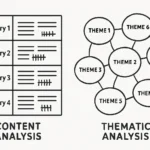
Read through your consolidated notes and tag each paragraph or note with a short theme label. You are looking for concepts that appear in at least three or four different sources. For a literature review on workplace wellbeing, these themes might be: “job control/autonomy”, “social support networks”, “presenteeism vs absenteeism”, “measurement tools”, “intervention effectiveness”. For a methodology chapter on qualitative research, they might be: “positionality/reflexivity”, “data saturation criteria”, “thematic analysis procedures”, “validity and trustworthiness”.
Aim for four to seven themes. Fewer than four and your chapter will feel thin; more than seven and it will read as fragmented. If you find yourself with twelve theme tags, look for parent categories that can absorb two or three smaller ones.
Using AI to stress-test your themes
Once you have your theme list, paste your consolidated notes into an AI writing tool and ask it a specific question: “Based on the following research notes, what are the main conceptual clusters, and are there any themes I appear to have missed?” This is not asking the AI to organise your chapter for you — it is using the AI as a sounding board to surface blind spots in your categorisation. A good AI tool will often identify a cross-cutting tension between two of your themes (for example, noting that “individual-level interventions” and “structural/organisational interventions” appear to be treated as separate in some sources and conflated in others). That observation is your chapter’s analytical contribution.
Creating a theme map
Before moving to outlining, produce a simple theme map: each theme as a heading, with the source notes that belong to it listed underneath. This document — typically one to two pages — becomes the skeleton you work from in Stage 3. If a note does not fit under any theme, put it in an “outliers” section. Outliers are often the most interesting material: they either point to a gap in the literature (a useful finding for a discussion chapter) or suggest your theme categories need refining.
Stage 3 — Building an Argument Outline, Not Just a Structure
Most students outline a chapter as a list of topics: Introduction → Theme A → Theme B → Theme C → Conclusion. This produces a chapter that covers ground but does not argue a position. An argument outline is different: each section makes a claim, and the sections are ordered so that each claim depends on or develops from the one before it.
The claim-evidence-analysis unit
The atomic unit of an academic chapter is the paragraph, and the atomic unit of the paragraph is: claim → evidence → analysis. Before you draft a single paragraph, you should be able to state — in one sentence — the claim that paragraph makes. If you cannot state the claim, you are not ready to write the paragraph. This is where most students rush, and where AI assistance is most valuable: use it to force this discipline on yourself before you start drafting.
At the outline level, your job is to write a one-sentence claim for each planned section, then list which pieces of evidence (sources, data, examples) support that claim, and note the analytical point you will make in connecting them. For a five-section literature review, you should be able to produce a table like this:
| Section | Core claim | Key sources | Analytical move |
|---|---|---|---|
| Section 1: Defining the construct | “Job control” lacks a consistent operational definition across studies | Karasek (1979), Hackman & Oldham (1976), Humphrey et al. (2007) | Establish measurement inconsistency as a problem that limits comparability |
| Section 2: Effect on wellbeing outcomes | Positive association between control and wellbeing holds across sectors but effect sizes vary | Nielsen et al. (2017), Stansfeld & Candy (2006) | Effect size variance returns to measurement inconsistency from Section 1 |
Building this table — which an AI tool can help you populate once your theme map is ready — takes one to two hours. It is the most valuable two hours you will spend on the chapter, because every drafting decision downstream flows from it. Students who skip this step and go straight to writing produce chapters that meander.
For a deeper look at how AI outlining compresses the planning phase across your whole thesis, see our guide on how to write your thesis faster with AI outlining.
Stage 4 — AI-Assisted Drafting: Scaffolding Your Paragraphs
With a solid argument outline in hand, you are ready to use AI to help convert your notes and outline points into draft prose. This is the stage where the workflow diverges most sharply from the “just ask ChatGPT to write my chapter” approach — which produces generic, unsourced text that your supervisor will immediately recognise as not yours.
What to give the AI
For each section of your outline, provide the AI with three specific inputs:
- The claim the section needs to make (one sentence from your outline table)
- The evidence notes for that section — the relevant excerpts from your consolidated note document, with citations included
- A brief sample of your own writing — paste a paragraph you have already written and that you are happy with, and ask the AI to match that register and tone
Then ask the AI to draft a structured paragraph that makes the claim, incorporates the evidence points, and keeps placeholders for the citations you will insert manually. A good prompt looks like: “Using only the evidence notes I have provided below, draft an academic paragraph that argues [your claim]. Match the writing style of the sample paragraph. Mark every claim that draws on a source with [CITE: author, year] so I can insert the full reference.”
Treating AI output as scaffolding, not copy
The AI draft is a first-draft scaffold, not finished text. It will compress nuance, miss the analytical move you noted in your outline, and produce generic transitions (“Furthermore…”, “In addition…”) that flatten the argument. Your job in the revision pass is to:
- Add the analytical commentary that connects evidence to claim in your own words
- Replace AI-generated transitions with transitions that reflect the logical relationship between the ideas
- Rewrite any sentence where the AI has introduced a characterisation of a source that you would not yourself use — AI tools sometimes soften critical positions or overstate consensus
- Insert the real citations where the [CITE] placeholders sit
A chapter drafted this way — AI scaffold + your rewrite + your citations — is unmistakably yours by the time you have finished, and it will have taken a fraction of the time a blank-page drafting approach would have required. If you find yourself barely changing the AI output, that is a warning sign that you have outsourced your analysis. Every paragraph should require meaningful rewriting.
If you are working on a discussion chapter specifically, where interpretation of your own data is involved, the process is the same but even more authorship-critical. Read our dedicated guide on how to write your dissertation discussion chapter with AI for the additional considerations that apply when the evidence is your own findings.
Keeping Your Academic Voice When AI Is Helping
Academic voice is not just about formal grammar. It is about the specific way you frame problems, the qualifications you apply to claims, the sources you choose to put in dialogue with each other, and the arguments you find worth making. These are the things that make a thesis recognisably a piece of human scholarship. AI tools trained on general academic text will produce prose that sounds plausibly academic but lacks the specific intellectual signature of your project.
The priming technique
The most reliable way to maintain your voice is the priming technique: before asking any AI tool to help you draft, paste in three to four paragraphs of your own writing that you consider representative — from an earlier chapter, a seminar paper, or even a well-developed introduction section. Label them “Writing sample — match this style.” Every subsequent drafting request in that session will be filtered through the register, sentence length, and argumentative style of your sample. The difference between primed and unprimed AI output is substantial.
Write your analytical commentary first
Another reliable technique is to draft your own analytical commentary sentences before asking AI to fill in the evidential connective tissue. Start each paragraph by writing the two sentences that are most entirely yours: the claim sentence and the “so what?” sentence that explains why the evidence you are about to present supports the claim. Then use AI to draft the middle of the paragraph — the evidence summary and the transition — around those fixed points. This keeps the intellectual direction of the paragraph firmly in your control.
Struggling to improve the quality of prose that is already drafted? The AI writing quality guide covers how to use AI editing tools for clarity and academic tone without losing your own voice.
Citations and Integrity: The Guardrails You Cannot Skip
This is the part of the workflow where corners are most often cut and where the consequences are most serious. Citation errors and academic integrity breaches are not the same problem, but they are both routes to a failing mark, and AI use introduces specific risks for both.
The hallucinated citation problem
Large language models fabricate references. This is not a bug that will be fixed in the next version — it is a fundamental property of how these models generate text. They produce plausible-sounding citations by combining real author names, real journal titles, and real-ish volume numbers in combinations that may never have existed. A student who asks an AI tool to “add some supporting citations from the literature” and then does not verify each one individually is virtually certain to submit a thesis containing non-existent sources.
The rule is absolute: every citation in your thesis must correspond to a source you have personally accessed and read. If the AI suggests a source you have not read, verify it exists, access it, read the relevant section, and then decide whether it actually supports the claim the AI used it for. Often, it does not — the AI has guessed at relevance rather than having read the paper.
Use Tesify’s Auto Bibliography to format the references you have personally collected — it handles APA, MLA, Harvard, Chicago, and dozens of other styles automatically. What it will not do, by design, is invent sources. You supply the source data; it formats them perfectly.
Avoiding plagiarism when paraphrasing with AI
When AI helps you paraphrase a source, there is a risk of “patch plagiarism” — where the AI has changed some words but retained the sentence structure of the original so closely that it constitutes unacknowledged paraphrase. This is distinct from AI-detection flags (which concern AI-generated text) and can still produce a Turnitin similarity match to the original source. The safeguard is to rewrite AI-produced paraphrases in your own words a second time, not just review them. If you cannot explain the paraphrased idea without looking at the AI draft, you have not processed the idea deeply enough — and your chapter will show it.
Before you submit any chapter, run it through a robust plagiarism checker to catch both similarity issues and to verify that your citations are not creating inadvertent matching. This is a standard pre-submission step, not a sign of distrust in your own work — it is what thorough scholars do.
The AI-detection flag risk
If you use AI to draft paragraphs and then do not sufficiently rewrite them, AI-detection tools like Turnitin’s AI writing indicator will flag the text. This is not inherently a misconduct finding — but it will trigger a review, and if your chapter is predominantly AI-generated text that has not been meaningfully transformed by your own intellectual contribution, that does constitute academic misconduct at most institutions. The rewrite discipline described in Stage 4 is your practical safeguard against this risk.
A Full Workflow Example: Literature Review Chapter
To make the pipeline concrete, here is how it plays out for a master’s student writing a 5,000-word literature review chapter on digital mental health interventions for university students.
Starting material: 34 sources read over six weeks, notes in Zotero (highlights + typed annotations), a shared Google Doc of reading summaries, and a voice memo from a supervision meeting where the supervisor flagged that the student needed to “take a stronger position on the measurement issues.”
Stage 1 — Note audit (60 minutes): Consolidate all Zotero annotations, typed summaries, and supervision notes into one document. Result: 4,800 words of raw material with citation data recorded throughout.
Stage 2 — Theme grouping (45 minutes): Manual tagging pass produces six themes: (1) definition/scope of digital MH interventions, (2) target populations and accessibility, (3) effectiveness evidence — RCTs, (4) effectiveness evidence — real-world data, (5) measurement inconsistency across studies, (6) implementation barriers. Supervisor’s measurement note maps directly to theme 5, confirming it needs to be a prominent section. AI stress-test confirms the themes but flags that themes 3 and 4 might be better merged under “effectiveness evidence” with measurement inconsistency treated as a cross-cutting critique, not a separate section. Student agrees — revised to five themes.
Stage 3 — Argument outline (90 minutes): One-sentence claim for each section, sources mapped to each claim, analytical move identified. Key insight from this stage: the chapter’s contribution is that measurement inconsistency is not a methodological inconvenience but the reason why effectiveness evidence appears more mixed than it is — a defensible position that the supervisor had gestured at but the student had not previously articulated explicitly.
Stage 4 — AI-assisted drafting (3 hours across two sessions): Each section drafted using the primed AI technique — sample paragraph supplied, claim + evidence notes provided per section, AI produces first scaffold, student rewrites each paragraph adding analytical commentary, all [CITE] placeholders replaced with formatted references. Auto Bibliography formats all 34 references in Harvard style in under ten minutes.
Result: 5,100-word draft ready for supervisor review, produced in approximately six focused hours of work rather than the two to three weeks of fragmented drafting the student had originally expected. The supervisor’s response at the next meeting: “This is the clearest argument you have put on paper. The measurement critique in section 4 is exactly what I meant.”
When you are feeling overwhelmed by the sheer volume of work remaining across all your chapters, the approach in this example scales directly to the bigger-picture strategy covered in our guide to finishing your dissertation when overwhelmed.
Common Mistakes Students Make at Each Stage
| Stage | Common mistake | Consequence | Fix |
|---|---|---|---|
| Note audit | Skipping it and going straight to outlining | Incomplete chapter; key sources missed entirely | Always consolidate first, even if it takes an hour |
| Theme grouping | Creating themes based on sources rather than concepts | Chapter reads as “Author A says X, Author B says Y” | Tags should be concepts (autonomy, measurement) not author names |
| Argument outline | Listing topics rather than claims | Descriptive chapter with no analytical position | Every section heading should be expressible as a complete sentence claim |
| AI-assisted drafting | Accepting AI output with minimal rewriting | Generic prose, AI-detection flag, lost voice | Every AI paragraph must require meaningful rewriting to be genuinely yours |
| Citations | Using AI-generated references without verification | Fabricated sources in submitted thesis; potential misconduct finding | Never submit a citation you have not personally verified in the original source |
| Integrity check | Skipping pre-submission plagiarism check | Avoidable similarity flags discovered after submission | Run every chapter through a plagiarism checker before sending to supervisor |
The Tools That Make This Workflow Practical
The workflow described here requires a few key capabilities from your toolset: a writing environment that supports AI drafting with context-awareness, an auto-bibliography tool that handles your reference list without inventing sources, a plagiarism checker that catches both similarity and can flag AI-generated text, and an editing layer that helps you improve academic tone and clarity after your rewrite pass.
Tesify integrates all four of these into a single platform built specifically for dissertation and thesis writing. Unlike general-purpose AI assistants, it is designed around the academic chapter workflow — so the AI drafting tool understands academic register, the Auto Bibliography formats from your source data without hallucinating, the AI Editor helps you improve clarity and flow in your rewrite pass, and the plagiarism checker is calibrated for academic similarity standards rather than web-content detection.
For students who want the full picture of what an AI-native thesis workflow looks like end to end — from first draft to polished submission — Tesify’s free trial is the fastest way to see whether this approach fits how you work. The note-to-chapter workflow above can be run inside the platform from the consolidated note document all the way through to formatted, citation-checked draft prose.
Ready to turn your notes into a chapter?
Start the four-stage workflow inside Tesify — AI-assisted drafting, Auto Bibliography, and a plagiarism check all in one place. No generic AI output; an academic workflow built for dissertation students.
Frequently Asked Questions
Can I use AI to turn my research notes into a thesis chapter?
Yes — ethically and effectively. AI tools work best as a scaffolding aid: they help you group themes, build an argument outline, and convert bullet-point notes into flowing prose. The critical thinking, interpretation, and final writing decisions must remain yours. Always declare AI use according to your institution’s policy, and never submit AI-generated paragraphs that you have not meaningfully rewritten and grounded in sources you have personally verified.
How do I organise messy research notes before writing a thesis chapter?
Start by consolidating every note — highlights, typed summaries, voice memos, margin comments — into a single working document with citation data attached to every note. Then do a theme-tagging pass to cluster notes under four to seven recurring conceptual themes. From those clusters, identify your argument spine: the logical sequence of claims and evidence. Only then open your writing document and begin drafting.
Will AI-drafted paragraphs get flagged by Turnitin or plagiarism checkers?
AI-generated text is assessed by AI-detection tools (like Turnitin’s AI writing indicator), not traditional similarity indexes. To avoid flags, always rewrite AI-drafted paragraphs substantially in your own voice, ground every claim in a source you have personally read and cited, and run your final chapter through a plagiarism checker before submission. Paragraphs you have genuinely rewritten and filled with your own analysis will not read as AI-generated to detection tools.
How do I keep my academic voice when using AI to draft sections?
Use the priming technique: paste three to four paragraphs of your own writing into the AI session and instruct it to match your register and style before generating any draft text. Then write your own analytical commentary sentences (claim and “so what?”) first, and use AI only to draft the evidential middle of the paragraph around those fixed points. Your voice emerges through the rewrite, not the blank page.
What is the safest way to cite sources when using AI to help write a chapter?
Only cite sources you have personally read and verified. Never allow AI to generate citations directly — models reliably hallucinate author names, journal titles, volume numbers, and DOIs. Use a bibliography tool that formats references you supply rather than inventing them. Check every reference against the original publication before submitting. A single fabricated citation is an academic integrity issue; a chapter with several is a serious misconduct risk.
How long does it take to go from raw notes to a finished draft chapter using AI?
For a 4,000–5,000-word literature review or discussion chapter, a focused student can complete the full workflow — note audit, theme grouping, argument outline, AI-assisted drafting, rewrite pass, and citation formatting — in approximately five to six hours of focused work across two or three sessions. This compares favourably to the unstructured blank-page approach, which typically takes one to two weeks of fragmented drafting for the same output.
Write your thesis with AI
Structure, draft, cite, and format your thesis faster with Tesify’s AI writing tools, automatic bibliography, and plagiarism checker. Free to start, no credit card required.


Leave a Reply