

How to Write a Placement Year Report Step by Step (2026)
A placement year report is the assessed document that converts twelve months of paid work into academic credit. It combines an account of your role, an analysis of the organisation, and structured reflection against your learning outcomes — assessed by your university, not your employer.
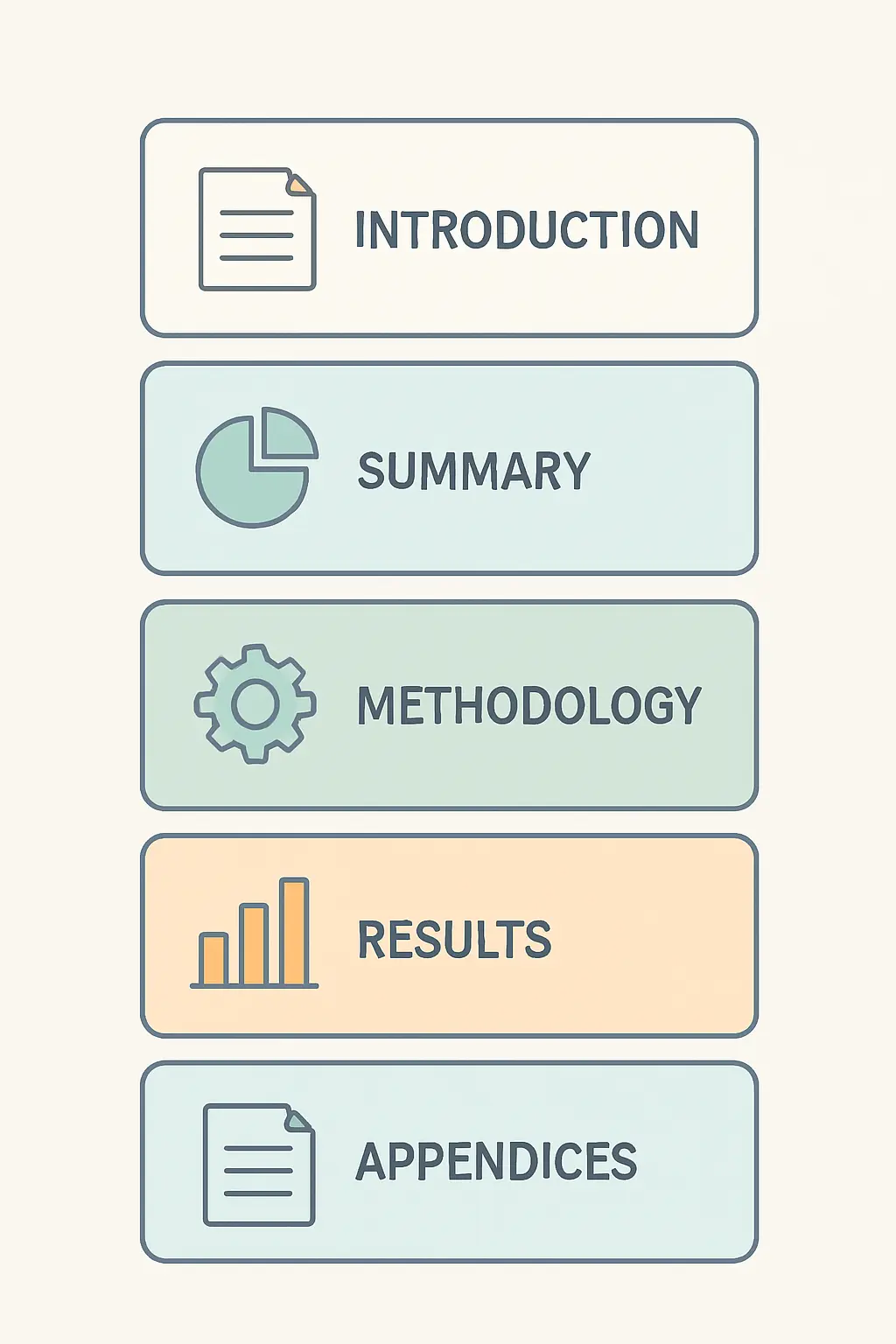
Step 1: Find your actual assessment brief before you write anything
This sounds obvious and it is the step most students skip. Placement reports are one of the least standardised assessments in UK higher education. Two students on the same sandwich degree at different universities can face completely different documents.
Some departments want a 5,000-word reflective portfolio. Others want a 10,000-word business analysis closer to a consultancy report. Engineering schools often want a technical report on one project you delivered. Your module handbook is the only authority here.
Extract three things before drafting: the word count, the weighting between description and reflection, and the learning outcomes you are being marked against. Everything below is scaffolding you fit to that brief.
Step 2: Establish what you are allowed to disclose
This is the step that has no equivalent in a normal dissertation, and it is where placement reports go wrong most expensively. You have spent a year inside a commercial organisation. Some of what you learned is confidential.
Check whether you signed a non-disclosure agreement or a confidentiality clause in your contract. If you did, it binds you even though your reader is an academic marker. Common restrictions cover client names, financial figures, unreleased products, internal process documentation and personal data about colleagues.
Three workable solutions, in order of preference:
- Ask your line manager to review and approve the draft. Most employers are happy to; build two weeks into your timeline for it.
- Anonymise and generalise. “A major UK retail bank” instead of the name; percentage change instead of absolute revenue.
- Request a confidential submission. Many universities allow a report to be marked but not deposited in the library. Ask your placement tutor early — this is usually a formal process with a deadline.
Never assume that because your marker is bound by academic confidentiality, your employer’s clause does not apply. It does.
Step 3: Write the organisational context, briefly
Give your marker enough to understand the setting and no more. Sector, size, structure, where your team sat, and what the organisation is actually trying to do. Six hundred words is usually plenty.
The common failure is a ten-page company history copied from the corporate website. It earns almost nothing. Markers award credit for analysis of the organisation, not description of it — so if you include a section on market position, make it serve a later argument about why your work mattered.
Step 4: Describe your role in terms of responsibility, not tasks
A task list reads as junior. A responsibility account reads as professional. The difference is whether you describe what you were given or what you owned.
| Weak (task framing) | Strong (responsibility framing) |
|---|---|
| “I updated the stock spreadsheet each morning.” | “I owned daily stock reconciliation for three depots, escalating variances above 2% to the operations manager.” |
| “I helped with testing.” | “I wrote and maintained the regression test suite for the payments module across two release cycles.” |
| “I attended client meetings.” | “I prepared the weekly client status pack and presented the delivery section from month four onwards.” |
Quantify wherever your confidentiality position allows. Volume, frequency, and scope are usually safe to disclose even when values are not.
Step 5: Build the reflective core around a model
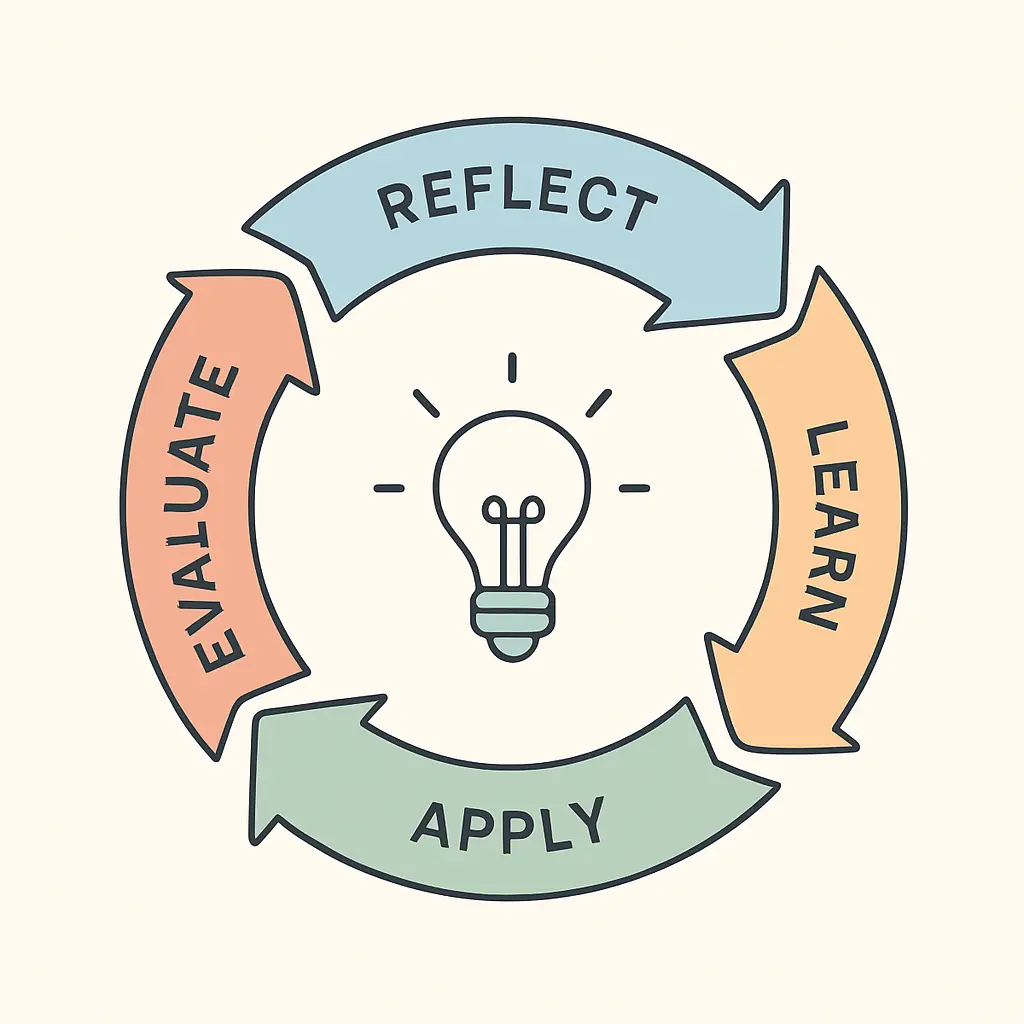
Reflection is where the marks are, and it is the section students find hardest because it feels unacademic. It is not. Reflection in an assessed report means analysing an experience against a framework and drawing a transferable conclusion.
Use a named model and say which one you are using. Gibbs’ reflective cycle and Kolb’s experiential learning cycle are the two most commonly taught in UK business and engineering schools; Schön’s reflection-in-action and reflection-on-action distinction is common in education and healthcare programmes. Any of them works. Not naming one is what costs marks.
Structure each reflective episode the same way: what happened, what you did, what the outcome was, what you would do differently, and what general principle you take from it. Two or three developed episodes beat eight shallow ones.
Choose episodes where something went wrong or was genuinely difficult. A placement report in which everything succeeded is not credible and gives you nothing to analyse. Markers reward candid analysis of a mistake far more than a polished success story.
Step 6: Map explicitly to your learning outcomes
Your placement module has published learning outcomes. Your marker has a rubric built from them. Make the mapping visible rather than leaving the marker to infer it.
The simplest technique is a short table near the end: each learning outcome in one column, the evidence and the section where you address it in the other. It takes twenty minutes and materially changes how a rushed marker reads the rest of your work.
Step 7: Handle appendices and evidence properly
Appendices are where placement reports carry their evidence — project artefacts, supervisor feedback, training records, timesheets. They usually sit outside the word count, which tempts students to dump everything into them.
Resist that. Only include material you explicitly reference in the body, label each appendix, and redact anything commercially sensitive before it goes in. Our guide to writing an appendix for a thesis or dissertation covers labelling and cross-referencing conventions that apply directly here.
Step 8: Get employer sign-off, then proofread against the brief
Build in the employer review from step 2 as a hard milestone, not an afterthought. Line managers go on leave; approvals take longer than students expect.
Then do a final pass reading only the assessment brief and your report side by side. Check the word count, that every learning outcome is addressed, and that you have not named anything your confidentiality position forbids. Being honest about what your placement could not teach you is a strength, and the same discipline that shapes a good research limitations section applies to a placement report’s closing reflection.
A realistic writing timeline
| When | What to do |
|---|---|
| Throughout the year | Keep a weekly log — 10 minutes, dated. This is the single highest-value habit. |
| 2 months before deadline | Re-read the brief; outline against learning outcomes; confirm confidentiality position. |
| 6 weeks before | Draft context and role sections from your log. |
| 4 weeks before | Draft reflective episodes using your chosen model. |
| 3 weeks before | Send draft to line manager for approval. |
| 1 week before | Incorporate feedback, finalise appendices, proofread against brief. |
If you kept no log, reconstruct one from your calendar, sent email and version history before you start writing. It is slower but far better than writing from memory. Setting clear objectives for the report itself helps too — the approach in our guide to writing research aims and objectives transfers well to framing a placement report’s purpose.
Frequently asked questions
How long is a placement year report?
There is no national standard. UK placement reports commonly fall between 3,000 and 10,000 words, with business and management programmes tending towards the upper end and engineering technical reports towards the lower. Your module handbook is the only authoritative source.
Does my employer mark my placement report?
No. The report is marked by your university. Your employer usually submits a separate supervisor evaluation of your performance at work, which may contribute to the overall placement grade, but the report itself is academic work assessed against academic criteria.
Can I write about confidential information in my placement report?
Not without permission. If you signed an NDA or confidentiality clause it applies regardless of who reads the report. Anonymise organisations and figures, ask your line manager to approve the draft, and ask your placement tutor about confidential submission if the substance of your work cannot be generalised.
Do placement year marks count towards my degree classification?
It varies by institution. At many UK universities the placement year is credit-bearing but weighted lightly, or is assessed pass/fail and recorded as a “with placement year” or “sandwich” designation on the degree title. Check your programme regulations rather than assuming.
What reflective model should I use?
Gibbs’ reflective cycle is the most widely taught in UK business and engineering programmes and is a safe default. Kolb’s experiential learning cycle suits reports focused on skill development, and Schön’s reflection-in-action framing is common in education and healthcare. What matters most is naming the model and applying it consistently.
What if my placement went badly?
A difficult placement can produce a stronger report than an easy one. Markers assess the quality of your analysis, not the quality of your experience. Analyse honestly what went wrong, what was within your control, and what you would do differently — while keeping the tone professional rather than aggrieved.
What Tesify does not do
Tesify does not write your placement report, your reflective episodes, or your analysis. It cannot — the entire assessment rests on your experience of your placement, which only you have. What it does is build the artefacts around your writing: a section outline mapped to your learning outcomes, a formatted bibliography for the models and sources you cite, and an AI-use declaration you can submit with the report.
If a tool offers to produce the reflection for you, that is not a shortcut past the assessment — it is a submission with no original work behind it, which is precisely what your learning outcomes are designed to test.
Outline your placement report against your learning outcomes and generate a clean, correctly formatted reference list.
Write your thesis with AI
Structure, draft, cite, and format your thesis faster with Tesify’s AI writing tools, automatic bibliography, and plagiarism checker. Free to start, no credit card required.






Leave a Reply