
Do Examiners Read Your Whole Thesis? What Actually Gets Read in 2026
The short answer is yes — but “reading the whole thesis” and “reading it all equally” are two very different things. Most PhD and master’s examiners arrive at the viva having worked through every chapter, yet their attention is not distributed uniformly across 80,000 words. Research into examiner behaviour, published guidance from the UK Council for Graduate Education, and accounts from academics who examine regularly all point to the same pattern: a small set of sections receive intense, almost forensic scrutiny, while other parts of the thesis are read with considerably more economy.
Understanding exactly where examiner attention concentrates — and why — is one of the most practically useful things a doctoral or master’s student can know before submitting. It does not license cutting corners elsewhere, but it does tell you where your final polishing effort will have the greatest return.
Do examiners actually read the entire thesis?
Formal examiner guidelines from institutions including the University of Leicester Doctoral College and UCL Doctoral School make clear that examiners are expected to read and assess the thesis in full before the viva. Most institutions require the thesis to be submitted to examiners at least four to six weeks before the oral examination, specifically to allow time for a thorough reading.
In practice, reading happens in multiple sittings rather than a single cover-to-cover pass. Prof. Pat Thomson, emeritus professor at the University of Nottingham and a prolific writer on doctoral education, describes the typical examiner pattern as: a strategic pre-read of high-signal sections first, followed by a sequential reading of the full text, and then targeted re-reading of specific chapters when writing the pre-viva report. This means your thesis gets read more than once — but the emphasis on each pass differs.
What varies between examiners is not whether they read the thesis but how they annotate and triage it. Internal examiners tend to read very closely throughout. External examiners — particularly those who examine frequently — develop efficient reading strategies that front-load time in the sections most diagnostic of thesis quality.
Examiners from the School of Advanced Study, University of London discuss how they prepare for and conduct a PhD viva — including how they actually read and approach the thesis before the oral examination.
What order do examiners read a thesis in?
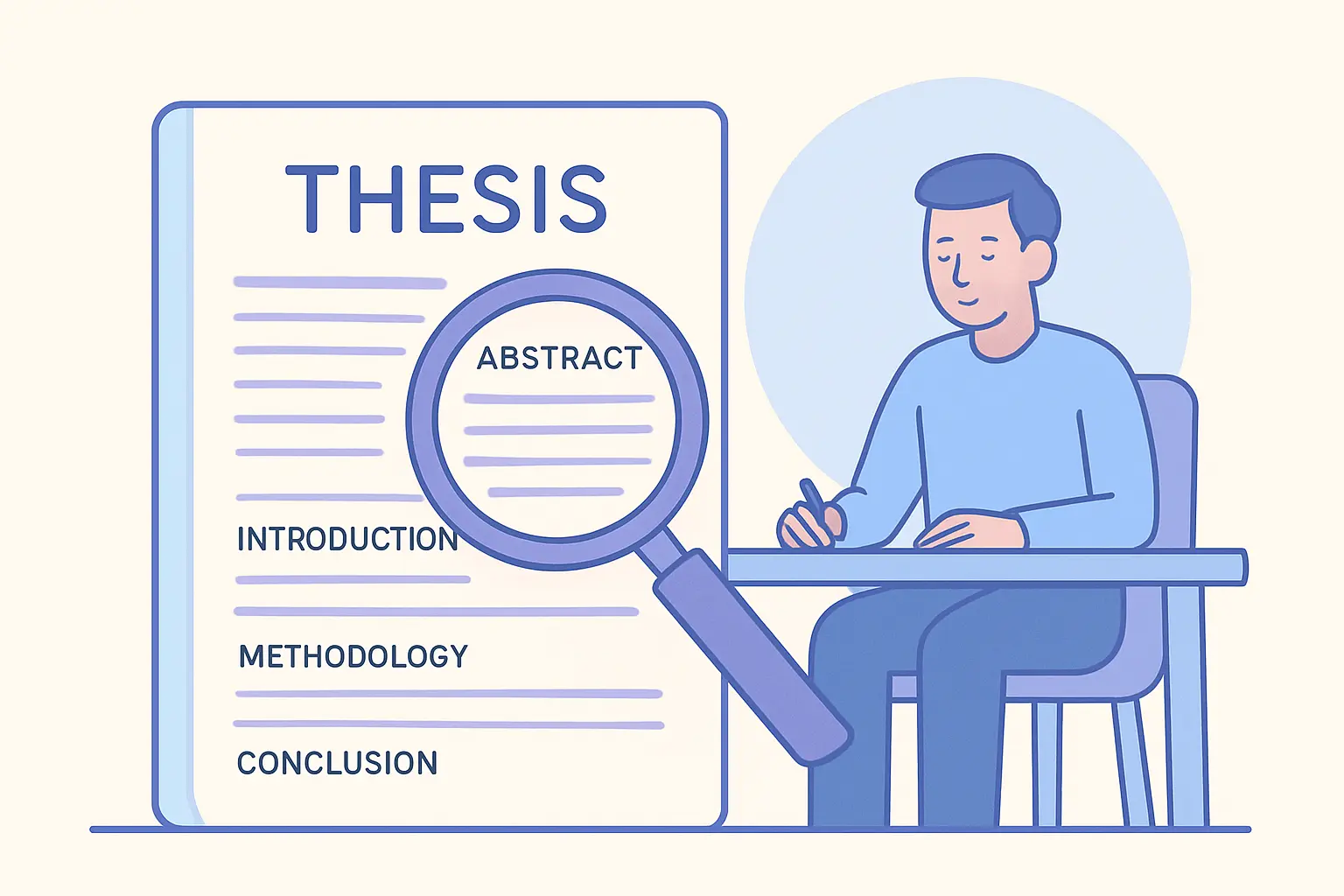
Before starting a linear read, most examiners conduct what Thomson calls a “pre-read” — a rapid structural survey that typically covers the abstract, the table of contents, the conclusion, and the reference list, in roughly that order. This pre-read forms a first impression that, while not irreversible, shapes how the examiner then reads every subsequent chapter.
The research by Holbrook, Bourke, Fairbairn, and Lovat (published in Assessment & Evaluation in Higher Education) found that examiners frequently reported forming their initial judgement of a thesis’s quality by the end of the second or third chapter — often by the end of the literature review. That early impression then acts as a lens through which the rest of the thesis is filtered. A strong opening buys goodwill; a weak one creates a burden of proof the student must overcome across every subsequent chapter.
After the pre-read, most examiners proceed sequentially through the remaining chapters before returning to targeted sections when completing their written report.
How closely do examiners read the abstract?
Very closely — the abstract is among the first things an examiner reads and it sets the frame for everything that follows. Examiner guidance from the University of Manchester notes that a strong abstract should communicate what was studied, why, how, what was found, and what it means — all in a single page. Examiners look at the abstract to check whether the student can accurately summarise their own argument in condensed form, which is itself a test of conceptual mastery.
A muddled or vague abstract immediately signals potential problems with the thesis’s overall coherence. Conversely, a precise, well-structured abstract starts the examiner’s reading with confidence. Because the abstract is so short, every sentence receives attention that longer chapters simply cannot guarantee.
What are examiners looking for in the introduction?
The introduction is the second high-scrutiny zone. Examiners read it to verify that the thesis has a clear research problem, a well-articulated research question or aim, a stated rationale for why the question matters, and a signposted structure. The UK Council for Graduate Education guidance emphasises that the introduction sets the intellectual contract between thesis and examiner — it commits the student to delivering specific claims, and the examiner evaluates the rest of the thesis in light of whether those claims are fulfilled.
A common examiner complaint is an introduction that describes what was done rather than arguing why it needed to be done. The distinction matters: description places you in the role of technician; argumentation places you in the role of researcher. Examiners examining at doctoral level are specifically licensed to determine whether the student can carry out independent research, and the introduction is the first place where that independence is tested.
Do examiners scrutinise the literature review?
Yes, and they read it in two distinct ways. First, as a narrative: does the student synthesise the field rather than merely list it, and is there a clear argument that moves from the existing literature to the gap this thesis addresses? Second, as an audit: are the key works in the field cited, and are important recent contributions present? Examiners with deep subject knowledge will notice missing seminal texts immediately.
Research published in the journal Assessment & Evaluation in Higher Education confirmed that examiners cross-reference the literature review with the reference list as one of their earliest actions. If the reference list looks thin or dated, they read the literature review more critically for signs that the student lacks command of the field. If the references are robust, the examiner typically reads the literature review with a more generous baseline assumption.
The literature review is also the chapter where most students make the mistake of summarising sources without showing how each source advances or complicates their argument. Examiners find this pattern quickly and it contributes to the most common viva question: “How does your work differ from X?”
Why is the methodology chapter the most examined section?
The methodology chapter is, in the words of Thomson, “the place where you demonstrate that you know how to design and conduct research.” It is the chapter where licensing decisions are made — where examiners determine whether the student understands not just what they did, but why those choices were defensible given the research question, the epistemological position, and the practical constraints of the study.
Examiners read the methodology chapter with particular attention to three areas: the match between the research question and the chosen design (if you ask a question about experience and use a survey with no qualitative component, that mismatch will be flagged); the rigour of data collection and analysis procedures; and the quality of the limitations section (a student who cannot articulate the limitations of their own methodology is unlikely to be judged as having achieved doctoral-level criticality). Our guide to the dissertation methodology chapter covers the structure examiners expect to see in detail.
Examiners often re-read the methodology chapter a second time when preparing their written report, checking their specific questions or concerns against the student’s stated procedures. It is the chapter most likely to generate viva questions that probe the student’s reasoning rather than their factual recall.
How carefully do examiners read the results and findings chapters?
Results and findings chapters tend to receive a more selective first read than the methodology, introduction, or conclusion. Examiners typically scan the structure — checking that tables, figures, and themes are clearly labelled and logically organised — before reading the analytical commentary around the findings in detail. They are looking for evidence that the student distinguishes between reporting a result and interpreting its significance, and that the analysis flows from the methodology described earlier.
In a second or third pass, when writing the examination report, specific findings are often checked more carefully if they appear in the conclusion’s claims. Examiners work backwards: if the conclusion states a major finding, they return to the relevant results section to verify that the evidence actually supports that claim.
Data-heavy chapters with many tables and figures receive fewer minutes per page than chapters with continuous analytical prose, simply because scanning a well-presented table is faster than reading a paragraph. This is a reason to invest in clear visual presentation of quantitative data — a well-formatted table communicates rapidly and efficiently, reducing cognitive load on the examiner and presenting your work at its strongest.
How much attention does the conclusion receive?
The conclusion receives disproportionately high examiner attention relative to its word count. It is typically one of the first sections read in the pre-read phase, and it is read again carefully during the linear pass and once more when the examiner writes their report. The reason is straightforward: the conclusion is where the thesis makes its knowledge claims. Examiners are assessing whether those claims are proportionate to the evidence presented, whether the contribution to knowledge is clearly articulated, and whether the student demonstrates awareness of the limitations and future directions of their research.
A strong conclusion should answer four questions that examiners carry into every viva: What was the research question? What did you find? How does that advance knowledge? What would you do next? A conclusion that fails to address all four — or that makes claims larger than the evidence supports — is one of the most common reasons for requests for major corrections. Our deeper guide to the difference between the discussion and conclusion chapters explains the functional distinctions that examiners treat as diagnostic.
Do examiners check the reference list?
Yes — and earlier than most students expect. The reference list is frequently part of the examiner’s pre-read, reviewed before they have finished reading chapter two. Examiners use the reference list as a field-knowledge audit: are the seminal works cited? Are the key journals in the discipline represented? Is the most recent scholarship present, or does coverage stop suspiciously early? A reference list that ends two or three years before submission is often a signal that the literature review was drafted early and not updated.
Examiners also check the reference list for consistency with the in-text citations. Missing references, mismatched dates, or incorrect author names generate immediate credibility concerns. Running your reference list through a plagiarism and formatting checker before submission helps catch these formatting errors before they reach an examiner. The Tesify Plagiarism Checker can identify citation inconsistencies alongside originality checks, reducing the risk of examiner-flagged referencing errors.
Are appendices read?
Appendices are rarely read in full during the first pass. Examiners typically check the appendix list early to understand the scope of supporting material available, and then dip into specific appendices when questions arise during their reading of the main chapters. If the methodology references an interview guide in Appendix B, an examiner interested in the quality of that instrument will look it up. If the analysis mentions a coding framework in Appendix D, they may check that too. Our guide on how to write a thesis appendix explains what belongs in an appendix and how to reference it correctly so examiners can locate materials easily.
The practical implication: appendices must be complete, clearly labelled, and accurately cross-referenced in the body text. An appendix that is promised in the methods chapter but absent from the appendix section is a credibility problem, even if the examiner only discovers it while checking a specific point.
Where should you focus your final polish?
Given the reading patterns described above, the highest-return final revision investment — in descending priority order — is:
- Abstract: Every sentence is read. It must be accurate, concise, and representative of your actual argument. Re-read it after finalising your conclusion to check it still matches.
- Introduction: The problem statement, research question, rationale, and chapter signposting must be precise and coherent. Examiners form early impressions here.
- Methodology chapter: Justify every design decision. State limitations clearly. Ensure the research question–design fit is explicit.
- Conclusion: Articulate your contribution to knowledge directly and proportionately. Answer the four examiner questions (question, finding, contribution, future work).
- Reference list: Check completeness, recency, and formatting consistency. Every in-text citation must have a matching entry.
- Literature review: Ensure the argument moves from field → gap → your study, and that key recent works are present.
Body chapters and appendices benefit from proofreading and structural clarity checks, but they absorb a smaller share of examiner attention than the sections above. If your revision time is limited, allocate it accordingly.

For students using Tesify to structure and review their thesis, the platform’s section-by-section feedback is particularly useful for the high-scrutiny chapters: the tool flags logical gaps in arguments, checks that research questions are answered in the conclusion, and highlights underdeveloped justifications in methodology sections — exactly the issues that prompt examiner corrections. Looking at how top-scoring master’s theses are structured gives a useful calibration point for what distinction-level execution looks like in each chapter.
Frequently Asked Questions
Do examiners read the whole thesis before the viva?
Yes. Institutions require examiners to have read the thesis in full before the viva. Most guidelines provide examiners with the thesis four to six weeks in advance to allow sufficient reading time. The viva is not the first time an examiner encounters your work — it is a structured conversation about a thesis they have already studied.
Which chapter do examiners read most carefully?
The methodology chapter typically receives the deepest and most critical scrutiny because it is where examiners assess whether the student can design and justify independent research. The abstract, introduction, and conclusion are also read with high attention because they communicate the thesis’s core argument and claims. The reference list is examined early and more carefully than most students expect.
Do examiners read chapters in order?
Not always on the first pass. A common examiner approach is to pre-read the abstract, table of contents, conclusion, and reference list before reading the thesis sequentially from chapter one. This means your conclusion is read relatively early, before the examiner has worked through your evidence chapters. A strong, clearly argued conclusion matters from the start.
Do examiners read appendices?
Appendices are rarely read in full. Examiners typically scan the appendix list and then refer to specific appendices when questions arise from their reading of the main chapters — for example, checking an interview schedule referenced in the methodology. Appendices must be complete and accurately cross-referenced, but they do not receive the same sustained reading as the core chapters.
How many times does an examiner read a thesis?
Most examiners read the thesis at least twice: once as a complete linear read and once more selectively when writing their pre-viva report. High-attention sections — methodology, conclusion, abstract — are typically revisited during report writing. Some examiners read particularly strong or problematic theses a third time before arriving at the viva.
Do examiners check the reference list?
Yes, and usually early in the pre-read phase. Examiners use the reference list to assess how well the student knows their field — checking that seminal works are cited, that the coverage is current, and that entries match in-text citations. A reference list with missing entries, incorrect dates, or formatting inconsistencies reduces examiner confidence before they have finished the opening chapters.
Does it matter if my body chapters have some rough prose?
It matters, but less than rough prose in your abstract, introduction, methodology, or conclusion. Body chapters receive important but less intensive scrutiny than the high-signal sections. Consistent argument quality and clear presentation in the results or findings chapters still matters — but if revision time is limited, priority should go to the sections examiners read most carefully. A polished abstract and precise conclusion carry disproportionate weight.
Can I use AI tools to help polish the high-scrutiny sections?
Yes, within your institution’s AI policy. AI-assisted writing tools can help identify vague or unsupported claims in your introduction and conclusion, flag methodology justifications that are underdeveloped, and check that your abstract accurately represents the thesis. The key constraint is transparency — many institutions require disclosure of AI use. Our guide to whether AI can be used in dissertation writing in 2026 gives a policy-grounded breakdown by institution type.
What do examiners look for in the conclusion specifically?
Examiners look for four things in the conclusion: a clear restatement of the research question, a direct answer based on the evidence presented, an articulation of the contribution to knowledge (what your study adds that was not known before), and a reflexive acknowledgement of limitations and future directions. Conclusions that conflate discussion and conclusion, or that make claims disproportionate to the evidence, generate correction requests. See the detailed breakdown in our guide to the difference between the discussion and conclusion chapters.
Write and polish with Tesify
Tesify is built specifically for thesis and dissertation writing at postgraduate level. It provides structured guidance through every chapter, with particular depth in the sections examiners scrutinise most — abstract, introduction, methodology, and conclusion — helping you close the gaps before they become viva questions.
Write your thesis with AI
Structure, draft, cite, and format your thesis faster with Tesify’s AI writing tools, automatic bibliography, and plagiarism checker. Free to start, no credit card required.


Leave a Reply