
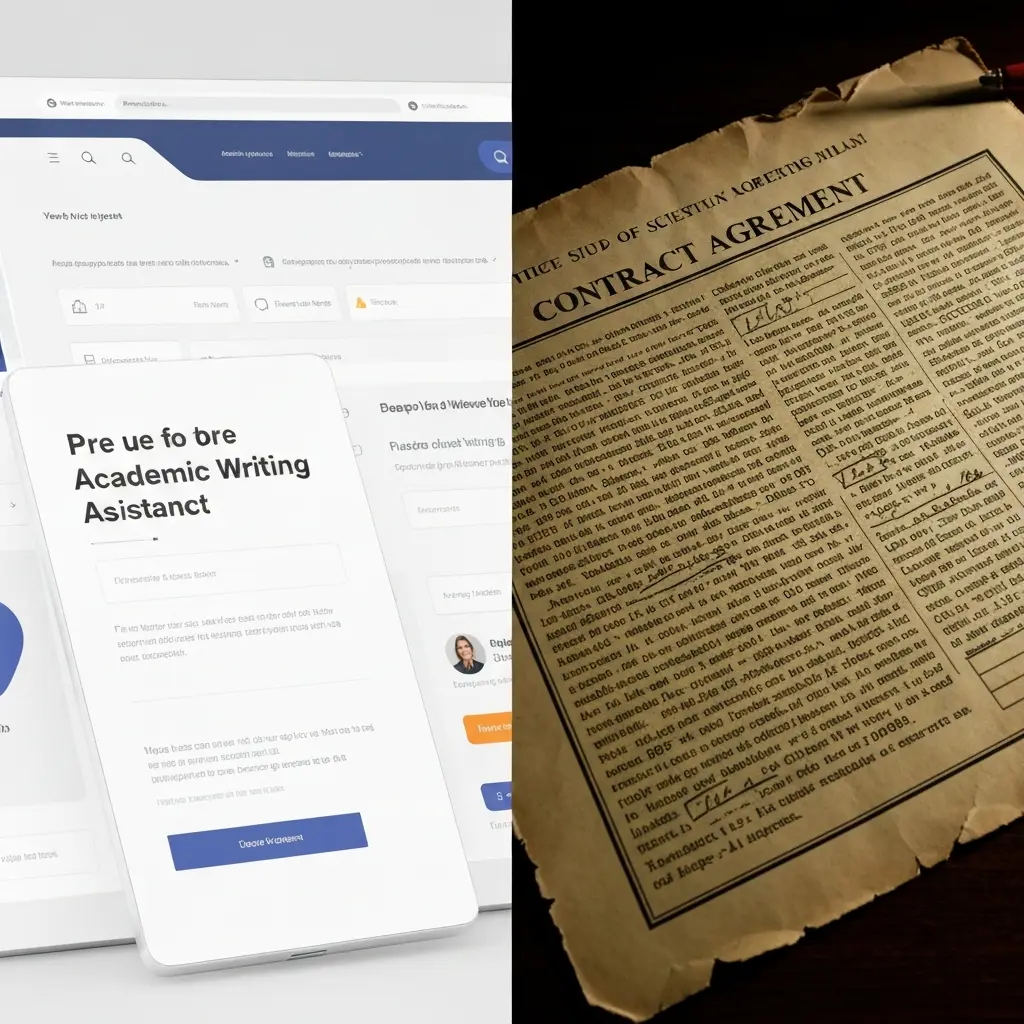
Dissertation Help Online: Legitimate Tools vs Ghostwriting 2026
When the deadline pressure peaks and your dissertation is still half-written, searching for dissertation help online feels urgent and necessary. In 2026, that search returns an enormous range of services — from legitimate AI writing tools that accelerate your work to ghostwriting mills that will write your entire dissertation for a fee and, if you submit it, potentially end your academic career. The line between them is not always obvious from a Google search results page.
This guide gives you the practical tools to distinguish legitimate dissertation assistance from academic misconduct exposure — and explains why the legitimate options, especially purpose-built AI tools like Tesify, can genuinely transform your productivity without putting your degree at risk.
What Legitimate Dissertation Help Actually Looks Like
The core principle is straightforward: legitimate dissertation help supports your intellectual work. It does not replace it.
Help is legitimate when:
- It improves how you express ideas you have developed
- It helps you find and organise sources you then read and critically engage with
- It formats citations from sources you have actually used
- It identifies problems in your argument for you to resolve
- It checks your work for plagiarism and academic integrity issues
- It provides feedback you use to improve your own writing
Help is academic misconduct when:
- Someone else writes sections, chapters, or the complete dissertation for you
- You submit work that is not the product of your own intellectual effort
- You use AI to generate arguments and analysis you could not produce yourself
- The submitted work misrepresents the extent and nature of your own contribution
The distinction is about authorship and intellectual contribution — not about how much assistance you received along the way.
The Ghostwriting Reality: What Happens When It Goes Wrong
The dissertation ghostwriting industry is large, and its marketing is sophisticated. Services present themselves as “dissertation consultants,” “academic writing services,” and “research support companies.” Some operate legally in grey areas by selling “model” dissertations “for reference purposes only.” But the students who buy these services know what they are doing — and so do universities.
Detection Has Improved Dramatically in 2026
Universities use multiple overlapping detection methods that are increasingly difficult to evade:
- Turnitin AI writing detection: Commercial ghostwriters write for many clients. When two dissertations share structural patterns and stylistic signatures, both flag simultaneously.
- Writing history analysis: Supervisors compare the submitted dissertation to previous work — seminar essays, email correspondence, draft sections submitted for feedback. A sudden and dramatic improvement in writing quality is a detection trigger.
- Oral examination: The most reliable detector. You cannot defend an argument you did not construct. Viva voce examinations are specifically designed to verify that the student understands their own thesis.
- Digital forensics: Document metadata, IP address analysis, and contractor platform records can be subpoenaed in serious cases.
- Whistleblowing: Ghostwriting services have been exposed repeatedly by employees and disgruntled clients. Records of transactions have been turned over to institutions.
The Consequences Are Severe
Academic misconduct findings for dissertation fraud in 2026 typically result in:
- Immediate failure of the dissertation (no opportunity for resubmission)
- Possible withdrawal of the degree if discovered post-award
- Academic misconduct notation on permanent record
- Referral to professional regulatory bodies for law, medicine, and teaching graduates
- In extreme cases, legal action for obtaining a degree qualification by fraud
Several UK universities have successfully prosecuted ghostwriting service providers under the Office for Students regulatory framework. The risk is real and increasing.
How to Spot Ghostwriting Services in 2026
Ghostwriting services have become more sophisticated in their marketing. Here are the signals that distinguish them:
- They offer to write your dissertation for a fee: No ambiguity. Any service that produces completed dissertation chapters for payment is a ghostwriting service, regardless of what they call it.
- They advertise “100% original” and “plagiarism-free guarantees”: Legitimate writing tools do not need to guarantee originality — your writing is original because you wrote it.
- They use phrases like “model dissertation” or “reference only”: Boilerplate disclaimers that are legally meaningless when the purpose of purchase is clear.
- They quote by the word or page: Pricing for your dissertation content rather than for specific service functions (editing, formatting, checking) is a red flag.
- They ask for your full dissertation brief and marking criteria: They need this to produce something your university would accept. A legitimate editing service does not need your full brief.
- Customer reviews describe receiving completed chapters: Look at independent review sites, not testimonials on the service’s own website.
Legitimate Online Dissertation Help: A Ranked Guide
1. AI Academic Writing Tools (Tesify, Grammarly)
The best legitimate assistance for most dissertation challenges. AI tools that work with your writing — improving clarity, formatting citations, checking plagiarism, scaffolding structure — provide real productivity benefits without authorship issues. You write the intellectual content; the tool helps you express it better and manage the administrative burden.
2. Academic Editing Services
Professional proofreaders and academic editors who correct grammar, improve clarity, and provide structural feedback on work you have written. Distinct from ghostwriting because the intellectual content is entirely yours. Most UK universities allow proofreading and editing with disclosure; some require it. Check your institution’s policy — many have approved service lists.
3. University Academic Writing Support
Most universities offer free academic writing support through their writing centres, academic skills services, or library teams. These services provide guidance on argument structure, citation, academic conventions, and writing under pressure. Often underutilised and genuinely valuable.
4. Dissertation Writing Coaches
Professional coaches who work with you on your writing process — helping you develop your argument, maintain writing productivity, and manage the psychological challenges of dissertation writing. They do not write for you; they help you write better and faster. Expensive but legitimate and effective for students with significant blocks.
5. Peer Writing Groups
Informal writing groups with other postgraduate students. Provide accountability, feedback, and mutual support. Many universities organise these through graduate schools. Free, legitimate, and often more valuable than students expect.
AI Writing Tools: The Safe Middle Ground
Purpose-built AI writing tools like Tesify occupy a clearly legitimate space: they provide powerful assistance that dramatically reduces the time spent on specific dissertation tasks, while keeping the intellectual work entirely with the student. Here is what Tesify specifically helps with:
- Writing assistance: Helps you articulate your own ideas more clearly — not generating new arguments, but helping you express the arguments you have developed
- Structure scaffolding: Provides chapter and section outlines to give you a framework to write into, reducing the “blank page” problem
- Bibliography generation: Formats your actual sources automatically — no fabrication, no academic risk
- Plagiarism checking: Lets you know your similarity score before your university does — so you can fix issues before submission
- AI editor: Improves your academic prose without rewriting your arguments
The decisive advantage over ghostwriting: when you use Tesify, you understand and can defend every word in your dissertation because you wrote it. The tool helped you write better, not instead of you.
Get the help you need — without the risk
Tesify is the legitimate alternative to ghostwriting: real AI writing assistance, auto bibliography, plagiarism checking, and academic editing — all in one platform. Free to start.
Free University Support You Are Probably Not Using
Before spending money on any service, verify you are using what your institution already provides:
- Academic writing centre: Most universities offer one-to-one writing support appointments. Students who use them consistently produce higher-quality dissertations.
- Librarian research support: Academic librarians at postgraduate level can help you develop your literature search strategy, identify relevant databases, and navigate access to sources.
- Graduate school skills training: Many graduate schools offer workshops on academic writing, argument structure, and dissertation planning. Often available online and free.
- Peer support networks: Your institution’s postgraduate student association likely has dissertation support groups or writing circles.
- Extended supervisor access: If you are struggling, request additional supervisor meetings. Most supervisors prefer to know you are stuck than to receive a late submission.
Decision Framework: Is This Help Acceptable?
Use this checklist to evaluate any source of dissertation help before you use it:
- Will the intellectual content — the arguments, analysis, and conclusions — be entirely mine?
- Will every citation in my submitted work correspond to a source I have actually read?
- Can I explain and defend everything in the submitted work at a viva examination?
- Does my institution’s policy permit this type of assistance?
- If required, am I prepared to disclose this assistance accurately?
If yes to all five: the help is legitimate. If any answer is no: the risk is real and the consequences can be career-ending.
For further reading: Is It Plagiarism to Use AI for Thesis Writing in 2026? and Can I Use AI to Write My Dissertation in 2026?
Also worth reading: AI Thesis Writer: How to Use AI Ethically for Your Dissertation 2026
Frequently Asked Questions
Is it legal to use a dissertation writing service?
In the UK, buying and submitting a ghostwritten dissertation is illegal under the 2017 Education (Student Loans) Act and the contract cheating provisions introduced subsequently. In Australia, similar legislation has been enacted. In the US, it is not federally illegal but violates every university’s academic integrity policy, with consequences including expulsion and degree revocation. The “model dissertation for reference only” legal fiction does not protect buyers when the purpose of purchase is clear.
Can universities detect ghostwritten dissertations in 2026?
Yes, with increasing effectiveness. Universities in 2026 use a combination of AI writing detection, stylometric analysis comparing the submission to previous work, oral examination, and investigation of document metadata. Ghostwriting services have been exposed through data breaches and whistleblowing, with transaction records turned over to institutions. Detection rates are rising year on year.
What is the difference between a dissertation editor and a ghostwriter?
A dissertation editor works on text you have written — correcting grammar, improving clarity, providing structural feedback. The intellectual content, arguments, and analysis are yours throughout. A ghostwriter writes the dissertation for you — the intellectual content originates with them, not you. Editing is generally legitimate (with disclosure at many institutions); ghostwriting is academic misconduct.
What legitimate help can I get online for my dissertation?
Legitimate online dissertation help includes: AI writing platforms like Tesify (writing assistance, bibliography, plagiarism checking), professional academic editing of your own draft, university writing centre appointments (now frequently available online), academic writing coaches, literature research tools like Elicit, and reference management tools like Zotero. All of these support your own intellectual work rather than replacing it.
Is it safe to use Tesify for my dissertation?
Yes. Tesify is designed for the legitimate use cases that universities permit: AI-assisted editing of your own prose, auto bibliography generation from your real sources, integrated plagiarism checking, and structured writing support. It does not write your dissertation for you — it helps you write it better. The intellectual content, arguments, and analysis remain entirely yours, which is what academic integrity requires.
What should I do if I’m struggling with my dissertation?
First, contact your supervisor — they have seen this before and can often identify the specific problem quickly. Then use your university’s free support resources: writing centre, academic skills service, and peer support groups. For tool-based help, Tesify’s writing assistance and structured approach helps many students break through blocks. If the challenge is time or mental health, contact your university’s student wellbeing team — extensions and adjustments exist precisely for these situations.
Write your thesis with AI
Structure, draft, cite, and format your thesis faster with Tesify’s AI writing tools, automatic bibliography, and plagiarism checker. Free to start, no credit card required.





Leave a Reply