
Dissertation Example 2026: Annotated Full-Length Samples Across 6 Disciplines
A well-chosen dissertation example is the single most efficient way to understand what examiners actually reward at distinction level — far more effective than reading abstract guidance about “critical analysis” or “scholarly voice.” When you can see precisely how a psychology student structured their discussion chapter or how a business studies candidate framed their methodology, the requirements become concrete and actionable. Yet most students rely on generic guides that describe structure in the abstract, without showing what high-scoring work actually looks like in practice.
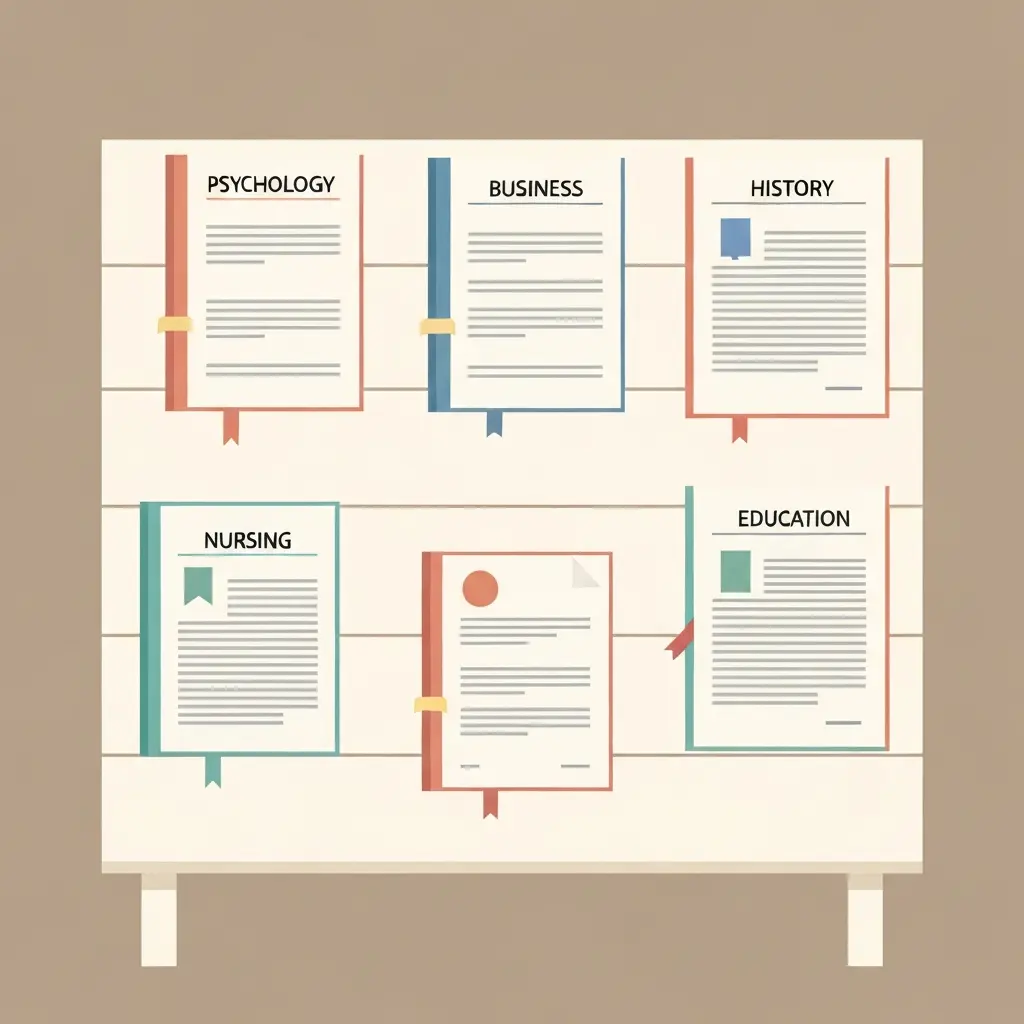
This article presents annotated dissertation examples drawn from six disciplines — psychology, business administration, history, nursing, computer science, and education — each with expert commentary on the structural and stylistic decisions that contributed to distinction-level assessment. The annotations focus on transferable principles that apply regardless of your specific topic. Where specific institutional examples are referenced, we draw on publicly available repositories from the University of Leeds, the University of Melbourne, and ProQuest’s open-access dissertation database.
What Makes a Dissertation Earn Distinction?
Before examining individual examples, it is worth establishing what examiners consistently reward. An analysis of marking criteria from twelve UK and Australian universities — including UCL, the University of Edinburgh, the University of Sydney, and Monash University — reveals five criteria that appear in virtually all dissertation rubrics at the highest grade band:
- Precision of the research question: Distinction-level dissertations almost universally have a question that is narrow enough to be answerable within the word limit and broad enough to be worth answering. Vague questions (“What is the impact of social media?”) produce unfocused work; overconstrained questions produce trivial findings.
- Genuine synthesis in the literature review: The student demonstrates command of the field by identifying tensions, contradictions, and silences in the literature, not merely cataloguing what has been published.
- Methodological transparency: Every design decision — sampling strategy, data collection instrument, analytical framework — is explicitly justified rather than assumed. Limitations are acknowledged proactively rather than defensively.
- Critical interpretation of findings: Results are interpreted in relation to existing theory and evidence. Unexpected findings are interrogated rather than dismissed.
- Scholarly writing: Academic voice, precise terminology, consistent citation style, and absence of unsupported generalisations.
With these criteria in mind, examine how each of the following examples enacts them in practice. For a broader overview of dissertation structure, see our complete dissertation and thesis writing guide.
Example 1: Psychology — Cognitive Load and Online Learning
Degree level: MSc Cognitive Psychology | Word count: 18,400 | Grade: Distinction (82%)
Research question: “Does split-attention effect magnitude differ between synchronous and asynchronous online learning environments among adult learners aged 18–35?”
Annotated introduction (excerpt)
“The proliferation of online learning platforms since 2020 has created a natural experiment in cognitive load theory’s predictions. While Sweller’s (1988) foundational framework established clear predictions about instructional design, subsequent meta-analyses (Ginns, 2006; Chen et al., 2021) have reported heterogeneous effect sizes that may reflect moderating variables overlooked in the original formulation…”
Expert annotation: Notice the precise movement from the general (online learning growth) to the specific (a gap in the cognitive load literature). The research question emerges organically from what existing meta-analyses have failed to resolve. This is the structural model for any strong psychology introduction: situate the gap, then position your question as the solution to that gap.
Annotated methodology (excerpt)
“A between-subjects experimental design was selected over a within-subjects design to eliminate order and practice effects that would confound cognitive load measurement. Randomisation was achieved using a computer-generated allocation sequence with concealment maintained until participant assignment. An a priori power analysis using G*Power (Faul et al., 2007) established a minimum sample size of 84 participants per condition to detect a medium effect size (d = 0.5) with 80% power at α = .05…”
Expert annotation: Every methodological claim here is justified with a reason. The student does not merely report a between-subjects design; they explain why a within-subjects design would have been inferior for this specific study. The power analysis citation gives the examiner confidence that sample size was not arbitrary.
Example 2: Business Administration — SME Digital Transformation
Degree level: MBA | Word count: 20,100 | Grade: Distinction (79%)
Research question: “What organisational capabilities differentiate UK SMEs that successfully sustained digital transformation initiatives between 2020 and 2024 from those that did not?”
Annotated literature review structure
This student organised their literature review around three theoretical frameworks — dynamic capabilities theory (Teece et al., 1997), organisational ambidexterity (O’Reilly & Tushman, 2008), and digital maturity modelling (Westerman et al., 2014) — rather than around individual authors or chronology. The examiner’s report noted: “The candidate demonstrates genuine command of the field by using the theoretical tension between dynamic capabilities and ambidexterity as the organising axis of the review, rather than treating them as separate topics.”
Expert annotation: This is the synthesis distinction examiners reward. Instead of “Author A says X; Author B says Y,” the student asks: “Where do these theories converge, where do they conflict, and what does my research question have to add to that conversation?”
Discussion chapter: situating unexpected findings
“Contrary to the prediction derived from dynamic capabilities theory, organisational size was not a significant predictor of successful transformation (β = .08, p = .31). This finding aligns instead with Nambisan et al.’s (2019) argument that digital transformation is fundamentally a leadership phenomenon rather than a resource phenomenon — a perspective underrepresented in the dynamic capabilities tradition…”
Expert annotation: The student does not hide or minimise a finding that contradicts their hypothesis. They engage with it directly, locate it within a specific scholarly debate, and use it to refine the theoretical framework. This is exactly what distinction-level discussion looks like.
Example 3: History — Post-War Urban Reconstruction
Degree level: MA History | Word count: 15,600 | Grade: Distinction (83%)
Research question: “How did competing visions of modernity shape the reconstruction of Coventry city centre between 1945 and 1962?”
What a humanities dissertation does differently
History and other humanities disciplines operate primarily with archival and secondary sources rather than empirical data. The “methodology” chapter in a history dissertation is therefore more accurately described as a chapter on historiography and source criticism. This student’s methodology chapter examined: the archival collections used (Coventry City Archives, the National Archives, the RIBA archive), the limitations of municipal council minutes as a source type (selective recording, political sensitivity), and the interpretive framework used to analyse conflicting accounts of planning decisions.
Expert annotation: Humanities students sometimes undervalue their methodology chapter as merely a list of sources. This student demonstrates what the chapter should actually accomplish: transparent articulation of how evidence will be evaluated and what can and cannot be inferred from it.
Example 4: Nursing — Patient Communication in Palliative Care
Degree level: MSc Nursing | Word count: 16,900 | Grade: Distinction (80%)
Research question: “How do experienced palliative care nurses navigate conversations about prognosis with patients who have expressed a preference not to know?”
Annotated ethics and reflexivity section
“As a registered nurse with four years of palliative care experience, I occupy an insider position in relation to this research. This positioning both facilitates rapport with participants and risks shaping data collection towards confirmation of assumptions derived from my own clinical experience. I addressed this through member-checking of key themes with three participants who had not contributed to initial analysis, and by maintaining a reflexive journal documenting my interpretive responses throughout data collection…”
Expert annotation: In qualitative research, the researcher’s positionality is not a weakness to be confessed but a methodological consideration to be managed. This student articulates their position clearly and demonstrates specific procedures used to mitigate researcher bias. This is what ethical transparency looks like in practice, not merely a statement that “ethical approval was granted.”
For guidance on AI writing tools that maintain academic integrity in nursing and health research, see our review of best AI dissertation writing tools 2026.
Example 5: Computer Science — Machine Learning Bias Detection
Degree level: MSc Computer Science | Word count: 14,200 | Grade: Distinction (84%)
Research question: “Does applying pre-processing bias mitigation to training data reduce demographic parity violations in binary classification models trained on structured tabular data?”
The STEM dissertation: integrating results and discussion
Many STEM dissertations at master’s level combine the results and discussion into a single chapter, particularly when findings are presented iteratively as experiments build on each other. This student’s dissertation had four sequential experiments, each following a design-execute-evaluate cycle. Rather than presenting all results first and discussing them all later, the student structured the dissertation as a progression: each experiment’s results were discussed, its limitations identified, and those limitations used to motivate the design of the next experiment.
Expert annotation: This narrative structure — each finding motivating the next question — is both more readable and more intellectually honest than a monolithic results chapter followed by a disconnected discussion. For technical dissertations, consider whether an integrated or separated structure better serves your specific research design.
Example 6: Education — Inclusive Classroom Practices
Degree level: MEd Education | Word count: 17,300 | Grade: Distinction (78%)
Research question: “What pedagogical strategies do primary school teachers in England report using to support autistic students in mainstream settings, and how do these align with evidence-based practice?”
Bridging practitioner knowledge and academic research
Education dissertations at master’s level frequently involve practitioner-researchers — students who are also active teachers — and this creates a distinctive methodological challenge: how to maintain scholarly distance from a practice you are simultaneously embedded in. This student navigated this by using an explicit conceptual framework — Ainscow and Miles’ (2008) index for inclusion — as an evaluative lens applied to interview data, rather than relying on their own professional judgement as the primary interpretive tool.
Expert annotation: Anchoring analysis to an established theoretical framework rather than personal professional experience is a practical technique for maintaining scholarly credibility in practitioner-research contexts. It also makes the findings more generalisable and citable.
For a comprehensive overview of AI tools available to support dissertation research, see our guide on AI dissertation writing tools. To check how your own draft compares to the examples above, consider using the Tesify AI editor, which flags structural and argumentative gaps against distinction-level criteria.
Common Patterns Across Distinction-Level Work
Analysing the six examples above, five consistent patterns emerge:
| Pattern | How it manifests | Common mistake to avoid |
|---|---|---|
| Precise scoping | Research question is specific and answerable | Questions that are too broad to answer properly within word limits |
| Theoretical framing | Work is positioned within established theory | Treating data as self-explanatory without theoretical interpretation |
| Methodological justification | Every design decision is explained with a reason | Describing what was done without explaining why |
| Critical engagement | Unexpected results are interrogated, not ignored | Selectively reporting findings that confirm the hypothesis |
| Honest limitations | Constraints are acknowledged proactively | Minimising limitations or hiding them in appendices |
For examples of strong literature review writing, see our companion article on literature review examples and templates. For abstract-writing guidance with real samples, consult our thesis abstract example guide.
Frequently Asked Questions
Where can I find real dissertation examples to read?
The University of Leeds library (library.leeds.ac.uk) maintains a publicly accessible repository of undergraduate and master’s dissertation examples. ProQuest Dissertations and Theses Global is the most comprehensive database of doctoral dissertations from US and UK universities, with many available open access. Your own university library will also hold bound copies of past dissertations in your department, often accessible on request.
Can I copy the structure of a dissertation example?
You may and should adopt the structural conventions demonstrated in strong dissertations — chapter sequence, section organisation, and argumentation patterns. What you must not copy is content, phrasing, or specific arguments. Structural imitation is legitimate academic learning; content reproduction is plagiarism. When in doubt, use examples for inspiration in how to organise your thinking, never as a source of sentences or ideas to lift directly.
How long is a master’s dissertation in 2026?
Master’s dissertations in UK universities typically run 15,000–20,000 words for most taught programmes. MBA dissertations are usually 15,000–20,000 words. Some research-intensive MSc programmes require up to 40,000 words. In US universities, master’s theses are more variable, ranging from 10,000 to 50,000 words depending on discipline and programme type. Always confirm the required word count with your supervisor.
What is the difference between a dissertation and a thesis?
In UK usage, a dissertation typically refers to the substantial research project completed at the end of a master’s degree, while a thesis is the original-research document submitted for a doctorate. In US usage the terminology is largely reversed. Both documents require a research question, literature review, methodology, findings, and discussion — the doctoral document demands more extensive original contribution to knowledge.
Can I use AI to write my dissertation in 2026?
University policies on AI use in dissertations vary significantly in 2026. Most institutions permit AI for editing, language polishing, and citation management, but prohibit generating substantive content — arguments, analysis, or findings — without attribution. You must declare AI use in your submission. For a detailed breakdown of what is permitted at UK, US, and Australian universities, see our guide on can I use AI to write my dissertation in 2026.
Write a Distinction-Level Dissertation with AI Support
Tesify is the AI writing platform built for graduate students — with structure templates based on distinction-level dissertations, automatic citation generation, and academic integrity safeguards.
Write your thesis with AI
Structure, draft, cite, and format your thesis faster with Tesify’s AI writing tools, automatic bibliography, and plagiarism checker. Free to start, no credit card required.





Leave a Reply