
Critical Thinking in Academic Writing: How to Build Arguments That Impress Examiners (2026)
The single most common reason a well-researched thesis or dissertation fails to reach the highest grade band is not poor research — it is inadequate critical thinking. Students who read widely, cite extensively, and structure their work correctly can still plateau at a mid-range grade because their writing is predominantly descriptive rather than analytical. They tell examiners what researchers have found. They rarely engage with why those findings matter, whether the evidence is robust, how competing claims relate, or what the implications are for their own research question.
Critical thinking in academic writing is the capacity to move beyond description into analysis, evaluation, and synthesis — to construct an argument, weigh evidence, identify contradictions, and reach reasoned conclusions. It is the academic skill most explicitly rewarded in marking rubrics at UK, US, and Australian universities, yet it is the one students receive the least concrete guidance on how to develop.
This guide breaks critical thinking in academic writing into learnable, practisable components. By the end, you will have a concrete framework for transforming descriptive summaries into analytical arguments — and the vocabulary, sentence structures, and revision strategies to implement it in your current piece of writing.
What Is Critical Thinking in Academic Writing?
Critical thinking is not the same as criticism — it does not mean finding fault with everything you read. In the academic context, it is the systematic process of evaluating claims, identifying assumptions, weighing evidence, recognising limitations, considering alternative explanations, and reaching reasoned, well-supported conclusions. Applied to writing, it produces text that makes an argument, not merely a report.
The University of York’s academic writing guide defines critical writing as involving three key elements: description (what the research says), analysis (why it matters and how it works), and evaluation (how strong the evidence is and what its limitations are). Advanced critical writing adds a fourth element: judgment — a clear, substantiated position of your own that synthesises the evidence and advances the intellectual conversation in your field.
Examiners at UK universities consistently describe the same deficit in student work: essays and dissertations that read as “library reports” — accurate summaries of what researchers have said, but without the evaluative intellectual engagement that distinguishes university-level work from school essays. Developing your critical thinking is not optional if you want to reach the highest grade bands.
The Core Problem: Description vs Analysis
The clearest way to understand the distinction is through example. Here are the same research finding presented at three levels of critical depth:
Level 1 — Pure Description (weak)
“Smith (2022) found that students who used AI writing tools scored lower on academic integrity assessments than those who did not.”
Level 2 — Description + Analysis (adequate)
“Smith (2022) found that students who used AI writing tools scored lower on academic integrity assessments. This suggests that AI tool use may correlate with reduced awareness of citation norms, though Smith’s cross-sectional design cannot establish whether this relationship is causal — students with lower prior integrity awareness may be more likely to adopt AI tools in the first place.”
Level 3 — Description + Analysis + Synthesis + Evaluation (distinction-level)
“Smith (2022) found lower academic integrity assessment scores among AI tool users, a finding that superficially supports concerns about AI-facilitated contract cheating (Lancaster & Cotarlan, 2021). However, Smith’s cross-sectional design cannot establish directionality, and Jones and Patel (2023) — using a randomised controlled design — found no significant integrity outcome differences between AI users and controls when institutional AI literacy support was provided. This suggests the problem may not be inherent to AI tool use per se, but rather reflect a gap in institutional support, a conclusion with significant implications for how universities should respond to the AI adoption trend.”
The third passage does four things that the first does not: it contextualises Smith within a broader debate; it identifies a methodological limitation of Smith’s design; it introduces contradictory evidence; and it draws an evaluative conclusion that advances the argument beyond what any single source claims. This is critical thinking in action.
How to Structure an Academic Argument
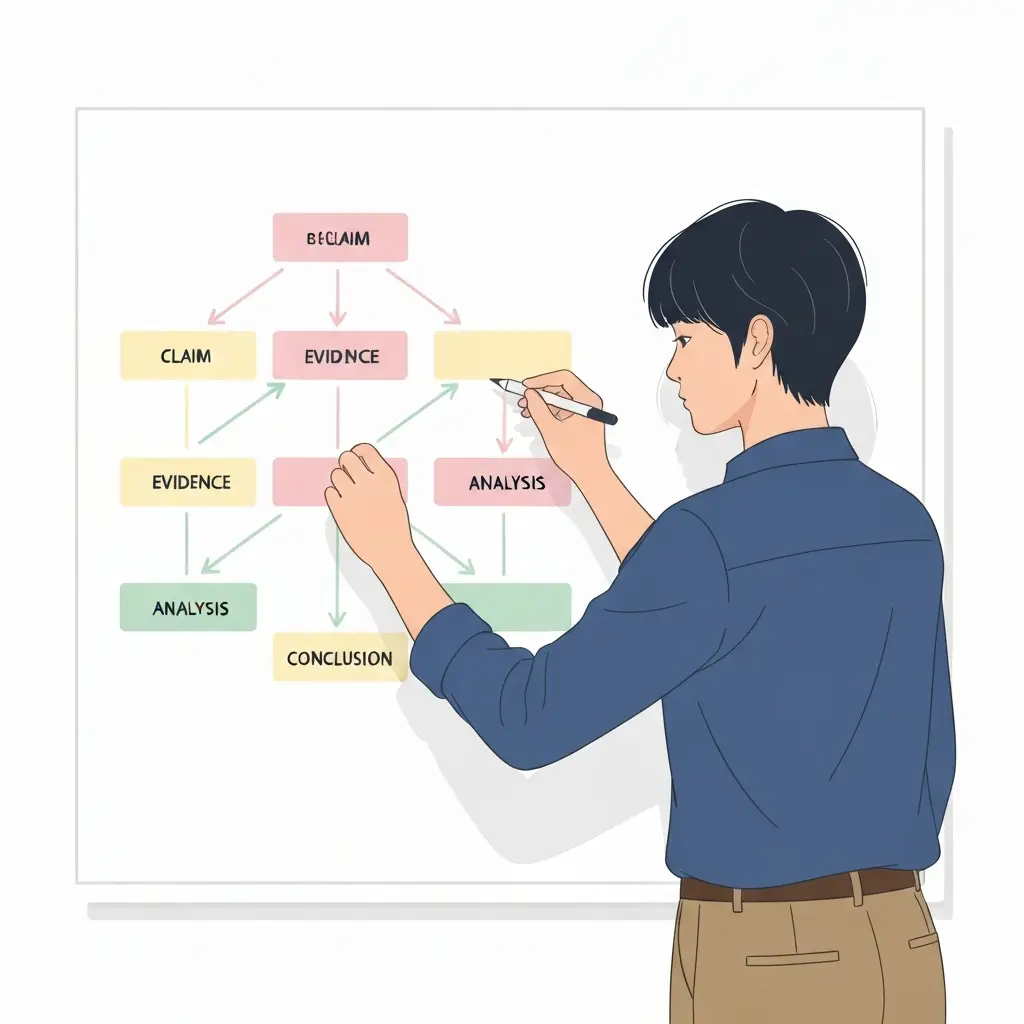
An academic argument is not an opinion expressed forcefully. It is a structured chain of reasoning that moves from a claim through evidence and analysis to a conclusion, designed to be defensible against informed challenge. Every paragraph in your thesis that makes a substantive point should follow this logic.
The PEEL Paragraph Structure
PEEL (Point, Evidence, Explanation, Link) is the most widely taught analytical paragraph framework at UK universities. It provides a reliable scaffold for building critical paragraphs:
- P — Point: State your claim clearly in the first sentence. This is your topic sentence — it should advance your overall argument, not merely announce a topic (“this paragraph will discuss…”).
- E — Evidence: Cite the specific evidence supporting your claim — empirical data, a quotation, a statistic, a theoretical principle.
- E — Explanation/Analysis: Explain why the evidence supports your point, what it means, why it matters, and what its limitations are. This is the analytical heart of the paragraph.
- L — Link: Connect the paragraph’s argument back to your overarching thesis statement and forward to the next paragraph. This creates the coherent “line of argument” examiners look for.
A variation preferred at many research universities is PEAL (Point, Evidence, Analysis, Link) — functionally identical but with explicit emphasis on analysis as a separate step from evidence citation.
The Overall Argument
Beyond individual paragraphs, your overall thesis must have an overarching argument — a central claim that your entire work builds toward. This is distinct from your research question (which asks something) and your research aim (what you set out to do). Your overall argument is your answer to the question — the substantive position you are defending based on your evidence and analysis.
Every section of your literature review, methodology, results, and discussion chapter should contribute to this overall argument. Sections that merely describe (without connecting to the argument) should be revised or removed — they add word count but reduce analytical focus.
Evaluating Evidence: How to Assess What Sources Are Worth
Critical use of evidence means more than citing a source — it means assessing the quality, relevance, and limitations of that source and making those assessments visible in your writing. Key evaluation dimensions:
Methodological Quality
How was the evidence generated? A randomised controlled trial provides stronger causal evidence than a correlational study; a large, pre-registered study with a representative sample is more credible than a small convenience sample. A systematic review with meta-analysis sits at the top of the evidence hierarchy for empirical claims. When you cite a finding, consider its evidential strength and signal this to your reader: “Using a pre-registered RCT design, Brown et al. (2024)…” communicates more credibility than a passive citation alone.
Currency
In fast-moving fields (AI, genomics, public health policy), evidence from five years ago may be substantially outdated. In others (classical history, pure mathematics), older sources remain definitive. Know your field’s norms — and where you cite older work in a fast-moving field, acknowledge why it remains relevant or note that it may have been superseded.
Positionality and Conflict of Interest
Who funded the research? Who published it? A study of sugar’s health effects funded by the sugar industry warrants scrutiny, even if published in a peer-reviewed journal. Industry-funded research shows systematic publication bias and selective outcome reporting in multiple meta-analyses. Acknowledging this is critical thinking — it is not conspiracy theorising.
Replication Status
Has the finding been independently replicated? Given the replication crisis context (see our article on research reproducibility), citing a single unreplicated study as definitive is methodologically naive. Phrase unreplicated findings with appropriate tentativeness: “In a study that has not yet been independently replicated…” or “Although this finding requires further corroboration…”
Synthesis: Moving from Summary to Scholarly Argument
Synthesis is the skill that separates a high-quality literature review from a descriptive annotated bibliography. To synthesise rather than summarise:
- Group sources by their position on the central debate in your field, not chronologically or author by author
- Identify agreements and disagreements across sources: “Across the literature, there is consistent evidence that… However, studies diverge on…”
- Identify the gaps and contradictions that your own research addresses: “While extensive research has examined X, the mechanisms by which Y influences Z remain poorly understood…”
- Draw explicit connections between sources that individual authors may not have made themselves: “Taken together, the findings of Smith (2021) and Brown (2022) suggest a pattern that earlier theoretical work by Jones (2015) anticipated but could not empirically demonstrate…”
For detailed guidance on structuring a synthesising literature review, see our guide on literature review methodology: from sources to scholarly argument and our literature review example templates.
Hedging and Academic Stance: Writing with Appropriate Certainty
Hedging is the linguistic practice of expressing claims with appropriate tentativeness — calibrating your certainty to the strength of your evidence. It is not a sign of intellectual weakness; it is a marker of scholarly maturity. Overconfident claims (“This proves that…”) are rejected by examiners as epistemologically naive. Excessive hedging (“It is perhaps possible that some might argue that there could be…”) is equally problematic — it suggests you have no view of your own.
Hedging by Claim Strength
| Evidence Strength | Appropriate Language |
|---|---|
| Highly consistent, replicated evidence | “demonstrates”, “establishes”, “confirms”, “the evidence strongly supports” |
| Multiple consistent but not replicated studies | “suggests”, “indicates”, “appears to”, “the weight of evidence points toward” |
| Single or mixed evidence | “may”, “might”, “could”, “there is some evidence that”, “it is possible that” |
| Theoretical inference, not yet empirically tested | “one might propose”, “it could be argued”, “this reasoning implies” |
| Your own reasoned position | “this analysis suggests”, “the present author argues”, “based on the foregoing evidence, it is contended that” |
Engaging Counter-Arguments: The Mark of High-Level Critical Writing
Distinction-level academic writing actively seeks out and engages the strongest objections to its own arguments. This is sometimes called the “steelman” approach — presenting the opposing view in its strongest possible form, then addressing it. Weak academic writing ignores or strawmans counter-evidence. Strong academic writing does the opposite.
The standard structure for counter-argument engagement:
- Acknowledge: “It could be argued that… / Some researchers contend that… / Counter to this position, Brown (2022) found that…”
- Present fairly: Give the counter-argument its due — explain why it is a credible position, not a foolish one
- Respond: Explain why, despite its merit, the counter-argument does not undermine your overall position — or qualify your claim in light of it
- Advance: Use the engagement with the counter-argument to refine and strengthen your original claim
The concessive clause construction is the standard linguistic vehicle: “Although [counter-argument], [your position] because [reason].” For example: “Although Brown et al. (2022) found no significant effect in their experimental study, their three-week intervention period may have been insufficient for the learning mechanisms proposed by Jones (2020) to manifest, suggesting the null result may be a power rather than a conceptual failure.”
Critical Language: Sentence Frames for Analytical Writing
Having the analytical thinking is only half the challenge — you also need the vocabulary to express it. The following sentence frames can be adapted throughout your thesis:
Introducing Your Position
- “This [paper / chapter / analysis] argues that…”
- “The central contention of this thesis is that…”
- “The evidence reviewed here supports the position that…”
Evaluating Evidence Strength
- “While methodologically sound, [Smith, 2021] is limited by its reliance on self-report measures, which…”
- “The [large sample size / pre-registered design / longitudinal nature] of this study lends particular credibility to its findings.”
- “However, the lack of [control group / effect size reporting / independent replication] means that…”
Synthesising Across Sources
- “Taken together, these studies suggest…”
- “While [Author A] and [Author B] agree on X, they diverge sharply on Y…”
- “This body of research is consistent with [theoretical framework] but cannot yet account for…”
Identifying Gaps
- “Notably absent from this literature is…”
- “To date, no study has examined [phenomenon] in [context / population / time period].”
- “Existing research has focused primarily on X, leaving Y comparatively unexplored.”
Drawing Conclusions
- “The foregoing analysis suggests that…”
- “On balance, the evidence supports [position] over [alternative], though with the caveat that…”
- “This has significant implications for [theory / practice / policy], specifically…”
Levels of Criticality: From Undergraduate to Doctoral
Examiner expectations for critical thinking increase significantly across degree levels. Understanding what your level requires helps you calibrate your writing correctly:
| Level | What’s Expected | Common Shortfall |
|---|---|---|
| Undergraduate (Year 1–2) | Accurate description; basic analysis; awareness of limitations | Pure description; no analysis or evaluation |
| Undergraduate (Final Year / Dissertation) | Consistent analysis; evidence evaluation; emerging synthesis; own position | Analytical paragraphs without explicit evaluative stance |
| Master’s | Systematic synthesis; methodological critique; confident scholarly position; contribution to debate | Descriptive literature review; no methodology critique; hedged to the point of having no position |
| PhD | Original contribution; engagement with theory; sustained argument across 80,000 words; positioning in the international literature | Incremental empiricism without theoretical framing; no clear original contribution |
A Revision Strategy for Adding Critical Depth
The most practical way to improve the critical thinking in an existing draft is a targeted revision pass — separate from grammar and clarity editing — that specifically focuses on analytical depth. Here is a four-step process:
- The “So what?” check: After every paragraph that cites evidence, ask “So what?” — why does this matter? What does it mean for your argument? If you cannot answer, the paragraph is purely descriptive. Add an analysis sentence.
- The “Evidence quality” check: For your three most important claims, examine the evidence you have cited. Is it empirically strong? Pre-registered? Replicated? If not, have you signalled appropriate tentativeness?
- The “Counter-argument” check: For your central argument, identify the strongest objection a knowledgeable critic could make. Is it addressed anywhere in your text? If not, add a paragraph that raises and responds to it.
- The “Synthesis” check: Read your literature review section by section. Does each section present a synthesised argument about what the literature collectively shows — or is it an author-by-author summary? Restructure any sections that follow the annotated bibliography format.
For further guidance on how to structure your complete thesis or dissertation, see our complete guide to writing a thesis and our article on thesis definitions and types. You may also find our academic writing tips guide useful for complementary sentence-level and structural improvements. For academic integrity considerations when using AI writing tools in your thesis, see our guide on can I use AI to write my dissertation.
Common Critical Thinking Mistakes in Academic Writing
- The summary trap: Each paragraph summarises one source, ending with a citation. No synthesis, no analysis, no evaluative stance.
- Assertion without evidence: “It is clear that X is true” — with no citation or reasoning. Every substantive claim needs either a citation or an explicit logical argument.
- Cherry-picking: Only citing evidence that supports your position while ignoring contrary evidence. Examiners know the literature too.
- Confusing description with analysis: Describing that a study found X is description. Evaluating why the finding might be limited, what it implies, or how it relates to other findings is analysis.
- Hedging everything: Over-hedging is as damaging as under-hedging. If the evidence is strong and replicated, use confident language. Reserve hedging for genuinely uncertain claims.
- Avoiding a conclusion: Presenting evidence for both sides and then refusing to reach a conclusion is intellectual cowardice. Critical writing means taking a defensible position, not just mapping disagreement.
Frequently Asked Questions
What is the difference between descriptive and analytical writing?
Descriptive writing tells the reader what researchers found — it reports facts, summarises studies, and presents information. Analytical writing goes further: it evaluates the quality of that evidence, identifies what it means and why it matters, examines limitations and assumptions, and connects findings to an overarching argument. Most student dissertations contain too much description and too little analysis. A useful self-test: if you removed your in-text citations from a paragraph, would there be anything of analytical value left? If not, the paragraph is probably too descriptive.
Is it acceptable to express my own opinion in academic writing?
Yes — but your own position must be a reasoned, evidence-based conclusion, not an unsupported personal preference. Examiners explicitly look for “your voice” in distinction-level work. The key is to base your position on a critical evaluation of the evidence and to signal it clearly with academic language (“this analysis suggests”, “the present author contends”, “on balance, the evidence supports the view that”). Personal opinions expressed without evidence are appropriately discouraged; reasoned scholarly positions derived from critical analysis of evidence are not only acceptable but required at postgraduate level.
How do I criticise a study without being dismissive?
Academic critique focuses on methodological limitations, not on the researchers’ intentions or competence. Use specific, methodological language: “The cross-sectional design of Smith (2022) precludes causal inference, as directionality cannot be established” is appropriately critical. “Smith’s study is weak” is not. Always acknowledge what the study does establish before identifying what it cannot — “While Smith (2022) provides strong evidence that X and Y are associated in a UK student population, its convenience sample limits generalisability to other contexts.” This signals that you understand both the contribution and the boundaries of the evidence.
What does ‘your own voice’ mean in academic writing?
Your academic voice is your analytical stance — the perspective from which you interpret evidence, the evaluative judgments you make about sources, the syntheses you draw, and the conclusions you reach. It is not about using informal language or personal anecdotes. Writing with your own voice means your reader can identify a consistent intellectual position running through your work, rather than a neutral summary of what everyone else thinks. It shows up in your argument’s structure, your choice of evidence, your evaluation of its quality, and your willingness to reach a conclusion when the evidence warrants one.
How do I improve my critical thinking for academic writing quickly?
The fastest improvement comes from three targeted practices. First, run the “So what?” check on every paragraph — after each evidence citation, add one or two sentences explaining what it means and why it matters for your argument. Second, for your three most important claims, actively search for counter-evidence in the literature and address it in your text. Third, rewrite your literature review so that each section opens with your synthesised conclusion about what the research collectively shows, then supports that conclusion with citations — rather than opening with the author name and working through sources one by one. These three changes will immediately shift your writing from descriptive to analytical.
What is synthesis in academic writing?
Synthesis in academic writing means combining information from multiple sources to produce a new insight, argument, or evaluation that goes beyond what any individual source says. Rather than summarising each source separately, synthesis requires you to identify patterns, agreements, contradictions, and gaps across the literature — and to present these as a coherent scholarly argument. Synthesis is what transforms a descriptive annotated bibliography into a critical literature review. It is also the basis of every analytical paragraph: taking evidence from two or more sources and drawing a combined conclusion that the individual sources did not reach.
Write Your Thesis with the Analytical Depth Examiners Expect
Critical thinking takes practice — but it also takes time you may not have. Tesify helps you build analytically rigorous thesis chapters, synthesise literature, and structure arguments that meet the highest examination standards. Try it free today.
Write your thesis with AI
Structure, draft, cite, and format your thesis faster with Tesify’s AI writing tools, automatic bibliography, and plagiarism checker. Free to start, no credit card required.




Leave a Reply