
AI Thesis Writing Tools: ChatGPT vs Tesify — Which Actually Works?
You’ve got six weeks until submission. Your literature review is a mess of half-finished paragraphs, your bibliography is 47 sources deep and formatted in three different styles, and you’ve opened ChatGPT at 2am wondering if it can somehow fix all of it. Sound familiar?
AI thesis writing tools have exploded in popularity — and for good reason. But not every tool does what it promises. ChatGPT is brilliant at a lot of things. Writing a dissertation that passes your university’s plagiarism check and meets academic formatting standards? That’s a different story.
This guide breaks down exactly how AI thesis writing tools like ChatGPT and Tesify compare across every dimension that actually matters to dissertation students: originality, citations, workflow, and whether your supervisor will flag it.
Why ChatGPT Falls Short for Dissertation Writing
ChatGPT is genuinely impressive. Ask it to explain quantum entanglement, draft a cover letter, or debug your Python script, and it delivers. But there’s a fundamental mismatch between what ChatGPT was built for and what dissertation writing actually demands.
Here’s the core problem: ChatGPT generates text based on patterns in training data. It doesn’t access live academic databases. It can’t verify whether a source actually exists. And it has no idea what your university’s referencing guidelines say.
The result? Students end up with beautifully written paragraphs that cite papers that don’t exist — a phenomenon researchers call “hallucinated references.” A 2023 study published in Nature found that language models fabricate citations at alarming rates when asked to produce academic content. You wouldn’t know it by reading the output. The reference looks perfect. It just doesn’t exist.
What most people miss is that the danger isn’t just academic dishonesty — it’s the time lost. You spend hours formatting a bibliography, then your supervisor emails back asking for the DOI on a paper that was never published. You’re back to square one.
ChatGPT also has no concept of your dissertation’s structure. It’ll write you a strong paragraph about methodology, but it won’t know that paragraph contradicts the theoretical framework you wrote two chapters earlier. It doesn’t hold your whole thesis in its head — it responds to prompts, one at a time.
The Hallucination Problem in Academic Writing
Academic hallucination is more than embarrassing — it’s a grade killer. The Guardian reported in 2023 that AI-generated academic content makes plagiarism harder to detect, creating a double bind for students: the text may be “original” in that it wasn’t copied from an existing source, but the citations it invents may constitute academic misconduct anyway.
Turnitin — the most widely used academic integrity tool — has been scanning for AI-generated content since early 2023. Their first-anniversary report confirmed that millions of papers had been flagged globally, with detection rates improving rapidly. If your dissertation went through ChatGPT without careful editing and verification, there’s a real chance it registers.
ChatGPT vs Tesify: Side-by-Side Feature Comparison
Stop guessing and look at the actual features. Here’s an honest, detailed breakdown of what each tool does — and doesn’t — offer for dissertation students.
| Feature | ChatGPT (GPT-4) | Tesify |
|---|---|---|
| Purpose | General-purpose AI assistant | Purpose-built dissertation platform |
| Real academic source access | ❌ No (training data only) | ✅ JSTOR, ProQuest, EThOS, ERIC, Google Scholar |
| Plagiarism detection | ❌ None built-in | ✅ Real-time against millions of sources |
| Automatic bibliography | ❌ Manual formatting, hallucination risk | ✅ APA 7th, MLA, Chicago, Vancouver — one click |
| Thesis structure templates | ❌ Must prompt manually | ✅ Professional templates included |
| AI writing editor | ✅ Strong general writing | ✅ Academic-specific rewriting and feedback |
| Export formats | Copy/paste only | ✅ PDF, Word, LaTeX |
| Academic coherence checking | ❌ Per-prompt only | ✅ Document-level feedback |
| University compliance tools | ❌ None | ✅ Certified originality reports |
| Free to start | ✅ Limited free tier | ✅ Free sign-up, no credit card required |
| Designed for PhD/Masters/Bachelor level | ⚠️ Generic — not tuned for academic tiers | ✅ All three levels supported |
The picture that emerges is straightforward: ChatGPT is a powerful raw material, but it’s missing the structural supports that make a dissertation actually submittable. For a deeper roundup of the best AI writing tools for dissertations, including how Tesify compares against other platforms, that comparison covers the full landscape.
Plagiarism and Academic Integrity: The Real Risk
This is where the conversation gets uncomfortable — and where students often don’t get straight answers.
The honest truth is that using any AI tool for your dissertation carries some risk. The question isn’t whether to use AI (most universities are moving toward regulated use, not prohibition), but how you use it and whether the output you submit is verifiably original.
Research published in the Journal of Higher Education and summarised in an MDPI study on student perceptions of AI-assisted writing found that students who used AI tools without proper verification workflows reported significantly higher anxiety about academic misconduct — even when their work was, in fact, original. That anxiety is valid. And it points to a gap that general tools like ChatGPT can’t fill.
Here’s where it gets interesting: the problem isn’t always that AI produces plagiarised content. It’s that you can’t verify it without a proper checker. ChatGPT might write a paragraph that closely echoes a 2019 paper on sustainable development theory — not because it copied it, but because that paper was dominant training data. The similarity score on a plagiarism detector? Potentially damaging.
What “Plagiarism-Free” Actually Means in Academic Contexts
Tesify’s plagiarism checker addresses this directly. It compares your text in real time against millions of scholarly sources across JSTOR, ProQuest, EThOS, ERIC, and Google Scholar — the same databases your university almost certainly uses. You get a certified originality report, not just a similarity score. That’s a meaningful distinction when you’re sitting in front of your supervisor.
If you’re working through how to write plagiarism-free academic texts with AI support, the key principles are: verify before you submit, cite everything AI surfaces or suggests, and never let generated text stand without review.
Check Your Dissertation for Plagiarism — Free with Tesify →
The Bibliography Problem That Kills Grades
Ask any dissertation student what their single most time-consuming, soul-crushing task is. More often than not, the answer is the bibliography.
This isn’t a minor inconvenience. A survey by the UK’s Higher Education Academy found that students spend an average of 11-14 hours on bibliography formatting across a standard 15,000-word master’s thesis. That’s time that could have gone into your actual argument.
ChatGPT can format references if you paste in the details. But you still have to manually track down every source, verify the metadata, and input it yourself. And as mentioned, if you ask ChatGPT to suggest sources on a topic, it will sometimes invent them — complete with plausible-looking author names, journal titles, and page numbers that don’t exist.
Automatic Bibliography Generation: How Tesify Solves This
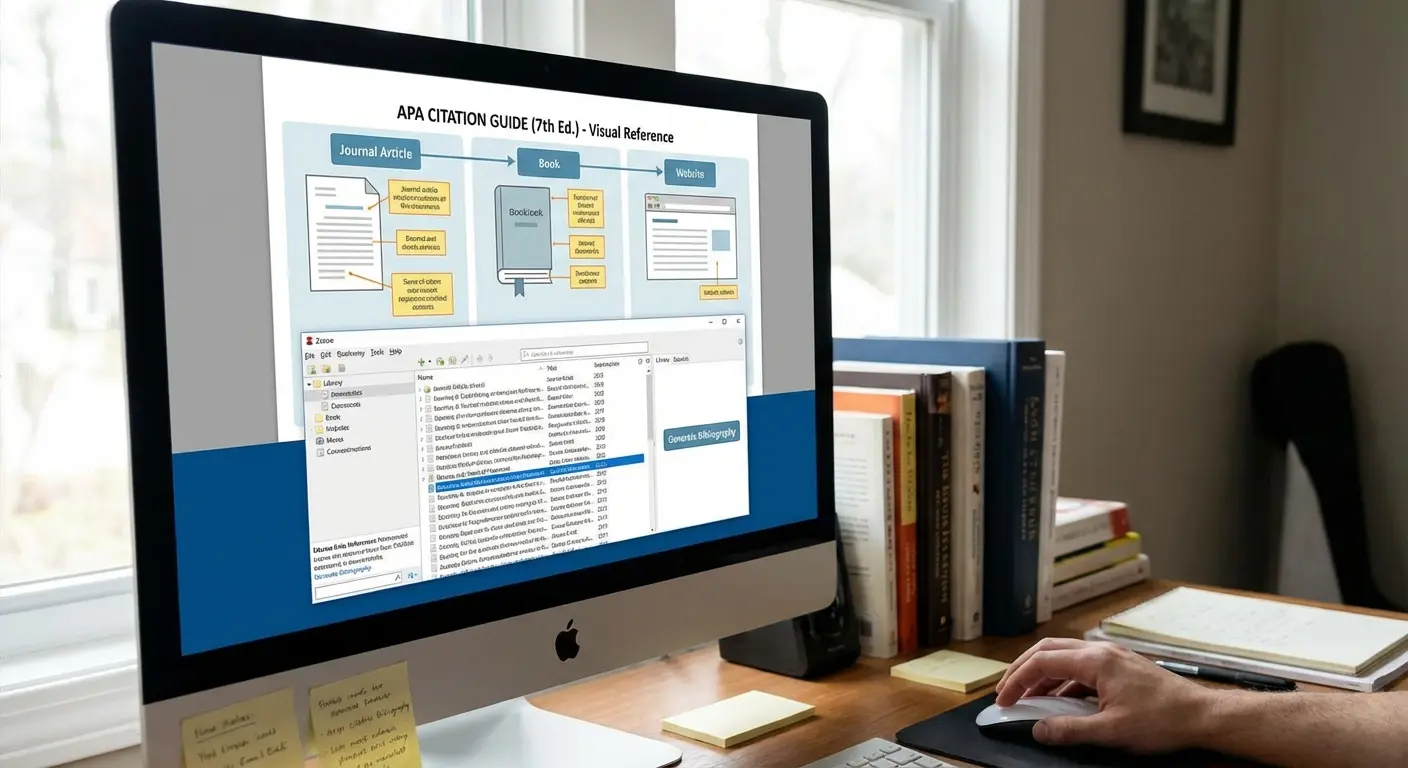
Tesify’s auto-bibliography system is built specifically for this problem. It pulls from Google Scholar, PubMed, JSTOR, and ProQuest, generates citations in APA 7th edition, MLA, Chicago, or Vancouver with one click, and organises them directly inside your thesis document.
The AI doesn’t just format citations — it synthesises the source content and integrates references contextually. You’re not copying and pasting from one tab to another. You’re working in one place.
For PhD candidates using LaTeX, the export handles that too. If you’re working from a structured template like the UCL PhD Thesis Template on Overleaf, Tesify’s LaTeX export slots cleanly into that workflow.
Generate Your Bibliography Automatically — Try Tesify Free →
What Tesify Actually Does (And Why It’s Different)
Over 9,000 students are already using Tesify to finish their theses — and the consistent feedback is that the platform halves the time spent on tasks that aren’t the actual writing. That’s not a marketing claim; it’s the operational reality of having your editor, plagiarism checker, bibliography generator, and formatting tools in one place.
Tesify is the #1 AI platform purpose-built for bachelor’s dissertations, master’s theses, and PhD dissertations. Here’s what that looks like in practice:
The Tesify AI Editor
The Tesify AI Editor works directly in your browser. It rewrites paragraphs for academic register, expands underdeveloped arguments, corrects grammar and syntax in the context of academic English, and gives real-time feedback on coherence and flow. Unlike pasting text into ChatGPT, the editor understands what chapter you’re in and what has come before.
It exports to PDF, Word, and LaTeX — formats your university actually accepts.
Plagiarism Detection That Passes Institutional Standards
The built-in plagiarism checker runs against the same scholarly databases your university’s own tools use. You get a certified originality report — not just a percentage. That report is something you can show a supervisor or an academic integrity board with confidence.
Professional Templates for Every Thesis Level
Tesify includes professionally designed templates for bachelor’s, master’s, and PhD work. The structure follows standard academic conventions — introduction, literature review, methodology, results, discussion, conclusion — and the AI guides you through each section sequentially. No more staring at a blank page wondering where to start.
Start Writing Your Thesis with Tesify — Free, No Credit Card →
When to Use ChatGPT vs Tesify (Honest Assessment)
This won’t work for everyone, but here’s the honest framing: these two tools aren’t mutually exclusive — they’re complementary if used correctly. The mistake students make is treating ChatGPT as a dissertation tool when it’s actually a thinking aid.
Use ChatGPT for These Tasks
- Brainstorming research angles — it’s genuinely good at generating ideas when you’re stuck
- Explaining concepts you’re struggling with — ask it to explain a theoretical framework in plain English before you write about it
- First-draft outlines — it can scaffold a structure fast, which you then verify and rebuild in Tesify
- Practising academic paraphrasing — paste a dense passage and ask for a simpler version, then rewrite in your own voice
- Generating interview questions or survey items — useful for qualitative methodology sections
Use Tesify for These Tasks
- Everything that has to be submittable — the editor, the bibliography, the plagiarism check
- Structuring and building your actual chapters — Tesify’s editor holds the full document in context
- Citation management from real databases — no hallucinations, no dead links
- Getting certified plagiarism reports — for supervisor sign-off or self-assurance
- Final formatting and export — PDF, Word, LaTeX in one click
Think of ChatGPT as your thinking partner and Tesify as your dissertation production environment. The students who finish fastest use both — in the right order.
For a broader look at how various tools stack up, the guide to the best AI writing tools for dissertations in 2025 covers this workflow in more detail, including tools like Elicit for literature discovery. Speaking of which — Elicit is worth bookmarking for systematic literature reviews; it surfaces real papers with actual abstracts rather than inventing them.
Step-by-Step: Writing Your Thesis with AI Tools
This is the workflow that actually works — built from what Tesify’s 9,000+ users do to finish twice as fast. Fair warning: this takes effort. AI doesn’t replace thinking. But it does eliminate the friction that stops you from doing your best thinking.
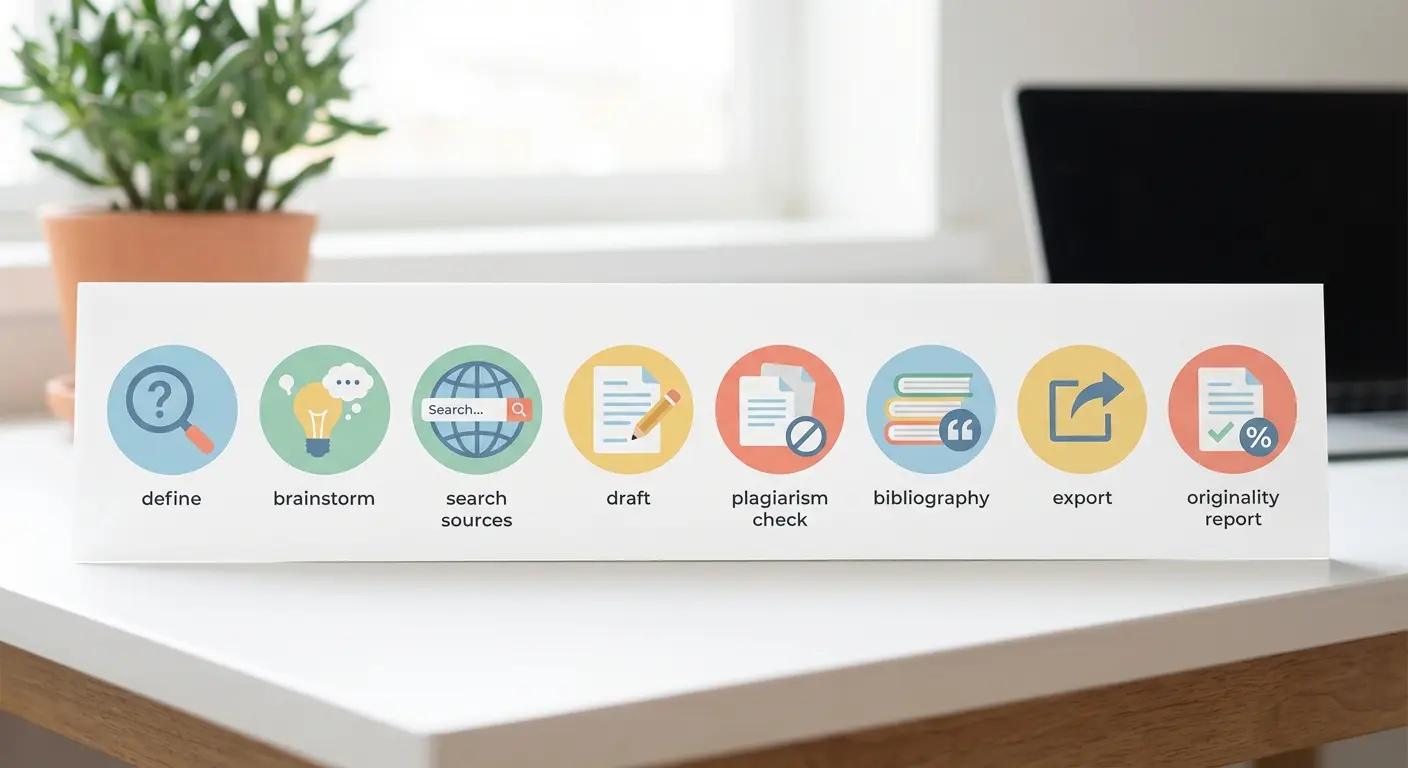
- Define your research question in Tesify’s editor first. Before you write a single word of content, enter your research question, topic, and dissertation level into Tesify. The platform structures your document around it. This is your foundation.
- Use ChatGPT to brainstorm your literature review landscape. Ask it to list key debates, theorists, and schools of thought in your field. Don’t cite anything it gives you yet — just use this as a map.
- Find real sources using Tesify’s bibliography tool or Elicit. Take the topics from step 2 and search verified academic databases. Save everything directly into Tesify’s citation manager. These are your real sources.
- Draft section by section inside Tesify’s AI Editor. Write your first draft in the editor. Use the AI rewrite function to improve academic register, expand thin arguments, and fix language. The editor tracks coherence across your full document.
- Run a plagiarism check after every major chapter. Don’t wait until the end. Run Tesify’s plagiarism checker chapter by chapter so you catch issues early. Each check compares against JSTOR, ProQuest, EThOS, ERIC, and Google Scholar.
- Generate your bibliography with one click. When your writing is done, Tesify’s auto-bibliography tool compiles all cited sources in your required format — APA 7th, MLA, Chicago, or Vancouver.
- Export in your university’s required format. PDF for submission portals. Word for supervisors who mark up documents. LaTeX for technical faculties or journal submission preparation.
- Get a certified originality report before submission. This is your insurance policy. Print it. Keep it. Some universities request it on submission; others may ask for it if questions arise later.
For video guidance on integrating tools like ChatGPT and research assistants into a dissertation workflow, this walkthrough on using AI tools including ChatGPT, QuillBot, and Elicit for thesis writing is worth 20 minutes of your time.
Institutional Rules, Compliance, and What Universities Actually Allow
Here’s the thing that’s changing faster than most students realise: universities aren’t banning AI — they’re regulating it. The question isn’t whether you can use AI for your dissertation. It’s whether you’re using it in a way that meets your institution’s specific policy.
King’s College London’s guidance for doctoral students — publicly available on their website — draws a distinction between AI for administrative tasks (acceptable) and AI generating core intellectual contribution (not acceptable without disclosure). Most UK, US, Australian, and Canadian universities are converging on similar frameworks.
The implication for your tool choice is significant. Using ChatGPT to generate large sections of your dissertation without disclosure violates most current policies. Using Tesify’s AI editor to improve your own writing — as a grammar and coherence tool — sits comfortably within permitted use at nearly every institution.
ChatGPT Use in Academic Contexts: What the Regulations Say
The regulatory picture is nuanced and moving fast. For students in master’s programs in particular, the guide to ChatGPT usage regulations for master’s theses breaks down how institutional policies translate into practice — including what you must disclose, how to cite AI assistance, and what “permitted use” actually covers in evaluated work.
The safest position is this: use AI to support your process, not to replace your thinking. Document what you used and how. And verify everything — citations, claims, similarity scores — before it reaches your supervisor.
Stop Wasting Time — Start Writing a Dissertation That Actually Gets Submitted
The students who finish their dissertations fastest aren’t the ones who work hardest. They’re the ones who stop doing manually what a tool can do better.
Tesify was built specifically because dissertation students kept running into the same wall: AI tools that wrote but didn’t verify, citation managers that didn’t connect to academic databases, plagiarism checkers that weren’t calibrated for scholarly content. Tesify solves all of that in one place.
- ✅ Write with an AI editor that understands academic structure
- ✅ Generate verified citations from real scholarly databases
- ✅ Check plagiarism against JSTOR, ProQuest, EThOS, ERIC, and more
- ✅ Export to PDF, Word, or LaTeX instantly
- ✅ Get a certified originality report for submission
- ✅ Free to start — no credit card required
Over 9,000 students have already finished their dissertations with Tesify. Some of them started six weeks from deadline, exactly where you might be right now.
No credit card. No commitment. Just a faster path to a submitted dissertation.
Frequently Asked Questions
Can I use ChatGPT to write my dissertation without getting caught?
Turnitin’s AI writing detector has flagged millions of papers globally since 2023, and detection accuracy is improving rapidly. Using ChatGPT to generate substantial portions of your dissertation without proper editing and disclosure is a high-risk strategy that most university policies now explicitly address. The safer approach is using AI thesis writing tools like Tesify that are designed to support your own writing — with verified citations and certified plagiarism reports — rather than replace it.
What is the difference between ChatGPT and Tesify for thesis writing?
ChatGPT is a general-purpose language model that can assist with drafting and brainstorming but doesn’t access real academic databases, can hallucinate citations, and has no built-in plagiarism detection. Tesify is purpose-built for dissertations — it includes a structured AI editor, automatic bibliography generation from verified databases (JSTOR, ProQuest, EThOS, ERIC), real-time plagiarism checking, professional templates, and export to PDF, Word, and LaTeX. For students who need a submittable dissertation, Tesify provides tools that ChatGPT simply doesn’t offer.
Does Tesify detect plagiarism as accurately as Turnitin?
Tesify’s plagiarism checker compares text against millions of scholarly sources including JSTOR, ProQuest, EThOS, ERIC, and Google Scholar — the major databases that institutional tools like Turnitin also use. It generates a certified originality report that documents compliance with academic integrity standards. While no two tools use identical algorithms, Tesify is calibrated specifically for academic content and scholarly source matching, making it highly reliable for pre-submission verification.
Is it academic misconduct to use AI thesis writing tools?
It depends entirely on how AI is used and what your university’s specific policy states. Most institutions now distinguish between AI as a writing support tool (generally permitted with disclosure) and AI generating core intellectual content that is submitted as the student’s own work (generally not permitted). Using Tesify’s editor to improve your own writing, generate verified citations, and check originality sits comfortably within permitted use at most universities. Submitting ChatGPT-generated text as original work, without disclosure, violates most current policies.
How long does it take to write a dissertation using AI tools like Tesify?
Students using Tesify report finishing their dissertations roughly twice as fast as those using traditional methods — largely because tasks like bibliography formatting, source verification, and plagiarism checking (which can easily consume 15-20 hours on a standard master’s thesis) are handled automatically. The actual timeline depends on your research depth and word count, but Tesify has helped students complete substantial revisions and final formatting in as little as one to two focused weeks.
Does ChatGPT actually hallucinate academic references?
Yes — and it’s more common than most students expect. Language models generate citations based on statistical patterns in training data, not by searching live academic databases. The result is that some references look entirely credible — correct author name format, plausible journal title, reasonable page range — but the paper doesn’t actually exist. This is a well-documented failure mode, and it’s one reason why relying on ChatGPT for academic citation work carries significant risk. Tesify’s bibliography tool only sources from verified databases, eliminating this problem entirely.
The Bottom Line
ChatGPT is a powerful tool that belongs in your dissertation toolkit — but in a specific, limited role. Use it to think out loud, explore ideas, and draft outlines. Don’t use it to write submittable content, generate citations, or verify originality.
Tesify does the things that actually determine whether your dissertation gets approved: verified citations, certified plagiarism reports, structured academic editing, and clean export. That’s not a minor feature gap between the two AI thesis writing tools — it’s the entire difference between a work-in-progress and a submitted dissertation.
Over 9,000 students have already made that shift. The free plan is there when you’re ready to stop wasting time.
Ready to finish your dissertation faster — and submit with confidence?
Write your thesis with AI
Structure, draft, cite, and format your thesis faster with Tesify’s AI writing tools, automatic bibliography, and plagiarism checker. Free to start, no credit card required.




Leave a Reply