
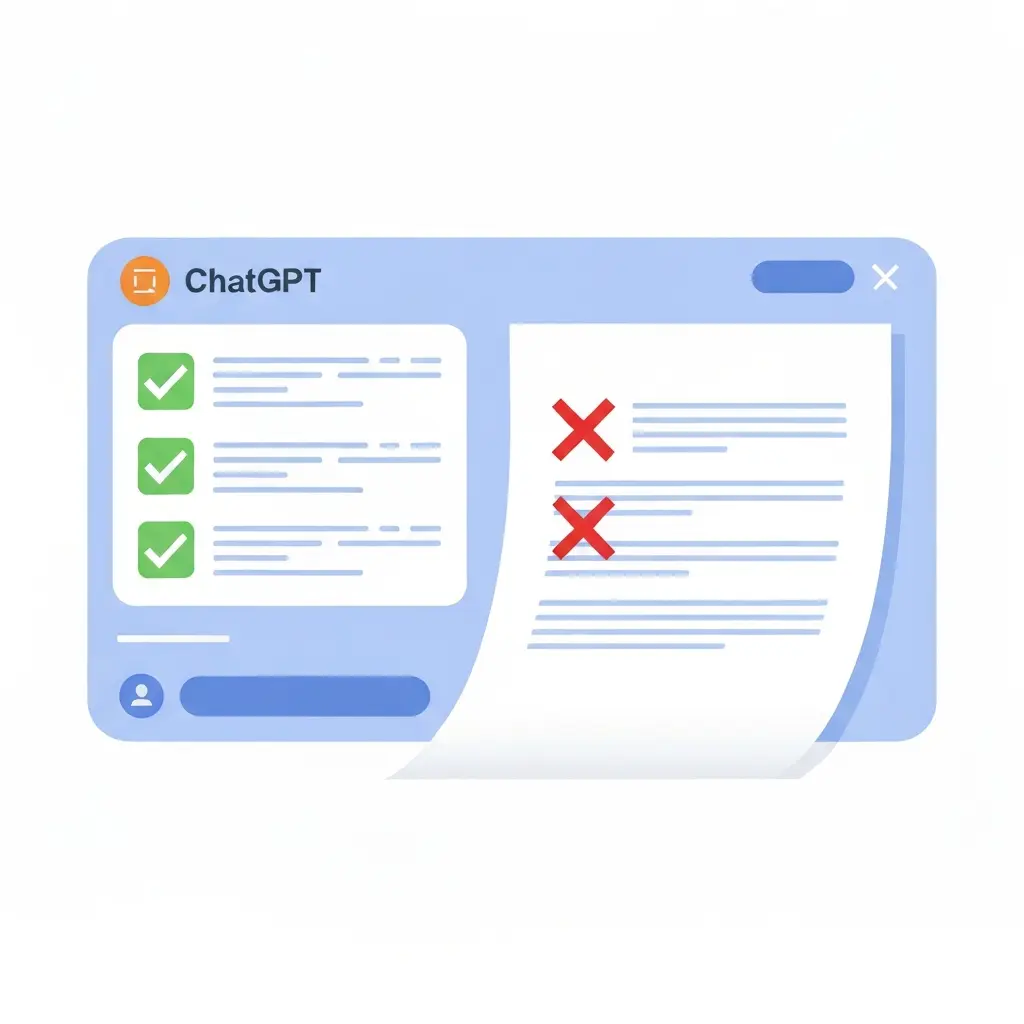
ChatGPT Thesis Writing: What Works and What Doesn’t 2026
More students are turning to ChatGPT for thesis writing in 2026 than ever before — and more are getting it catastrophically wrong. The gap between what ChatGPT is genuinely good at and what it confidently fabricates is enormous. A student who knows the difference gains a real productivity advantage. A student who doesn’t risks submitting hallucinated references, institutionally prohibited content, or academically weak analysis dressed up in confident prose. This guide tells you exactly where the line is.
University AI policies have matured significantly since 2023. In 2026, the dominant institutional approach is not “ban AI” but rather “verify the intellectual process.” Viva examiners at UK and US universities are now trained to probe AI-assisted work through questioning. If you cannot explain your own analysis in depth, the use becomes apparent — regardless of any detection software. The safest, most effective approach is to use ChatGPT for the tasks it handles well while keeping your intellectual contributions firmly your own.
What ChatGPT Does Well for Thesis Writing
Used correctly, ChatGPT can save meaningful hours on lower-stakes thesis tasks without compromising the integrity of your work:
1. Brainstorming Research Angles
Ask ChatGPT to generate 10 possible research questions around your topic, then critically evaluate each one yourself. This is legitimate and helpful — it surfaces angles you might not have considered. The intellectual judgment about which questions are viable remains entirely yours.
2. Structuring and Outlining
Generating a draft chapter outline or a thesis structure is a productive use. Ask: “Suggest an outline for a master’s thesis on X using qualitative methodology.” Then adapt, revise, and populate it with your own content. No academic integrity issues arise if the text is yours.
3. Improving Clarity and Flow
Pasting your own drafted paragraphs and asking ChatGPT to “improve the academic tone and clarity” is broadly equivalent to asking a native speaker to proofread your work. Most universities permit this with disclosure. The ideas, analysis, and conclusions must remain yours.
4. Explaining Complex Concepts
Using ChatGPT to understand a statistical test, a theoretical concept, or a methodological approach before you write about it in your own words is intellectually sound. Think of it as a 24/7 tutor — it helps you understand; you do the writing.
5. Translating Technical Terms or Non-English Sources
Translation assistance is widely permitted. Disclose the tool used in your methodology. Never rely solely on AI translation for critical arguments — always cross-verify with a native speaker or verified translation service.
6. Generating Cover Letter Drafts or Acknowledgements
Low-stakes sections not assessed for intellectual contribution (acknowledgements, cover letters for ethics forms) are generally fine to draft with AI assistance.
Where ChatGPT Fails (And Why It’s Dangerous)
This is the section most students need — and ignore at their peril.
1. Literature References (Critical Failure)
ChatGPT fabricates academic references. Not occasionally — routinely. It produces plausible-sounding author names, journal titles, volume numbers, and page ranges that simply do not exist. In a 2023 study published in academic integrity research, roughly 47% of ChatGPT-generated academic citations were found to be fabricated when verified. Submitting these is plagiarism of the worst kind — fabricating sources. Your examiner will check.
2. Statistical Data
ChatGPT generates statistics that are fabricated or outdated with disturbing confidence. Any statistic you intend to cite must be verified against the original source. Use Google Scholar, Web of Science, or PubMed — not ChatGPT — for data.
3. Critical Analysis
ChatGPT produces analysis that sounds sophisticated but is typically shallow and predictable. It synthesises patterns from training data rather than generating original arguments. A thesis assessed at doctoral level requires intellectual originality — something AI genuinely cannot provide. Examiners at Oxford, Cambridge, and equivalent institutions read thousands of theses; they recognise the difference instantly.
4. Discipline-Specific Technical Content
In fields like law, medicine, biochemistry, and mathematics, ChatGPT makes substantive technical errors — misrepresenting legal precedent, citing superseded clinical guidelines, or making algebraic mistakes. Using these errors in your thesis creates serious problems that proofreading alone will not catch.
5. Current Events and 2025–2026 Data
ChatGPT’s training data has a cutoff. Anything after early 2024 may be outdated or missing. For any thesis with a contemporary component, do not rely on ChatGPT for recent data, policy changes, or current statistics.
Task-by-Task Guide: Use ChatGPT or Not?
| Thesis Task | Use ChatGPT? | Recommended Tool Instead |
|---|---|---|
| Generate research questions | Yes (for brainstorming) | — |
| Find relevant papers | No — hallucinations | Elicit, Semantic Scholar, Google Scholar |
| Outline thesis structure | Yes | Tesify (structured templates) |
| Write literature review sections | No — fabricates sources | Write manually from verified papers |
| Improve writing clarity | Yes (with disclosure) | Grammarly, Writefull |
| Explain statistical methods | With caution | Textbooks, your methods chapter |
| Generate citations in APA/MLA/Chicago | No — formatting errors | Zotero, Tesify Bibliography |
| Write research methodology | No — misconduct risk | Write from your own design decisions |
| Draft acknowledgements | Yes | — |
| Prepare viva questions | Yes (excellent use) | — |
The Hallucination Problem: Why You Can’t Trust ChatGPT References
This is the single most dangerous misuse of ChatGPT in academic work. When you ask ChatGPT to “find references on X topic,” it generates citations that look completely convincing — proper academic format, plausible author names, reputable journals — but which do not exist. This is called hallucination.
A typical example: ChatGPT might produce “Smith, J., & Jones, K. (2022). The effects of remote learning on academic performance. British Journal of Educational Psychology, 92(3), 445–467.” This looks real. The journal is real. The year is plausible. But the article does not exist. If you cite it in your thesis, your examiner will search for it, find nothing, and flag it as academic misconduct — fabricating sources.
The fix is straightforward: never use ChatGPT to find references. Use Google Scholar, Semantic Scholar, or Elicit — tools that search actual academic databases and return real, verifiable papers.
University Policies on ChatGPT for Theses in 2026
By 2026, the majority of Russell Group universities and Ivy League institutions have moved to nuanced, transparent-use frameworks rather than blanket bans. The core principle everywhere is the same: the intellectual work — the ideas, analysis, arguments, and conclusions — must be your own.
Practically:
- Oxford and Cambridge: AI text generation in assessed work requires explicit written permission; declaration mandatory in submission
- UCL, Imperial, Edinburgh: Disclosure required; most departments permit research-assistance use
- MIT and Stanford: Supervisor approval required before using AI in any thesis component
- Harvard: Course-specific policies; graduate school level — check with your department
In 2026, process verification is more common than detection-based enforcement. Examiners focus on whether you understand your own work — which means ChatGPT shortcutting your critical thinking is a genuine viva liability.
Better Tools for Specific Thesis Tasks
Several AI tools are purpose-built for academic writing and avoid the pitfalls of general-purpose LLMs:
- Tesify — designed specifically for thesis writing; chapter-by-chapter structure, auto-bibliography, and academic integrity guardrails built in
- Elicit — AI for literature search with real, verified paper results; extracts key data from papers
- ResearchRabbit — citation mapping to discover related papers you might have missed
- Writefull — academic writing improvement without generating your content
- Consensus — AI that answers research questions with evidence from real papers
For further guidance on using these tools ethically, see our article on can I use AI to write my dissertation and the complete thesis writing guide.
Write smarter, not riskier.
Tesify gives you structured AI thesis support — outlines, chapter templates, bibliography generation — designed around academic integrity requirements. No hallucinations. No policy violations.
Frequently Asked Questions
Can I use ChatGPT to write my thesis conclusion?
No — not in a way that would be submissible. The conclusion synthesises your specific findings, reflects on your research questions, and offers original implications. These require knowledge of your own data and analysis that ChatGPT does not have. You can use ChatGPT to outline a conclusion structure, but the writing must be yours.
How do universities detect ChatGPT in thesis submissions?
Turnitin’s AI detector has an 85% catch rate for clearly AI-generated text but significant false positive rates for ESL writers. In 2026, universities increasingly rely on viva questioning — examiners ask detailed methodological and analytical questions that reveal AI-generated work immediately. Style inconsistencies between sections are also flagged by human markers.
Is ChatGPT good for thesis outlines?
Yes, this is one of ChatGPT’s most legitimate uses for thesis writing. Generating a structural outline for your chapter or entire thesis gives you a scaffold to react to, revise, and populate with your own content. The outline itself is not assessed — only the completed thesis is — so using AI for structural planning is widely accepted.
What should I do if ChatGPT gives me a reference I can’t verify?
Discard it immediately. Do not use any reference you cannot verify in full — author, title, journal, year, volume, and DOI or URL. Search Google Scholar or your institution’s library database. If a search for the exact title returns nothing, the reference is almost certainly fabricated. Never cite anything you have not read.
Is Tesify better than ChatGPT for thesis writing?
For thesis-specific tasks, yes. Tesify is purpose-built for academic writing with structured chapter guidance, automatic bibliography generation, and academic integrity guardrails — it won’t fabricate references or generate sections you are not supposed to submit as your own. ChatGPT is a general-purpose tool that requires careful supervision to use safely in academic contexts.
Further reading
- Can I Use AI to Write My Dissertation? 2026
- How to Write a Thesis: Complete Guide 2026
- How to Avoid Plagiarism in Academic Writing 2026
- Thesis Introduction Examples 2026
Cross-platform
See also tesify.fr’s guide to ChatGPT for French academic dissertations for parallel guidance under French academic integrity frameworks.
Write your thesis with AI
Structure, draft, cite, and format your thesis faster with Tesify’s AI writing tools, automatic bibliography, and plagiarism checker. Free to start, no credit card required.





Leave a Reply