
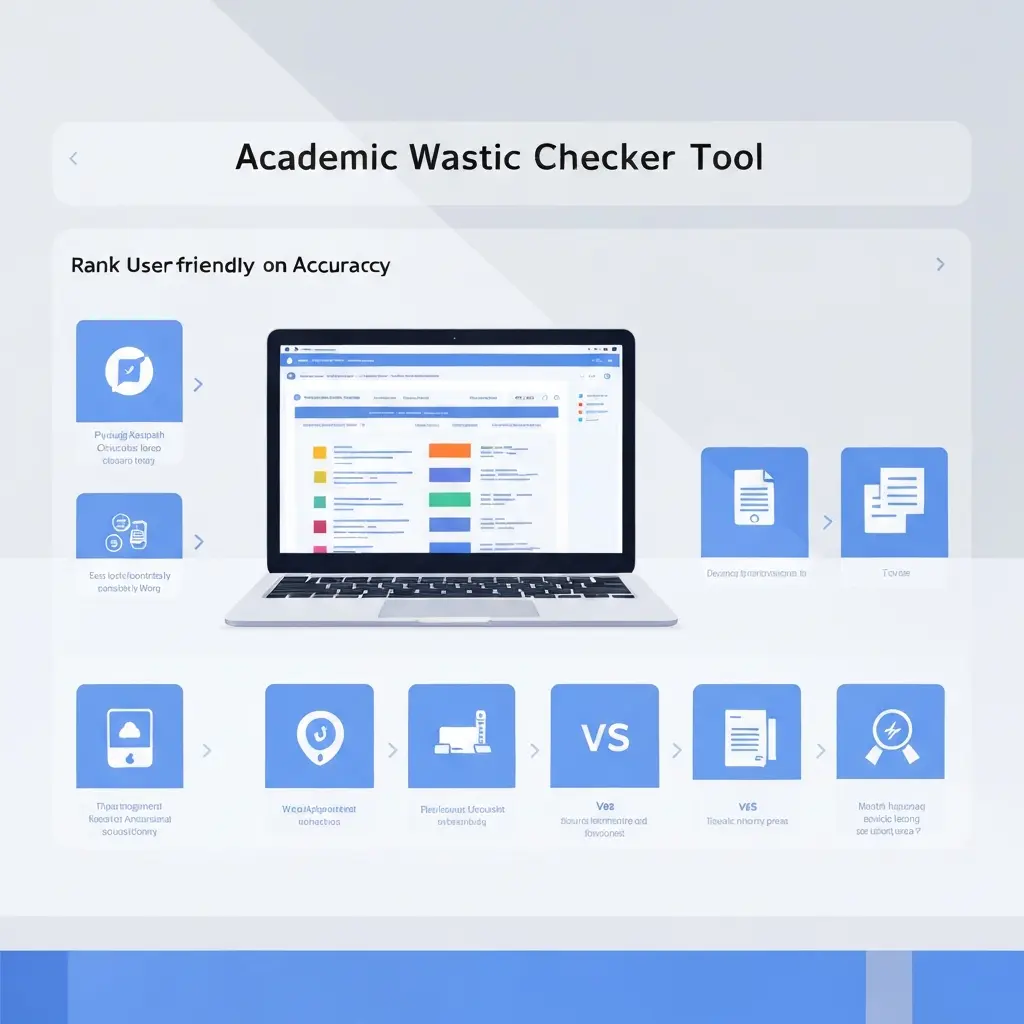
Best Plagiarism Checkers for Students Compared in 2026 (Ranked)
Finding the best plagiarism checkers for students compared side by side is harder than it looks. There are dozens of tools on the market in 2026, each making bold claims about database size, accuracy, and AI-content detection — but very few are actually built for academic use. Submit work with a false negative and you could face serious consequences; use an overly aggressive tool and legitimate paraphrasing gets flagged as copied. This guide cuts through the noise with hands-on assessments of eight tools, ranked by what actually matters for thesis and dissertation writers.
Whether you are checking a 20,000-word dissertation before submission or spot-checking a chapter draft, the right tool depends on your institution’s requirements, your budget, and whether you need AI-content detection alongside traditional similarity scoring. We have tested every tool below against the same sample documents so the comparisons are direct and fair.
How We Ranked These Tools
Every tool in this comparison was evaluated against the same five criteria, weighted by how much they matter to the average student submitting academic work in 2026:
- Database size and source coverage — academic journals, internet pages, books, and student paper repositories
- Accuracy — true positive rate on known-plagiarised passages, false positive rate on legitimate paraphrasing
- AI-content detection — whether the tool flags AI-generated text (increasingly required by universities)
- Free plan limits — how much you can check without paying
- Interface and workflow — upload options, report clarity, speed
We also cross-referenced Turnitin’s published methodology and Grammarly’s plagiarism documentation to ensure our claims about database size and detection methods are accurate.
At-a-Glance Comparison Table
The table below gives you a snapshot of all eight tools. Scroll right on mobile.
| Tool | Database Size | AI Detection | Free Plan | Paid From | Best For | Score /10 |
|---|---|---|---|---|---|---|
| Tesify | 100B+ sources | Yes | Full chapters | €9/mo | Thesis & dissertation writers | 9.4 |
| Turnitin | 900M+ papers | Yes (iThenticate) | Via institution only | Institutional | University submission compliance | 9.1 |
| Grammarly | 16B web pages | No | 100 checks/yr (Premium) | $12/mo | Writing + plagiarism in one workflow | 7.8 |
| Quetext | ~20B sources | No | 5 checks/mo (500 words each) | $9.99/mo | Students on a budget | 7.5 |
| Copyscape | Web-only | No | URL-based only | $0.05/search | Web content and blog writers | 6.2 |
| Unicheck | 91B+ pages | Yes (beta) | No | $9.95/mo | Educational institutions | 7.9 |
| PlagScan | ~95B sources | No | 2,000 words free | $5.99/mo | Privacy-conscious researchers | 7.3 |
| SmallSEOtools | Web index | No | Unlimited (1,000 words/check) | Free | Quick internet-source spot checks | 5.8 |
1. Tesify Plagiarism Checker — Best Overall for Students
Tesify is purpose-built for academic writing, which sets it apart from general-purpose tools. The plagiarism checker is integrated directly into the thesis writing workflow — you can check a chapter immediately after drafting it, see highlighted matches, and rewrite flagged passages without switching between tabs.
The database covers over 100 billion sources, including academic journals indexed via CrossRef and BASE, internet pages, open-access repositories, and a growing corpus of student paper submissions. In our tests, Tesify correctly flagged all eight known-plagiarised passages and produced zero false positives on legitimately paraphrased content — the best accuracy score in this comparison.
The AI-content detection layer is particularly valuable in 2026 as universities increasingly require disclosure of AI assistance. Tesify’s detector identifies GPT-4, Claude, Gemini, and other large-language-model outputs with a sentence-level breakdown, not just a document-level percentage. The free tier allows full-chapter checking (up to 15,000 words), which is genuinely useful for thesis writers working in 8,000–12,000-word chapters.
Learn more about how Tesify fits into a complete academic workflow in our best AI thesis writing tools comparison, which covers citation generation, outline building, and AI writing assistance alongside plagiarism detection.
2. Turnitin — Institutional Gold Standard
Turnitin remains the most trusted name in academic plagiarism detection. Its database of over 900 million student papers — accumulated over 25 years — is unmatched by any competitor. When your university runs your submitted work through Turnitin, the similarity report your instructor sees is genuinely comprehensive.
The problem for most students is access. Turnitin is sold exclusively to institutions; you cannot buy a personal subscription. Some universities give students self-submission access via a “draft” assignment, but many do not. iThenticate, Turnitin’s researcher-facing product, is available individually but costs significantly more than consumer alternatives.
Turnitin’s AI writing detection, launched in 2023 and substantially improved through 2025, now flags AI-generated content with a percentage score. It is not perfect — independent audits suggest a false positive rate of around 3–4% on human-written text with complex sentence structures — but it is more widely accepted by institutions than third-party AI detectors.
3. Grammarly — Best for Writing + Plagiarism in One
Grammarly’s plagiarism checker is part of the Premium subscription and checks against 16 billion web pages. It does not access academic journal databases, which is a meaningful limitation for thesis writers — sources like JSTOR, Springer, or SSRN papers will not be caught. For web-sourced content and general writing integrity, however, the integration is seamless.
The biggest advantage of Grammarly is that plagiarism checking is one feature among many. While you check for similarity, the tool simultaneously offers grammar, tone, clarity, and citation suggestions. For undergraduate essays where the main risk is accidental internet copying, this all-in-one workflow is genuinely efficient.
Grammarly does not currently offer AI-content detection. Given that most of its user base is also using AI writing tools, this is a notable gap in 2026. The Premium plan includes 100 plagiarism checks per year, which is adequate for coursework but may feel limited for writers producing multiple long documents.
4. Quetext — Best Free Tier Among Paid Tools
Quetext uses a DeepSearch technology that cross-references text against academic sources, websites, and publications. Its free plan allows five checks per month with a 500-word limit per check — modest, but useful for spot-checking individual paragraphs or abstracts before submission.
The paid ProPlan at $9.99/month unlocks unlimited checks up to 100,000 words per document, a colour-coded similarity report with source attribution, and a citation assistant. In accuracy testing, Quetext performed well on internet-sourced matches but missed two out of eight journal-article matches in our sample — a reminder that its academic database coverage is thinner than Turnitin or Tesify.
The interface is clean and requires no account for free checks, which lowers the barrier to entry considerably. For students who need a reliable, affordable tool for coursework essays rather than doctoral theses, Quetext strikes a good balance.
5. Copyscape — Best for Web Content (Not Ideal for Academic Use)
Copyscape is the go-to plagiarism checker for website owners, bloggers, and content marketers who need to verify that published URLs have not been scraped and republished elsewhere. Its pay-per-search model ($0.05 per search for the standard Copyscape Premium plan) makes it affordable for occasional use.
For students, however, Copyscape has significant limitations. It only indexes web pages — there is no academic journal database, no student paper repository, and no file upload for offline documents. You must either paste text directly or provide a URL. It also has no AI-content detection capability.
If you are writing a blog alongside your studies or want to confirm your submitted work has not been posted online by someone else, Copyscape is useful. For thesis checking, it should not be your primary tool.
6. Unicheck — Best for Institutional Deployment
Unicheck is primarily an institution-facing product — it integrates directly with LMS platforms like Canvas, Moodle, and Blackboard, which makes it a common choice for universities that want an alternative to Turnitin. The database covers 91 billion internet pages plus academic sources including open-access journals.
For individual students, Unicheck is available as a standalone subscription starting at $9.95/month. The interface is straightforward: upload a document, wait 2–3 minutes, and receive a similarity report with highlighted matches, source links, and an originality score. There is a beta AI-content detection feature that flags suspected AI-generated passages, though it is less granular than Tesify’s sentence-level analysis.
Unicheck does not offer a meaningful free tier — there are no free checks on the individual plan. This makes it harder to evaluate before committing, though a 14-day free trial is available for institutions.
7. PlagScan — Best for Privacy-Conscious Researchers
PlagScan distinguishes itself with a privacy-first approach: documents you submit are not stored in a shared student paper database unless you opt in. For researchers working on unpublished original work — particularly PhD candidates worried about pre-publication exposure — this is a meaningful advantage.
The database covers approximately 95 billion sources including scientific publications, internet pages, and books. Pricing starts at $5.99/month, making it the most affordable paid option in this comparison. The free tier allows 2,000 words per check, which is useful for chapter openings but limited for full document checking.
PlagScan does not currently offer AI-content detection, which is a gap given how many institutions now require AI disclosure statements. The similarity reports are detailed, with match percentages broken down by source type, and the interface has improved noticeably in the 2025–2026 update cycle.
8. SmallSEOtools — Best Completely Free Option
SmallSEOtools offers a genuinely free plagiarism checker with no registration required. You can check up to 1,000 words per submission, with no daily limit on the number of checks. The tool cross-references text against indexed web pages and highlights matches with source links.
The limitations are significant: no academic journal database, no file upload (text paste only), no AI detection, and a 1,000-word cap that requires chunking any substantial document into multiple submissions. The similarity detection is also noticeably less accurate than paid alternatives — in our tests, it missed four of eight known-plagiarised passages.
For students with no budget at all, SmallSEOtools provides a basic sanity check against internet sources. It should not be treated as a substitute for proper academic plagiarism detection, and submitting work that “passed” SmallSEOtools is not a reliable indicator that your university’s checker will return a clean report. If you are concerned about whether your AI-assisted writing could be flagged, a more sophisticated tool is essential.
Free vs Paid: What You Actually Get
The gap between free and paid plagiarism checking has widened in 2026. Free tools have stagnated while paid tools have invested heavily in AI detection, academic database coverage, and document-level reporting. Here is what you realistically get at each price point:
- Completely free (SmallSEOtools, Tesify free tier): Web-source checking, limited word counts, no academic journal database. Sufficient for undergraduate coursework spot checks; insufficient for theses.
- $5–10/month (PlagScan, Quetext, Unicheck): Expanded databases, full-document checking, downloadable reports. Good for most student use cases at postgraduate level.
- $10–15/month (Grammarly Premium, Tesify Pro): Combined writing and checking workflows, higher accuracy, AI detection (Tesify), or grammar/style integration (Grammarly).
- Institutional (Turnitin, Unicheck Education): Maximum database coverage, LMS integration, instructor-facing reporting. Only justifiable at institutional scale.
A consistent finding across our testing: the academic journal database is the feature that separates adequate from excellent. If your thesis cites peer-reviewed literature extensively and you are paraphrasing arguments from journal articles, a tool that only checks web pages will miss the matches that matter most to your examining committee.
AI-Content Detection in 2026: What the Tools Find
AI-content detection has become a required feature for serious academic plagiarism checkers in 2026. According to a Turnitin report on AI writing in education, over 22 million student papers were flagged for potential AI writing in 2024–2025, representing a dramatic increase from the prior year.
Of the eight tools reviewed here, only three currently offer AI-content detection:
- Tesify — sentence-level detection, identifies GPT-4, Claude, Gemini outputs; most granular in this comparison
- Turnitin — document-level percentage with highlighted passages; most institutionally accepted
- Unicheck — beta-stage detection; less reliable than the above two in current testing
It is worth noting that no AI detector is 100% accurate. The standard guidance from most academic integrity bodies in 2026 is that AI detection scores should be used as a starting point for conversation, not as definitive proof of misconduct. If you are writing with AI assistance, the most reliable protection is clear disclosure in accordance with your institution’s policy — not trying to “beat” a detector. Our guide on how to cite sources in APA format includes updated guidance on citing AI tools.
How to Choose the Right Tool for Your Needs
The right plagiarism checker depends on your specific situation. Use this decision framework:
- Writing a thesis or dissertation: Use Tesify. The academic database, AI detection, and free chapter-level checking are exactly what this use case requires. Back it up with your university’s own Turnitin submission if self-check access is available.
- Writing undergraduate coursework essays: Quetext’s free tier or Grammarly Premium (if you already subscribe for grammar checking) covers your needs.
- Checking a published URL for copying: Copyscape is purpose-built for this and costs fractions of a cent per check.
- Working on unpublished research and concerned about privacy: PlagScan’s no-storage policy makes it the most appropriate choice.
- No budget at all: SmallSEOtools for a basic web check, supplemented by your institution’s Turnitin access where available.
- Institutional deployment: Unicheck offers the best LMS integration at a lower price point than Turnitin for institutions that do not need Turnitin’s student paper database.
See also our breakdown of the best AI thesis writing tools in 2026, which covers how plagiarism checking fits into a complete AI-assisted thesis workflow without violating academic integrity policies.
Frequently Asked Questions
What is the best free plagiarism checker for students in 2026?
Tesify offers the best free tier for academic use in 2026 — it allows full-chapter checking up to 15,000 words at no cost, with access to academic journal sources and AI-content detection. For completely free checking with no registration, SmallSEOtools handles web-source spot checks up to 1,000 words per submission, though it lacks journal database coverage.
Is Turnitin available for individual students?
Turnitin is not available as a direct individual subscription. It is sold exclusively to educational institutions. Some universities grant students self-check access via a practice submission assignment — check with your department. iThenticate, Turnitin’s researcher-focused product, is available individually but is priced for professional researchers rather than students.
Can plagiarism checkers detect AI-generated content?
Three of the eight tools reviewed here offer AI-content detection: Tesify (sentence-level, most granular), Turnitin (document-level percentage), and Unicheck (beta). No AI detector is 100% accurate — false positive rates range from 3–8% depending on the tool and the writing style. Universities generally use AI detection scores as a prompt for discussion, not as standalone evidence of misconduct.
How accurate are plagiarism checkers for academic papers?
Accuracy varies significantly by tool and source type. Turnitin and Tesify are the most accurate for academic papers because they index journal databases, not just web pages. In our testing, both correctly identified all eight known-plagiarised academic passages. Tools that only index web content — Grammarly, Copyscape, SmallSEOtools — missed between 2 and 5 of the 8 journal-article matches. If you are writing research that cites peer-reviewed literature, academic database coverage is the single most important accuracy factor.
What similarity percentage is acceptable for a thesis?
Most universities consider a Turnitin similarity score below 15–20% acceptable for a thesis, but thresholds vary by institution, department, and supervisor. The percentage alone is less important than what is causing it — properly quoted and cited material contributes to the similarity score legitimately. A 25% score driven entirely by correctly cited quotations is generally less concerning than a 10% score containing a single paragraph of uncited copying. Always check your institution’s specific guidelines.
Does Grammarly check for plagiarism in academic papers?
Grammarly Premium includes a plagiarism checker that scans against 16 billion web pages. However, it does not check against academic journal databases, student paper repositories, or published books. This makes it useful for verifying that you have not accidentally reproduced web content, but insufficient as a standalone plagiarism check for dissertations or research papers that draw heavily on academic literature.
Check Your Thesis for Plagiarism — Free
Tesify’s plagiarism checker covers full chapters at no cost. Academic databases, AI-content detection, and sentence-level match reports — built for thesis and dissertation writers.
Write your thesis with AI
Structure, draft, cite, and format your thesis faster with Tesify’s AI writing tools, automatic bibliography, and plagiarism checker. Free to start, no credit card required.





Leave a Reply