
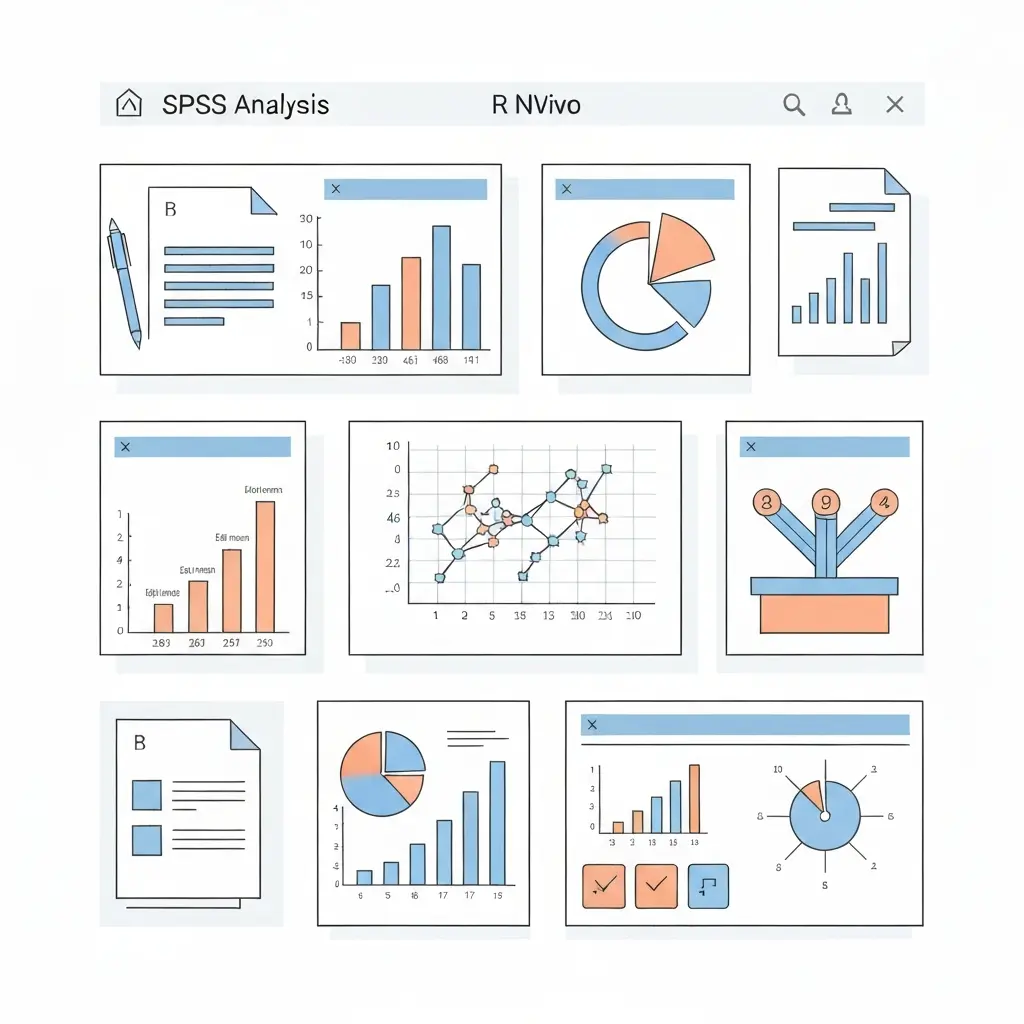
Best Data Analysis Software for Thesis Research Compared 2026: SPSS, R, NVivo, and More
Choosing the right data analysis software for your thesis is a decision that affects your methodology chapter, your ethics application, your analysis process, and — in oral examinations — your ability to explain and defend your analytical choices. In 2026, the landscape has expanded significantly: traditional workhorses like SPSS and NVivo now compete with open-source alternatives (R, Python, ATLAS.ti) and AI-enhanced analysis tools. This guide compares the major options by methodology type, price, and practical usability for postgraduate researchers.
Master Comparison Table
| Software | Method | Price | Learning Curve | University Access |
|---|---|---|---|---|
| SPSS | Quantitative | ~£70/mo or free via uni | Low | Most UK/US universities |
| R | Quantitative | Free | High | N/A (open source) |
| Python | Quantitative / Mixed | Free | High | N/A (open source) |
| NVivo | Qualitative | ~£350/yr or free via uni | Medium | Most UK/Australian universities |
| ATLAS.ti | Qualitative | ~€200/yr academic | Medium-High | Some universities |
| MAXQDA | Mixed Methods | ~€175/yr academic | Medium | Some universities |
Quantitative Analysis: SPSS vs R vs Python
SPSS (IBM SPSS Statistics):
SPSS has been the workhorse of social science quantitative analysis for 50 years. Its point-and-click interface makes it accessible to students without programming experience. Most supervisors in social sciences, psychology, education, and business recognise SPSS output and can help you interpret it. Its menu-driven approach for t-tests, ANOVA, regression, factor analysis, and reliability analysis covers the vast majority of master’s-level quantitative designs.
Limitation: SPSS syntax (required for reproducibility in research) adds complexity that beginners avoid, creating reproducibility problems. It is also increasingly viewed as legacy software in STEM and computational social science, where R is now expected.
R (with RStudio):
R is free, open-source, and the increasingly dominant choice in academic statistics. Top journals in ecology, epidemiology, psychology, and economics now expect R code submission alongside data. RStudio (now Posit) makes R much more accessible. The learning curve is real — expect 4–6 weeks of active learning before you are proficient — but the payoff is a reproducible, transparent analysis process that examiners and journal reviewers increasingly require.
R is particularly strong for: complex regression models, structural equation modelling (SEM), multilevel/hierarchical models, survival analysis, meta-analysis (metafor package), and visualisation (ggplot2).
Python:
Python (with pandas, scipy, statsmodels, and scikit-learn) is the dominant language in data science and increasingly used in computational social science. If your research involves large datasets, machine learning, natural language processing, or network analysis, Python is the right choice. For standard social science quantitative analysis, R is more efficient.
Qualitative Analysis: NVivo vs ATLAS.ti vs MAXQDA
NVivo (Lumivero):
NVivo is the most widely used qualitative data analysis (QDA) software in UK and Australian universities. It supports thematic analysis, grounded theory, IPA, discourse analysis, and framework analysis. Most university libraries provide NVivo access free to researchers. Its Node (now “Code”) system for managing qualitative codes is intuitive, and its query functions enable systematic theme identification.
In 2024, NVivo 14 introduced AI-assisted coding suggestions — useful for identifying potential codes but requiring critical validation by the researcher. See our detailed guide on thematic analysis methodology for how NVivo fits into Braun and Clarke’s reflexive TA approach.
ATLAS.ti:
ATLAS.ti 24 (Windows/Mac/web) is particularly favoured by grounded theory researchers, with strong network visualisation for showing relationships between codes and categories — a core output in grounded theory analysis. ATLAS.ti also has strong support for visual and multimedia data (video, images, audio), making it useful for multimodal research.
MAXQDA:
MAXQDA stands out for mixed methods research because it handles both qualitative and quantitative data in the same project — enabling mixed methods analysis where you can directly link qualitative themes to quantitative variables. For theses using a sequential or concurrent mixed methods design, MAXQDA is the most efficient single-tool solution.
Mixed Methods: Which Software Works Best?
For mixed methods theses, the most practical approach:
- MAXQDA: best single-tool solution for mixed methods (handles both qualitative and quantitative)
- NVivo + SPSS/R: industry standard in most UK universities — qualitative in NVivo, quantitative in SPSS or R, with manual integration in the discussion chapter
- Python + NVivo: emerging approach in computational social science
For writing your methodology chapter covering data analysis, see our guides on qualitative research methods and quantitative research methods. For guidance on reporting your analysis in APA 7 format, see the APA citation format guide.
Cost and University Access: Practical Guidance
Before paying for any software, check these sources:
- Your university’s software catalogue — most universities provide SPSS, NVivo, and ATLAS.ti free. Search “[your university] + software downloads + student”
- IT Services or Research Computing — often has licences not listed in the main catalogue
- Your department — many departments hold software licences specifically for research students
- Student academic pricing — ATLAS.ti Academic (€200/yr), MAXQDA Academic (€175/yr), and NVivo student ($99/yr) are all substantially cheaper than standard licences
- Free alternatives: R (quantitative), Taguette (basic qualitative), OpenCode (basic coding), Python (advanced)
Once your analysis is complete and you are writing up, Tesify helps you structure your findings chapter and integrate your analytical outputs into coherent academic argument.
Frequently Asked Questions
What is the best software for analysing survey data in a thesis?
For Likert scale and survey data: SPSS for beginners (most university libraries provide free access), R for researchers who want open-source reproducibility. SPSS is more familiar to social science supervisors and examiners; R is increasingly expected in top programmes and required for journal publication in many fields. Both export to formats suitable for thesis tables and figures.
Is NVivo free for university students?
NVivo is available free through most UK, Australian, and many US universities — check your university’s software downloads portal or contact IT services. If your university does not provide it, NVivo Academic 14 costs approximately £99–£350 depending on the licence type. A free 14-day trial is available at lumivero.com. Taguette is a completely free, open-source alternative for basic qualitative coding, though it lacks NVivo’s advanced query functions.
Should I use SPSS or R for my thesis?
It depends on your field and skills. Use SPSS if: you have no programming experience, your supervisor uses SPSS, and you are in social sciences, education, or business at master’s level. Use R if: you have some coding experience, you are in a STEM or computational field, you plan to publish your research (most journals now expect R code), or your supervisor recommends it. R is free and more powerful; SPSS is easier to learn and more familiar to most supervisors.
What software should I use for thematic analysis?
NVivo is the most widely used and most likely to be available free via your university. ATLAS.ti is a strong alternative, particularly for grounded theory. However, Braun and Clarke’s reflexive thematic analysis explicitly notes that software is optional — many researchers successfully conduct TA using only Word documents with colour coding and memo-writing. Software does not make your analysis more rigorous; systematic engagement with your data does.
Write Up Your Analysis with Tesify
Once your SPSS, R, or NVivo analysis is done, the hard work of writing it up begins. Tesify helps you structure your findings and discussion with AI-assisted academic writing — so your data tells the story your examiners need to hear.




Leave a Reply