

Best AI Tools for Academic Writing Compared 2026: 10 Tools Tested and Ranked
The best AI tools for academic writing compared in 2026 are not the best AI writing tools in general — they are a specific subset calibrated for the unique demands of scholarly work: formal register, verified citations, discipline-specific vocabulary, and institutional integrity compliance. We tested 10 tools across the full academic writing stack — from research discovery through final draft — and ranked them on output quality, citation accuracy, academic integrity safety, and cost-effectiveness for students.
The core challenge in 2026 is that the most powerful general AI tools (ChatGPT, Claude, Gemini) are also the highest-risk for academic submissions. Purpose-built academic tools trade some of that raw capability for guardrails that keep students on the right side of institutional policies. This guide maps that trade-off clearly so you can build the right stack for your specific academic needs.
Full Feature and Pricing Matrix
| Tool | Primary Function | Citations | Plagiarism Check | AI Detection Risk | Starting Price |
|---|---|---|---|---|---|
| Tesify Write | Full thesis workflow | Auto-bibliography | Built-in | Low (2-4%) | Free |
| Paperguide | Literature review generation | Inline from databases | No | Low-Medium | Free tier |
| Elicit | Research discovery | From Semantic Scholar | No | N/A (no generation) | Free / $12/mo |
| Jenni AI | Autocomplete drafting | Real-time inline | No | Low (co-writing) | $20/mo |
| Paperpal | Editing and review | Style check | 100B pages (free 7K/mo) | Low (editor) | Free / $25/mo |
| Writefull | Language polish | No | No | Very low (edit only) | $7.21/mo |
| QuillBot | Paraphrasing | Separate tool | Paid add-on | Low-Medium | Free / $9.95/mo |
| Grammarly | Grammar checking | No | Premium (16B pages) | Low (editor) | Free / $12/mo |
| Connected Papers | Research mapping | Visual from graph | No | N/A (no generation) | Free / $6/mo |
| ChatGPT | General reasoning | Often fabricated | No | Very high (87-91%) | Free / $20/mo |
1. Tesify Write — Best Overall AI Tool for Academic Writing
Tesify Write tops this comparison for the same reason it tops our more targeted thesis-writing comparison: it is the only tool that addresses the complete academic writing workflow — structure, generation, citation, plagiarism checking, and language editing — in a single integrated platform. For students who are tired of juggling five different browser tabs across the writing process, Tesify’s unified environment is a genuine quality-of-life improvement.
The academic integrity design is deliberate. Tesify’s output registers at 2-4% on AI detection tools because it is built to assist your writing rather than replace it. The generated text adopts your established style rather than producing a generic AI voice. Citations are pulled from verified academic databases and formatted automatically — eliminating the fabrication risk that makes ChatGPT-generated references dangerous. The tool is free to start, with no credit card required.
2. Paperguide — Best for Literature Review Generation
Paperguide’s full document generation feature creates complete academic drafts by pulling real citations from indexed research databases rather than fabricating them. Its built-in AI Humanizer reduces the AI detection footprint of generated text — useful for students at institutions with AI detection systems. The free tier is functional for short documents; the paid plan unlocks unlimited document generation and advanced features.
Paperguide works best as a literature review accelerator when combined with Elicit for source discovery and Tesify for chapter structuring. Literature reviews that would previously take weeks of reading, note-taking, and drafting can be produced in hours when this three-tool stack is used effectively. See our Best AI Literature Review Tools for Researchers 2026 for a deep dive on this specific use case.
3. Elicit — Best for Research Discovery
Elicit is the most underused tool in the academic AI stack. Submit a research question to Elicit and it surfaces relevant papers from Semantic Scholar, summarises their key findings in a table view, and maps how different studies relate to each other. For students in the early stages of a thesis who need to survey the existing literature quickly and identify the key papers in their field, Elicit reduces weeks of database searching to hours.
Elicit does not write anything — it only surfaces and summarises existing research. This makes it one of the safest tools in this comparison from an academic integrity standpoint. The free tier is usable for moderate research volumes; the $12/month Pro plan removes session limits and adds export capabilities.
4. Jenni AI — Best for Drafting Assistance
Jenni AI occupies a distinctive position: it writes with you rather than for you. Its autocomplete feature suggests the next sentence as you type, keeping you in creative flow without handing control to the AI entirely. Citations appear inline as you write, linked to sources from your uploaded PDFs or Jenni’s research index. The collaborative feel of Jenni’s interface is different from any other tool in this comparison — more like a writing partner than a generation engine.
At $20/month, Jenni is priced for regular use. For students who find that AI writing tools make them passive rather than active in the writing process, Jenni’s co-writing model is a more academically appropriate approach than bulk generation tools.
5. Paperpal — Best for Editing Existing Work
Paperpal earns its place in this comparison through specialisation: it is the best tool specifically for taking an existing draft and improving it to publication or submission standard. Its AI Review feature identifies structural weaknesses, unclear arguments, and language issues with the kind of precision that would previously require a professional academic editor. The plagiarism checker’s 100-billion-page database and data privacy commitment (no storage, no training) make it a trustworthy final-pass tool.
The workflow recommendation: draft with Tesify, refine with Paperpal. The $25/month Prime plan is worth the cost for students in the final month before thesis submission — treat it as a subscription you run for one month rather than ongoing.
6. Writefull — Best for Language Polish
Writefull is trained on published academic texts from peer-reviewed journals, which means its suggestions are calibrated to genuine scholarly register rather than business or general prose. At $7.21/month — the most affordable specialist tool in this comparison — it delivers a clear return on investment for students who know their ideas are strong but whose written English is not yet at submission standard.
Writefull is particularly strong for STEM students who work in LaTeX and Overleaf environments. Its direct Overleaf integration makes it the only tool in this comparison that works natively inside a LaTeX editor. For non-native English speakers writing in English, Writefull and QuillBot together cover the grammar, vocabulary, and paraphrasing needs of most academic writing projects.
7. QuillBot — Best Paraphrasing Tool
QuillBot remains the go-to paraphrasing tool for academic writing in 2026. Its seven paraphrasing modes — Standard, Fluency, Formal, Academic, Simple, Creative, and Expand — give granular control over how a passage is reworded. The Academic mode in particular produces output that reads like polished scholarly prose. At $9.95/month, it is accessible for almost any student budget.
The key use case for QuillBot in academic writing is not rewriting someone else’s work (which is plagiarism) — it is refining your own prose for clarity and formality. Using QuillBot to improve the way you have expressed your own ideas is a legitimate and effective editing technique. For a comparison of how QuillBot handles academic prose versus Grammarly and Tesify, see our Grammarly vs QuillBot vs Tesify analysis.
8. Grammarly — Best Grammar Checker for Academic Writing
Grammarly’s free tier catches the grammar and spelling errors that matter most in academic submissions. The Premium plan ($12/month) adds tone suggestions, clarity improvements, a plagiarism checker covering 16 billion web pages, and an AI detector. For students who already have a writing workflow and need a robust grammar layer on top, Grammarly integrates with every major writing environment — browser, Word, Google Docs, and Overleaf.
Grammarly’s academic writing limitation is that it is trained on general writing rather than scholarly text. Some of its suggestions for academic prose — particularly around sentence variety and passive voice — conflict with discipline-specific academic conventions. Use it as a technical grammar check rather than a style guide.
9. Connected Papers — Best for Mapping Research Networks
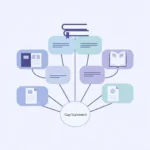
Connected Papers generates visual graphs of academic literature, showing how papers are related to each other based on citation overlap. Enter one seed paper in your research area and Connected Papers surfaces the most central papers in that research network — the ones that every other paper in the field cites. For students doing a literature review who are not sure which papers are foundational versus peripheral, this visual map is invaluable for prioritising what to read.
The free plan covers 5 graphs per month; the $6/month plan is unlimited. This is one of the most cost-effective research tools in this comparison relative to the value it provides, particularly early in a research project.
10. ChatGPT — Most Powerful, Highest Risk
ChatGPT closes this ranking at #10 not because it lacks capability — it has more raw language capability than any other tool here — but because its risk profile for academic writing is the highest. Fabricated citations, high AI detection flags (87-91%), and the absence of academic integrity guardrails make it the wrong primary tool for academic submissions. As a thinking partner for brainstorming, argument development, and concept explanation, it is unmatched. As a writing tool for academic submissions, it requires extensive expertise and verification to use safely.
For the detailed Tesify vs ChatGPT comparison including test data on citation accuracy and AI detection rates, see our Tesify vs ChatGPT for Thesis Writing 2026 comparison.
Recommended Tool Stacks by Student Type
Undergraduate writing first dissertation
- Primary: Tesify Write (structure + generation + plagiarism + bibliography)
- Grammar: Grammarly free tier
- Research: Elicit (free tier)
Postgraduate writing a masters thesis
- Primary: Tesify Write
- Research discovery: Elicit Pro + Connected Papers
- Literature review: Paperguide
- Language polish: Writefull
- Final plagiarism check: Paperpal (one month subscription)
PhD candidate writing a dissertation
- Research mapping: Elicit + Connected Papers
- Literature review: Paperguide
- Chapter drafting: Tesify Write
- Language polish (STEM): Writefull (Overleaf integration)
- Conceptual development: ChatGPT (as reasoning partner, not writer)
- Final edit: Paperpal Prime (one month)
Non-native English speaker
- Primary: Tesify Write (structure and draft)
- Paraphrasing: QuillBot Academic mode
- Grammar and vocabulary: Writefull or Grammarly Premium
For broader academic tool recommendations including reference management and note-taking, see our Complete Guide to AI Tools for University Students 2026. French-speaking students can also access this comparison at tesify.fr.
Frequently Asked Questions
What is the best AI tool for academic writing in 2026?
Tesify Write is the best all-in-one AI tool for academic writing in 2026. It combines structured academic draft generation, built-in plagiarism detection, auto-bibliography, and academic integrity compliance in a single free platform. For specialised tasks, pair it with Elicit (research discovery), Writefull (language polish), and Paperpal (editing and final plagiarism check).
Can AI tools be used for academic writing without violating academic integrity?
Yes, when used appropriately. Most universities in 2026 permit AI-assisted editing (grammar, language polish, citation formatting), AI research discovery (Elicit, Connected Papers), and AI writing assistance where the student substantially revises the output and takes intellectual ownership. What is typically prohibited is submitting AI-generated text as your own original work without disclosure. Always check your institution’s specific policy.
Which AI writing tool is hardest for universities to detect?
This question frames AI tool use as circumventing detection, which is not the right approach to academic writing. The more useful question is: which AI tools help you write genuinely good academic work while staying compliant with your institution’s policy? Tesify Write is specifically designed for this — its output reads as human-assisted writing because it is. The goal should be using AI to write better, not to avoid detection.
Is Jenni AI or Tesify better for academic writing?
Tesify Write is better for students who want a complete thesis workflow with built-in plagiarism detection, auto-bibliography, and structured chapter generation. Jenni AI is better for students who prefer a collaborative co-writing experience where they maintain full creative control sentence by sentence. Tesify is free to start; Jenni costs $20/month.
What AI tools do PhD students use for academic writing?
Based on our research, PhD students most commonly use a multi-tool stack: Elicit and Connected Papers for literature mapping, Tesify Write or Paperguide for chapter drafting, Writefull for language polish in English or Overleaf environments, and ChatGPT as a conceptual reasoning partner (with careful verification of any content). Zotero or Mendeley remain standard for reference management across the full PhD project. See our guide on the best AI research assistants for PhD students for more detail.
Is there a free AI tool for academic writing in 2026?
Yes. Tesify Write is free to start with no credit card required and includes thesis generation, plagiarism detection, and auto-bibliography in the free tier. Elicit, Connected Papers, Zotero, and ZoteroBib all offer functional free tiers. Writefull, Grammarly, and QuillBot also have free tiers that cover basic academic writing needs.
Does Paperpal or Tesify include a plagiarism checker?
Both include a plagiarism checker. Tesify’s plagiarism detection is built into the thesis writing workflow and runs automatically. Paperpal’s plagiarism checker scans against 100 billion web pages and 200 million open-access articles, with a free tier covering 7,000 words per month. Neither tool stores submitted content for AI training or adds it to a student paper repository.
How much do AI academic writing tools cost in 2026?
Costs in 2026 range from free to $29/month for individual tools. Tesify Write is free. Writefull starts at $7.21/month. QuillBot at $9.95/month. Grammarly Premium at $12/month. Elicit Pro at $12/month. Jenni AI at $20/month. Paperpal Prime at $25/month. The recommended stack for most students — Tesify + Elicit free + Writefull — costs $7.21/month in total if you use Writefull for language polish.
Start with the Best Academic AI Tool
Tesify Write is the only AI academic writing tool with built-in plagiarism detection, auto-bibliography, and structured thesis generation — all free to start. No credit card needed.



Leave a Reply