
Average Thesis Word Count by Discipline 2026: PhD & Master’s Length Data
A history PhD candidate in the UK will write roughly twice as many words as their counterpart in mathematics. A master’s student in clinical medicine at Cambridge faces a 40,000-word ceiling; one in philosophy faces an 80,000-word ceiling — at the same university, for the same degree level. The average thesis word count by discipline varies enormously, and knowing the real figures — not vague ranges — is the first practical step in planning your writing schedule. This page pulls together data from official university word-limit regulations and published analyses of submitted dissertations to give you a field-by-field picture.
The figures below draw primarily on two sources: the published word-limit regulations of the University of Cambridge, which publish subject-specific limits in unusually granular detail across more than 30 disciplines, and the widely cited dissertation-length analysis by Marcus Beck, a data scientist who scraped and analysed page counts from thousands of submitted dissertations at the University of Minnesota using R — data made publicly available via his R is my friend blog. Together they give both the regulatory ceiling and the observed real-world central tendency.
Why Thesis Length Varies by Discipline
The length gap between disciplines is structural, not stylistic. Three mechanisms drive it:
- Evidence type. A humanities thesis carries its entire argument in prose. A STEM thesis carries a significant portion of its argument in figures, schematics, code outputs, and experimental data — content that takes up page space but adds few countable words. Strip the figures from a physics dissertation and the remaining word count shrinks dramatically.
- Literature review depth. A history dissertation must engage with decades or centuries of secondary literature. A computer science dissertation may cite primarily papers from the last five years. The scope of the field’s literature directly determines how long the review chapter must be.
- Proof conventions. Mathematical and formal disciplines value concision; a proof that spans six lines is not improved by expanding it to sixty. Qualitative social science disciplines value thick description; a thin account of fieldwork observations is considered methodologically weaker, not more elegant.
These structural differences are why university regulations encode discipline-specific ceilings rather than imposing a universal word count — and why those ceilings are the most reliable benchmark available.
PhD Dissertation Word Count by Discipline
The table below synthesises word-count limits from Cambridge PhD regulations and observed length data from the Beck / University of Minnesota analysis. “Regulatory ceiling” is the maximum permitted word count (excluding bibliography and appendices unless stated); “typical observed range” reflects the central 50% of submitted dissertations in Beck’s dataset, converted to approximate word counts at 250 words per page — the standard academic estimate.
| Discipline | Regulatory Ceiling (words) | Typical Observed Range | Notes |
|---|---|---|---|
| History | 80,000 | ~220,000–280,000 words equiv. (280–360 pp) | Beck dataset: longest median across all fields; extensive footnotes often not counted in UK limits but add length |
| English / Literature | 80,000 (Cambridge) | ~180,000–250,000 words equiv. (220–300 pp) | Textual analysis and close reading add substantial prose length |
| Philosophy | 80,000 (Cambridge) | ~150,000–200,000 words equiv. (190–250 pp) | Argumentative density; footnotes included in Cambridge’s count |
| Sociology / Anthropology | 80,000 (Cambridge) | ~175,000–240,000 words equiv. (200–280 pp) | Ethnographic fieldwork requires thick description; qualitative data presentation adds length |
| Politics / International Studies | 80,000 (Cambridge) | ~160,000–220,000 words equiv. (200–260 pp) | Mixed methods common; quantitative annexes typically excluded |
| Psychology | 80,000 (Cambridge) | ~150,000–200,000 words equiv. (180–240 pp) | APA reporting conventions add precision but limit padding |
| Education | 80,000 (Cambridge) | ~150,000–200,000 words equiv. (180–240 pp) | Qualitative designs dominant; appendices typically excluded |
| Law | 80,000 excl. footnotes; 100,000 max total (Cambridge) | ~160,000–220,000 words equiv. (190–260 pp) | Extensive footnotes and statutory references drive total length |
| Economics | 60,000 (Cambridge; incl. tables, footnotes) | ~100,000–140,000 words equiv. (120–170 pp) | Beck: among the shorter non-STEM fields; formal models replace some prose |
| Business & Management | 80,000 (Cambridge) | ~140,000–190,000 words equiv. (170–230 pp) | Mixed methods; case-study depth adds length |
| Biology | 60,000 (Cambridge; 80,000 with permission) | ~100,000–150,000 words equiv. (120–180 pp) | Figures and data tables carry significant information outside word count |
| Clinical Medicine | 60,000 (Cambridge; 80,000 with permission) | ~100,000–160,000 words equiv. (120–200 pp) | Clinical trial data and patient-level tables excluded from counts |
| Engineering | 65,000 (Cambridge) | ~100,000–140,000 words equiv. (120–170 pp) | CAD drawings, circuit diagrams, and appendix data excluded |
| Computer Science | 60,000 (Cambridge) | ~80,000–130,000 words equiv. (100–160 pp) | Code listings in appendices excluded; results chapters are figure-heavy |
| Physics / Chemistry / Astronomy | 60,000 (Cambridge; incl. tables, footnotes, appendices) | ~75,000–125,000 words equiv. (90–150 pp) | Beck: physical sciences among the shortest median fields |
| Mathematics | Varies by institution | ~50,000–90,000 words equiv. (60–120 pp) | Proofs replace prose; shortest median in Beck’s dataset; famous outlier: Nash’s 1950 Princeton dissertation was 26 pages |
Sources: University of Cambridge Degree Committee word limits; Marcus Beck, “Average dissertation and thesis length, take two” (R is my friend, 2014), n=3,037 University of Minnesota dissertations. Page-to-word conversions at 250 words/page are approximate.
Master’s Thesis Word Count by Discipline
At Master’s level, the spread is narrower but the discipline divide remains sharp. Taught MSc dissertations — the kind completed alongside taught modules in a single year — run considerably shorter than research master’s degrees (MPhil, MRes, MLitt), which are standalone research qualifications. The table below covers both categories where regulations distinguish them.
| Discipline | Taught MSc / MA (words) | Research Master’s MPhil / MRes (words) | Notes |
|---|---|---|---|
| History | 20,000–30,000 | 50,000 (Cambridge MLitt) | Cambridge MLitt min 40,000; excludes footnotes and bibliography |
| English / Literature | 20,000–30,000 | 45,000–60,000 (Cambridge MLitt) | Cambridge: 45,000 minimum, 60,000 maximum for MLitt; includes notes and appendices |
| Philosophy | 15,000–25,000 | Up to 60,000 (Cambridge MLitt) | Includes appendices and footnotes at Cambridge |
| Social Anthropology | 20,000–30,000 | Up to 60,000 (Cambridge MSc/MLitt) | Excludes bibliography, appendices, preliminary materials |
| Sociology | 15,000–25,000 | Up to 80,000 (Cambridge PhD-track) | Excludes cover, declaration, reference list, appendices |
| Politics / International Studies | 15,000–25,000 | Up to 60,000 | Mixed methods common; quantitative appendices excluded |
| Psychology | 10,000–20,000 | Up to 80,000 (Cambridge MPhil) | Taught MSc dissertations often capped at 10,000–15,000 in UK programmes |
| Education | 15,000–20,000 | Up to 60,000 (Cambridge MSc) | Excludes title page, abstract, preface, acknowledgements, contents, appendices, references |
| Law (LLM) | 15,000–20,000 | Up to 60,000 (Cambridge MLitt) | LLM dissertations at LSE/UCL typically 15,000 words |
| Business (MBA / MSc) | 10,000–20,000 | Up to 40,000 (Cambridge MSc) | MBA dissertations often shorter; applied focus reduces prose length |
| Economics | 10,000–20,000 | Up to 60,000 (Cambridge; incl. tables, footnotes) | Formal models replace prose; among the shorter research fields |
| Biology (MPhil) | 15,000–25,000 | 20,000 (Cambridge MPhil; excl. tables, footnotes, bibliography, appendices) | One of the lowest research-master’s ceilings at Cambridge |
| Clinical Medicine (MSc) | 10,000–20,000 | 40,000 (Cambridge; excl. figures, photos, tables, appendices, bibliography) | Clinical data and instrument appendices not counted |
| Engineering (MEng / MRes) | 10,000–20,000 | Up to 65,000 (Cambridge; excl. diagrams, bibliography, appendices) | Taught MEng projects often 15,000–20,000; research MRes much longer |
| Computer Science (MSc) | 10,000–20,000 | Up to 60,000 (Cambridge; excl. appendices, bibliography) | Code listings and data appendices excluded; among the shortest MSc dissertations |
| Geography (MSc/MLitt) | 15,000–25,000 | Up to 60,000 (Cambridge) | Excludes photos, diagrams, captions, appendices, bibliography |
Sources: University of Cambridge Degree Committee word limits. General taught MSc ranges reflect commonly observed UK institutional norms. Always verify with your own university’s specific programme handbook — limits vary by institution and year of entry.
For a deeper look at what these word counts mean for your chapter structure, see our guide on how long a master’s thesis should be, which breaks down the figures by region and degree type.
Cambridge Word Limits: The Most Detailed Public Dataset
Cambridge’s Degree Committee publishes subject-by-subject word limits in granular detail — including whether footnotes, appendices, tables, and figure captions count toward the limit. This makes it the most detailed publicly available regulatory dataset for academic thesis lengths in the English-speaking world. Key findings from that dataset:
- The standard PhD ceiling in humanities and social sciences is 80,000 words (history, English, philosophy, sociology, anthropology, politics, law, education, psychology, music, and more).
- The standard STEM PhD ceiling is 60,000 words (biology, physics, chemistry, computer science, clinical medicine, economics). Engineering sits at 65,000.
- What “counts” varies enormously by subject. Physics includes summary, tables, footnotes, and appendices in its 60,000-word count. History excludes footnotes, the abstract, acknowledgements, and bibliography — so the 80,000-word body can be much longer in total.
- Masters ceilings follow the same pattern. MSc/MLitt limits cluster at 60,000 for humanities research degrees and 20,000–40,000 for STEM.
The practical implication: a humanities PhD student writing to their 80,000-word Cambridge limit produces a longer document (in total page count) than a STEM student who has included tables and figures in their 60,000-word count, because the humanities student’s footnotes and acknowledgements sit outside the counted figure.
Beck Analysis: Observed Real-World Dissertation Lengths
Marcus Beck’s analysis — scraped from the University of Minnesota’s electronic dissertations database, covering 3,037 doctoral dissertations and 930 master’s theses using R — provides the observed real-world data that complements regulatory ceilings. Key findings:
- History has the longest median length across all disciplines, at approximately 290–320 pages.
- Mathematics has the shortest median, with dissertations in the 90–120 page range — far shorter than any other field.
- STEM dissertations average approximately 159 pages across disciplines, while non-STEM dissertations average approximately 223 pages — a difference of roughly 40%.
- The interquartile range is large within disciplines, reflecting variation by adviser expectations, subfield conventions, and research design. A political science dissertation can legitimately span 150–350 pages at the same programme.
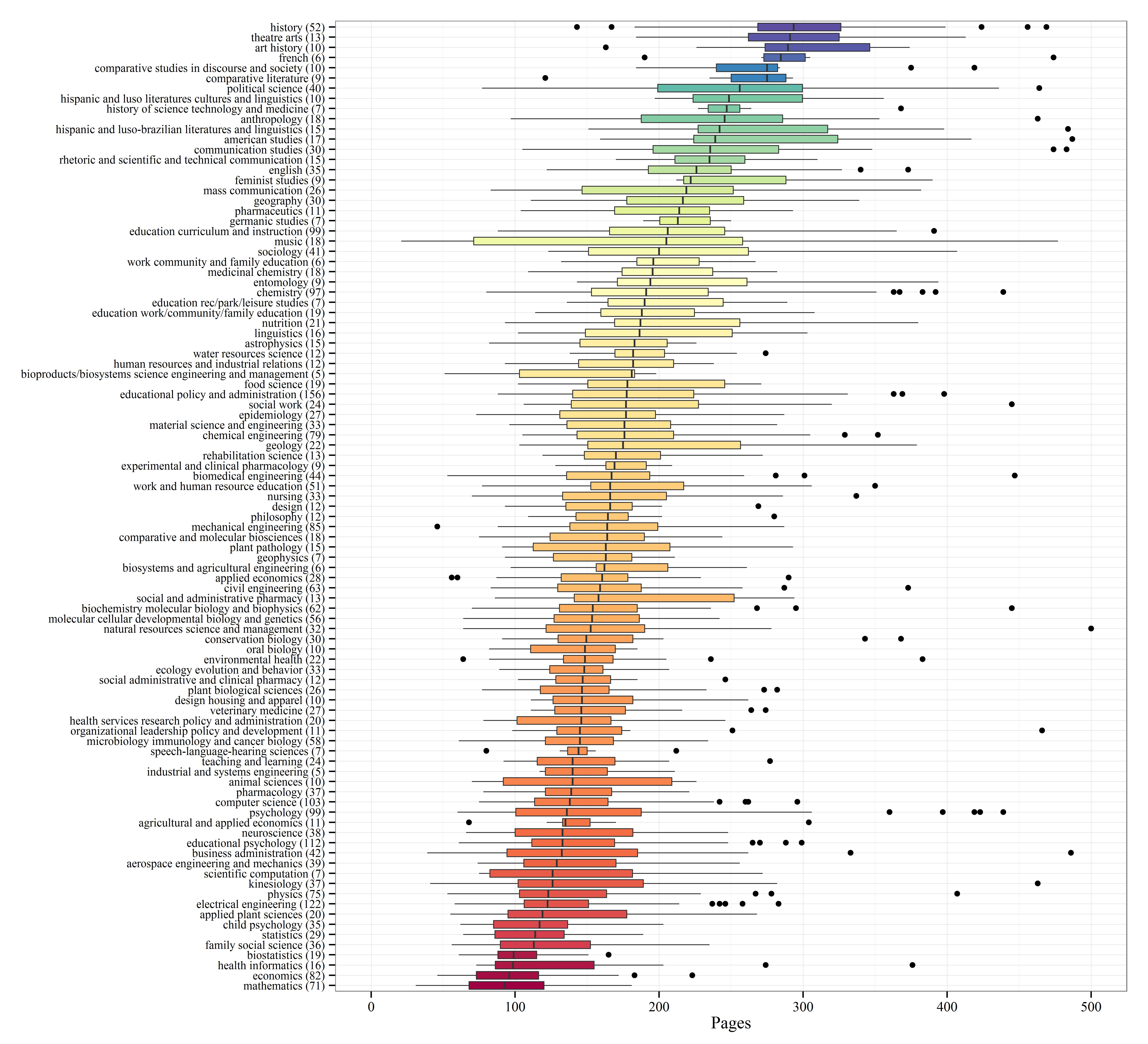
Beck’s page data does not map perfectly to word counts because STEM dissertations carry more visual content per page. But the relative ranking — history at the top, mathematics and physical sciences at the bottom — is consistent across every institutional dataset that has been published.
STEM vs Humanities vs Social Sciences: The Core Divide
The field-by-field data collapses into a clear three-tier structure at the PhD level:
| Broad Field | Typical PhD Regulatory Ceiling | Observed Median (approx. pages) | Why |
|---|---|---|---|
| Humanities (History, English, Philosophy, Classics, Divinity) |
80,000 words | 240–320 pages | Entire argument in prose; extensive secondary literature; detailed textual analysis |
| Social Sciences (Sociology, Psychology, Politics, Education, Anthropology) |
80,000 words | 180–260 pages | Mix of qualitative and quantitative; tables carry some load; theory chapters add length |
| STEM (Physics, Chemistry, CS, Engineering, Biology, Maths) |
60,000–65,000 words | 100–170 pages | Figures, data, and equations carry the argument; concision is a disciplinary value |
| Borderline fields (Economics, Law, Geography) |
60,000–80,000 words | 140–220 pages | Formal models or legal citations partly replace narrative prose; variable by subfield |
Understanding which tier your field sits in matters for planning. A STEM student targeting a 120-page dissertation writes a fundamentally different planning schedule than a history student targeting 280 pages — even if their supervisor quotes the same “write 1,000 words a day” heuristic. For guidance on how to structure those words chapter by chapter, see our dissertation methodology chapter guide and our overview of the difference between discussion and conclusion chapters.
What Counts Toward the Word Limit?
The definition of “word count” is not standardised across institutions or even across departments within a single university. The most common inclusions and exclusions:
| Element | Typically Included | Typically Excluded |
|---|---|---|
| Main body text | Almost always | — |
| In-text citations | Usually | Some disciplines exclude reference lists but include in-text |
| Footnotes | In humanities (Cambridge: philosophy, law, history & philosophy of science) | In many social science and STEM disciplines |
| Tables and figures | Some disciplines include table text (economics at Cambridge) | Most disciplines exclude figures; captions sometimes excluded separately |
| Abstract | Rare | Almost always excluded |
| Bibliography / Reference list | Rare; some disciplines (land economy at Cambridge) | Almost always excluded |
| Appendices | Some disciplines (philosophy, land economy) | Most disciplines; STEM almost universally |
| Acknowledgements, contents, title page | Very rare | Almost always excluded |
The practical takeaway: if your discipline excludes footnotes and appendices from the word count, your total document can legitimately run 20–30% longer than the stated limit. A Cambridge history PhD with an 80,000-word body limit and extensive footnotes will produce a complete document of well over 100,000 words in total. Always check your department’s specific regulations, not just the divisional or university-wide guidance. For a complementary look at how word counts translate into examiner expectations, see our analysis of what top-scoring master’s theses have in common.
Planning Your Thesis?
Tesify is built for Master’s and PhD students who need to manage word counts, structure chapters correctly, and maintain citation accuracy throughout a long document. It handles the structural scaffolding so you can focus on the argument.
Frequently Asked Questions
What is the average word count for a PhD thesis?
In the UK, most PhD theses are expected to be between 60,000 and 100,000 words. The UK Quality Code and most research councils do not prescribe a universal limit — universities set their own. Humanities PhDs typically run to the 80,000-word ceiling set by most institutions; STEM PhDs are typically capped at 60,000–65,000 words. In the US, PhD dissertations are measured in pages and typically run 150–300 pages (approximately 37,500–75,000 words at 250 words per page), with the median shorter in STEM and longer in humanities.
How many words is a Master’s thesis in STEM?
A taught MSc dissertation in a STEM discipline typically runs 10,000–20,000 words in the UK. Research master’s degrees (MPhil, MRes) in STEM fields vary more: the University of Cambridge caps biology MPhil theses at 20,000 words, engineering and computer science at up to 60,000–65,000. The lower figures for taught programmes reflect the module-heavy nature of one-year MSc degrees, where the dissertation is one component among many. A 15,000-word MSc dissertation in engineering is not short by this standard — it is entirely normal.
Why are humanities dissertations so much longer than STEM dissertations?
The argument in humanities is carried entirely in prose. There are no figures, experimental data tables, or schematics to convey findings efficiently. A historian must describe, contextualise, and analyse their primary sources in words; a physicist conveys the same density of information through spectra, equations, and diagrams that take up page space without adding word count. Additionally, the secondary literature in established humanities fields is vast — a PhD candidate in English or history must engage with decades or centuries of scholarship, which demands a longer literature review than fields where the relevant literature spans only five to ten years.
Do the references and bibliography count toward the word limit?
In most universities and disciplines, the bibliography or reference list does not count toward the word limit. However, this varies by institution. At Cambridge, land economy is one of the few disciplines that explicitly includes references in the word count. In most other subjects — including all STEM disciplines and the majority of humanities and social science disciplines — the bibliography is excluded. Always confirm with your degree committee or programme handbook, as the difference can be 5,000–15,000 words in a long thesis.
What is the shortest type of PhD dissertation on record?
John Forbes Nash Jr.’s 1950 Princeton mathematics dissertation was 26 pages and contained only two citations. While this is an extreme outlier — and Nash won a Nobel Prize for its content — it illustrates that in mathematics, the quality of a proof matters far more than length. More typically, mathematics PhD dissertations run 90–120 pages, which remains the shortest median across all disciplines in published analyses of US dissertation databases.
Is there a minimum word count for a PhD thesis?
Yes, most institutions specify both a minimum and a maximum. At Cambridge, history PhDs must be at least 70,000 words; English MLitt degrees must be at least 45,000 words. Most universities set a minimum equivalent to 75–80% of the maximum. A thesis that is substantially under the minimum raises examiner concerns about whether the research question has been adequately addressed — being well under the limit is generally not seen as a virtue. Check your department’s regulations for both figures before you begin.
How many pages is a 80,000-word thesis?
An 80,000-word thesis body is approximately 300–330 double-spaced A4 pages at a standard 12pt font with 2.5 cm margins — the typical formatting standard for UK thesis submission. Single-spaced, the same text would be 150–165 pages. Note that if your bibliography, appendices, figures, and acknowledgements are excluded from the word count but included in the document, the total page count of the submitted thesis will be considerably higher — a history thesis with extensive footnotes and a long bibliography may run to 400+ pages in total.
How does discipline affect word count at undergraduate dissertation level?
At undergraduate level, the discipline divide is less extreme but still present. Humanities undergraduate dissertations typically run 8,000–12,000 words; social science dissertations 6,000–10,000 words; and STEM final-year projects 4,000–8,000 words. Some UK institutions cap laboratory-based STEM projects at 5,000 words on the grounds that data tables, figures, and appendices carry the majority of the content. Humanities undergraduate dissertations rarely include tables or figures, so prose length must do all the communicative work — producing the same upward pressure on word count seen at higher degree levels.
Can I submit a thesis that is over the word limit?
No — not without prior written permission from your degree committee or graduate school. Examiners at most institutions are required to enforce word limits and may decline to read material beyond the permitted length, or may penalise the thesis in their assessment. If you have a legitimate reason for exceeding the limit — for example, a clinical trial dataset that substantially increases the results chapter — most institutions have a formal process for applying for an extension, which typically requires approval from your supervisor and must be sought well before submission. Never assume that being slightly over the limit will be overlooked.
Where can I find the official word limit for my specific programme?
The most reliable source is always your own institution’s official documentation. Start with your programme handbook or degree committee regulations — not general university guidance, which may differ from your department’s specific rules. If the information is not in your handbook, your graduate administrator or supervisor can direct you to the correct document. For a reference point, the University of Cambridge publishes subject-specific word limits in full at cambridgestudents.cam.ac.uk, which is a useful benchmark even if you are at a different institution.
Write your thesis with AI
Structure, draft, cite, and format your thesis faster with Tesify’s AI writing tools, automatic bibliography, and plagiarism checker. Free to start, no credit card required.






Leave a Reply