
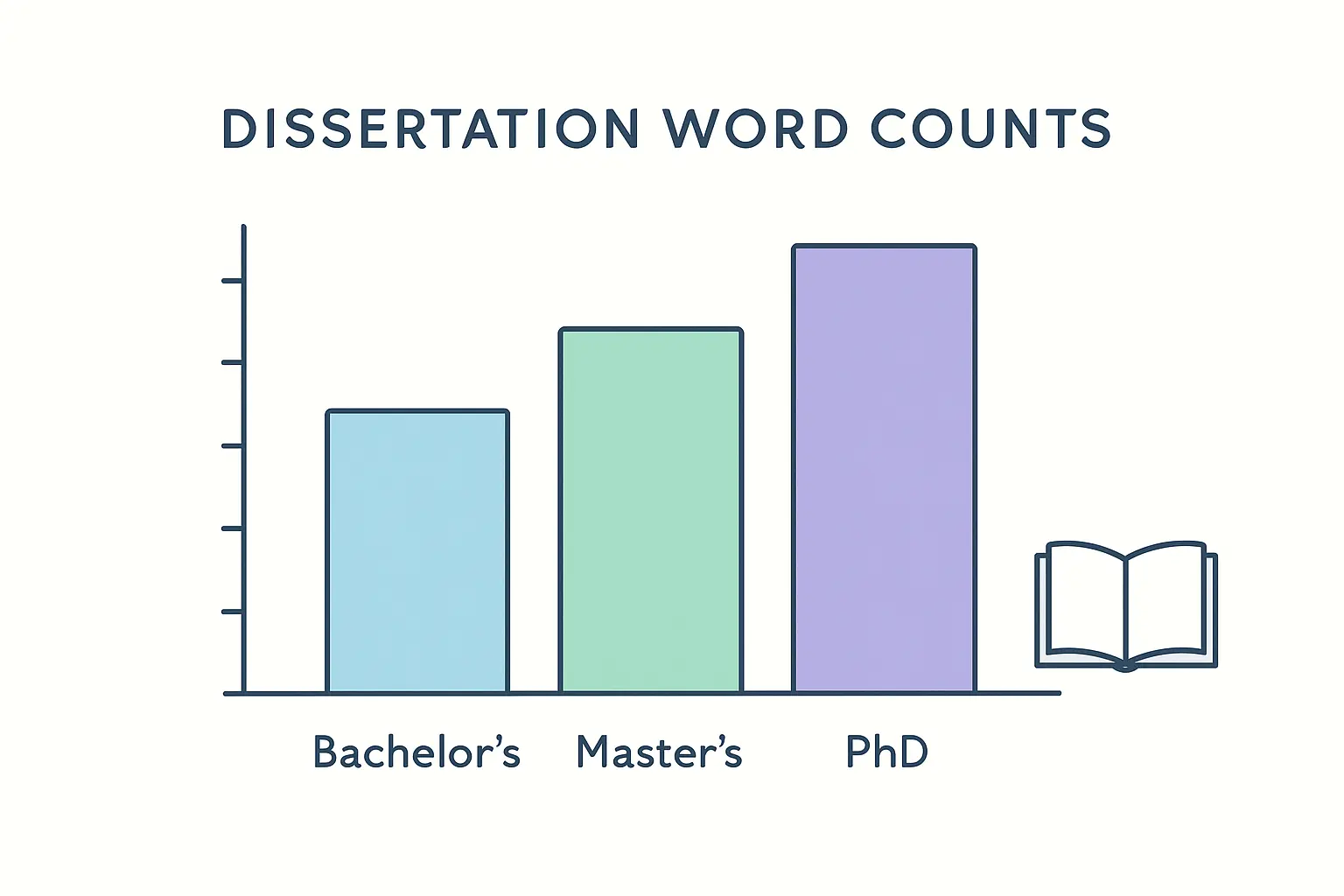
Average Dissertation Length in 2026: Word Counts by Degree and Discipline (Sourced Data)
The question “how long should my dissertation be?” hides a more precise one: how long does it need to be, given your degree level, your discipline, and your institution’s published regulations? A PhD candidate in history at a Russell Group university faces a target almost twice as high as their counterpart in computer science at the same institution — and both face different expectations from an undergraduate writing a final-year dissertation. The average dissertation length varies by a factor of ten across degree levels and disciplines. This guide sets out the sourced data behind those numbers, organised by degree level rather than discipline, so you can find your situation quickly.
The figures below draw on official word-count regulations from four major UK universities (Cambridge, Manchester, Sheffield, and Essex), and on Marcus Beck’s widely cited empirical analysis of 3,037 doctoral dissertations from the University of Minnesota’s open database — the most-referenced published dataset of observed real-world dissertation lengths. For a full discipline-first breakdown see our companion piece on average thesis word count by discipline, which covers Cambridge’s subject-specific limits in granular detail.
Data Sources Used in This Guide
Every figure in this article is traceable to a published source. For regulatory limits, the primary sources are the official thesis submission regulations of four UK universities, selected because they publish discipline-specific word limits in publicly accessible documents:
- University of Cambridge — Degree Committee word limits, covering more than 30 disciplines at PhD and Master’s level (cambridgestudents.cam.ac.uk)
- University of Manchester — Presentation of Theses Policy (DocID 7420, updated May 2026): PhD maximum 80,000 words of main text including footnotes; MPhil maximum 50,000 words (60,000 for the journal format)
- University of Essex — Postgraduate research thesis format page: PhD maximum 80,000 words; MPhil maximum 50,000 words; MA/MSc by Dissertation maximum 30,000 words (excluding appendices, tables, figures, abstract, references, acknowledgements, and footnotes without substantive argument)
- University of Sheffield — Thesis preparation guidelines by faculty: Arts and Humanities PhD 75,000 words; Science PhD 80,000 words; Social Sciences PhD 75,000–100,000 words; Health PhD 75,000 words
For observed real-world data — as distinct from regulatory ceilings — the main empirical reference is Marcus Beck’s analysis of page-count data from the University of Minnesota’s open dissertation database, covering 3,037 doctoral dissertations across disciplines, published on the R is my friend blog (2014). That dataset reflects US formatting norms (double-spaced, one-sided pages); page counts are not directly convertible to UK-equivalent word counts without knowing each document’s figure density.
Bachelor’s Dissertation Length
Undergraduate dissertations — called “final-year projects” in many STEM programmes — have the widest variation in prescribed length relative to degree level. Most UK institutions set the ceiling between 8,000 and 15,000 words, with the centre of gravity around 10,000–12,000 for humanities and social science dissertations. STEM laboratory projects at many UK universities are capped at 5,000–8,000 words, on the basis that data tables, figures, and appendices carry a large proportion of the technical content without contributing to the word count.
| Discipline Group | Typical UK Range (words) | Typical US Range (words) | Notes |
|---|---|---|---|
| Humanities (history, English, philosophy) | 10,000–15,000 | 10,000–20,000 | US honours theses at research-intensive institutions trend longer; entire argument in prose |
| Social sciences (sociology, psychology, politics) | 8,000–12,000 | 8,000–15,000 | Qualitative studies tend toward the upper end; quantitative studies with large tables toward the lower |
| STEM (sciences, engineering, computing) | 5,000–10,000 | 5,000–12,000 | Lab data, figures, and appendices excluded from most word counts; some institutions cap at 5,000 |
Sources: General UK institutional norms reflected in publicly available programme handbooks; Oxbridge Essays guide to dissertation length. Always verify with your own programme handbook — undergraduate word limits vary more by institution than at postgraduate level.
One nuance at undergraduate level: many UK universities label the STEM final-year project a “project report” rather than a “dissertation” and assign it a lower word ceiling than an arts or social science dissertation in the same year group. This is a formatting convention, not a quality signal. A well-executed 7,000-word chemistry project report is not short by the standards of the discipline.
Master’s Thesis Length
The most important distinction at master’s level is between a taught programme dissertation — completed over one summer as a component of a one-year taught MSc or MA — and a standalone research degree such as an MPhil, MRes, or MLitt. These two modes sit in substantially different word-count categories, even when the degree title looks similar. Understanding how many references are expected at your level matters too — for sourced benchmarks by degree type, see how many references a thesis should have.
| Degree Mode | Typical Range (words) | Sourced Example |
|---|---|---|
| Taught MSc / MA dissertation (STEM) | 10,000–20,000 | Cambridge MSc Biology MPhil: 20,000 max (excl. tables, footnotes, bibliography, appendices) |
| Taught MSc / MA dissertation (humanities / social science) | 15,000–30,000 | University of Essex MA/MSc by Dissertation: 30,000 max; Cambridge MSc Education: 20,000 |
| Research master’s MPhil / MRes (STEM) | 20,000–50,000 | University of Essex MPhil: 50,000 max; University of Manchester MPhil: 50,000 max (60,000 journal format) |
| Research master’s MPhil / MLitt (humanities) | 40,000–60,000 | Cambridge MLitt English: 45,000–60,000 (min–max); Cambridge MLitt History: 40,000–50,000 |
Sources: University of Cambridge Degree Committee word limits; University of Essex thesis format page; University of Manchester Presentation of Theses Policy (DocID 7420, 2026).
The discipline gradient visible at PhD level is already present at master’s level. A taught MSc dissertation in computer science at most UK universities is capped at 15,000–20,000 words, while a taught MA dissertation in history or sociology at the same university typically runs 20,000–30,000 words. The same structural reasons apply: humanities dissertations must carry their full argument in prose, while STEM dissertations carry a significant portion of their content in figures, tables, and code output that sits outside the word count.
PhD Dissertation Length
The PhD is where regulatory limits tighten into a recognisable band — most UK universities converge on 60,000–80,000 words — but observed real-world lengths remain variable. Marcus Beck’s 2014 analysis of 3,037 dissertations in the University of Minnesota’s open database found a median of 147 pages, with a range of 21 to over 2,000 pages. History dissertations produced the longest observed median; mathematics and biostatistics produced the shortest. Because Beck’s dataset is US-formatted (double-spaced, one-sided pages), a 147-page median at 250 words per page equates to roughly 35,000–40,000 words of body text — well below UK regulatory ceilings, a difference explained primarily by formatting conventions and the high proportion of figure-dense STEM dissertations in any large cross-disciplinary dataset.
| Institution | Humanities PhD Ceiling | STEM PhD Ceiling | Social Sciences PhD Ceiling |
|---|---|---|---|
| University of Cambridge | 80,000 words | 60,000–65,000 (engineering: 65,000) | 80,000 words |
| University of Manchester | 80,000 words | 80,000 words | 80,000 words |
| University of Sheffield | 75,000 words | 80,000 words | 75,000–100,000 words |
| University of Essex | 80,000 words | 80,000 words | 80,000 words |
Sources: University of Cambridge Degree Committee word limits; University of Manchester Presentation of Theses Policy (DocID 7420, 2026); University of Sheffield thesis preparation guidelines; University of Essex thesis format regulations.
“Theses submitted for PhD, EngD and MD degrees at the University of Manchester must not normally exceed 80,000 words of main text, including footnotes and endnotes.” — University of Manchester Presentation of Theses Policy (DocID 7420, 2026)
UK STEM PhDs have lower formal ceilings than humanities PhDs at Cambridge, but the complete submitted document is not necessarily shorter. Figures, schematics, data appendices, and code listings occupy substantial physical space without contributing to the word count. A 60,000-word experimental physics thesis with eighty figures and four appendices can run to 250 pages, well within the range of humanities theses that contain far fewer visuals but hit their 80,000-word text limit. For perspective on the broader PhD journey, see our data piece on PhD completion and dropout rate statistics by country.
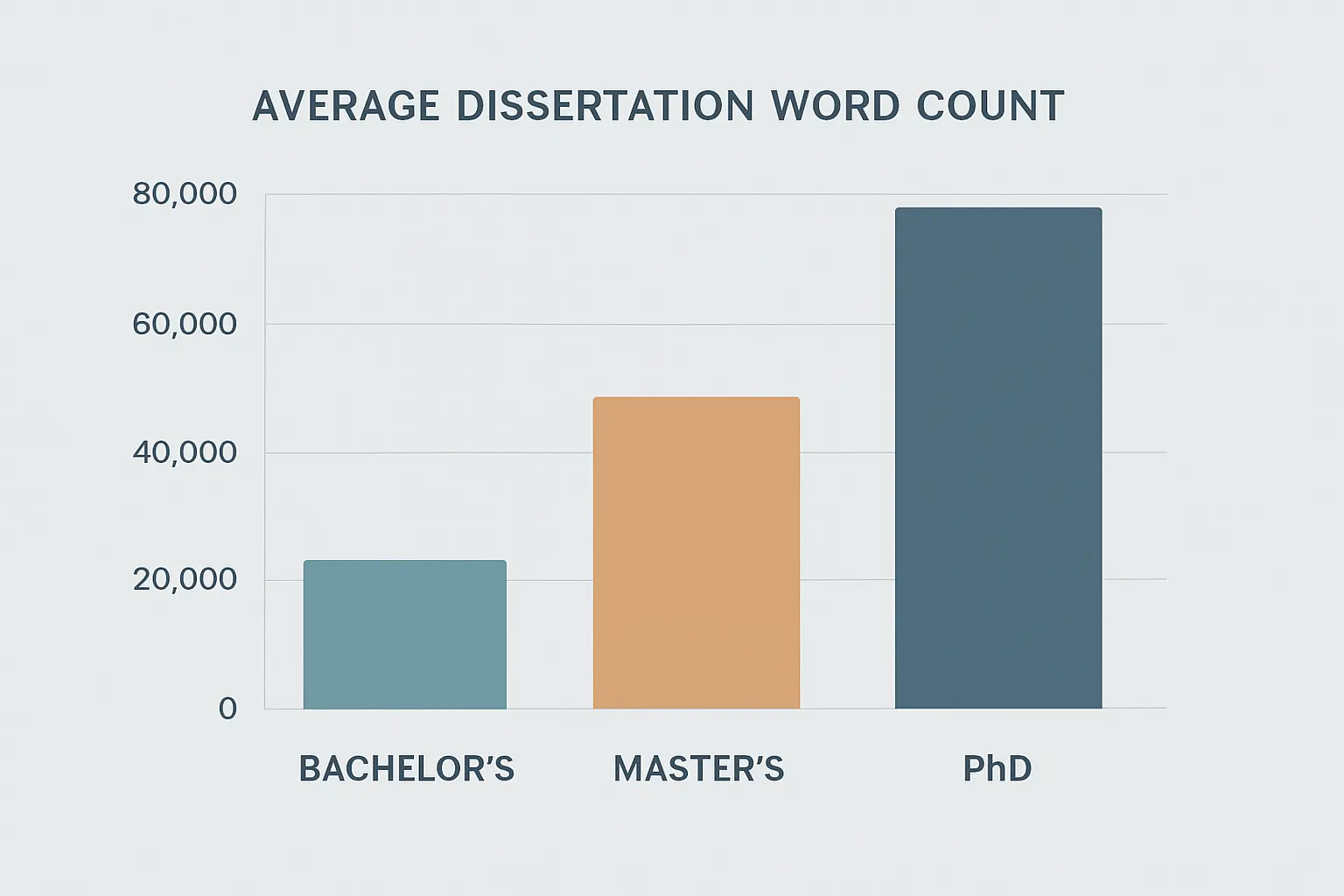
Summary Table: Average Dissertation Length by Discipline Across All Degrees
The following table synthesises regulatory data across degree levels. Regulatory ceilings are drawn from Cambridge (the most publicly granular dataset) and cross-checked against Sheffield where limits differ. “Observed” figures for PhD level reflect Beck’s University of Minnesota dataset. At bachelor’s and master’s level, observed and regulatory figures tend to converge more closely because formats are more tightly prescribed.
| Discipline | Bachelor’s (words) | Taught Master’s (words) | PhD UK ceiling (words) | Primary source |
|---|---|---|---|---|
| History | 10,000–15,000 | 20,000–30,000 | 80,000 | Cambridge; longest observed median (Beck) |
| English / Literature | 10,000–15,000 | 20,000–30,000 | 80,000 | Cambridge (MLitt: 45,000–60,000 min–max) |
| Sociology / Anthropology | 8,000–12,000 | 15,000–25,000 | 80,000 | Cambridge; Sheffield Soc Sci: 75,000–100,000 |
| Psychology | 8,000–12,000 | 10,000–20,000 | 80,000 | Cambridge; APA reporting conventions favour concision |
| Economics | 6,000–10,000 | 10,000–20,000 | 60,000 (Cambridge; incl. tables) | Formal models replace prose; shorter observed median (Beck) |
| Biology | 5,000–8,000 | 10,000–20,000 | 60,000 (Cambridge; 80,000 with permission) | Figures carry significant information load |
| Engineering | 5,000–10,000 | 10,000–20,000 | 65,000 (Cambridge); 80,000 (Sheffield) | CAD drawings, circuit diagrams excluded from most counts |
| Computer Science | 5,000–10,000 | 10,000–20,000 | 60,000 (Cambridge) | Code appendices excluded; shorter observed median (Beck) |
| Mathematics | 4,000–8,000 | 10,000–20,000 | Varies by institution | Shortest observed median in Beck’s dataset; proofs replace prose |
| Medicine / Clinical | 5,000–10,000 | 10,000–20,000 | 60,000–80,000 (Cambridge) | Patient data and trial tables excluded from count |
Sources: University of Cambridge Degree Committee word limits (2026); University of Sheffield thesis preparation guidelines; Marcus Beck, “Average dissertation and thesis length, take two,” R is my friend (2014), n=3,037. General bachelor’s and taught master’s ranges reflect commonly observed UK institutional norms — check your own programme handbook for the precise figure.
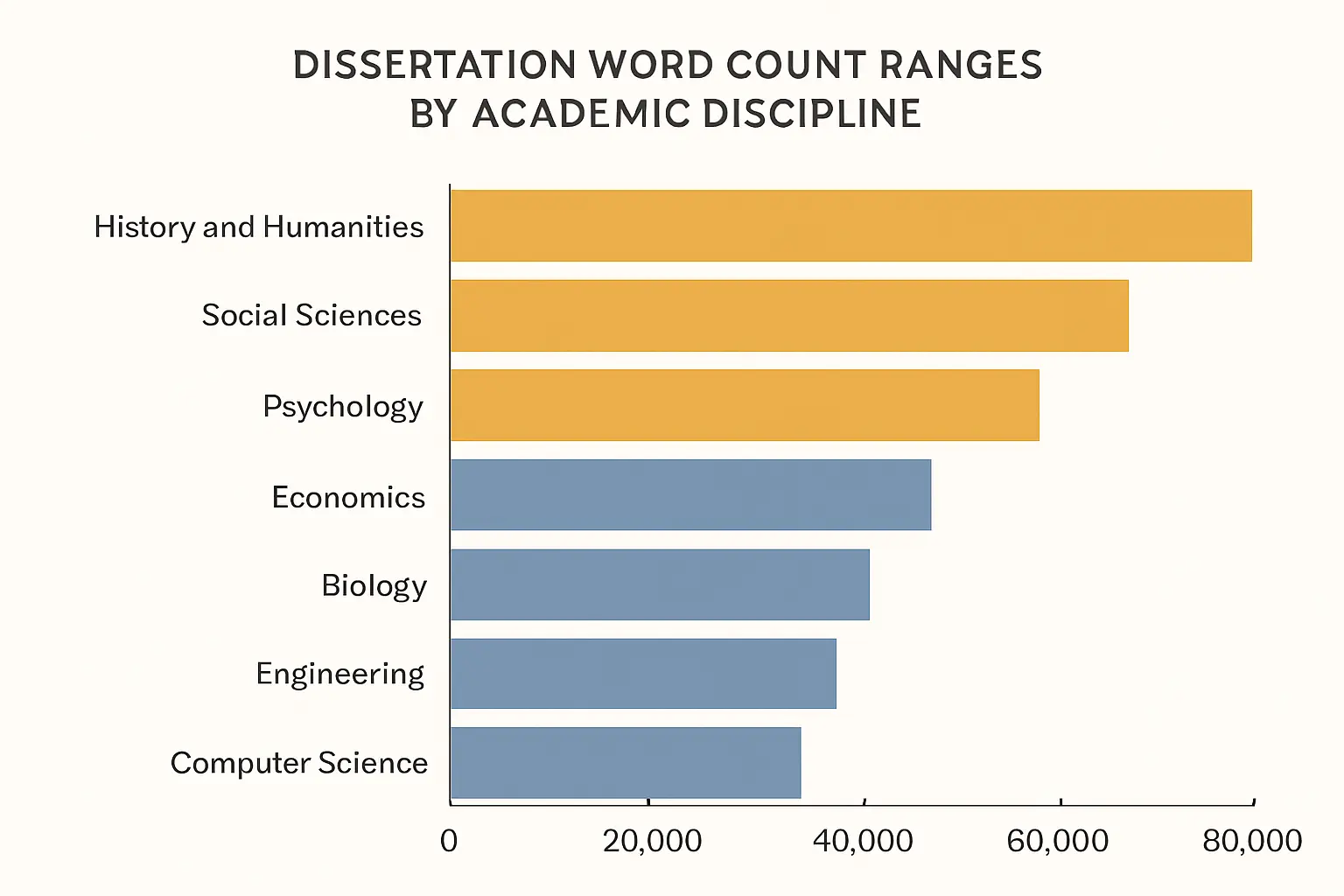
UK vs US Dissertation Length: Geographic Differences
The terminology itself signals the divide: “dissertation” is the default US term for doctoral-level work; “thesis” is the UK default. Structural conventions differ too, which affects observed lengths independently of institutional limits.
In the UK, word counts are the governing metric. Universities publish explicit ceilings, examiners enforce them, and submitting above the limit without prior approval risks the work being returned unread. The standard UK PhD ceiling is 80,000 words in humanities and social sciences, and 60,000–65,000 in STEM at Cambridge (80,000 at institutions such as Manchester, Essex, and Sheffield, which do not distinguish by faculty). These limits exclude bibliography, appendices, abstract, and most front matter at the majority of institutions.
In the US, page count is the dominant convention and formal word-count ceilings are rare. Advisor and committee expectations govern length. Beck’s Minnesota dataset found a median of 147 pages across all disciplines. History and political science had the longest medians; mathematics and biostatistics had the shortest. Converting 147 pages to words at the standard estimate of 250 words per double-spaced page gives approximately 36,750 words — far below UK regulatory ceilings, which reflects both US formatting conventions and the disproportionate STEM representation in the dataset.
| Country / System | Primary Metric | Typical PhD Range | How Limit Is Set |
|---|---|---|---|
| UK | Words | 60,000–80,000 (STEM to humanities) | University regulation, enforced by Degree Committee |
| US | Pages | ~150–300 pages; observed median 147 pp (Beck, 2014) | Advisor and committee norms; formal limits rare |
| Australia | Words | 70,000–100,000 | University regulations by faculty, similar structure to UK |
| Canada | Pages / words | ~150–250 pages | Mixed; closer to US norms in practice at most institutions |
What “Word Count” Includes — and Excludes
University word-count policies are not uniform. Two students at different UK universities can both be “within the 80,000-word limit” while their submitted documents differ by tens of thousands of words, because what counts toward the limit varies by institution and by department within the same institution. The most consequential differences:
- Footnotes: Included in Cambridge’s count for history, philosophy, law, and history and philosophy of science. Excluded for most STEM and many social science disciplines. A history thesis with dense archival footnotes can have 15,000–20,000 words of footnote text outside the counted figure.
- Tables: Explicitly included in Cambridge’s Economics PhD limit, meaning every number in every data table counts toward the 60,000-word ceiling. Most other disciplines exclude tables entirely.
- Appendices: Excluded at most institutions — STEM dissertations with large raw-data or code appendices benefit substantially. Cambridge includes appendices in the limit for philosophy and land economy.
- Bibliography / reference list: Almost universally excluded. Cambridge includes references for land economy; essentially all other disciplines do not. A long thesis can have a bibliography of 5,000–15,000 words; the treatment of this element significantly affects planning.
- Abstract: Excluded at most institutions. The University of Essex explicitly caps the abstract at 300 words, not counted in the thesis total.
The practical consequence: before comparing your draft word count to your institution’s limit, confirm which elements your word processor includes and match them to your department’s definition. Misreading this can mean cutting thousands of legitimate words from a thesis that was never actually over-limit. If you find your draft genuinely over-limit after careful counting, our guide to cutting thesis word count without losing substance sets out the most effective reduction strategies. When writing a long document with multiple chapter targets, Tesify’s section-level word tracking makes it easier to monitor count by chapter in real time.
Frequently Asked Questions
What is the average dissertation length for a PhD?
In the UK, PhD theses are typically submitted at or close to the institutional word-count ceiling: 80,000 words for humanities and social sciences, and 60,000–65,000 words for STEM at institutions such as Cambridge. In the US, the observed median across disciplines is approximately 147 pages (Beck, 2014, n=3,037 at the University of Minnesota), equating to roughly 35,000–40,000 words of body text at 250 words per double-spaced page — substantially lower than UK limits, reflecting US formatting conventions and the large proportion of figure-dense STEM dissertations in cross-disciplinary datasets.
How long is an undergraduate dissertation?
A typical UK undergraduate dissertation in humanities or social sciences runs 8,000–15,000 words, with many universities setting 10,000–12,000 as the standard expectation. STEM final-year projects are generally shorter — 5,000–10,000 words — because figures, data tables, and laboratory data carry content that does not require corresponding prose. US undergraduate honours theses vary more widely: 8,000–20,000 words depending on the programme and institution, with research-intensive universities tending toward the upper end.
How long is a master’s dissertation?
A taught master’s dissertation (completed over one summer as part of a one-year MSc or MA programme) typically runs 10,000–30,000 words, with STEM dissertations at the lower end and humanities at the upper end. A research master’s degree (MPhil, MRes, or MLitt) is substantially longer: 40,000–60,000 words in humanities; 20,000–50,000 in STEM. The University of Essex caps its MPhil at 50,000 words; the University of Manchester caps its standard MPhil at 50,000 words of main text including footnotes (60,000 for the journal format).
Are dissertation word limits the same at all universities?
No. While most UK research-intensive universities converge on 80,000 words for humanities PhDs and 60,000–65,000 words for STEM PhDs (at Cambridge; 80,000 at Manchester, Essex, and Sheffield regardless of discipline), the limits vary by institution, by faculty within an institution, and by what elements are counted. The University of Sheffield’s Social Sciences faculty allows PhDs up to 100,000 words; Cambridge’s Clinical Medicine PhD has a 60,000-word ceiling (with 80,000 by special permission). Always verify with your own institution’s published regulations rather than general guides.
How many pages is a typical PhD dissertation?
Beck’s 2014 analysis of the University of Minnesota dissertation database (n=3,037) found a median of 147 pages, with history and political science consistently producing the longest documents (often over 300 pages) and mathematics the shortest (sometimes under 100 pages). In the UK, an 80,000-word thesis with standard formatting — 12pt, double-spaced, 2.5cm margins — produces approximately 300–330 pages of body text. The complete submitted document, including figures, bibliography, and appendices, typically runs longer still, particularly in STEM disciplines with extensive appendix material.
Why are humanities dissertations longer than STEM dissertations?
The argument in a humanities dissertation is carried entirely in prose. There are no figures, experimental data tables, or schematics to convey findings efficiently. A historian must describe, contextualise, and analyse their primary sources in words; a physicist conveys the same density of information through spectra, equations, and diagrams that occupy page space without adding word count. The secondary literature in established humanities fields is also much larger — engaging with centuries of scholarship demands a longer literature review than fields where the relevant literature spans five to ten years.
Does the bibliography count toward the dissertation word limit?
In the vast majority of universities and disciplines, the bibliography or reference list does not count toward the word limit. However, exceptions exist: at Cambridge, land economy is one discipline where references are explicitly included in the word count. Because a long thesis bibliography can run to 5,000–15,000 words, confirming whether yours counts is material to planning. Always check your department’s specific programme handbook — not just the general university guidance, which may differ from your faculty’s rules.
Write your thesis with AI
Structure, draft, cite, and format your thesis faster with Tesify’s AI writing tools, automatic bibliography, and plagiarism checker. Free to start, no credit card required.





Leave a Reply