
Open-Access APC Cost Statistics 2026: What Article Processing Charges Really Cost by Publisher and Field
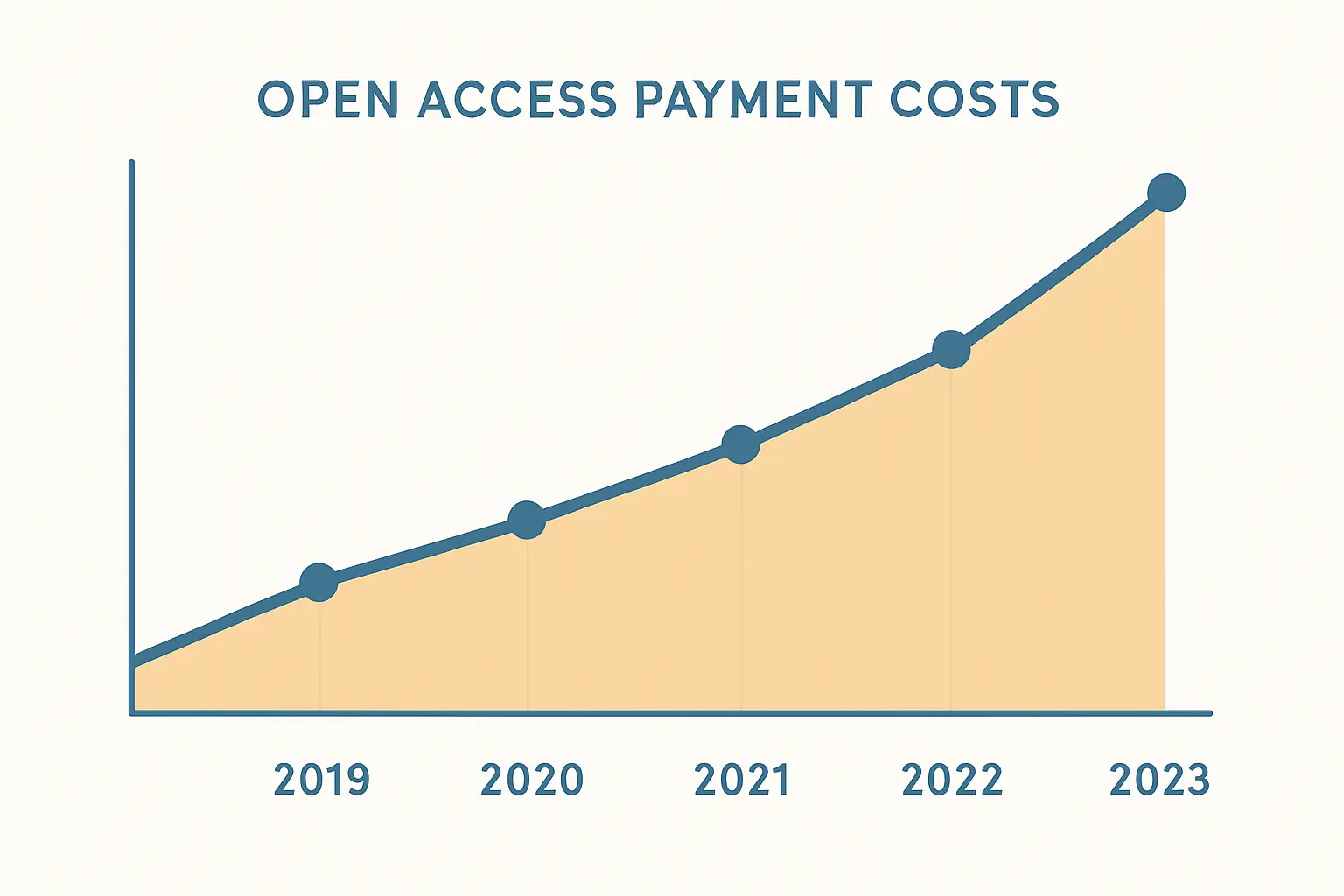
The bill for open-access publishing has never been larger. Article processing charge statistics compiled from the largest publicly available dataset show that global APC spending tripled from $910.3 million in 2019 to $2.538 billion in 2023 — a five-year cumulative outlay of $8.349 billion paid to just six publishers (Elsevier, Frontiers, MDPI, PLOS, Springer Nature, and Wiley) alone (Schneider et al., arXiv 2407.16551, July 2024; OPUS Project). Behind that headline sits a wide spread: a researcher publishing in PLOS ONE pays $2,477 (2025–2026 list price), while publishing in Nature now costs $12,850 — a gap that shapes who can afford to make their work freely available and who cannot.
This data roundup gathers verified figures from publisher price lists, the Open and Universal Science (OPUS) Project dataset, cOAlition S/Plan S policy documents, the NIH’s 2025 Request for Information on APC caps, and peer-reviewed studies in Learned Publishing and Quantitative Science Studies. Every number below carries a named source and year so you can cite it directly in your own work.
What Are Article Processing Charges?
An article processing charge (APC) is a fee paid by an author — or their institution or funder — to a journal publisher in exchange for making the published article immediately and freely accessible to anyone online. APCs are the primary revenue mechanism for gold open-access journals and for the hybrid open-access option in subscription journals. They are distinct from submission fees or page charges, which some journals also levy.
The APC model emerged as an alternative to the reader-pays subscription model. Under subscription publishing, libraries pay; under APC-funded open access, the cost burden shifts to authors and research funders. An independent analysis estimated that efficient open-access publishing should cost between €200 and €1,000 per article (as cited in the Wikipedia article on APCs, drawing on studies in the publishing economics literature). Current list prices at major commercial publishers sit well above that range.
For more background on how open-access mandates have reshaped journal selection, see the companion article Open Access Publishing Statistics 2026: APC Costs, Mandates, and Growth Data, which covers the mandate landscape and OA growth rates alongside these cost figures.
Global APC Spending: 2019–2023 in Numbers
The most comprehensive public estimate of global APC revenue comes from Schneider and colleagues’ July 2024 paper (arXiv: 2407.16551), developed under the Open and Universal Science (OPUS) Project. The researchers combined annual APC list prices for 8,712 unique journals across six major publishers with open-access article counts drawn from OpenAlex, producing annual spending estimates from 2019 through 2023.
| Year | Estimated APC spending (USD) |
|---|---|
| 2019 | $910.3 million |
| 2020 | ~$1.1 billion |
| 2021 | ~$1.5 billion |
| 2022 | ~$2.0 billion |
| 2023 | $2.538 billion |
| 5-year total | $8.349 billion ($8.968B in 2023 dollars) |
| Source: Schneider et al. (2024), arXiv 2407.16551 / OPUS Project. Intermediate annual figures are interpolated from the reported 2019 and 2023 endpoints and reported growth trajectory; cite the primary paper for precision. | |
The study found that hybrid OA APCs (charged by subscription journals that offer an open-access option) exceeded gold OA fees in total dollar volume — and that the median APCs authors actually paid were higher than the published list prices for both gold and hybrid journals. This divergence likely reflects authors selecting journals above the median price point when given a choice.
By 2023, five major publishers accounted for 56% of all articles published globally (Wikipedia, citing Morrison et al. 2018 and subsequent market data). That concentration means APC pricing decisions by a handful of firms have system-wide consequences for research budgets worldwide.
APC Costs by Publisher (2025–2026 List Prices)
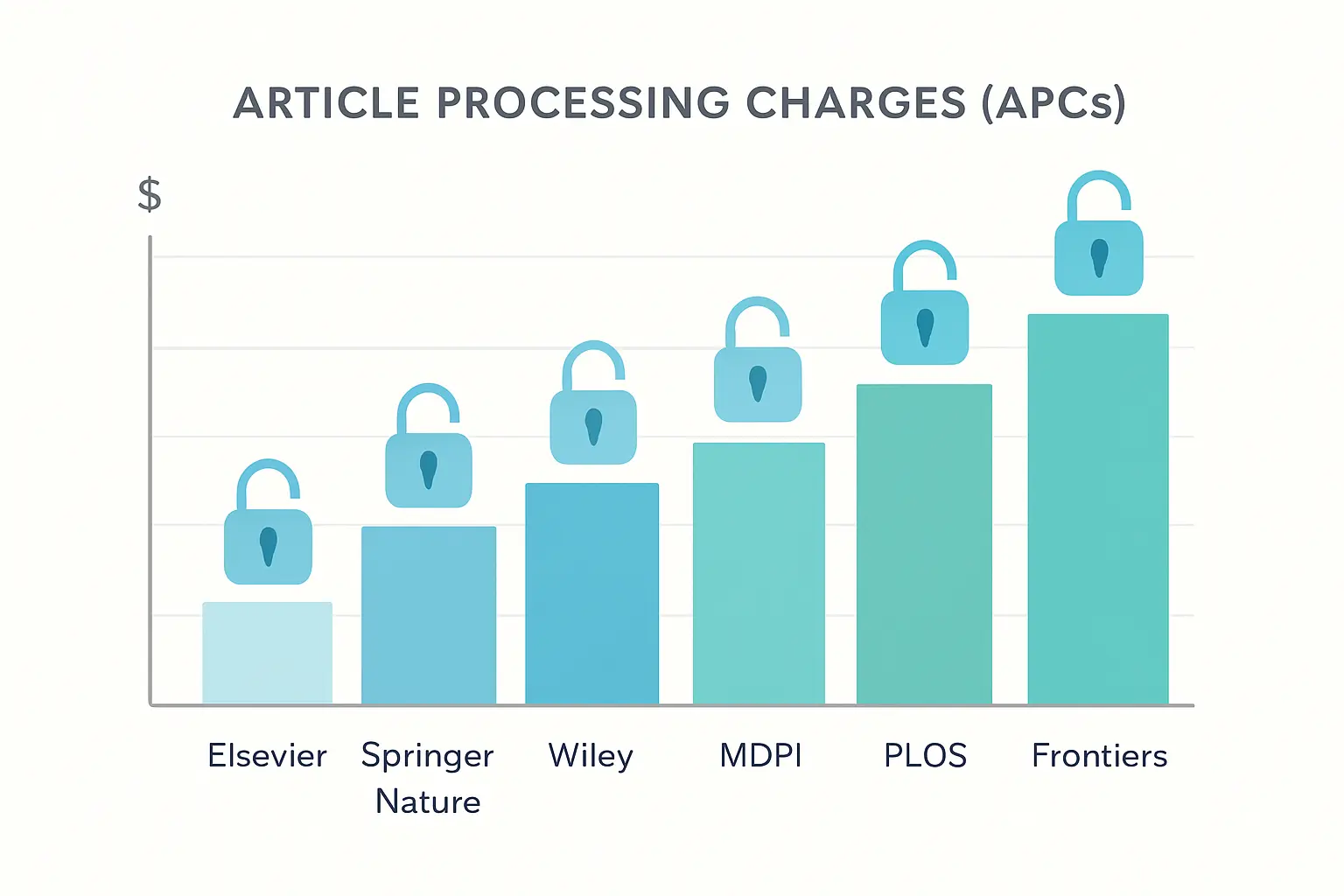
The table below summarises verified APC list prices from publisher websites and recent news reporting. All figures are as of 2025–2026 unless otherwise noted.
| Publisher / Journal | APC (USD unless noted) | Notes / Source |
|---|---|---|
| Nature (Springer Nature) | $12,850 / £9,390 / €10,850 | Highest list price of any general journal; Science.org, AAAS reporting 2025 |
| Cell (Elsevier) | $11,400 | Gold OA, exc. taxes; Manusights/Elsevier 2026 |
| Science Advances (AAAS) | $5,450 | Gold OA; Manusights 2026 |
| Springer Nature (higher-priced gold OA titles) | up to $6,850 | AAAS/Science.org reporting 2025 |
| Wiley (higher-priced gold OA titles) | up to $5,720 | AAAS/Science.org reporting 2025 |
| Elsevier (Lancet gold OA titles) | $5,270 | AAAS/Science.org reporting 2025 |
| Elsevier (portfolio average) | ~$3,400 | Range $200–$11,400; Elsevier pricing policy page 2024–2025 |
| Frontiers in Psychology | CHF 3,150 (~$3,465) | Frontiers fee policy page 2025 |
| PLOS ONE | $2,477 | Standard research article; PLOS ONE APC page 2025–2026 |
| MDPI (sample: Societies) | CHF 1,600 (~$1,760) | mdpi.com/journal/societies/apc, January 2025 |
| MDPI (sample: Resources) | CHF 1,800 (~$1,980) | mdpi.com/journal/resources/apc, January 2025 |
| CHF/USD conversion at approximately 1.10 USD per CHF (indicative). List prices exclude institutional Read & Publish agreements, waivers, and geographic discounts. | ||
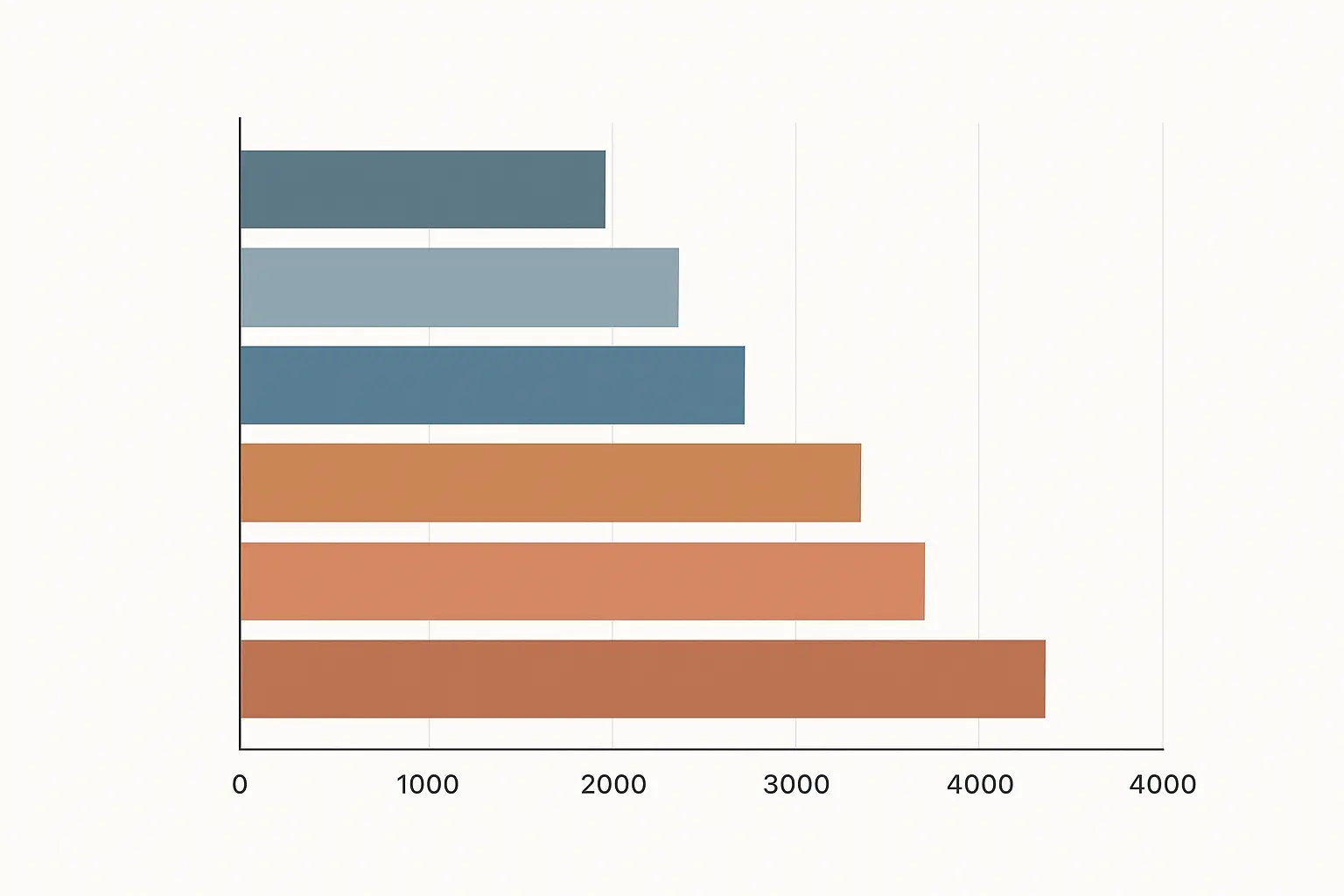
Across all six publishers in the OPUS dataset, the overall average APC (weighted by article volume) was approximately $2,859 in 2023, with gold OA journals averaging around $1,977 and hybrid journals averaging around $3,137 (Schneider et al. 2024, OPUS Project). The gap between gold and hybrid reflects the longstanding criticism that hybrid journals charge twice — once through institutional subscriptions, once through APCs — a practice known as “double dipping.” For a deeper comparison of per-publisher cost trajectories, see the APC Costs by Publisher 2026 article.
APC Costs by Academic Field
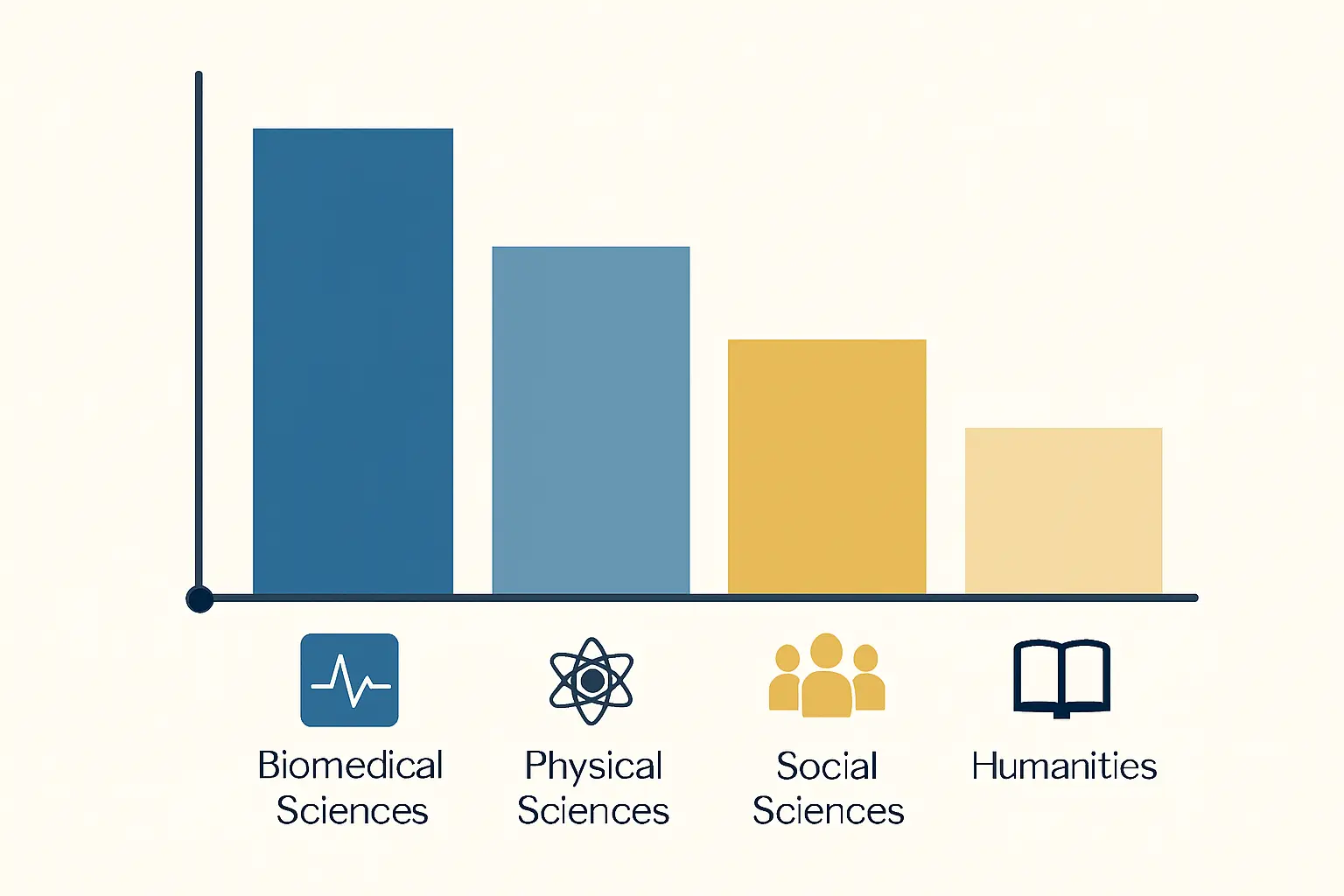
APC levels correlate with the funding environment of a discipline. Fields with generous grant funding — biomedical sciences, physics, and engineering — tend to host journals with higher APCs, partly because authors in those fields are more able to pay and funders often mandate open access. Social science and humanities disciplines, where external grant income is lower and OA mandates have historically been weaker, see lower average APCs and a larger share of diamond open-access journals (those charging no APCs at all).
Borrego (2023), reviewing the APC literature in Learned Publishing, confirmed that journals in disciplines with plentiful grant funding charge higher APCs, while authors in the social sciences and humanities rely more frequently on personal funds — a pattern that raises equity concerns independent of geography. A 2016 study of research-intensive universities in the USA and Canada (Morrison et al., PeerJ) found that median APC spending was highest in biomedical and clinical sciences, followed by physical sciences, with social sciences and humanities at the lower end. While exact 2025 cross-disciplinary averages are not yet available in a single peer-reviewed source, the directional pattern has been consistent across multiple studies.
Diamond open-access journals — which charge neither subscription fees nor APCs — represent 69% of journals in the Directory of Open Access Journals (DOAJ) but publish only 35% of open-access articles (as reported in the Wikipedia article on APCs, sourcing from Piwowar et al. and follow-on studies). Diamond OA is particularly prevalent in the humanities, linguistics, and social sciences, where community-based publishing models remain viable at lower article volumes.
Waiver Rates and Eligibility by Publisher
Every major publisher operates an APC waiver or discount programme, though coverage is narrower than it might appear. Eligibility is typically tied to World Bank income classifications.
| Publisher | Low-income countries | Lower-middle-income countries | Source |
|---|---|---|---|
| Taylor & Francis | 100% waiver (GDP < $100B) | 50% discount (GDP < $200B) | Taylor & Francis author services page, 2024 |
| Elsevier | 100% waiver (all-LIC-author papers) | 20–90% geo-price reduction | Elsevier pricing policy, updated July 2025 |
| PLOS | Full waiver | Partial waiver available | PLOS fee policy and Plan S blog, 2023 |
| IEEE | 100% waiver | Discount programme | IEEE Open LIC Discount Program, 2024 |
| Oxford University Press | 100% waiver | 50% discount | OUP APC waiver policy page, 2024 |
| Frontiers | Fee support programme | Case-by-case grants | Frontiers fee policy; $9M+ waived in 2025 (11,300 articles) |
| World Bank income classifications as of July 2025. Note: waiver policies typically do not apply to hybrid journals, and Cell Press / Lancet titles are excluded from most Elsevier waiver programmes. | |||
A critical limitation: no Latin American country currently qualifies for full APC waivers, since all are classified at least as lower-middle-income economies, and only a subset qualifies for partial discounts (Scholarly Kitchen, 2023; bioRxiv preprint, October 2025). Researchers in Brazil, Mexico, Argentina, and Colombia — many publishing on publicly funded research — therefore pay near-full list prices unless covered by a national or institutional agreement.
Plan S, cOAlition S, and the 2024–2025 Policy Shift
Plan S, launched by cOAlition S in September 2018, required that research funded by member agencies be published immediately in fully open-access venues. For several years the mechanism of choice was the “transformative agreement” (read-and-publish deal) in which a consortium pays a single fee covering both subscription access and OA article publication for affiliated researchers. These agreements displaced a proportion of individual author APCs.
In 2023, cOAlition S announced that member funders would no longer financially support transformative arrangements after 2024 (cOAlition S official statement, 2023). The Gates Foundation went further: as of 1 January 2025, it ended funding for APCs in both fully OA and hybrid journals for its grantees, instead requiring only preprint posting (cOAlition S / Gates Foundation, 2024).
Despite these shifts, the share of journal articles published immediately as gold open access grew from 14% in 2014 to 40% in 2024 (cOAlition S, citing data from the OA Monitoring project). The growth reflects not only mandates but also the rising volume of gold-OA and hybrid journals across all major publishers. As transformative agreements wind down, however, more OA costs will again fall on individual author APCs — raising pressure for institutional funds and national consortia.
The NIH APC Cap Proposal: What a $2,000 Ceiling Would Mean
In July 2025, NIH Director Jay Bhattacharya stated publicly that journal fees of “as much as $13,000 per article” force US taxpayers to fund research twice: once through grants and again to access the published findings. On 30 July 2025, NIH issued a formal Request for Information (NOT-OD-25-138) outlining several policy options for capping allowable APC reimbursement from grant funds, with a proposed effective date of 1 January 2026.
The options under consultation included:
- A hard cap of $2,000 per paper — near the average APC for US-published journals ($2,177, as cited in the NIH RFI context).
- A $3,000 cap for journals that compensate peer reviewers and publish open peer review reports.
- A flexible cap of 0.8% of direct grant costs, or $20,000 over the award lifetime, whichever is greater, with a $6,000 per-paper ceiling.
- A complete ban on using NIH grant funds for APCs, with only preprint deposition required.
A $2,000 cap would exclude all Nature-branded journals ($12,850), Cell ($11,400), Lancet OA titles ($5,270), Science Advances ($5,450), most Springer Nature and Wiley premium titles, and even Frontiers in Psychology (CHF 3,150 / ~$3,465) from NIH-funded APC reimbursement. Critics told Science (AAAS, 2025) that such a cap could steer NIH-funded researchers away from high-impact journals, affecting hiring and promotion decisions; supporters argue it would redirect funds toward diamond OA or lower-cost gold OA venues. Final policy had not been published as of June 2026.
Where APC Costs Are Heading
Three trends are converging to reshape APC markets through 2026 and beyond. First, 89% of journals raised their APCs between 2019 and 2024, with 40% of price increases outpacing general inflation (AAAS/Scholarly Kitchen reporting, citing OPUS dataset analysis). The pace of increase has drawn scrutiny from university library consortia, which are increasingly refusing to renew transformative agreements without price concessions. Second, government intervention is accelerating: the NIH cap proposal, regardless of its final form, signals that funders see unconstrained APC inflation as a policy problem. The UK’s Wellcome Trust and European Research Council are tracking similar metrics. Third, diamond OA infrastructure — preprint servers, overlay journals, and community-funded platforms — is expanding as an APC-free alternative, though its aggregate article volume remains modest relative to commercial APC journals.
Researchers navigating these trends need reliable data on where to submit and how to fund publication. Tools that help structure and strengthen a manuscript before submission — reducing the risk of costly revisions or rejections after APC payment — become more valuable as publication fees climb. Academic Publishing Statistics 2026 covers rejection rate data alongside APC trends, which together shape the expected cost per successfully published article.
“The five-year total of $8.35 billion paid to just six publishers for OA publishing rights between 2019 and 2023 raises fundamental questions about whether the APC model, as currently structured, serves the interests of the research community or primarily those of large commercial publishers.”
For researchers looking for APC-free dissemination routes, a curated list of vetted repositories is available in the Best Open Access Research Repositories 2026 guide, which covers both disciplinary and institutional options. When articles do require APCs, Tesify’s structural feedback tools help authors submit cleaner, reviewer-ready manuscripts — reducing the probability of rejection after fees are committed.
Frequently Asked Questions
What is the average article processing charge in 2025?
Based on the OPUS Project dataset (Schneider et al. 2024, arXiv 2407.16551), the overall average APC across the six largest publishers was approximately $2,859 USD in 2023, the most recent year with full data. Gold open-access journals averaged approximately $1,977; hybrid journals averaged approximately $3,137. The NIH cited an average of $2,177 for US-published journals in its 2025 Request for Information. The global per-journal average was $1,626 as of 2021 data (Wikipedia APC article, sourcing Morrison et al.).
Which publisher earns the most from APCs?
In 2023, MDPI led the six publishers studied in the OPUS Project with an estimated $681.6 million in APC revenue, followed by Elsevier ($582.8 million) and Springer Nature ($546.6 million) (Schneider et al. 2024). MDPI’s position at the top reflects its very high article volume across hundreds of journals at moderate per-article APC rates.
Can I publish open access for free?
Yes, through several routes. Diamond open-access journals (69% of DOAJ-listed journals) charge no APCs to authors. Preprint servers such as arXiv, bioRxiv, and SSRN are permanently free. Some institutional and national agreements with publishers cover APCs for affiliated authors. And every major commercial publisher offers waiver programmes for corresponding authors based at low-income or lower-middle-income country institutions.
What is the most expensive APC in 2026?
The highest verified list price for a general journal is $12,850 USD (£9,390 / €10,850) for Nature, as reported by AAAS/Science.org in 2025. Cell (Elsevier) charges $11,400 for gold open access. Science Advances (AAAS) charges $5,450. These figures are list prices and may be reduced through institutional Read & Publish agreements.
What is the NIH APC cap proposal?
In July–August 2025, NIH issued a Request for Information (NOT-OD-25-138) proposing to limit how much of an NIH grant could be used to pay APCs. Options ranged from a $2,000 hard cap to a $6,000 per-paper ceiling or a complete ban on using grant funds for APCs, with a proposed effective date of 1 January 2026. As of June 2026, the final policy had not been formally published.
How has Plan S affected APC costs?
Plan S, backed by cOAlition S, mandated immediate open access for funded research. Its main APC-related mechanism was the transformative agreement, under which consortia paid publishers a combined subscription-plus-OA fee, absorbing individual author APCs. However, cOAlition S confirmed in 2023 that it would end financial support for transformative arrangements after 2024. The Gates Foundation also ended APC funding for its grantees as of 1 January 2025. These moves push more OA costs back toward individual author APCs or national funds.
Write your thesis with AI
Structure, draft, cite, and format your thesis faster with Tesify’s AI writing tools, automatic bibliography, and plagiarism checker. Free to start, no credit card required.





Leave a Reply