
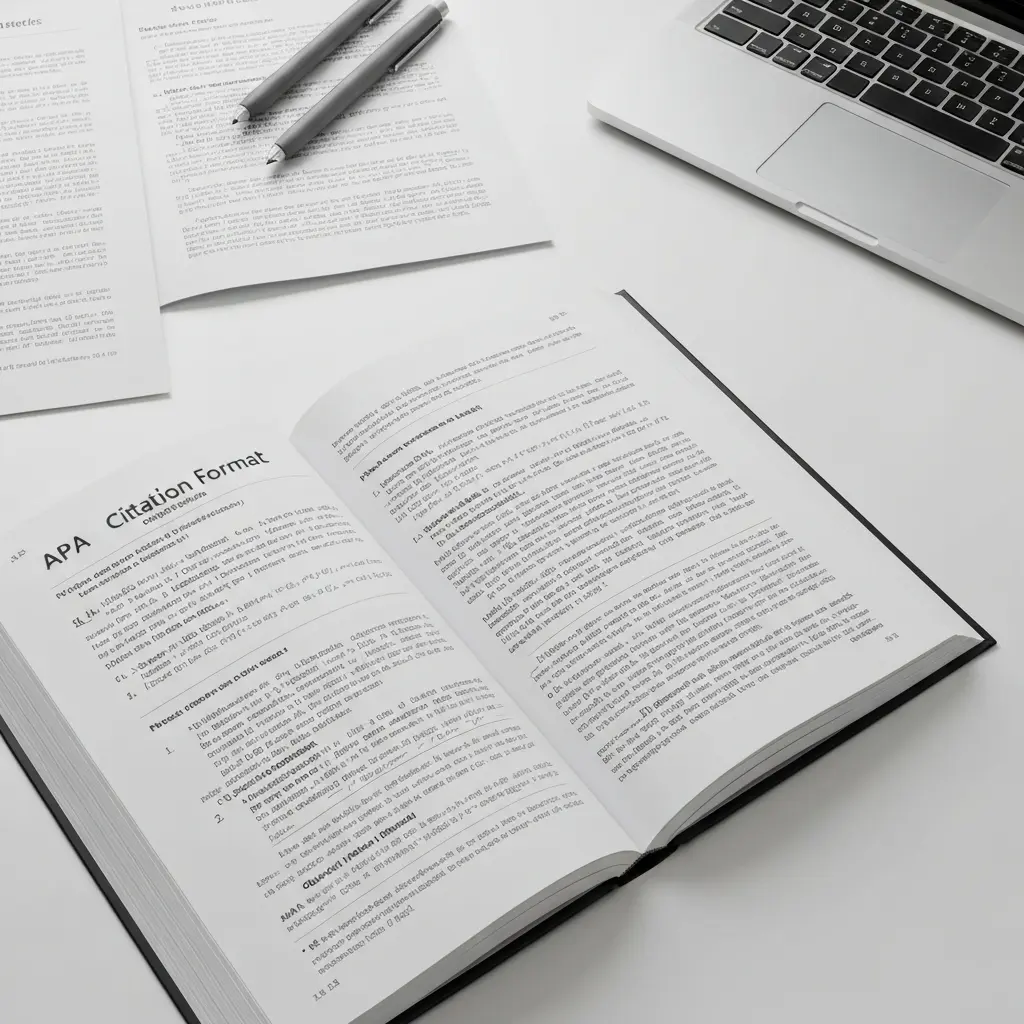
APA Citation Format: The Complete Guide with Examples for Every Source Type (2026)
The APA citation format is the most widely required citation system in psychology, education, nursing, and the social sciences — yet it consistently ranks among the most common sources of lost marks on dissertations and research papers. Published by the American Psychological Association, the seventh edition (2019) introduced sweeping changes to how digital sources, group authors, and edited volumes are handled. This guide covers every rule in practical, example-first depth so you can apply APA confidently from your first in-text citation to the final line of your reference list.
Whether you are writing an undergraduate essay, a master’s dissertation, or a doctoral thesis, understanding the exact architecture of APA style is not optional — it is a marker of scholarly credibility. Reviewers, supervisors, and journals notice formatting errors immediately. This 2026 guide reflects the current 7th edition standard with annotated examples for books, journal articles, websites, social media, and more.
What Is APA Citation Format?
APA stands for the American Psychological Association. Its publication manual — now in its 7th edition — defines not only how to cite sources but also how to format the entire paper: margins, headings, abstracts, tables, and figures. For citation purposes, the key feature of APA is the author–date system, in which every borrowed idea or quotation is linked to its source through a compact in-text reference that points the reader to a full bibliographic entry in the References section.
The 7th edition, released in 2019, made several important changes from the 6th edition. Running heads are now required only for manuscripts submitted for publication, not for student papers. The default font is no longer strictly Times New Roman — any legible 11–12pt font is acceptable. DOIs are now formatted as hyperlinks (https://doi.org/…), and URLs no longer require a “Retrieved from” prefix unless a retrieval date matters (e.g., for wikis). For papers with three or more authors, APA 7 abbreviates to “First Author et al.” from the very first citation — the 6th edition required the full author list on the first mention.
In-Text Citation Rules
In-text citations in APA appear either as a parenthetical citation at the end of a sentence or as a narrative citation woven into the prose. Both are correct; choose based on emphasis. If you want to foreground the author, use narrative. If you want to foreground the idea, use parenthetical.
Parenthetical vs. Narrative Format
| Type | Format | Example |
|---|---|---|
| Parenthetical | (Author, Year) | Research confirms this pattern (Smith, 2024). |
| Narrative | Author (Year) | Smith (2024) confirmed this pattern. |
| Direct quote | (Author, Year, p. X) | “Exact words” (Smith, 2024, p. 47). |
| 3+ authors | (First Author et al., Year) | (Jones et al., 2023) |
| No date | (Author, n.d.) | (World Health Organization, n.d.) |
Multiple Sources in One Citation
When citing multiple works parenthetically, list them in alphabetical order by first author and separate them with semicolons: (Adams, 2022; Brown, 2021; Chen, 2023). When the same author has multiple works from the same year, add lowercase letters: (Turner, 2024a, 2024b).
Block Quotations
Any direct quotation of 40 or more words is formatted as a block quotation: indented 0.5 inches from the left margin, with no quotation marks. The parenthetical citation appears after the closing punctuation, not before it — this is one of the most frequently misplaced elements in student papers.
Reference List Format and Layout
The References list begins on a new page after the body of the paper. The heading “References” is centered and bold. All entries use double spacing and a hanging indent (the first line is flush left; subsequent lines are indented 0.5 inches). Entries are alphabetized by the first author’s surname. When the same author appears multiple times, order entries chronologically from oldest to newest.
Key Formatting Rules at a Glance
- Author names: Surname first, then initials (Smith, J. A.).
- Title capitalization: Sentence case for article and book titles — only capitalize the first word, proper nouns, and the first word after a colon.
- Journal title capitalization: Title case (capitalize all major words).
- Italics: Italicize journal titles, book titles, and volume numbers.
- DOIs: Always include when available, formatted as a hyperlink: https://doi.org/xxxxx
- URLs: Include for online sources without DOIs; no “Retrieved from” unless retrieval date matters.
Citing Journal Articles
Journal articles are the most common source type in academic writing. The APA reference format for a journal article follows this template:
Author, A. A., & Author, B. B. (Year). Title of article in sentence case. Title of Periodical in Title Case, Volume(Issue), Page–Page. https://doi.org/xxxxx
Examples
- Single author:
Williams, R. T. (2023). Cognitive load in online learning environments. Journal of Educational Psychology, 115(3), 412–429. https://doi.org/10.1037/edu0000712 - Two authors:
Patel, S., & Nguyen, L. K. (2024). Social media use and academic performance: A meta-analysis. Computers & Education, 198, 104785. https://doi.org/10.1016/j.compedu.2023.104785 - 21 or more authors: List the first 19, insert an ellipsis (. . .) and then the final author’s name.
- Advance online publication (no volume/issue):
Chen, W. (2025). Neuroplasticity in adolescent bilingualism. Language Acquisition. Advance online publication. https://doi.org/10.xxxx/xxxxx
Citing Books and Book Chapters
Books are cited differently depending on whether they are authored entirely by one set of authors or whether individual chapters are written by different contributors.
Whole Book
Author, A. A. (Year). Title of work: Capital letter also for subtitle (edition if not first ed.). Publisher.
Example: Creswell, J. W., & Creswell, J. D. (2023). Research design: Qualitative, quantitative, and mixed methods approaches (6th ed.). SAGE Publications.
Chapter in an Edited Book
Chapter Author, A. A. (Year). Title of chapter. In E. E. Editor (Ed.), Title of book (pp. X–Y). Publisher.
Example: Bandura, A. (2019). Self-efficacy mechanisms in human agency. In L. Zhang (Ed.), Advances in motivation science (Vol. 6, pp. 1–44). Elsevier.
e-Books
Treat e-books exactly like print books. If you accessed it through a database or app (e.g., Kindle), you do not need to state this. If there is a DOI or URL, add it at the end.
Citing Websites and Online Sources
Website references follow this template: Author, A. A. (Year, Month Day). Title of web page. Site Name. URL. When the author and site name are the same (e.g., a government body), omit the site name to avoid repetition.
Examples:
- World Health Organization. (2025, January 15). Global tobacco report 2025. https://www.who.int/publications/i/item/xxxxxxx
- American Psychological Association. (2023, March). Ethical principles of psychologists and code of conduct. https://www.apa.org/ethics/code
If no date is available, use (n.d.). If the page is likely to change over time (e.g., a wiki), add “Retrieved Month Day, Year, from” before the URL.
Special Source Types
Social Media Posts
Cite the real name of the account holder, not the username alone, then add the username in brackets: Smith, J. [@jsmith_phd]. (2024, April 2). New preprint on metacognition [Tweet]. Twitter. https://twitter.com/jsmith_phd/status/xxxxxxx
Theses and Dissertations
Published (ProQuest): Author, A. A. (Year). Title of dissertation [Doctoral dissertation, University Name]. ProQuest Dissertations & Theses Global.
Unpublished: Author, A. A. (Year). Title of thesis [Unpublished master’s thesis]. University Name.
Secondary Sources (Citing a Source Cited in Another Source)
Only cite secondary sources if the original is unavailable. In-text: (Piaget, 1936, as cited in Vygotsky & Luria, 2024). In the reference list, cite the secondary source (the one you actually read).
Personal Communications
Emails, interviews, and direct messages that cannot be retrieved are cited in-text only: (T. Evans, personal communication, February 10, 2025). They do not appear in the References list.
The 10 Most Common APA Citation Mistakes
- Using the 6th edition rules in a 7th edition paper. The DOI format, author abbreviation thresholds, and running head rules all changed.
- Wrong capitalization in titles. Article and book titles use sentence case; journal titles use title case.
- Missing page numbers in direct quotes. Every quoted passage requires a page or paragraph number.
- Comma after et al. Incorrect: (Jones et al., 2022). Correct: (Jones et al., 2022). (No comma after “al” before the date.)
- DOI formatted without the hyperlink prefix. Always write https://doi.org/xxx, never just doi:xxx.
- Inconsistent hanging indents. The second line of every reference must indent 0.5 inches.
- In-text citation not matching reference list. Every citation needs a corresponding entry and vice versa.
- Alphabetizing by first name rather than surname. References are ordered by the author’s last name.
- Including “Retrieved from” for stable URLs. This prefix is only needed for sources likely to change over time.
- Omitting the edition number from textbooks. Always include “(Xth ed.)” when it applies.
Frequently Asked Questions
What is the difference between APA 6th and 7th edition?
The 7th edition (2019) made several significant changes: running heads are now only required for manuscripts submitted to journals (not student papers); three or more authors are abbreviated with “et al.” from the first citation onward (previously only from the seventh); DOIs are formatted as hyperlinks starting with https://doi.org/; the default font is flexible (not strictly Times New Roman); and the place of publication is no longer required for books.
How do I cite a source with no author in APA format?
When there is no individual author, use the organization name or government body as the author. If there is no author and no organization, move the title to the author position. In the in-text citation, shorten the title to the first few words in quotation marks for articles or italics for books: (“Climate Change Indicators,” 2024) or (Global Report, 2024).
Does APA 7th edition require a DOI for every source?
Include a DOI whenever one is available — it is the preferred identifier. If a journal article lacks a DOI but you accessed it online, include the journal’s homepage URL. For print articles without a DOI, no URL is needed. Never include database URLs such as JSTOR or ProQuest links for articles that are also available outside those platforms.
How do I cite a website in APA 7th edition?
The format is: Author, A. A. (Year, Month Day). Title of page. Site Name. URL. If the author and site name are the same entity, omit the site name. For pages that are frequently updated or lack a date, use (n.d.) and add a retrieval date before the URL: “Retrieved March 15, 2026, from https://…”
What does “et al.” mean in APA citations?
“Et al.” is Latin for “and others.” In APA 7th edition, use “et al.” in in-text citations whenever a work has three or more authors — from the very first citation. In the reference list, however, list all authors up to 20. If there are 21 or more, list the first 19, then an ellipsis, then the final author.
How do I cite a YouTube video in APA format?
Format: Channel Name. (Year, Month Day). Title of video [Video]. YouTube. URL. Example: Khan Academy. (2024, September 3). Understanding statistical significance [Video]. YouTube. https://www.youtube.com/watch?v=xxxxxxx. If the channel name matches the uploader’s real name, just use it once in the Author position.
How many spaces go after a period in APA 7th edition?
APA 7th edition recommends one space after end-of-sentence punctuation for ease of reading in manuscript drafts. This differs from the 6th edition, which required two spaces. However, check your institution’s guidelines — some universities still prefer two spaces.
Strengthen Your Academic Writing with Tesify
Mastering APA citation format takes practice, but having the right tools makes the process significantly faster and more accurate. Tesify Write guides your citation formatting in real time, while the Tesify Plagiarism Checker ensures your work meets academic integrity standards before submission.
For related deep-dives, see our guides on Harvard referencing format, MLA format guide, and Chicago citation style. If you are writing the dissertation itself, our qualitative research methods guide and literature review methodology article cover the scholarly process end-to-end.
Write your thesis with AI
Structure, draft, cite, and format your thesis faster with Tesify’s AI writing tools, automatic bibliography, and plagiarism checker. Free to start, no credit card required.




Leave a Reply