
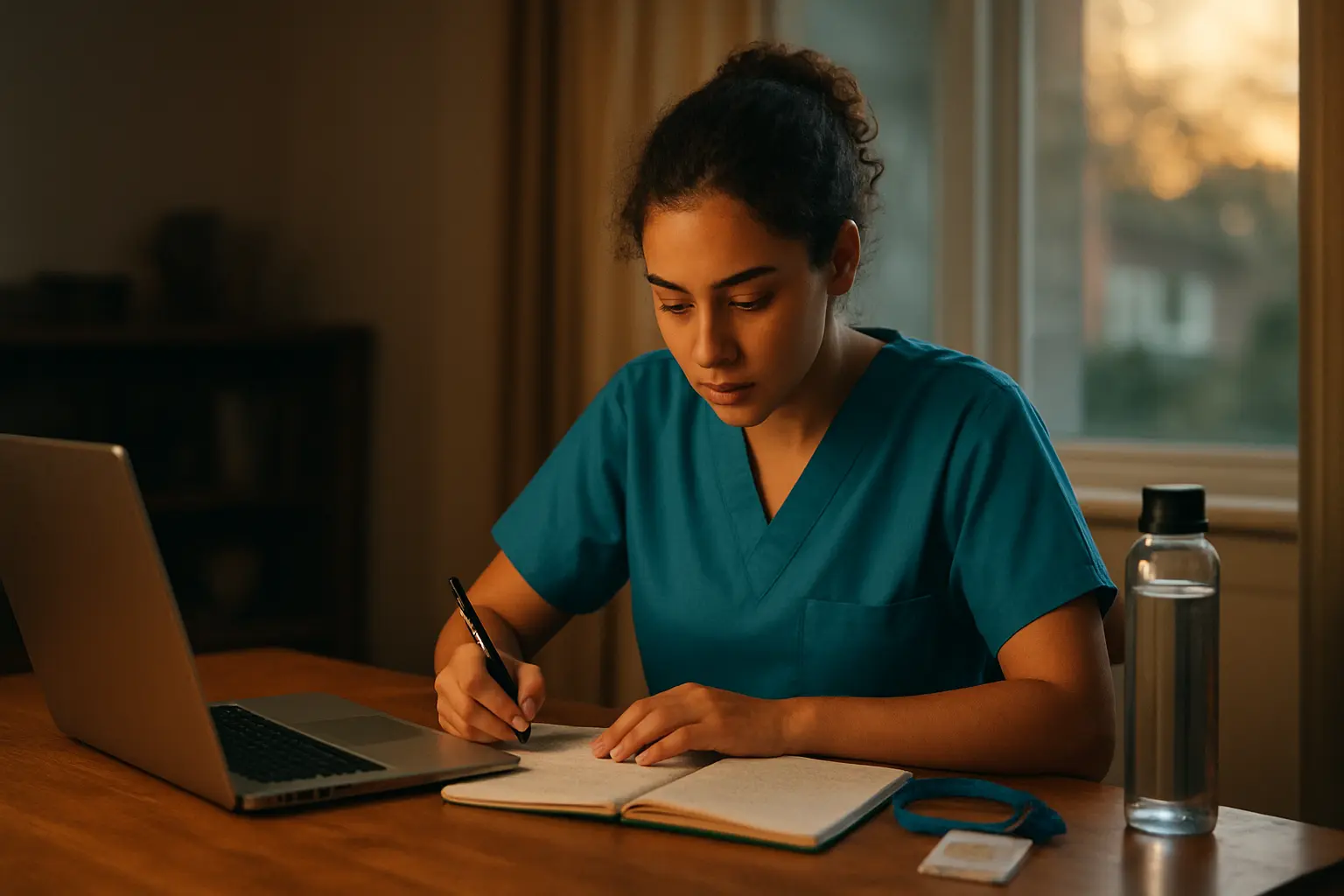
Healthcare courses do not spread the workload evenly. You get blocks of placement — often twelve-hour shifts, sometimes nights — and blocks of theory, and the assignment deadlines rarely fall where the free time is. The problem is not that you are disorganised. It is that the timetable was built around clinical hours, not around writing.
This is about working with that structure rather than pretending you can study normally. It matters to a lot of people: nursing and midwifery is by far the largest destination for adults entering higher education through Access, accounting for 7,105 accepted applicants in a single year, and most of them are studying alongside caring responsibilities and paid work.
Map the blocks against the deadlines first

Put your placement blocks and your submission dates on one calendar before the module starts. What you are looking for is the specific failure pattern: a deadline that lands in, or immediately after, a placement block.
When you find one — and you usually will — you have three options, all of which need deciding early: front-load the work into the theory block before placement, request an extension through the formal process, or accept that this piece gets written in fragments and plan the fragments deliberately.
What does not work is discovering the clash in the final week. By then the extension window may have closed and the front-loading opportunity has gone.
Capture material on placement, write later

Placement is where your assignment material comes from, and it is the worst possible time to write. Separate the two jobs.
During the block, capture only enough to reconstruct later: what happened, what you noticed, what you did not understand, what you would ask. Two or three lines is enough. Do it the same day, because clinical days blur together faster than you expect.
Capture it safely. No names, no dates of birth, no record numbers, nothing that could identify a patient or service user — and no photographs of records. Write about “a patient in their eighties admitted with…” rather than anything specific. This is a professional conduct requirement, not a formatting preference, and it applies to your private notes as well as to what you submit. Our guide to writing a reflective portfolio covers anonymisation in detail, including the combinations that identify someone even without a name.
Know which document you are writing
Healthcare programmes run several assessment types in parallel, and they reward different things.
| Assessment | What it wants | Where it goes wrong |
|---|---|---|
| Academic essay | Evidence-led argument from the literature | Anecdote used in place of evidence |
| Care study or case-based assignment | Clinical reasoning linked to evidence | Narrating the case at length |
| Reflective writing | Analysis of your own practice against a model | Reading like a diary |
| Practice documentation | Evidence against professional proficiencies | Left until the end of the block |
The most common error is bringing the wrong register: writing an essay full of what happened on your shift, or writing practice documentation as though it were an essay. Check what the brief is actually assessing before you start.
Working in fragments, deliberately
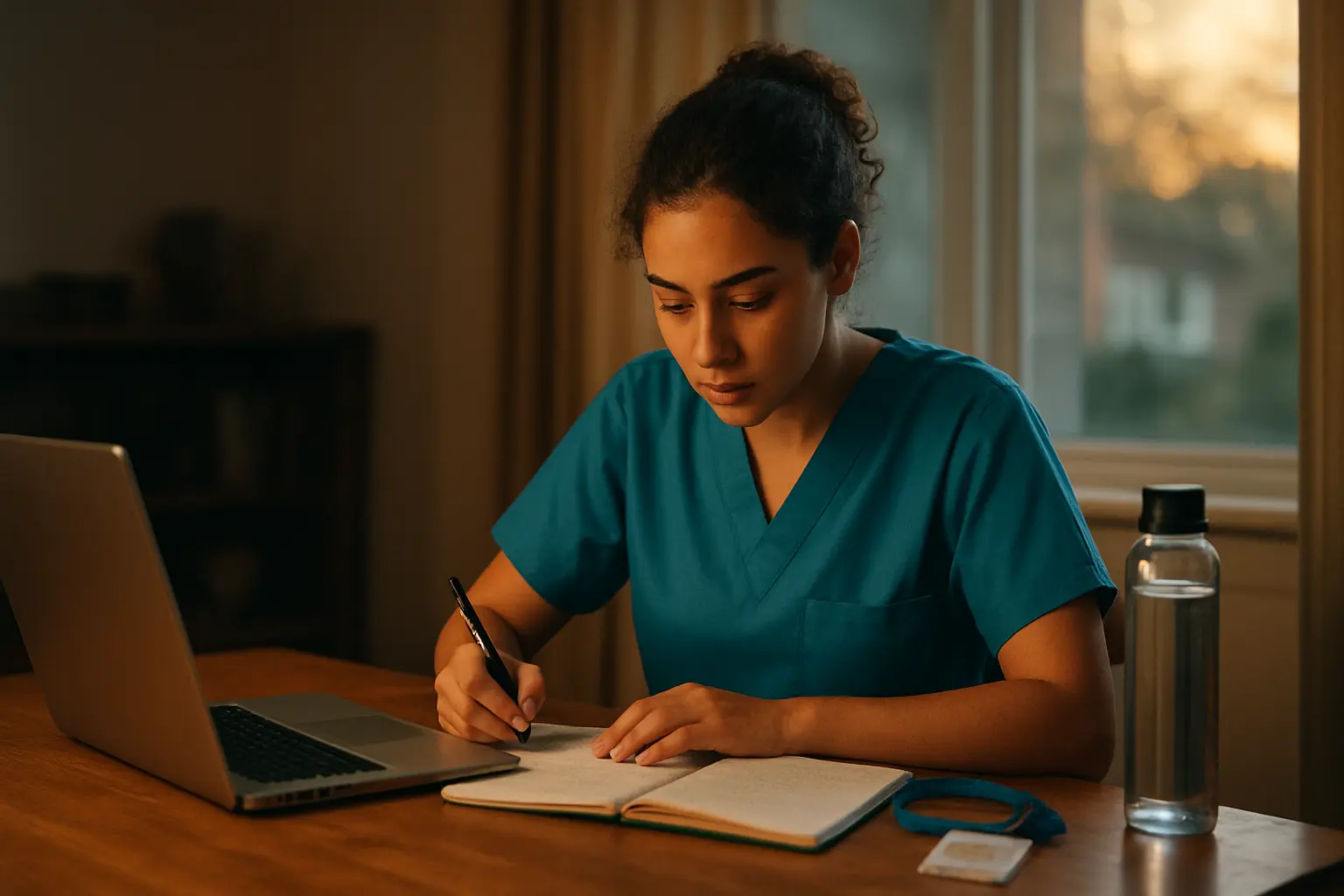
You will not do your best analytical thinking after a twelve-hour shift, and planning as though you will is how people end up with nothing written and a lost evening.
Sort the work by how much cognitive load it needs, and match it to the slot:
| When you have the slot | What to do in it |
|---|---|
| After a long shift | Format references, find sources, tidy the reference list, read one paper lightly |
| A day off during a placement block | Draft one section |
| A theory block | The analysis, the argument, the redrafting |
And end every session by writing the next specific task down. “Continue the essay” costs you thirty minutes of re-reading; “write the paragraph on why the guideline recommends X” starts immediately.
Use the systems that exist for this
Healthcare programmes know their students are on shifts, and most have arrangements you may not have asked about: extension and mitigating circumstances processes, personal tutors, and library support with extended loan periods or online access.
If something genuine happens — illness, a placement change, a bereavement, a caring crisis — use the formal process at the time rather than submitting something poor and explaining afterwards. Retrospective claims are much harder to make, and a resit costs far more time than an extension. Our guide to what happens if you miss a submission deadline covers the difference between an extension and a late submission, and which circumstances are typically accepted or refused.
If you have a learning difficulty or a health condition, disclose it and get support arranged before an assessment, not after a disappointing mark.
The specific thing that trips people up
It is not time management. It is that clinical confidence and academic confidence are different things, and being good at the first can make you worse at the second.
On placement you learn to act decisively on judgement. In an assignment, that same decisiveness reads as unsupported assertion. The sentence “this patient needed repositioning every two hours” is clinically obvious and academically unevidenced — it needs the guideline or the evidence base behind it. Practitioners who are strong on the ward often lose marks for exactly the quality that makes them good on the ward.
The fix is mechanical: when you write a clinical claim, ask where a reader could check it, and cite that. Our guide to returning to study after years out covers the same problem from the other direction.
What Tesify does not do
It cannot write your reflection or your care study, because both rest on placements only you attended and patients only you cared for. It cannot make work undetectable either — and on a healthcare programme that matters more than usual, because the thing being assessed is whether you can reason safely about practice. Submitting work you cannot explain is a professional problem before it is an academic one.
It also cannot make the anonymisation judgements for you. What is identifiable in your placement setting depends on knowledge only you have.
What it can do is take the mechanical load off the evenings after a shift: an outline mapped to your assignment criteria, references formatted and consistent, and an AI-use declaration ready to submit. You get a starting draft to rewrite in your own words, using the clinical reasoning that is yours.
Frequently asked questions
How do I write assignments when I am on placement full-time?
Separate capture from writing. Note material on placement in two or three lines a day, then do the analytical work in theory blocks or on days off. Match low-energy slots to mechanical tasks like referencing.
What if a deadline lands during a placement block?
Decide early. Either front-load the work into the preceding theory block, apply through the formal extension or mitigating circumstances process, or plan the fragments deliberately. All three need deciding before the final week.
Can I write about patients in my assignments?
Only anonymised. Remove names, dates of birth and record numbers, avoid combinations of details that could identify someone, and never append clinical records. This applies to your own notes as well as your submission.
Why do I lose marks when I know the clinical answer?
Because assignments assess evidenced reasoning rather than correct conclusions. A claim that is clinically obvious still needs the guideline or evidence base cited behind it.
Should I ask for an extension?
If you have genuine grounds, yes, and at the time rather than afterwards. Retrospective claims are harder to make and a resit costs far more time than an extension does.
How is a care study different from an essay?
A care study asks you to show clinical reasoning about a specific case linked to evidence; an essay argues a question from the literature. Both fail the same way — by narrating at length instead of analysing.
When should I complete my practice documentation?
During the block, not at the end of it. Evidence gathered as it happens is more accurate and far less work than reconstructing a whole placement from memory in the final week.
Write your thesis with AI
Structure, draft, cite, and format your thesis faster with Tesify’s AI writing tools, automatic bibliography, and plagiarism checker. Free to start, no credit card required.





Leave a Reply