

A Major Research Paper (MRP) is the independent research deliverable submitted instead of a thesis on a course-based master’s programme, most commonly in Canada. It is supervised, assessed by more than one faculty member, carries course credit like any other module, and is normally shorter than a thesis — typically in the region of 40 to 60 double-spaced pages.
If your offer letter said “course-based” or “coursework” rather than “thesis-based”, the MRP is almost certainly the thing standing between you and graduation, and it is governed by rules that differ from thesis rules in ways that catch people out.
What makes an MRP different from a thesis?
The clearest statement of the difference is structural rather than about length. The University of Guelph’s graduate calendar puts it directly: “In some course-based programs, a Major Research Project or Paper (MRP) may be required as part of the degree requirements. The MRP is assigned a course number and appropriate number of credits.”
That sentence contains the whole distinction. An MRP is a course. A thesis is a separate degree component with its own examination machinery. Because the MRP is a course, it has a course outline, a credit weighting, a grade, and a term structure — Guelph notes that “the MRP course may extend over two semesters.”
The practical consequences follow from that. Your MRP has a submission deadline tied to a term, not to an examination committee’s availability. It is normally not publicly defended. And in most programmes it is not deposited in the national or institutional thesis repository the way a thesis is — Guelph requires only that “a copy of the major paper or project must be deposited in the department or school in which the student is registered.”
How long is a Major Research Paper?
Length is set programme by programme, not nationally. Toronto Metropolitan University’s Immigration and Settlement Studies MA states that “normally, the MRP should be between 40 and 60 double-spaced pages in length”, and adds that “a student should consult with his/her MRP Supervisor if the length of the MRP is going to exceed the maximum page limit suggested here.”
Two things are worth reading out of that. Page counts, not word counts, are the common unit — which means your formatting settings are part of the specification, not a cosmetic choice. And the limit is a ceiling you are expected to negotiate before you breach, not after.
Treat any figure you find online, including the one above, as one programme’s rule. The number that binds you is in your own programme’s MRP guidelines document.
Who assesses an MRP, and how is it graded?

An MRP is not marked by your supervisor alone. Guelph’s regulation is explicit: “All evaluations will be completed by a member of the graduate faculty, and at least two graduate faculty members will contribute to the assessment of at least 50% of the final grade.”
At TMU the second assessor is named as a Second Reader, and the guidelines are careful about the role: “The Second Reader represents an additional academic review of the student’s work. However, the Second Reader is not a co-supervisor.” In practice they are usually brought in late — “in most instances to date, the Second Reader has been asked to read an MRP only when the Supervisor has deemed a completed draft satisfactory.”
The grading basis genuinely varies between institutions, and it matters more than most students realise. TMU’s ISS programme states that “the MRP is graded pass/fail. No letter grades are assigned in this course.” Guelph, by contrast, allows either: “the student’s performance will be indicated through assignment of a numeric grade or a designation of satisfactory (SAT) or unsatisfactory (UNS).”
If you intend to apply for a PhD, find out which applies to you early. A pass/fail MRP contributes nothing to your grade average, so the coursework you may be tempted to coast through is the only thing carrying a number on your transcript.
| Major Research Paper | Master’s thesis | |
|---|---|---|
| Sits in the degree as | A credit-bearing course | A separate degree component |
| Typical length | Around 40–60 double-spaced pages in the programmes that state a figure | Substantially longer; set by faculty regulation |
| Assessed by | Supervisor plus at least one further faculty assessor | An examining committee |
| Oral component | Sometimes an internal oral review; often none | Normally a formal defence |
| Grade | Pass/fail or a numeric grade, depending on the institution | Normally pass with or without corrections |
| Deposit | Often departmental only | Institutional repository |
| Coursework load | Higher — the route is coursework-weighted | Lower |
What does the MRP timeline actually look like?
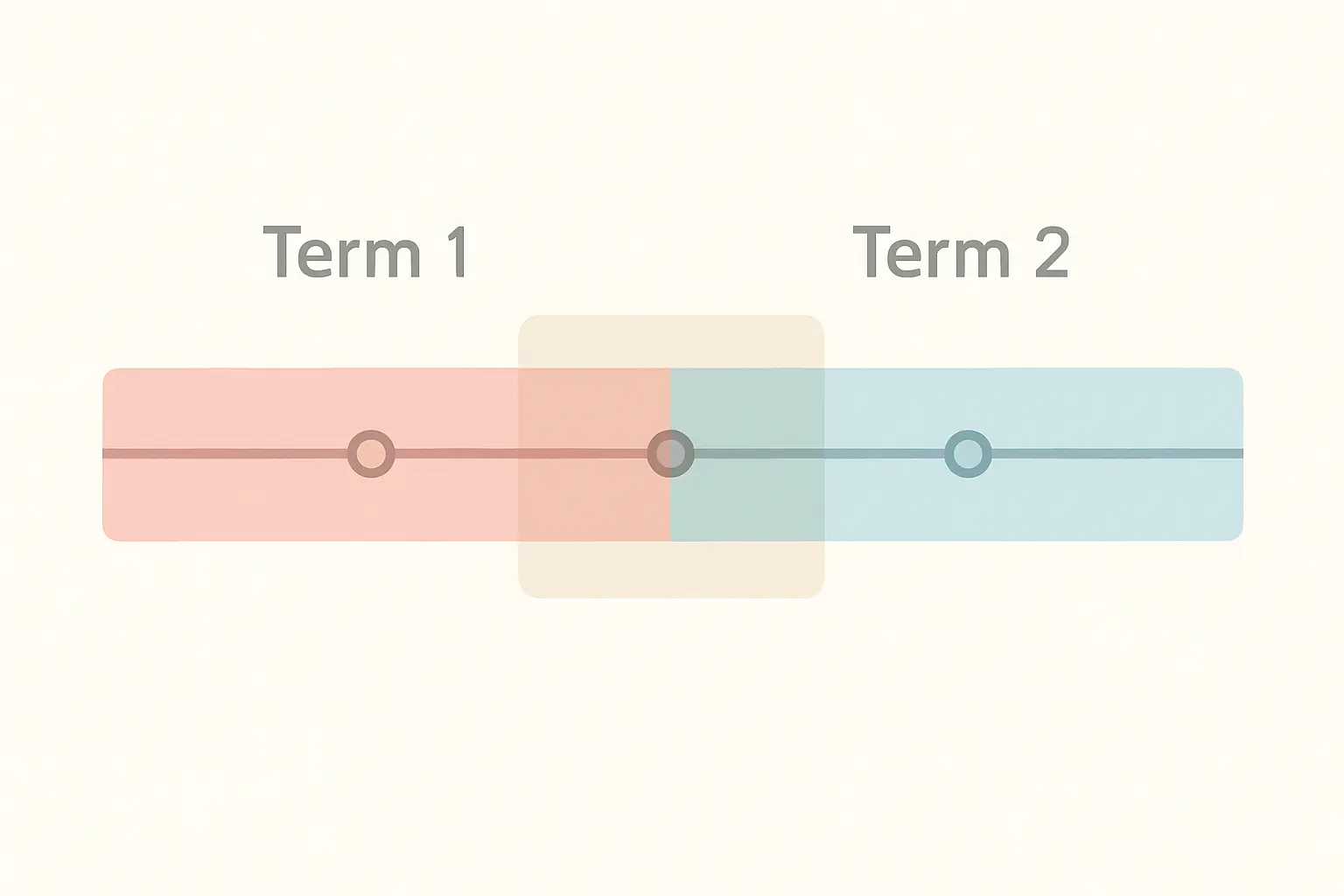
The sequence is remarkably consistent across programmes, even where the details differ.
- The proposal comes out of a methods course. TMU notes that “students will typically have prepared an MRP proposal in their Research Methods course”, and that the supervisor then approves a revised version: “students should expect to make some modification to the proposal submitted to the Research Methods course, as required by the Supervisor.”
- You approach a supervisor yourself. TMU is blunt that “students are responsible for approaching/selecting a Supervisor, who must be a member of the University’s graduate faculty”, and that “the faculty member and student must both be agreeable to the supervisory match.”
- Ethics review sets your real start date. TMU’s guidance gives the figure that ruins most MRP schedules: ethics applications “take time to process — typically about six weeks”, so it advises submitting “at least a month and a half before they intend to begin their human subject research.” Our guide to whether your project needs ethical approval covers how to work out whether yours is in scope.
- Drafting runs alongside coursework. This is the defining difficulty of the route and the reason the MRP is not simply a short thesis.
- The second assessor reads a draft the supervisor has already cleared.
- Submission is tied to a graduation deadline, not to when the work feels finished.
Why the coursework overlap is the real problem
A thesis student’s research and coursework are largely sequential. An MRP student’s are simultaneous, and the MRP is the only one of the two with no weekly deadline forcing progress.
That asymmetry is what makes MRPs slip. Every seminar paper has a date attached; the MRP has one date, months away. The reliable fix is to give the MRP artificial deadlines that match the rhythm of your courses — a section due the same week as each assignment — rather than reserving a block of time at the end that your courses will eat.
It also changes how you should choose a topic. An MRP topic that requires primary data collection has to fit around a full course load and a six-week ethics queue. Document, archival, policy and secondary-dataset topics are not lesser choices on this route; they are frequently the only feasible ones.
Is an MRP taken seriously for PhD admission?
Yes, with a caveat you should plan around. Admissions committees read the MRP as evidence you can carry out supervised independent research, which is exactly what they are trying to establish. What it does not give you is a formal defence to point to, or in many cases a numeric grade.
The practical compensations are straightforward: ask your supervisor for a reference that speaks specifically to the research, keep the MRP itself available as a writing sample, and if your programme offers an optional oral review, take it. A thesis-based route remains the more direct signal, but the gap is smaller than students fear and is largely closed by a strong supervisor letter.
How does the MRP compare to research deliverables elsewhere?
It has close relatives in other English-speaking systems, none of them identical. The Australian equivalent at a comparable stage is the research component of an Honours year, which we cover in our guide to writing an Australian Honours thesis — that sits at undergraduate level and is separately classified, so the comparison is structural rather than exact. In the UK, the nearest analogues appear in our reference list of final-year deliverables UK universities set.
Terminology is a live hazard here. Canada broadly follows the North American convention in which “thesis” means the master’s document and “dissertation” the doctoral one — the reverse of British usage — and the MRP sits outside that pair entirely. Our guide to thesis versus dissertation terminology by country sets out which convention applies where.
Frequently asked questions
Is an MRP the same as a thesis?
No. An MRP is a credit-bearing course within a coursework-weighted master’s, assessed by a supervisor plus at least one further faculty member, and usually without a formal public defence. A thesis is a separate degree component examined by a committee.
How many pages should an MRP be?
It is set by your programme. Toronto Metropolitan University’s Immigration and Settlement Studies MA specifies 40 to 60 double-spaced pages as its normal range; other programmes set different limits, and some specify words rather than pages. Your programme’s MRP guidelines are the only authority.
Do you defend a Major Research Paper?
Sometimes, but not in the way a thesis is defended. Some programmes hold an internal oral review with the supervisor and second reader; many hold nothing at all. It is not normally a public examination.
Does an MRP get a letter grade?
It depends on the institution. Some programmes grade the MRP pass/fail with no letter grade assigned; others assign a numeric grade or a satisfactory/unsatisfactory designation. Check before you plan your PhD applications, because it determines whether the MRP contributes to your average.
Can you do a PhD after an MRP-based master’s?
Yes. Course-based master’s graduates are admitted to doctoral programmes regularly. The MRP is your evidence of independent research capability, so treat it as a writing sample rather than as a box to tick, and secure a supervisor reference that speaks to the research directly.
Can I switch from the MRP route to the thesis route?
Some programmes allow a transfer, usually early and usually subject to finding a thesis supervisor with capacity. Because the two routes have different coursework requirements, a late switch can leave you owing courses you did not take. Ask your graduate program director before the end of your first term rather than after it.
Is an MRP published anywhere?
Usually only within your department. Guelph’s regulation requires that a copy “be deposited in the department or school in which the student is registered”, which is a narrower requirement than the institutional repository deposit a thesis triggers. Some programmes do make MRPs available through the university library — TMU’s ISS programme notes that most of its graduates’ MRPs can be read in the university libraries.
What Tesify does not do
Tesify cannot write your MRP. It has no access to your data or your programme’s assessment criteria, and it cannot make the analytic judgements your supervisor and second reader are specifically assessing. On a route where the MRP is your only substantial piece of independent research, a document you did not reason through yourself has nothing to recommend it — a second reader who was not involved in drafting is precisely the person who notices.
What it does is take the overhead off the top: a chapter scaffold you can align to your programme’s guidelines, references formatted and checked, and an AI-use declaration to submit alongside the paper.
Get your MRP structured early, so the writing runs alongside your coursework instead of waiting for a term that never clears.
Write your thesis with AI
Structure, draft, cite, and format your thesis faster with Tesify’s AI writing tools, automatic bibliography, and plagiarism checker. Free to start, no credit card required.




Leave a Reply