

Triangulation in Research Explained: Types & Examples (2026)
Triangulation in research is the use of more than one data source, method, investigator, or theory to study the same phenomenon, in order to strengthen the credibility and completeness of the findings. The term is borrowed from surveying and navigation, where fixing a position from two or more known points gives a more accurate location than a single sighting.
Triangulation is one of the most cited — and most misunderstood — strategies for building trustworthiness into a study. Used well, it deepens understanding and pre-empts the criticism that a finding is an artefact of one method or one observer. Used as a box-ticking phrase, it adds nothing. This guide explains the four types, what triangulation genuinely achieves, and how to report it so examiners take it seriously.
What Is Triangulation and Why Use It?
The purpose of triangulation is to reduce the risk that your conclusions depend on the limitations of a single method, source, or observer. Every method has blind spots: interviews capture accounts but not behaviour, surveys capture breadth but not depth, a single coder brings a single perspective. By combining approaches, you compensate for the weaknesses of one with the strengths of another, producing a fuller and more defensible picture. In qualitative research, triangulation is often listed alongside member checking and audit trails as a core strategy for establishing credibility.
What Are the Four Types of Triangulation?
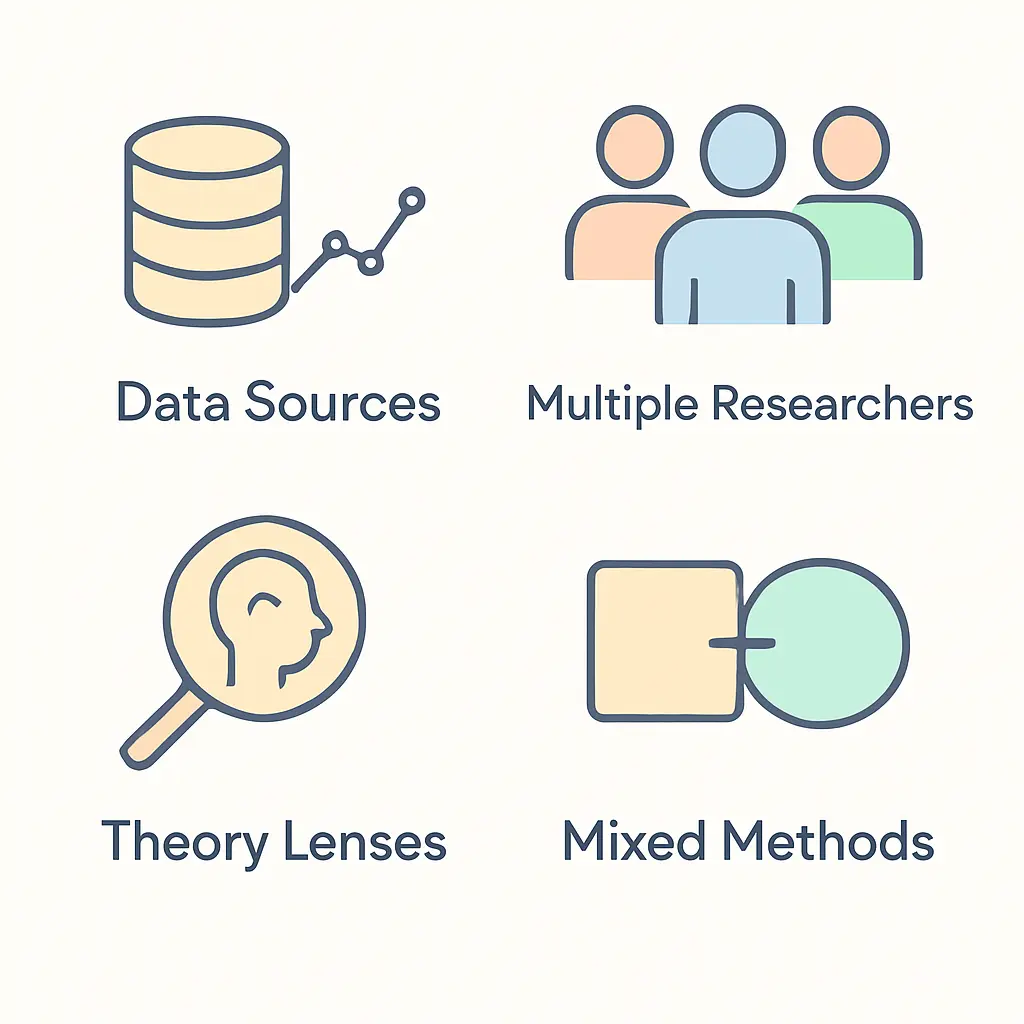
Norman Denzin’s classic typology remains the standard reference:
| Type | What varies | Example |
|---|---|---|
| Data triangulation | Sources, times, settings | Interviewing students, staff, and parents about the same policy |
| Investigator triangulation | Researchers / coders | Two analysts independently coding the same transcripts |
| Theory triangulation | Theoretical lenses | Interpreting findings through two competing frameworks |
| Methodological triangulation | Methods | Combining a survey with follow-up interviews |
Typology after Denzin (1978); many studies combine more than one type. Methodological triangulation is sometimes split into “within-method” and “between-method” variants.
Methodological triangulation is the most familiar because it overlaps with mixed methods research design, but the other three are equally valid routes to a more robust study, and investigator triangulation in particular strengthens the reliability of qualitative coding.
What Does Triangulation Look Like in Practice?
Consider a study of how a new attendance policy affects secondary-school students. Data triangulation might gather accounts from students, teachers, and parents. Methodological triangulation might pair attendance records (quantitative) with focus groups (qualitative). Investigator triangulation might have two researchers code the focus-group transcripts independently and compare. Theory triangulation might interpret the results through both a behavioural and a sociological lens. Where these converge, confidence rises; where they conflict — say, records show improvement but students report resentment — the tension becomes a finding in its own right.

What Does Triangulation Not Prove?
Triangulation is often misdescribed as a validity test that confirms findings are “true.” It is not. Convergence across sources increases credibility, but it can also reflect a shared bias rather than accuracy. More importantly, divergence is not failure: when two methods disagree, that disagreement is informative and should be explored, not smoothed over. Treating triangulation as a way to deepen and complicate understanding — rather than to mechanically “prove” a result — is both more honest and more analytically productive. This distinction connects to the wider debate about construct, internal, and external validity, which triangulation supports but does not settle.
How Do You Report Triangulation?
Vague claims that “data were triangulated” carry no weight. A convincing account specifies which type(s) of triangulation you used, why, and what happened when sources were compared:
- Name the type(s) explicitly — data, investigator, theory, or methodological.
- Justify the choice in relation to your research question and the weaknesses it offsets.
- Describe the procedure — how sources or coders were compared, and how disagreements were resolved.
- Report divergence honestly, treating conflicting evidence as a result to interpret.
Reporting triangulation transparently also demands reflexivity about your own role in the process, since investigator and theory triangulation both depend on how researchers interpret data — a point developed in work on reflexivity in qualitative research.
FAQ
What is triangulation in research?
Triangulation is the use of more than one source, method, investigator, or theory to study the same phenomenon, in order to strengthen the credibility and completeness of the findings. Borrowed from surveying and navigation, the idea is that viewing something from several angles gives a more accurate fix than a single viewpoint.
What are the four types of triangulation?
Norman Denzin identified four types: data triangulation (multiple data sources, times, or settings), investigator triangulation (multiple researchers), theory triangulation (multiple theoretical lenses), and methodological triangulation (multiple methods, such as combining interviews and surveys). Many studies use more than one type.
Does triangulation prove your findings are true?
No. Triangulation strengthens confidence and completeness but does not prove truth. When sources converge, credibility increases; when they diverge, that divergence is itself informative and should be explored rather than hidden. Triangulation is best understood as a way to deepen understanding, not a guarantee of validity.
What is the difference between triangulation and mixed methods?
Mixed methods research combines quantitative and qualitative approaches in one study, which is one way to achieve methodological triangulation. But triangulation is broader: it also includes using multiple data sources, researchers, or theories, and can occur within a single qualitative or quantitative study without mixing paradigms.
Related Reading
Write your thesis with AI
Structure, draft, cite, and format your thesis faster with Tesify’s AI writing tools, automatic bibliography, and plagiarism checker. Free to start, no credit card required.





Leave a Reply