

Research Proposal Template: Write a Winning Proposal (2026)
Whatever research proposal template your institution provides, the document you submit is not merely an administrative requirement — it is the intellectual contract between you and your funding body, institution, or supervisory committee. It demonstrates that you have identified a genuine research gap, possess the methodological competence to address it, and can communicate the significance of your planned work with clarity and scholarly precision. PhD proposals submitted to UKRI, the European Research Council, or Wellcome Trust are assessed by panels of experts who read hundreds of proposals annually and can immediately identify the difference between genuine scholarly ambition and dressed-up vagueness.
This guide provides a complete research proposal template with section-by-section guidance, common mistakes identified by admission tutors at Oxford, Cambridge, UCL, and Imperial College London, and annotated examples from proposals that successfully secured funding or programme admission. The principles apply equally to master’s dissertation proposals, PhD programme applications, and external grant applications.
Section 1: The Title
Your title must be simultaneously specific, informative, and accessible to a reader who is expert in your field but unfamiliar with your specific project. The most effective academic proposal titles include: the core subject, the method or theoretical framework, and the scope or population.
Weak: “Artificial Intelligence in Healthcare”
Strong: “Algorithmic Bias in Diagnostic AI: A Critical Examination of Racial Health Disparities in NHS Machine Learning Systems, 2018–2025”
The stronger version specifies: the phenomenon (algorithmic bias), the mechanism (diagnostic AI), the context (NHS), the demographic focus (racial disparities), and the temporal scope. Any reader can immediately identify whether this proposal is relevant to their expertise and what it intends to show.

Section 2: Abstract
The abstract is your proposal in miniature — 200 to 300 words that must accomplish four things: establish the research gap, state your research question, summarise your methodology, and assert the significance of your expected findings. Many reviewers make an initial decision about proposals based on the abstract alone. In competitive funding rounds, a strong abstract that clearly signals novelty and feasibility will be read more carefully than one that is vague or descriptive.
Abstract template structure:
- Sentence 1–2: Context and existing knowledge
- Sentence 3: The gap or problem (“However, existing research has not addressed…”)
- Sentence 4–5: Your research question and primary objective
- Sentence 6–7: Methodology in brief
- Sentence 8–9: Expected findings and their significance
Section 3: Background and Rationale
This section establishes why your research is necessary. It must do three things simultaneously: (a) demonstrate that you know the existing literature, (b) identify a genuine gap or limitation in that literature, and (c) argue that your proposed research will address that gap in a way that matters. This is not a literature review — it is a targeted argument for why your specific research is needed now.
The research gap you identify must be genuine. Common mistakes include: identifying a gap that already has extensive literature (indicating incomplete searching), identifying a gap that is trivially small (“no one has studied X in this specific county”), or identifying a gap without explaining why filling it matters beyond the study itself.
The Gap-Innovation-Significance Framework
Structure your rationale around three moves, each covered in one to two paragraphs:
- Gap: What is missing from current knowledge? (“Current studies on X have focused on Y, but have not examined Z…”)
- Innovation: What does your research offer that existing work does not? (“This study uniquely combines A and B methodologies to…”)
- Significance: Why does this gap matter? What are the theoretical, policy, or practical implications of current ignorance about this topic?
Section 4: Research Questions and Objectives
State your primary research question clearly and then break it into three to five specific research objectives. Research questions should be open-ended and exploratory (for qualitative work) or causal/predictive (for quantitative work). Objectives should be specific, measurable, and achievable within your proposed timeframe.
Example:
Primary research question: “How do NHS hospital trust policies shape the deployment and governance of diagnostic AI systems?”
Research objectives:
- To map current diagnostic AI deployment across NHS acute trusts using Freedom of Information requests and publicly available procurement records
- To analyse the governance frameworks applied to AI systems at five purposively selected trusts through semi-structured interviews with clinical informatics leads
- To evaluate the alignment between these governance frameworks and NHS AI guidelines and NICE Evidence Standards
- To develop recommendations for consistent AI governance standards applicable across NHS trust settings
Section 5: Literature Review
A research proposal literature review differs from a dissertation literature review in one key respect: it is shorter and more selective. Rather than comprehensively mapping the field, it targets the specific debates and evidence that your research directly engages with. Reviewers are looking for evidence that you have identified the key works in your area, understand the current state of debate, and have a clear position on where your research fits.
Use Google Scholar, JSTOR, and your institutional library databases to identify not just seminal works but recent publications (within the last five years) that show the field is still active and developing. Citing only classic sources without recent work suggests you have not engaged with current scholarship. Equally, citing only recent work without acknowledging foundational contributions suggests unfamiliarity with the field’s history.
A practical shortcut is to read completed dissertations in your field before drafting: their literature chapters reveal which sources examiners treat as essential and how recent gaps have been framed. This overview of where to find past dissertations in ProQuest, OATD, NDLTD and university repositories explains how to locate and cite them. Organise the review thematically rather than author by author, so that each paragraph advances your argument towards the gap your proposal addresses.
Section 6: Methodology
For a research proposal, the methodology section is necessarily shorter than in a completed dissertation, but it must still convey methodological credibility. You do not yet have data, but you must convincingly demonstrate that your proposed methods are appropriate, feasible, and will produce valid and reliable results.
Cover the following in approximately 400–600 words: research design (qualitative/quantitative/mixed and justification), data sources and collection methods, sampling strategy, analysis approach, ethical considerations and approval pathway, and any specific resources or access required.
Matching Design to Question
The single test reviewers apply to this section is alignment: does each method follow logically from the research question? A question about how participants interpret an experience points toward qualitative designs such as semi-structured interviews analysed thematically; a question about the strength of a relationship between variables points toward a survey or experimental design with a pre-specified statistical test. Mixed-methods proposals must explain not only both strands but also how and when they will be integrated. State your research paradigm briefly — positivist, interpretivist or pragmatist — because it justifies why your chosen methods produce the kind of knowledge your question demands.
If your study relies on established theory, show how its constructs will be operationalised. A proposal that presents a diagram of variables and their hypothesised relationships is far easier to assess; this guide to drawing a conceptual framework for a thesis walks through three worked examples that transfer well to other disciplines. Likewise, every key concept should receive both a conceptual and an operational definition, as illustrated in these conceptual versus operational definitions with 20 examples.
For survey-based studies, name the instrument you intend to use, cite its original validation, and explain how you will confirm validity and reliability in your own sample, for example through expert review and a pilot test. The steps are set out in this guide to establishing survey validity and reliability with a content validity index and pilot test. Finally, describe your ethics pathway concretely: which committee will review the study, how informed consent will be obtained, and how data will be stored, anonymised and eventually archived or destroyed.
Section 7: Timeline
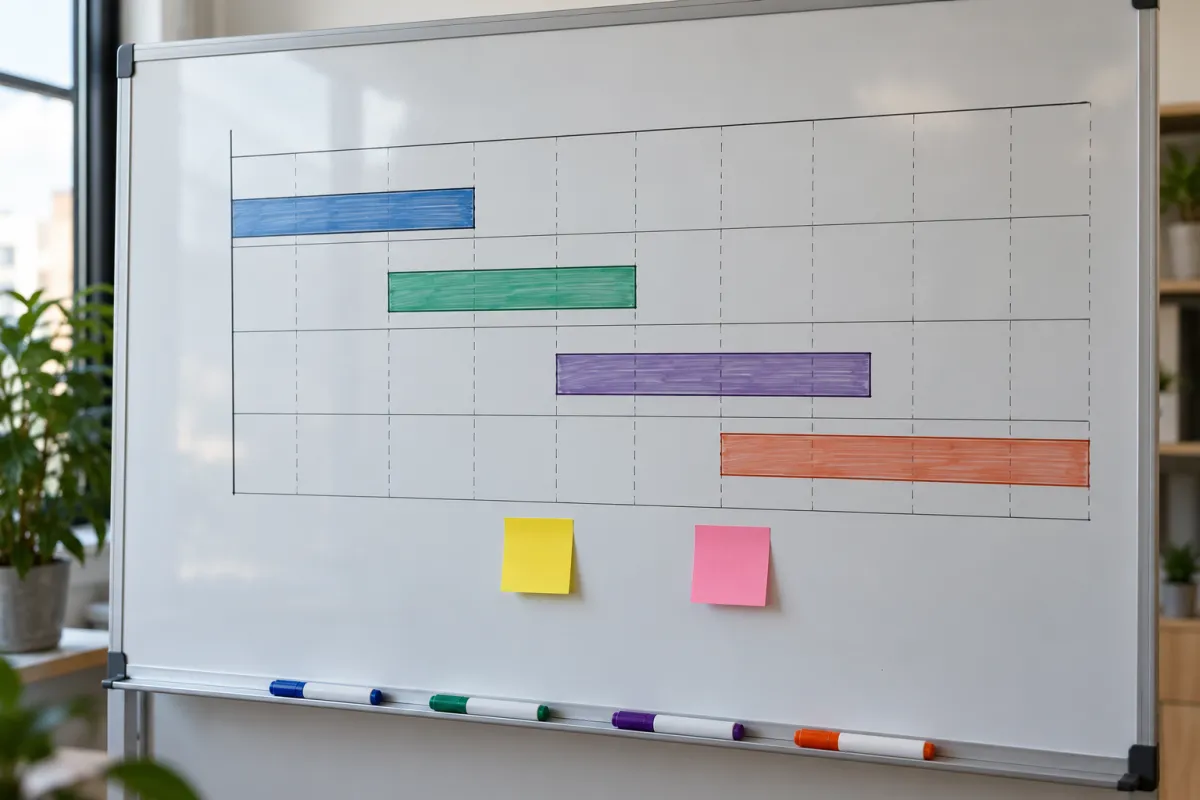
A research timeline demonstrates feasibility — that you understand how long each stage of your research will actually take and that the project is achievable within your proposed duration. Present your timeline as a Gantt chart or a phased table.
| Phase | Activities | Duration |
|---|---|---|
| Phase 1: Literature and Design | Comprehensive literature review; finalise research design; ethics application | Months 1–3 |
| Phase 2: Data Collection | Fieldwork / surveys / experiments; transcription; data management | Months 4–8 |
| Phase 3: Analysis | Data analysis; preliminary write-up; supervisor review | Months 9–12 |
| Phase 4: Writing and Submission | Full thesis writing; revisions; final submission | Months 13–18 |
Build in contingency time — fieldwork almost always takes longer than anticipated, and ethics approvals can cause significant delays. Reviewers who have conducted research themselves know this and will be sceptical of timelines with no slack.
Section 8: Significance and Expected Outputs
Articulate the intellectual, policy, and/or practical significance of your research. What will the knowledge you generate enable? Who will benefit from it and how? What publications, policy documents, or practical recommendations do you anticipate producing?
Be specific rather than generic. “This research will contribute to the field” is meaningless. “This research will produce the first systematic empirical map of AI governance practices across NHS acute trusts, generating evidence that NHS England and NHSX can use to develop standardised AI procurement guidelines” is specific, credible, and demonstrates understanding of the policy landscape.
Section 9: Budget (Where Required)
For externally funded research proposals, provide a detailed, justified budget. Each line item should be supported by a brief justification. Common budget categories include: personnel (your time and any research assistants), participant costs (honoraria, travel reimbursement), equipment and software, travel and fieldwork costs, dissemination (open access publication fees, conference attendance), and indirect costs (institutional overhead, typically a fixed percentage).
Reviewers are experienced at identifying inflated budgets. Request what you actually need, at realistic market rates, and provide a brief justification for each category.
Section 10: References
Follow the reference format specified by your institution or funding body precisely. Most UK universities use Harvard or APA 7th edition; most STEM funding bodies use Vancouver or a field-specific style. Reference management software (Zotero, Mendeley, EndNote) prevents formatting errors that can undermine an otherwise strong proposal.
Check every in-text citation against the reference list before submission; mismatched or missing entries are among the easiest errors for a reviewer to spot. Tools such as Tesify Auto Bibliography can generate and format the reference list in your required style, but always verify each entry against the original source.
FAQ
How long should a PhD research proposal be?
PhD application proposals in the UK typically run from 1,000 to 2,500 words, though some programmes specify up to 3,000. UKRI grant proposals and externally funded research proposals are typically longer — 5,000 to 10,000 words excluding references. Always check the specific requirements of the programme or funding body, as these vary significantly and submitting an over- or under-length proposal may result in disqualification.
Can I use AI tools to help write my research proposal?
AI tools can legitimately help with structuring your proposal, improving clarity and academic register, and checking that you have addressed all required sections. They cannot generate the intellectual content — your research question, your identification of the research gap, your methodological choices, and your significance claims must come from your own scholarly thinking. Using AI to generate the substantive intellectual content of an application would constitute academic dishonesty and potentially fraud in the case of funded proposals.
What is the most common reason research proposals are rejected?
The most common reasons, based on feedback from UKRI, the British Academy, and Wellcome Trust, are: (1) failure to identify a genuine research gap, (2) a research question that is too broad or too vague, (3) a methodology that is not sufficiently detailed or clearly matched to the research question, (4) an unrealistic timeline, and (5) failure to demonstrate why this research is significant beyond the immediate academic contribution. Strong proposals address all five of these clearly.
Do I need a supervisor before submitting a PhD proposal?
In the UK, most PhD programmes require you to have identified a potential supervisor before submitting your application. Many departments will not consider an unsolicited application without a supervisor willing to support it. The standard process is: (1) identify potential supervisors whose research interests align with yours, (2) email them with a brief pitch and your proposal draft, (3) if they express interest, submit a full application naming them as your proposed supervisor.
Write Your Research Proposal with Scholarly Precision
Tesify helps PhD applicants and master’s students structure their research proposals section by section, ensuring every required element is covered with the academic rigour that admission committees and funding panels expect. Start with a free account and build your proposal from a template framework aligned with UKRI, ERC, and Wellcome Trust requirements.
Write your thesis with AI
Structure, draft, cite, and format your thesis faster with Tesify’s AI writing tools, automatic bibliography, and plagiarism checker. Free to start, no credit card required.






Leave a Reply