

PhD Viva Outcome Statistics 2026: Pass, Minor Corrections, Major Corrections & Fail Rates
PhD viva outcome statistics show that 96% of candidates who sit their viva pass, based on an analysis of 26,076 PhD candidates across 14 UK universities between 2006 and 2017. Only 4% fail outright, and of that group, roughly 97% still walk away with an MPhil rather than no qualification at all. The most common result by far is a pass with minor corrections.
If you are weeks away from your own viva, those headline numbers matter less than the breakdown behind them: how many people pass with zero corrections, how many are asked to make major revisions, and what actually happens to the small minority who fail. This article walks through the sourced data, outcome by outcome, and compares what is known about the UK viva system to the US dissertation defense.
What Percentage of PhD Students Pass Their Viva?
Of the 26,076 candidates studied, 25,063 (96%) passed their viva in some form, and 1,013 (4%) did not. The data, gathered via Freedom of Information requests from universities including Oxford, UCL, Imperial College London, Edinburgh, Manchester, Bristol and Sheffield, is one of the largest published datasets on UK viva outcomes.
That headline pass rate is high, but it reflects a filtering process that happens long before the viva itself: supervisors and internal reviewers rarely allow a candidate to submit unless they are confident the thesis is close to viva-ready.
What Are the Possible Viva Outcomes?
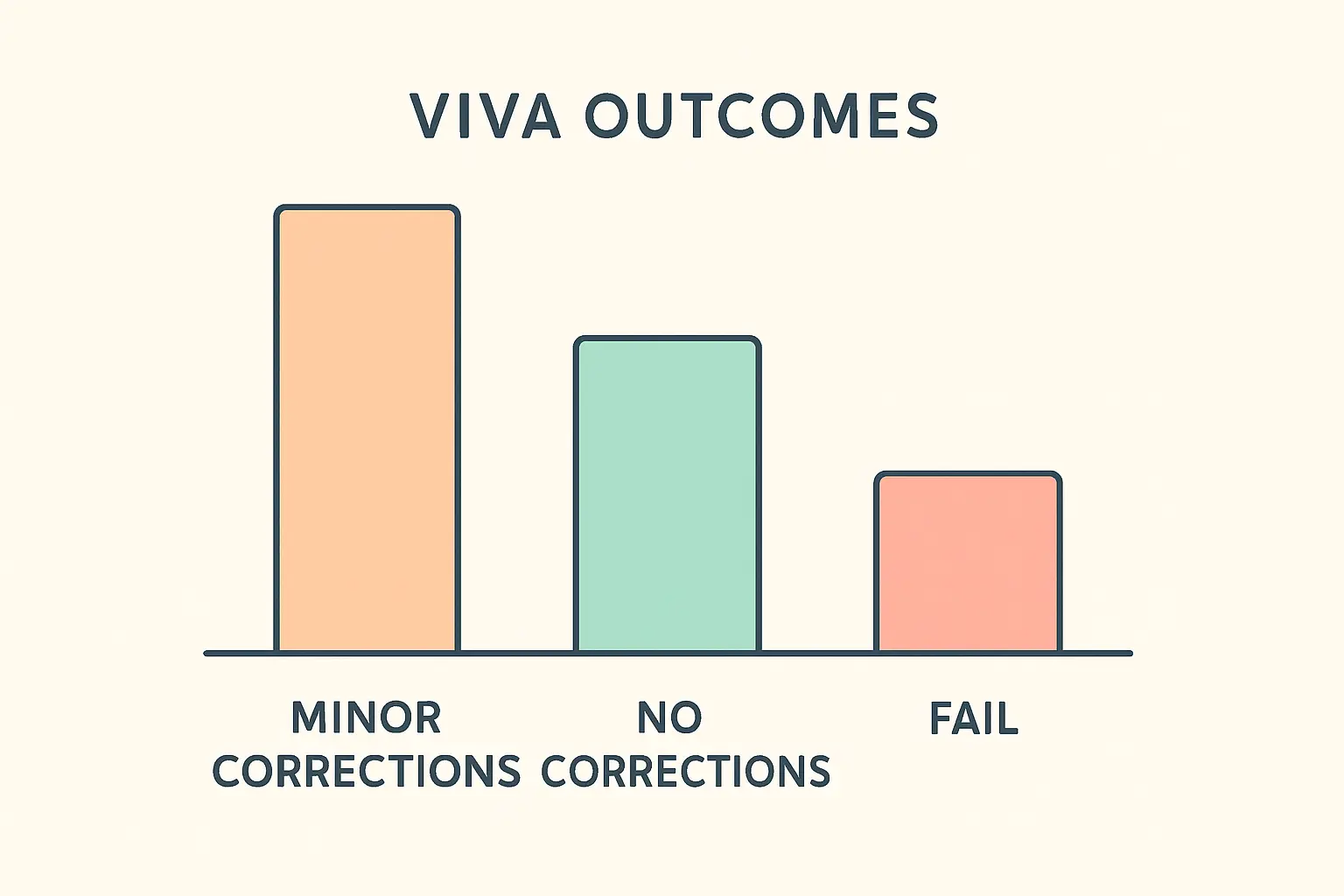
In the UK examination system, a viva does not simply end in “pass” or “fail.” Examiners choose from a small set of standard recommendations, and the data shows a clear hierarchy of how common each one is.
| Outcome | Share of all candidates | Share of passing candidates |
|---|---|---|
| Pass with no corrections | ~4.8% | ~5% |
| Pass with minor corrections | ~75.8% | ~79% |
| Pass with major corrections | ~15.4% | ~16% |
| Fail — MPhil awarded | ~3.9% | n/a |
| Fail — no degree awarded | ~0.1% | n/a |
Source: DiscoverPhDs analysis of 26,076 PhD candidates across 14 UK universities, 2006–2017, obtained via Freedom of Information requests.
Minor corrections usually mean fixing typos, clarifying arguments, tightening references, or addressing specific examiner comments — work that can typically be finished in a few weeks. Major corrections are more substantial: additional analysis, restructured chapters, or new literature engagement, and they signal that the examiners had real reservations about parts of the thesis, even though they still judged it fundamentally sound.
How Common Is a Straight Fail?
An outright fail — no degree, no resubmission — is rare. Of the 4% of candidates who did not pass, about 97% were still awarded an MPhil, which is the standard fallback qualification when a thesis does not meet PhD-level standards but does meet master’s-level standards. Only around 3% of the 4% (roughly 0.1% of all candidates) left with no award at all.
Examiners at institutions such as the University of Essex and the University of Sheffield both publish their formal outcome categories, and both include a “fail with right to resubmit” option before an outright fail is even considered — another reason total failure is so uncommon.
Does the Outcome Differ Between the UK and the US?
The US dissertation defense system does not have the same nationally standardized outcome categories as the UK viva, and no equivalent large-sample published dataset appears to exist for US institutions. What is consistent across both systems, based on available reporting, is the underlying mechanism: doctoral committees and supervisors act as a filter well before the defense date, so by the time a candidate is sitting in front of examiners, both sides usually already expect a pass.
US defenses more often result in a private committee discussion followed immediately by revisions requested, rather than the formal “minor/major corrections” letter categories used in the UK. The practical effect — a high pass rate with revisions being the norm rather than the exception — appears similar in both systems, even though the paperwork differs. Australian and Irish universities tend to sit closer to the UK model, with an external examiner report substituting for a live viva in some Australian institutions, followed by a written corrections process rather than an oral defense.
How Long Do You Get to Complete Corrections?
Deadlines are set institutionally, not nationally, so always check your own university’s examination regulations. As a general pattern reported across UK universities:
- Minor corrections: commonly around 3 months from the viva date.
- Major corrections: commonly around 6 months from the viva date.
- Resubmission after a fail-with-resubmission outcome: typically up to 12 months, often with a second viva required.
Missing a corrections deadline can itself trigger a separate process, similar to missing your original thesis submission deadline — most universities allow an extension request, but it is not automatic.
What Factors Influence Which Outcome You Get?
The published dataset does not break outcomes down by subject or supervisor behavior, but examiner guidance from institutions like Essex and Sheffield, along with the structure of the exam itself, points to a few consistent influences:
- How closely the thesis follows examiner expectations for the discipline — theses with an unusually low or high reference count for their field sometimes draw more scrutiny.
- Whether the candidate can defend methodological choices under direct questioning, not just describe them.
- How well the written thesis matches the verbal account given in the viva — inconsistencies are a common trigger for major corrections.
- Supervisor sign-off quality before submission, since supervisors act as an informal first filter.
- Internal vs. external examiner composition — most UK panels include one internal and one external examiner, and a chair is sometimes added for procedural oversight.
Preparation matters more than talent under pressure. Rehearsing likely questions, re-reading your own thesis critically in the weeks before the viva, and getting a mock viva from your supervisor are the most commonly cited ways candidates reduce their chance of major corrections. For candidates revising chapters after receiving examiner feedback, an AI thesis assistant such as Tesify can help restructure and tighten sections quickly during the corrections window.
What Should You Do If You’re Given Major Corrections?
Major corrections are not a failure — they affect roughly 1 in 6 candidates and still count as a pass outcome. The most effective response is to treat the examiners’ report as a structured to-do list rather than a verdict on your ability.
- Log every point separately. Break the examiners’ report into individual, numbered action items rather than tackling it as one document. This makes it easier to track what is done and what remains.
- Request clarification early. If a comment is ambiguous, most supervisors would rather you ask in week one than guess and redo work in week five.
- Draft a response document. UK universities typically require a short “response to examiners” memo alongside the corrected thesis, explaining exactly how each point was addressed and where in the text.
- Prioritise methodology and analysis concerns first. These tend to take the longest and are the parts most likely to trigger a second round of scrutiny if under-addressed.
- Set interim deadlines. With 6 months typically available, working backward from the submission date in monthly milestones keeps major corrections from becoming a last-minute scramble.

FAQ
What percentage of PhD students fail their viva?
In a study of 26,076 UK PhD candidates across 14 universities, about 4% failed their viva outright. Of that 4%, roughly 97% were still awarded an MPhil rather than leaving with no qualification at all, and only about 3% of failing candidates received no degree.
What is the most common PhD viva outcome?
Pass with minor corrections is by far the most common outcome, accounting for roughly 79% of all successful vivas in the UK dataset. A pass with no corrections at all happens in only about 5% of cases.
How long do you have to complete minor or major corrections?
Timelines are set by each university, but minor corrections are commonly given around 3 months and major corrections around 6 months. Always check your own institution’s examination regulations, since deadlines vary.
Can you resit a failed PhD viva?
Most UK universities allow a resubmission and second viva when the outcome is “fail with resubmission” rather than an outright fail, typically within 12 months. An outright fail with no resubmission option is rare.
Is the US dissertation defense pass rate similar to the UK viva pass rate?
Large-scale published defense statistics are harder to find for the US than for the UK. What is consistent across both systems is that committees and supervisors rarely put a candidate forward unless they are confident the candidate will pass, which keeps outright failure uncommon in both countries.
Does passing a PhD viva with no corrections happen often?
No. It is the rarest successful outcome, occurring in only around 5% of cases in the UK dataset of 26,076 candidates, compared to 79% for minor corrections and 16% for major corrections.
Related Reading
Write your thesis with AI
Structure, draft, cite, and format your thesis faster with Tesify’s AI writing tools, automatic bibliography, and plagiarism checker. Free to start, no credit card required.




Leave a Reply