
PhD Attrition by Year of Study Statistics 2026: When Do Doctoral Students Actually Leave?
PhD attrition by year of study statistics point to a consistent pattern across the research literature: doctoral students are most likely to leave in their first two years, not near the finish line. Estimates of overall non-completion run as high as 40-60%, but that headline figure hides a much more useful detail — attrition risk is heavily front-loaded, tied closely to funding status and academic field.
If you are a prospective or current doctoral student trying to understand your own odds, the “when” matters as much as the “how many.” This article breaks down the sourced data on timing, field differences, and the funding effect, and separates PhD attrition from the much rarer event of failing at the final examination stage.
When Are PhD Students Most Likely to Drop Out?
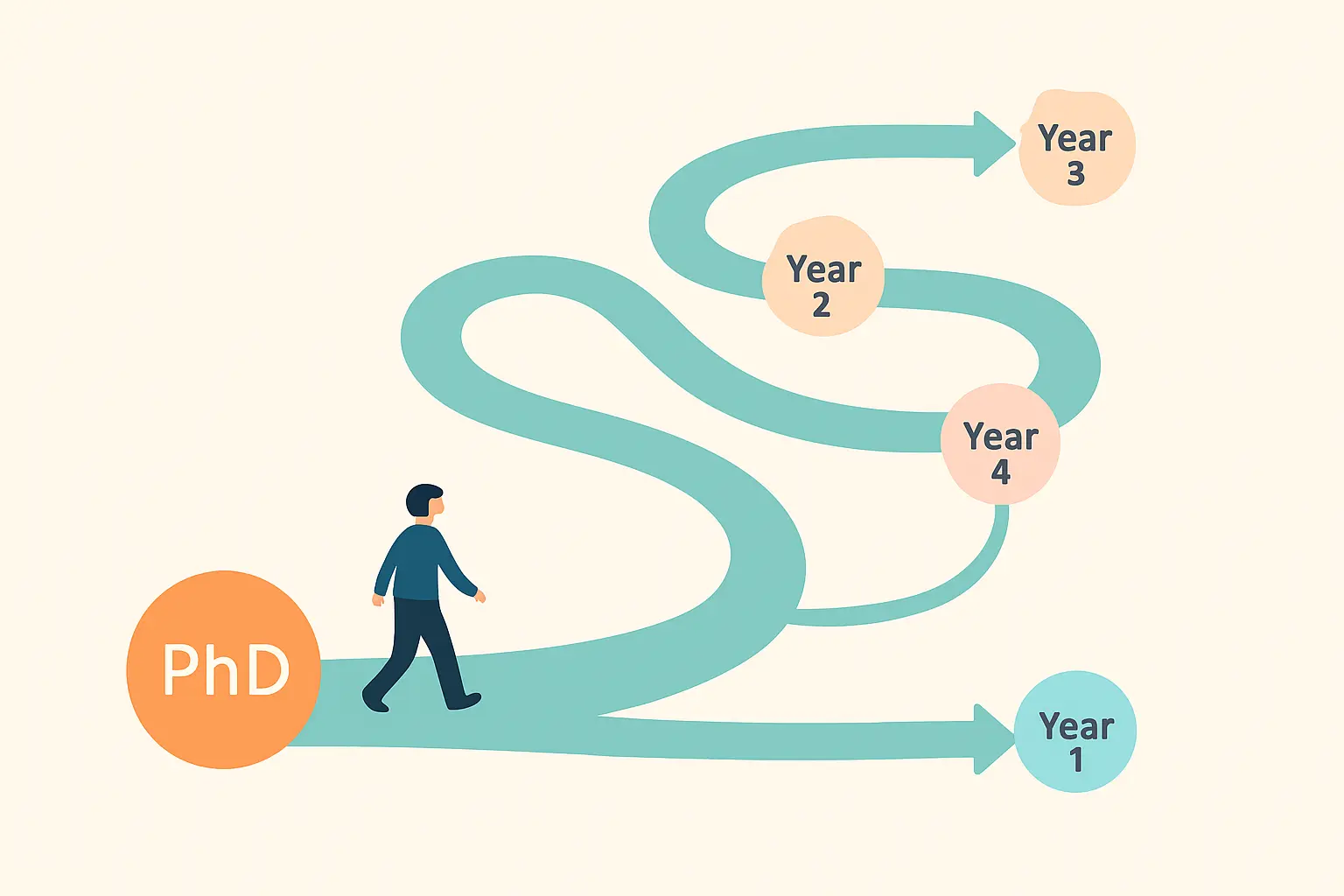
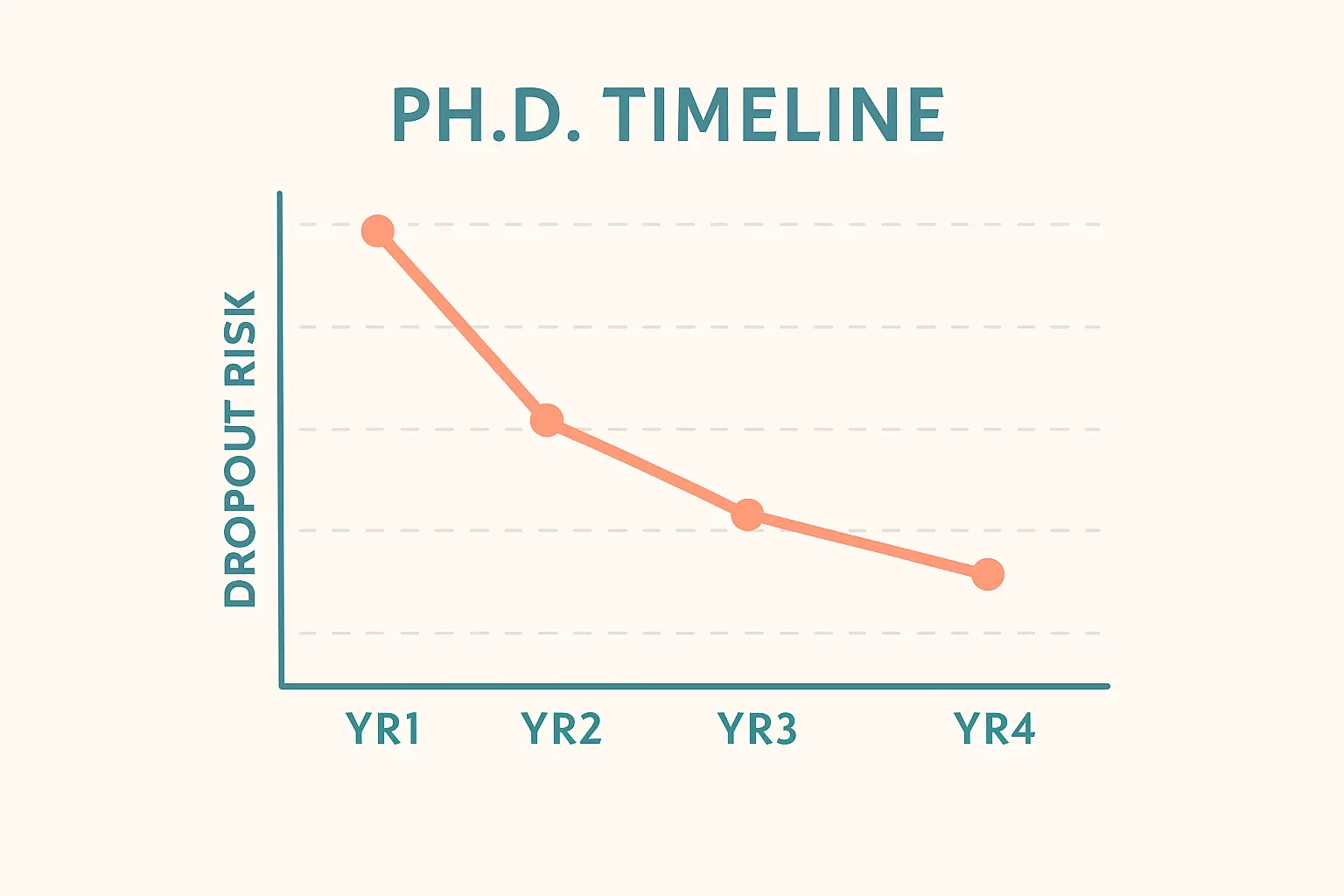
The consistent finding across doctoral attrition research is that dropout risk peaks in the first two years of study. This period combines the heaviest coursework and qualifying-exam load with the difficult transition into independent, self-directed research — a shift that frequently does not match students’ expectations of what doctoral life would look like.
By contrast, students who make it past the early “trial by fire” years and into the writing-up phase are comparatively unlikely to leave. Sunk cost, established supervisory relationships, and proximity to completion all work in a student’s favor once the early years are behind them.
| Stage | Relative attrition risk | Primary drivers |
|---|---|---|
| Year 1–2 (coursework / transition) | Highest | Unmet expectations, time pressure, weak early supervision |
| Mid-candidacy (fieldwork / data collection) | Moderate | Funding gaps, isolation, stalled progress |
| Writing-up / final years | Lowest | Sunk-cost commitment, proximity to completion |
Pattern synthesized from doctoral attrition literature reviewed by A Happy PhD (“Who drops out of the Ph.D.?”) and related peer-reviewed studies on doctoral persistence; relative risk categories are illustrative groupings of the underlying findings, not a single primary dataset’s exact percentages.
What Percentage of PhD Students Never Finish?
Overall non-completion estimates vary by country, field, and how “completion” is defined, but a commonly cited range across academic literature is 40-60%, making doctoral study the degree level with the lowest completion rate of any qualification tier.
The most rigorous large-scale US and Canadian dataset comes from the Council of Graduate Schools’ PhD Completion Project, a seven-year study covering 24 to 29 research universities and students entering between 1992–93 and 2003–04. It found that 57% of doctoral candidates completed their degree within 10 years, and only 20% had completed within 7 years — a reminder that doctoral timelines are long and completion continues to accrue well past the point many students (and funders) expect a PhD to be finished.
Does Funding Change the Odds?
Funding status is one of the most consistently cited factors in doctoral attrition research. Students without guaranteed funding face significantly higher dropout risk than fully funded peers, since financial strain adds a layer of pressure on top of the academic and personal demands of doctoral study. This tracks closely with what stipend and cost-of-living data shows about the financial gap many doctoral students already navigate even when funded.
Funding gaps do not just affect whether a student can afford to continue — they also affect focus. Students juggling part-time or gig work alongside a doctorate have measurably less time for the deep, uninterrupted research blocks that doctoral work requires, which compounds the risk in years where research momentum matters most.
Does Attrition Vary by Academic Field?
Yes, and the gap is not small. Research synthesized across multiple studies suggests science and technology students complete at meaningfully higher rates than health sciences students, and are roughly twice as likely to complete compared to humanities and social sciences students.
The Council of Graduate Schools data adds an important nuance to this: in the social sciences and humanities, the share of students completing actually keeps rising between years 7 and 10, unlike in science and engineering, where completion patterns flatten out earlier. In other words, humanities and social science students who stay enrolled tend to take longer but keep finishing, while science and engineering completions cluster earlier and then plateau. This lines up with what country-level PhD dropout data shows about field-driven variation within national averages.
Is PhD Attrition the Same as Failing a Viva or Defense?
No, and this distinction matters. The overwhelming majority of doctoral non-completion happens through voluntary or administrative withdrawal well before a final viva or defense is ever scheduled. Viva outcome data shows outright failure at the final examination stage affects only around 4% of candidates who actually reach that stage — and most of those still receive a fallback MPhil rather than leaving with nothing.
Put another way: if you make it to the viva or defense, your odds of walking away with a doctorate are very high. The real attrition risk sits earlier, in the years before a thesis is anywhere near submission-ready.
What Actually Reduces the Risk of Dropping Out?
Across the doctoral persistence literature, a small number of factors show up repeatedly as protective:
- Strong first-year supervisor support. Studies on doctoral dropout consistently find that the more support a student experiences in year one, the less likely they are to withdraw.
- Secure funding. Guaranteed funding removes one of the largest sources of first-two-years stress.
- Realistic expectations going in. Disillusionment with the day-to-day reality of research — versus the image students had of doctoral life — is a recurring theme in dropout interviews.
- Manageable time pressure. Students who report high time pressure in year one, independent of workload volume, show higher dropout likelihood, suggesting pacing and milestone-setting matter as much as raw hours worked.
- A clear research direction early. Passion for and clarity about the research topic is associated with lower attrition, which is one reason many programs now build a structured proposal or confirmation stage into year one.
If you are in the early, highest-risk window of a doctorate, tools that reduce friction in day-to-day writing and structuring can help protect the time you have for research itself. An AI thesis assistant such as Tesify can take some of the mechanical burden off early proposal drafts and literature review chapters, freeing up time for the supervisory and research relationships that the data shows matter most in year one.

Does This Pattern Hold for International Students?
International doctoral students face the same first-two-years risk window, with an added layer of complications: visa status tied to enrollment, distance from family support networks, and in many cases a language or academic-culture adjustment on top of the standard transition into independent research. Funding structures also differ by country of study, and where funding is less guaranteed for international candidates than for domestic ones, the funding-attrition link described above tends to compound rather than offset the other adjustment pressures.
Departments with structured international-student orientation and mentoring programs, in the general pattern reported across the literature, tend to see less early attrition among this group than departments that leave new international candidates to navigate the first year largely on their own. This is consistent with the broader finding that supervisor and departmental support in year one is one of the strongest protective factors regardless of a student’s background.
FAQ
When are PhD students most likely to drop out?
Research reviewed by A Happy PhD and related academic literature consistently points to the first two years of doctoral study as the highest-risk window, driven by unmet expectations about research life, intense coursework, and the transition into independent research.
What percentage of PhD students never finish?
Estimates vary by source and country, but a commonly cited range is that roughly 40-60% of doctoral students do not complete their degree, making doctoral study the degree level with the lowest completion rate. The Council of Graduate Schools’ PhD Completion Project found 57% of candidates across 24 North American institutions completed within 10 years.
Does funding affect PhD attrition rates?
Yes. Research synthesized in doctoral attrition literature indicates students without guaranteed funding are several times more likely to drop out than fully funded peers, since financial strain compounds the academic and personal pressures of doctoral study.
Does attrition vary by academic field?
Yes. Reviewed studies suggest science and engineering students tend to complete at meaningfully higher rates than humanities and social sciences students, and the Council of Graduate Schools data shows completion patterns differ by field, with humanities completions rising more gradually across years 7-10 than science and engineering.
Is PhD attrition the same as failing a viva or defense?
No. The vast majority of doctoral attrition happens through voluntary withdrawal long before a viva or defense is ever scheduled. Outright failure at the final examination stage is comparatively rare; most non-completion happens in the early-to-middle years of the program.
What is the single biggest predictor of whether a PhD student stays enrolled?
Across the studies reviewed, supervisor support during the first year is one of the most consistently cited protective factors, alongside secure funding. Students who report strong early supervisory support and manageable time pressure are less likely to withdraw.
Related Reading
Write your thesis with AI
Structure, draft, cite, and format your thesis faster with Tesify’s AI writing tools, automatic bibliography, and plagiarism checker. Free to start, no credit card required.




Leave a Reply