
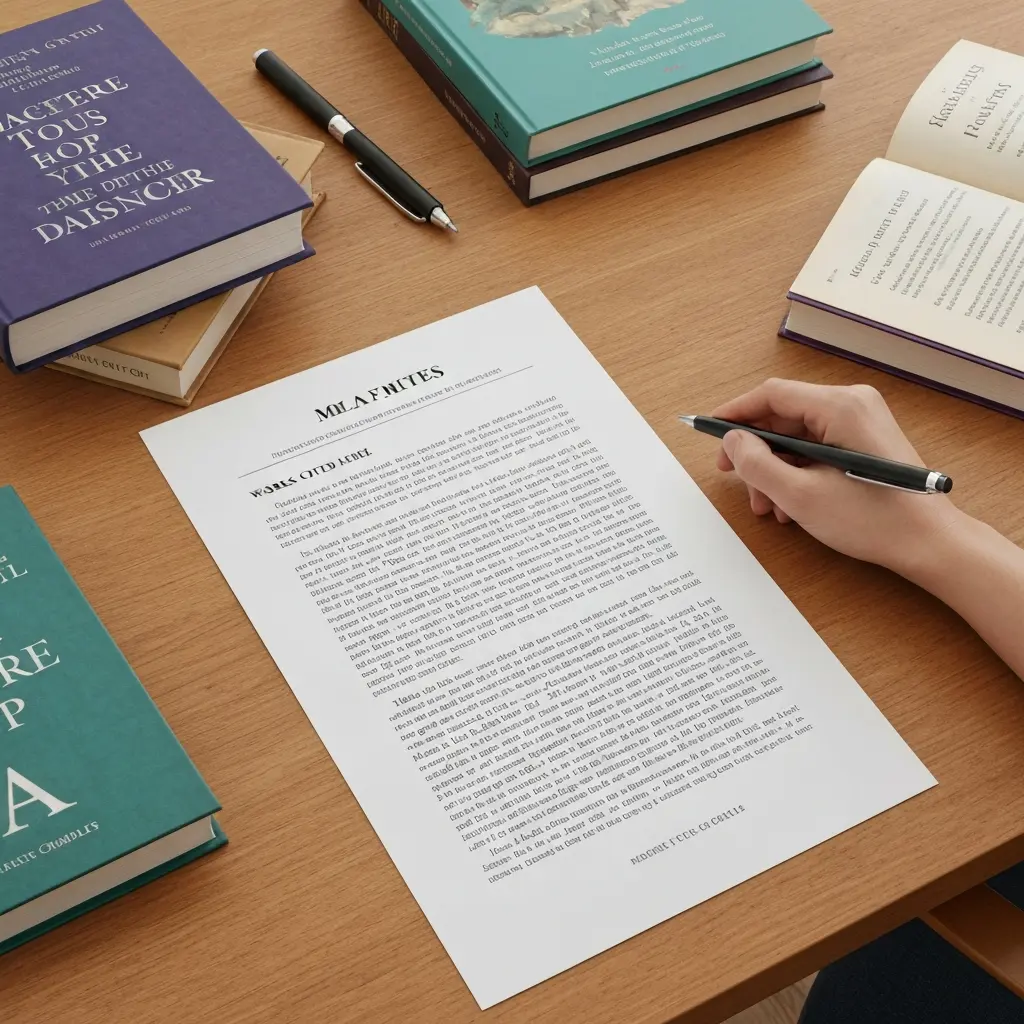
MLA Format Guide: Everything You Need to Know in 2026
The MLA format guide is the essential reference for students and researchers in the humanities — literature, languages, film studies, cultural studies, and the arts. Maintained by the Modern Language Association, the 9th edition (released 2021) overhauled citation practice with a flexible “container” model that adapts to any source type, from ancient manuscripts to TikTok videos. If your instructor requires MLA and you want to move beyond basic compliance to genuine fluency, this 2026 guide walks through every formatting rule, every citation template, and every edge case you are likely to encounter.
Unlike APA’s author–date system or Chicago’s footnote apparatus, MLA uses an author–page system: in-text citations give the author’s surname and the page number (or equivalent locator), pointing directly to a matching Works Cited entry at the end. This elegant pairing keeps scholarly conversation transparent while preserving readability — and understanding the logic behind it makes the rules far easier to remember.
Paper Formatting Rules
MLA paper formatting is standardized and straightforward. Follow these rules every time:
- Font: Times New Roman 12pt (or a legible equivalent).
- Margins: 1 inch on all sides.
- Spacing: Double-spaced throughout, including the Works Cited page. No extra spacing between paragraphs.
- Header (top right): Your last name and page number (e.g., Smith 3) — in the header, not the body.
- Opening identification block: Top-left, four lines: your name, instructor’s name, course, date (day month year — 15 March 2026).
- Title: Centered on the line after the identification block. Regular font — no bold, no italics, no extra size. Do not create a separate title page unless asked.
- Paragraph indentation: First line indented 0.5 inches (one tab stop).
MLA uses no cover page, no abstract, and no running head for most undergraduate papers. The four-line identification block replaces all of these. When submitting digitally, use PDF to preserve formatting.
In-Text Citations in MLA
Every time you paraphrase, summarize, or quote a source, insert a brief parenthetical citation that includes the author’s last name and the relevant page number (or equivalent locator). There is no comma between the author’s name and the page number.
Basic Formats
| Scenario | In-Text Format | Example |
|---|---|---|
| Named in text | Author named; (Page) | Fitzgerald argues that wealth corrupts (89). |
| Not named in text | (Author Page) | Wealth ultimately corrupts (Fitzgerald 89). |
| Two authors | (Author1 and Author2 Page) | (Gilbert and Gubar 45) |
| Three or more authors | (First Author et al. Page) | (Johnson et al. 112) |
| No page number (web) | (Author) | (National Archives) |
| No author | (Shortened Title Page) | (“Climate Risks” 7) |
Block Quotations
Quotations longer than four lines of prose (or more than three lines of verse) become block quotations. Indent the entire quotation 0.5 inches from the left margin, maintain double spacing, and do not use quotation marks. The parenthetical citation follows the closing punctuation with no period after the closing parenthesis.
The Container Model Explained
The most transformative feature of MLA 9th edition is the container model. A container is anything that holds or provides access to the source you are citing — a journal, a website, a streaming platform, an anthology. Sources can have two containers: for example, a journal article (container 1) accessed through JSTOR (container 2).
Each container is described through up to nine core elements in this order:
- Author
- Title of source
- Title of container
- Other contributors (editors, translators, directors)
- Version (edition, season)
- Number (volume, issue, episode)
- Publisher
- Publication date
- Location (page numbers, URL, DOI)
Not every element is relevant for every source. Omit any element that does not apply. This single template replaces the MLA 7th and 8th edition practice of memorizing distinct formats for each source type.
Works Cited Page Layout
The Works Cited page begins on a new page immediately after the body of the paper. Centre the heading “Works Cited” (no italics, no quotation marks, no bold). List all entries in alphabetical order by the author’s last name. Use a hanging indent: the first line is flush left, and all subsequent lines for that entry are indented 0.5 inches. The entire page is double-spaced — no extra line breaks between entries.
Entries are alphabetized letter by letter, ignoring articles (A, An, The) when they appear at the beginning of a title used in the author position. When the same author has multiple works, replace the author’s name in the second and subsequent entries with three hyphens (—) followed by a period.
Citing Common Source Types
Scholarly Journal Article
Author Last, First. “Article Title.” Journal Title, vol. X, no. X, Month Year, pp. X–X. DOI or URL.
Example: Morrison, Toni. “The Site of Memory.” PMLA, vol. 102, no. 1, Jan. 2019, pp. 24–31. https://doi.org/10.xxxx/xxxxx
Book
Author Last, First. Title of Book. Publisher, Year.
Example: Said, Edward W. Orientalism. Vintage Books, 1979.
Chapter in an Edited Collection
Chapter Author Last, First. “Chapter Title.” Book Title, edited by Editor First Last, Publisher, Year, pp. X–X.
Newspaper Article
Author Last, First. “Article Title.” Newspaper Name, Day Month Year, p. X. (Print) or URL. (Online)
Interview
Interviewee Last, First. Interview. By Interviewer First Last. Publication, Date.
Personal interview (you conducted it): Interviewee Last, First. Personal interview. Day Month Year.
Citing Digital and Multimedia Sources
Website
Author Last, First. “Page Title.” Site Name, Publisher (if different from site name), Date, URL.
Example: Lepore, Jill. “A New Americanism.” Foreign Affairs, Council on Foreign Relations, 18 Feb. 2024, www.foreignaffairs.com/articles/xxxxxx.
Film
Film Title. Directed by Director First Last, Studio, Year.
Example: Oppenheimer. Directed by Christopher Nolan, Universal Pictures, 2023.
YouTube Video
Channel Name. “Video Title.” YouTube, Date, URL.
Social Media Post
Account Name [@handle]. “First few words of post.” Platform, Date, URL.
Podcast Episode
Host Last, First, host. “Episode Title.” Podcast Name, Season X, Episode X, Publisher, Date. URL or streaming platform.
Special Cases and Edge Scenarios
Translated Works
Include the translator as a contributor after the title: The Stranger, by Albert Camus, translated by Matthew Ward, Vintage International, 1989.
Sacred Texts and Classical Works
For the Bible and other sacred texts, cite the edition as the source: The New Oxford Annotated Bible with Apocrypha, 5th ed., Oxford UP, 2018. In-text, include the version with the first citation: (New Oxford Annotated Bible, John 3:16). Subsequent citations of the same edition need not repeat the name.
Reprinted or Republished Works
Include the original publication date after the title, then the reprint details: Benjamin, Walter. “The Work of Art in the Age of Mechanical Reproduction.” 1935. Illuminations, translated by Harry Zohn, Schocken Books, 1969, pp. 217–252.
MLA vs. APA: Key Differences
| Feature | MLA 9th Edition | APA 7th Edition |
|---|---|---|
| In-text locator | Page number (Smith 47) | Date (Smith, 2024) |
| Reference list heading | Works Cited | References |
| Title capitalization | Title case (all major words) | Sentence case (first word only) |
| Paper header | Four-line ID block, no title page | Title page required |
| Primary disciplines | Humanities, literature, arts | Social sciences, psychology, nursing |
Frequently Asked Questions
What edition of MLA should I use in 2026?
The current standard is MLA 9th edition, published by the Modern Language Association in 2021. It replaced the 8th edition (2016) and introduced clearer guidance on inclusive language, expanded examples for digital sources, and refinements to the container model. Always confirm with your instructor, but 9th edition is the default in 2026.
Does MLA require a title page?
No. Standard MLA format uses a four-line identification block in the top-left corner of the first page (your name, instructor’s name, course, date), followed by a centered title. A separate title page is only used if specifically requested by your instructor or institution.
How do I cite a source with no author in MLA?
When there is no named author, begin the Works Cited entry with the title of the work. In the in-text citation, use a short version of the title (in quotation marks for articles, italicized for books), followed by the page number if applicable: (“Climate Change Overview” 3) or (Global Report 12). Alphabetize by the first significant word of the title.
Do I need to include the URL for online sources?
MLA 9th edition recommends including URLs (or DOIs) for online sources in the location element. However, if your instructor specifies not to include URLs (some do), follow their guidance. For sources accessed through library databases, include the database name rather than the full URL, unless the URL is stable and accessible to all readers.
What is the correct way to cite a poem in MLA?
For a poem published in a book or anthology: Author Last, First. “Poem Title.” Book Title, edited by Editor Name, Publisher, Year, pp. X–X. In-text, cite line numbers rather than page numbers for verse when lines are numbered: (Keats, lines 14–17). If lines are not numbered, use page numbers.
How do I handle multiple works by the same author in MLA?
In the Works Cited list, list multiple works by the same author alphabetically by title. For the second and subsequent entries, replace the author’s name with three hyphens followed by a period (—.). In-text citations must include a shortened title to distinguish between the works: (Woolf, Mrs. Dalloway 32) vs. (Woolf, To the Lighthouse 67).
Build Scholarly Fluency with the Right Tools
MLA format is more than a set of rules — it is a discipline of scholarly accountability. Each citation signals that your argument is grounded in evidence and that you respect the intellectual labour of your sources. For day-to-day writing support, Tesify Write helps you maintain consistent formatting throughout your paper, and the Tesify Plagiarism Checker ensures your paraphrasing is original before submission.
For more citation style guidance, see our comprehensive APA citation format guide, our Chicago citation style reference, and our overview of bibliography vs. references. Heading into dissertation territory? Our qualitative research methods guide covers methodology from design to analysis.


Leave a Reply