
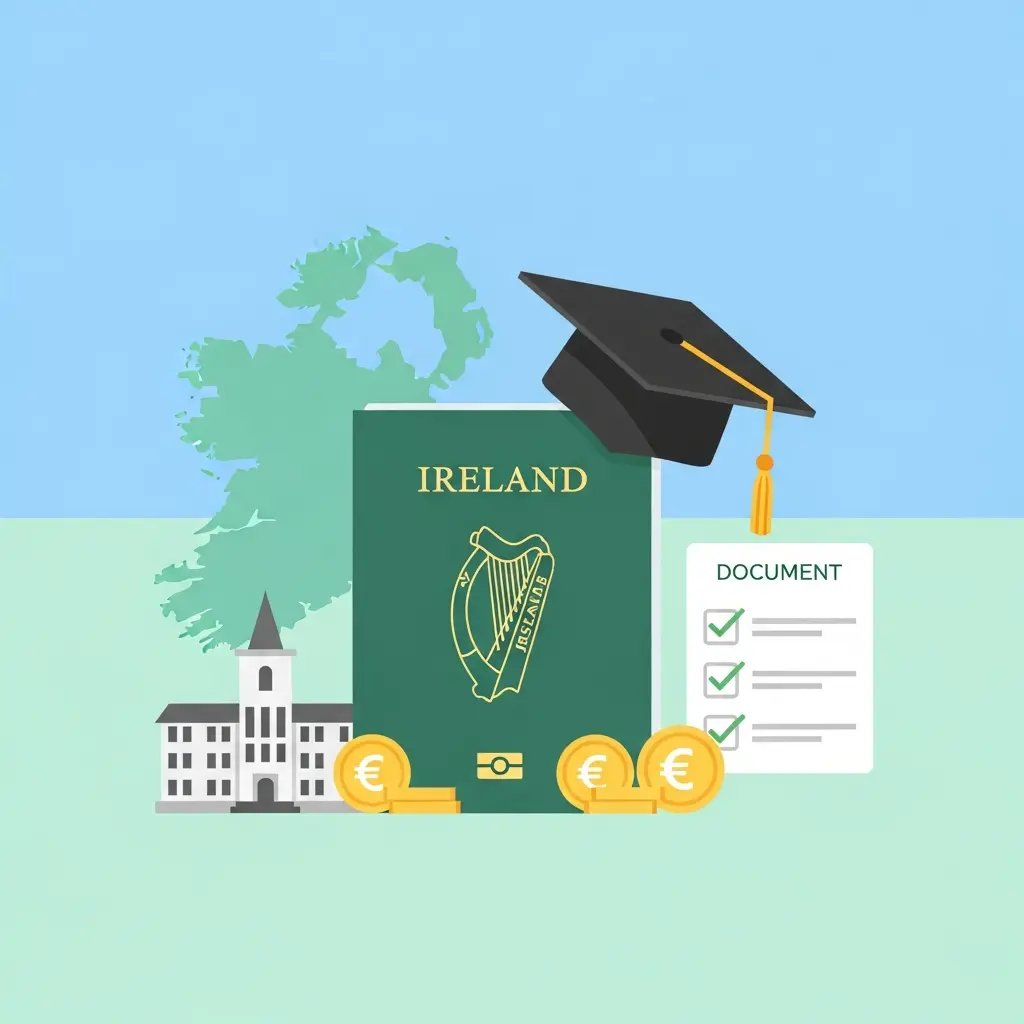
Ireland Study Visa 2026: Stamp 2, Funds, and Post-Study Work Pathway
Ireland attracts more than 30,000 non-EEA international students each year, drawn by its English-speaking environment, top-ranked universities such as Trinity College Dublin and University College Dublin, and one of the most generous post-study work pathways in the English-speaking world. If you are planning to study in Ireland in 2026, understanding the Ireland study visa guide — from the long-stay D visa through to the Stamp 1G graduate permission — is the single most important piece of admin you will complete before boarding your flight. Get it wrong and you risk refused entry, a void IRP card, or losing your right to work part-time. Get it right and you unlock a clear, structured route from student to skilled worker to permanent resident.
This guide covers every stage: whether you need a D visa at all (many English-speaking nationalities do not), how to prove the right amount of funds, which courses qualify under the ILEP and TrustEd frameworks, how Stamp 2 governs your daily life in Ireland, and what the Third Level Graduate Programme (Stamp 1G) offers when you finish your degree. All figures and rules are taken from official Immigration Service Delivery (ISD) sources and verified for 2026. If you are weighing Ireland against the Pacific, our New Zealand student visa 2026 guide covers the Fee Paying Student Visa in equivalent depth. To understand how your postgraduate qualification could lead to further funding, see our ranking of the best postdoc fellowships for 2026.
Non-EEA students studying in Ireland for more than 90 days need a Long Stay D Visa (unless visa-exempt) plus an Irish Residence Permit (IRP) with Stamp 2. You must show €10,000 in accessible funds for stays over 8 months, enrol on an ILEP/TrustEd-listed course, and pay €300 to register. You may work 20 hours/week in term and 40 hours/week in holidays. After graduation, Level 8 graduates can stay 12 months job-seeking on Stamp 1G; Level 9/10 graduates can stay up to 24 months.
1. Who Needs a D Visa — and Who Is Exempt
The first question every prospective Ireland student needs to answer is whether they require a Long Stay D Visa before they travel. Ireland operates a national visa list that is separate from the UK and Schengen systems — being visa-free for one does not mean you are visa-free for Ireland.
Visa-exempt nationalities (no D visa required): Citizens of the United States, Canada, Australia, New Zealand, and the United Kingdom do not need to apply for a D visa before travelling to Ireland to study. They may enter as normal and simply register with Immigration Service Delivery (ISD) within 90 days of arrival to receive their IRP card stamped with Stamp 2.
Visa-required nationalities: All other non-EEA/Swiss nationals — including citizens of India, China, Pakistan, Brazil, Nigeria, and most other non-EU countries — must apply for a Long Stay D Visa before travelling. Without it, they will be refused entry at the border.
EU, EEA, and Swiss citizens have an unconditional right to study in Ireland and do not need any immigration permission. This guide covers non-EEA/Swiss students only.
2. Step 1 — Choose an ILEP or TrustEd-Listed Course
Before you apply for a visa or book a flight, confirm that your chosen course is on the Interim List of Eligible Programmes (ILEP) or offered by a provider holding the TrustEd Ireland quality mark. These are the two frameworks that make a course eligible for Stamp 2 sponsorship. Institutions not on either list cannot sponsor a student immigration permission — enrolment there will not support a valid IRP card.
The current ILEP, published by ISD, covers the following categories of programme:
- English Language Courses: Must last a minimum of 25 weeks and be delivered by an accredited English language school. Shorter English courses (under 25 weeks) are covered by Stamp 2A, not Stamp 2.
- Higher Education Programmes: Full-time degree, master’s, and PhD programmes at NFQ Levels 6 through 10. These include certificates (Level 6), ordinary degrees (Level 7), honours bachelor’s degrees (Level 8), master’s degrees (Level 9), and doctorates (Level 10).
- Professional and Foundation Programmes: Certain professional certification pathways and foundation year programmes that lead into recognized qualifications.
Minimum requirements for any eligible programme: full-time delivery, a minimum of 15 study hours per week, and a minimum course duration of 25 weeks for language courses or a full academic year for higher education.
You can verify your course and institution on the ILEP page on the ISD website. Always do this before paying any tuition deposit.
3. Step 2 — Meet the Proof-of-Funds Requirement
Financial proof is one of the most common reasons Ireland study visa applications are refused. The rules are specific, and visa officers look for traceable, accessible funds — not locked savings accounts or a large sum deposited days before the application.
Funds Required for the D Visa Application
| Stay Duration | Funds Required | Notes |
|---|---|---|
| More than 8 months | €10,000 | Most full academic year and degree programmes fall into this category |
| 8 months or less | €6,665 | Some English language courses and shorter professional programmes |
These figures represent living expenses only — they are separate from your tuition fees, which must also be evidenced as paid. Acceptable evidence of funds includes:
- Six months of original bank statements showing a consistent balance (not a single large recent deposit)
- An official sanction letter for an education loan from an approved bank
- Sponsor’s bank statements if a family member is funding your study, along with a signed sponsor declaration
Tuition Deposit Rules
You must show proof that you have paid your institution’s required tuition deposit. However, the ISD guidance is explicit: do not pay more than €6,000 in tuition fees before your D visa has been approved. If your visa is refused, fees paid above this threshold may be difficult to recover.
Funds at IRP Registration (Post-Arrival)
Separate from your visa application, ISD requires that you have at least €3,000 in an Irish bank account at the time of your IRP registration appointment. This is an additional requirement on top of the visa-stage funds evidence. You will need to open an Irish bank account on arrival — most students use AIB, Bank of Ireland, or a fintech such as Revolut or N26, though immigration officers prefer to see a traditional Irish bank account.
| Metric | Figure |
|---|---|
| Total non-EEA students enrolled | 44,500 (record high) |
| Year-on-year growth | +10% |
| Largest source country | India (~20% of enrolments) |
| Undergraduate / postgraduate split | ~50/50 (22,825 UG / 21,710 PG) |
| Consecutive years of record growth | 4th straight year |
Source: Higher Education Authority (HEA) / ICEF Monitor, March 2026
4. Step 3 — Apply for Your Long Stay D Visa (Visa-Required Nationals Only)
If you are a visa-required national, you must apply online through the Automated Visa Application and Tracking System (AVATS) at visas.inis.gov.ie before travelling. The process runs as follows:
- Complete the online AVATS form. Select “Long Stay D” as the visa category and “Study” as the purpose. You will need your passport details, intended course start date, institution name, and financial information.
- Print, sign, and date the application summary. Once submitted online, print the summary sheet generated by AVATS. This forms the cover page of your physical document package.
-
Assemble your document package. Required documents include:
- Signed AVATS application summary form
- Valid passport (at least 12 months beyond your intended arrival date)
- Two recent passport-style photographs
- Original letter of acceptance from an ILEP or TrustEd Ireland institution
- Proof of tuition deposit payment (official receipt from institution)
- Six months of original bank statements evidencing funds (€10,000 or €6,665 depending on course length)
- Accommodation proof (university-provided housing confirmation or signed rental agreement)
- Private medical insurance certificate covering a minimum of €25,000 for accidents and €25,000 for illness
- English language certificate (if applicable to your course)
- Cover letter explaining your reasons for studying in Ireland, your future plans, and your intention to return home
- Submit to the Irish embassy or consulate in your country of residence. Some countries use Visa Application Centres (VACs) operated by VFS Global. Check the ISD website for the submission address in your country.
- Pay the visa fee. Single-entry D visa: €60. Multiple-entry D visa: €100. These fees are non-refundable, even if your application is refused or withdrawn.
- Wait for a decision. Normal processing: 4 to 8 weeks. Peak season (May–August): expect delays. Apply at least 3 months before your intended departure date.
- Receive your visa sticker. A D visa sticker is placed in your passport. It shows the permitted entry period — typically valid for a single entry to Ireland to take up your studies.
5. Step 4 — Register for Your IRP and Stamp 2
All non-EEA/Swiss students studying for more than 90 days — whether they entered on a D visa or as a visa-exempt national — must register with Immigration Service Delivery and obtain an Irish Residence Permit (IRP) card bearing Stamp 2. This is your legal permission to be in Ireland, study, and work part-time. Do not leave it to the last minute: registration must be completed within 90 days of arrival.
Registration Process (2026)
-
Book your appointment online.
- Dublin: book through the Burgh Quay Registration Office online portal. Since January 2025, all Dublin registrations are centralised at Burgh Quay — do not attend local Garda stations in Dublin.
- Outside Dublin: register at your local Garda National Immigration Bureau (GNIB) station. Booking methods vary by station.
-
Prepare your documents for the appointment:
- Valid passport (with D visa sticker if you are a visa-required national)
- Original letter of enrolment from your ILEP/TrustEd institution
- Proof of accommodation (university housing letter or signed lease)
- Private medical insurance certificate (€25,000 accident / €25,000 illness minimum)
- Evidence of €3,000 in an Irish bank account (bank statement or letter)
- Payment of the €300 IRP registration fee by debit or credit card
- Attend your appointment in person. Biometric data (fingerprints and photo) are taken at the counter. Your passport is stamped and you receive a receipt.
- Receive your IRP card by post within approximately 5–10 working days. The card shows your name, nationality, Stamp 2 permission, and expiry date. Carry it at all times — employers and landlords will ask to see it.
6. Step 5 — Understand Your Stamp 2 Work Rights
Stamp 2 gives you the legal right to work part-time in Ireland without a separate employment permit. This is one of the most practically useful features of the Irish student permission, and it is worth understanding the exact rules to avoid breaching your permission conditions.
Work Hours at a Glance
| Period | Maximum Hours/Week | Dates |
|---|---|---|
| Academic term | 20 hours | During active university term weeks |
| Summer holiday | 40 hours | 1 June – 30 September |
| Christmas holiday | 40 hours | 15 December – 15 January |
Before you can start any paid employment, you need two things in place:
- A valid IRP card bearing Stamp 2 — your employer must see this before your first shift
- A Personal Public Service (PPS) number — Ireland’s tax identification number, applied for at your local Intreo Centre or DSP office
What Stamp 2 does not permit: self-employment of any kind, full-time work outside designated holiday periods, access to social welfare or public benefits, and working beyond the 20/40-hour caps. Breaching these conditions can result in your permission being revoked and a future immigration ban.
7. Step 6 — Renewing Stamp 2 Each Year
Stamp 2 is typically granted for one academic year at a time, aligned with your course enrolment. You must renew it before it expires — usually in August or September before each new academic year. Renewal works through the same IRP registration appointment system and costs another €300 per person.
To renew successfully you will need to show:
- Your current (expiring) IRP card
- A letter from your institution confirming you are progressing academically and re-enrolling for the next year
- Proof of tuition fees paid for the new academic year
- Evidence of accommodation
- Continuing private medical insurance
- Up-to-date financial evidence
Annual academic progression is required. ISD will not renew Stamp 2 for a student who has failed to progress — for example, repeating the same year of study without a valid reason. Plan your academic workload accordingly.
Maximum duration on student permission: The general limit is 7 years of cumulative student immigration permission in Ireland (8 years for Level 9/10 graduates who subsequently take up the Stamp 1G graduate scheme). This cap prevents indefinite renewal of student status.
8. Step 7 — The Third Level Graduate Programme (Stamp 1G)
The Third Level Graduate Programme is Ireland’s post-study work pathway for non-EEA graduates of recognised Irish institutions. It grants Stamp 1G immigration permission — allowing you to remain in Ireland and seek graduate-level employment after you finish your degree. This is one of the most compelling features of the Ireland study visa guide for students weighing up study destinations.
Duration by Qualification Level
| Qualification | NFQ Level | Stamp 1G Duration |
|---|---|---|
| Honours Bachelor’s Degree | Level 8 | Up to 12 months |
| Master’s Degree | Level 9 | Up to 24 months |
| Doctoral Degree (PhD) | Level 10 | Up to 24 months |
Level 9 and Level 10 graduates receive their 24 months in two tranches: an initial 12-month grant, followed by a renewable further 12 months on presentation of evidence that you are actively seeking qualified employment.
Eligibility Conditions
- You must hold a current Stamp 2 permission and a valid, up-to-date IRP card at the time of application
- You must apply within 6 months of being formally notified in writing by your institution that you have achieved your award
- Your award must have been notified on or after 1 January 2017
- You must not have previously exceeded the seven-year cumulative student permission limit (eight years for Level 9/10)
- The programme can be accessed a maximum of twice during your student career in Ireland
What Stamp 1G Allows You to Do
On Stamp 1G you can work full-time — up to 40 hours per week — without needing an employment permit. This is a significant upgrade from Stamp 2. You remain ineligible for self-employment and social welfare, but you can take on any salaried or contracted role while you search for a position that qualifies for an employment permit.
How to Apply
- Receive your official results notification letter from your institution
- Apply online through the ISD portal within 6 months of that letter
- Upload: valid passport, IRP card, Statement of Final Results, private medical insurance certificate (minimum €25,000 hospital coverage)
- Pay the €300 registration fee online
- Processing typically takes 3–5 weeks; your new IRP card is delivered by post within 10–15 working days of approval
9. Step 8 — From Stamp 1G to Employment Permit and Beyond
Stamp 1G is a bridge, not a destination. While it gives you up to 24 months to secure employment, your ultimate goal is to transition to a work-based immigration permission that offers long-term stability. The two main routes are:
Critical Skills Employment Permit
Ireland’s Critical Skills Employment Permit (CSEP) is available for roles on the Critical Skills Occupations List — currently dominated by technology, engineering, healthcare, and finance roles. To qualify you need a job offer at a minimum annual salary threshold (currently €32,000 for roles on the occupations list, or €64,000 for all other occupations). After two years on a CSEP your employer can apply for Stamp 4, which removes the need for any employment permit and is a key step toward permanent residence and citizenship.
General Employment Permit
For roles not covered by the Critical Skills list, the General Employment Permit is the standard route. It requires a job offer, an approved employer, and evidence that the role was advertised domestically (the labour market needs test). It takes longer to transition from than the CSEP but covers a broader range of occupations.
Residence and Citizenship Timeline
Time spent lawfully in Ireland on student permission and Stamp 1G counts as reckonable residence toward Irish citizenship by naturalisation. The standard requirement is 5 years of legal residence in Ireland (with certain specific periods required close to the application date). For students who spend 3–4 years studying and 1–2 years on Stamp 1G before securing an employment permit, citizenship naturalisation becomes a realistic long-term horizon.
10. Full Cost Summary for 2026
Here is a consolidated breakdown of every government fee and financial requirement you will encounter on the Ireland student immigration pathway:
| Item | Amount | Who Pays |
|---|---|---|
| Long Stay D Visa (single entry) | €60 | Visa-required nationals only |
| Long Stay D Visa (multiple entry) | €100 | Visa-required nationals only |
| IRP registration (Stamp 2) — first year | €300 | All non-EEA students |
| IRP renewal (each subsequent year) | €300 | All non-EEA students |
| Stamp 1G graduate permission | €300 | Qualifying graduates |
| Proof of funds — stays over 8 months | €10,000 | Must be held (not paid out); for visa application evidence |
| Proof of funds — stays 8 months or less | €6,665 | Must be held; for visa application evidence |
| Irish bank account at IRP registration | €3,000 | Required at IRP appointment — separate from visa funds evidence |
| Tuition deposit (max before visa approval) | €6,000 | Pay no more than this until D visa is approved |
| Private medical insurance (minimum) | €25,000 accident / €25,000 illness | Required throughout student stay |
For broader context on how Ireland compares to other destinations on total study costs, see our guide to the cheapest countries to study abroad in 2026, and our comparison of post-study work visa options by country. The broader context for international student planning — including visa timelines, language requirements, and scholarship pathways — is covered in our complete studying abroad guide for 2026. If you are considering competing destinations, our Australia student visa subclass 500 guide and the Canada study permit guide for 2026 cover those pathways in equivalent depth.
Frequently Asked Questions
How much money do I need to show for an Ireland study visa in 2026?
You must demonstrate access to €10,000 for stays over 8 months, or €6,665 for stays of 8 months or less. These funds must be in accessible accounts — locked savings do not qualify. You must also show that your tuition deposit has been paid (up to €6,000 before visa approval). Separately, you must have €3,000 in an Irish bank account at the time of your IRP registration appointment after arrival.
Do US, Canadian, Australian, and UK citizens need a D visa for Ireland?
No. Citizens of the USA, Canada, Australia, New Zealand, and the United Kingdom are visa-exempt and can travel to Ireland without obtaining a D visa in advance. However, all non-EEA/Swiss nationals studying for more than 90 days must still register with Immigration Service Delivery within 90 days of arrival to receive their IRP card with Stamp 2. The €300 registration fee and document requirements apply equally to visa-exempt nationals.
How many hours can I work on a Stamp 2 student visa in Ireland?
You can work up to 20 hours per week during academic term time. During designated holiday periods — 1 June through 30 September, and 15 December through 15 January — you may work up to 40 hours per week. The limit applies across all jobs combined. Self-employment and access to social welfare are not permitted on Stamp 2. You need a valid IRP card and a PPS number before starting work.
What is the Third Level Graduate Programme (Stamp 1G) in Ireland?
The Third Level Graduate Programme grants Stamp 1G permission to non-EEA graduates of recognised Irish institutions. Level 8 (bachelor’s) graduates receive up to 12 months; Level 9 (master’s) and Level 10 (PhD) graduates receive up to 24 months. During this period you can work full-time — up to 40 hours per week — without needing an employment permit, while seeking a position that qualifies for a Critical Skills or General Employment Permit. Apply within 6 months of receiving your official results notification. Fee: €300.
What courses qualify for Stamp 2 in Ireland?
Your course must be listed on the Interim List of Eligible Programmes (ILEP) or offered by a provider holding the TrustEd Ireland quality mark. Eligible types include English language courses of at least 25 weeks, and higher education programmes at NFQ Levels 6–10 (certificate through PhD). The course must be full-time, involve at least 15 hours of study per week, and run for a minimum of 25 weeks (language) or a full academic year (higher education). Verify your course on the ISD website before paying any deposit.
How long does it take to process an Ireland student D visa?
Processing normally takes 4 to 8 weeks. During peak season (May to August) delays are common and processing can extend beyond 8 weeks. Apply at least 3 months before your intended travel date to avoid disruption. Visa-exempt nationals (US, Canada, Australia, NZ, UK) skip this step entirely and register with ISD after arriving in Ireland.
Write Your Thesis While in Ireland
Whether you are finishing a master’s dissertation on Stamp 2 or drafting your PhD thesis during your Stamp 1G graduate period, Tesify helps you structure, write, and cite your academic work faster — leaving more time for work experience, networking, and applications. Use the built-in Plagiarism Checker to ensure your submission meets your university’s originality standards before the deadline.
Write your thesis with AI
Structure, draft, cite, and format your thesis faster with Tesify’s AI writing tools, automatic bibliography, and plagiarism checker. Free to start, no credit card required.





Leave a Reply