
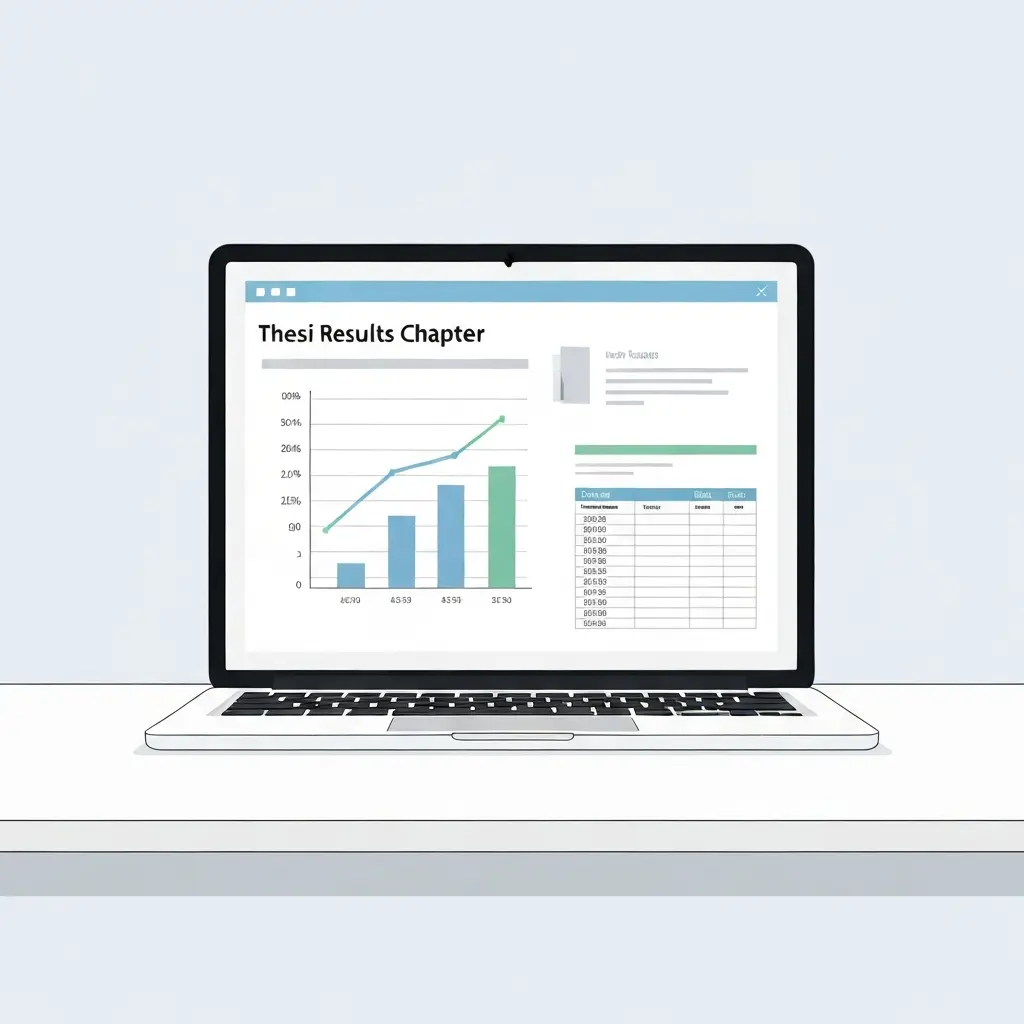
How to Write a Thesis Results Chapter Step by Step in 2026 (With Tables and Figures)
The results chapter is the chapter most students dread — not because the research is difficult, but because the writing rules are strict and surprisingly easy to break. You have spent months collecting data. Now you must present it clearly, objectively, and with properly formatted tables and figures, without slipping into interpretation. That single rule — report findings, do not discuss them — trips up a large proportion of thesis writers at every level, from undergraduate dissertations to doctoral theses. This guide walks you through how to write a thesis results chapter step by step, covering everything from deciding your organisational structure to captioning a figure correctly under APA 7th edition.
What Belongs in the Results Chapter (and What Does Not)
Before writing a single sentence, it is worth being precise about the chapter’s scope. The results chapter has one job: to describe what you found. It does not explain why you found it, how it compares to prior literature, or what it means for theory or practice. Those tasks belong to the discussion chapter.
A useful rule of thumb: if you find yourself writing “this suggests that” or “this is consistent with Smith (2021)”, you have crossed into discussion territory and should delete the sentence or move it. The results chapter is a factual record, not an argument. For a full treatment of where that boundary lies — and what each chapter is expected to do on its own — see the guide to discussion vs conclusion chapter differences.
What to include
- Responses to each research question or hypothesis, addressed in the same order they were introduced in the methodology
- Descriptive statistics (means, standard deviations, frequencies, percentages)
- Inferential statistics with exact p-values, confidence intervals, and effect sizes
- Tables and figures that present data more efficiently than prose alone
- Qualitative findings organised by theme, category, or case
- A brief reminder of participant numbers and data collection context (one or two sentences, not a full methodology recap)
What to exclude
- Interpretation of why results occurred
- Comparison with previous studies
- Recommendations or implications
- Raw data dumps (use appendices instead)
- Methodology details already covered in the preceding chapter
Step 1: Choose Your Organisational Structure
The single biggest structural decision you will make is how to order your findings. There are two dominant approaches, and the right choice depends on your research design.
By research question or hypothesis (quantitative research)
This is the standard approach for quantitative dissertations. Each subsection addresses one research question or tests one hypothesis, in the same sequence used in your introduction and methodology. The reader can follow the logical thread from question to finding with no effort. Supervisors and examiners strongly prefer this structure because it makes the thesis easy to audit.
Example structure for a quantitative study examining three hypotheses:
- 4.1 Descriptive statistics and sample characteristics
- 4.2 Hypothesis 1: [statement] — results of [test name]
- 4.3 Hypothesis 2: [statement] — results of [test name]
- 4.4 Hypothesis 3: [statement] — results of [test name]
By theme or pattern (qualitative research)
For qualitative studies using approaches such as thematic analysis, grounded theory, or phenomenological inquiry, findings are naturally organised around the themes or categories that emerged from analysis. Each theme gets its own subsection, with supporting evidence in the form of direct participant quotations. For a deeper look at thematic coding workflows, the complete guide to thematic analysis covers the six-phase process from familiarisation through to final theme definition.
By research instrument or data source (mixed methods)
Mixed methods theses often present quantitative and qualitative results in separate, clearly labelled subsections before integrating findings in the discussion. Keep the two strands distinct here — integration is a discussion-chapter task.
Step 2: Draft the Narrative Text
Every results chapter needs a connecting narrative — prose that guides the reader from one finding to the next. The text does three things for each finding: it points the reader to the relevant table or figure, summarises the most important values, and states whether the result supported or did not support the hypothesis (for quantitative work) or identifies the theme’s central finding (for qualitative work).
Opening paragraph
Open the chapter with one short paragraph that reminds the reader of the overall study purpose and the number of participants or data sources. Do not restate your methodology in detail — one sentence is enough. For example: “This chapter reports the results of the survey completed by 187 undergraduate students (104 female, 83 male; mean age 21.4 years, SD = 2.1) across four UK universities.”
Pointing to tables and figures
Always introduce a table or figure in the text before it appears. Use the label: “Table 3 presents the descriptive statistics for all study variables” or “As shown in Figure 2, response rates declined sharply after the second follow-up.” Never place a table or figure in your chapter without a preceding textual reference — this is a formatting error that examiners notice immediately.
What to highlight in prose vs. what to leave in the table
A common error is repeating every number from a table in the running text. Highlight only the most significant values in prose; let the table carry the full dataset. For a regression table with eight predictors, for example, name the two or three with the largest effect sizes in the text and direct the reader to the table for the complete output.
Step 3: Design and Format Your Tables
Tables are the most efficient way to present precise numerical data, particularly when you have multiple variables, groups, or time points. The key formatting decisions are numbering, title placement, line rules, and notes.
APA 7th edition table formatting rules
Under APA 7th edition, which is the dominant standard in social sciences, psychology, and health research, tables follow these rules:
| Element | Rule |
|---|---|
| Table number | Bold, above the title. Number sequentially (Table 1, Table 2) or by chapter (Table 3.1, Table 3.2). |
| Table title | Italicised, title case, on the line below the table number. |
| Borders | Top and bottom borders plus border below column headings only. No vertical lines. No borders between data rows. |
| Notes | Below the table. “Note.” in italics followed by general notes, specific notes (superscript letters), then probability notes (asterisks). |
| Alignment | Left-align text columns; right-align or centre numerical columns. Decimal points must align vertically. |
When to use a table vs. when to use prose
Use a table when you have four or more numbers to present and when the exact values matter. Use prose when you have only two or three numbers — a sentence is cleaner than a two-row table. The APA 7th edition format guide covers these conventions in full for every source and data type.
Numbering conventions
Choose one of two systems and apply it consistently throughout your thesis: either sequential numbering across the entire document (Table 1, Table 2, … Table 17) or chapter-based numbering (Table 3.1, Table 3.2). According to the University of British Columbia’s graduate thesis formatting guidelines, whichever approach you select, the numbering style must be the same for all numbered items — tables, figures, and appendices alike.
Step 4: Create and Caption Your Figures
Figures — charts, graphs, scatterplots, diagrams, photographs, and flow charts — are placed differently from tables. The key distinction: the table title goes above the table, while the figure caption goes below the figure.
APA 7th edition figure formatting rules
- Figure number: Bold, below the figure. “Figure 1.” followed by the caption in the same paragraph.
- Figure caption: Italicise the title portion only. Any additional description follows in plain text.
- Example: Figure 2. Mean anxiety scores across three time points for the intervention and control groups. Error bars represent 95% confidence intervals.
- Colours and patterns: If your thesis will be printed in black and white, design figures with patterns or line styles rather than colours alone. Examiners increasingly expect this accessibility consideration.
- Resolution: Minimum 300 dpi for rasterised images. Vector formats (SVG, EMF) scale without quality loss.
Choosing the right figure type
| Data type | Best figure type | Avoid |
|---|---|---|
| Group comparisons (means) | Bar chart with error bars | 3D bar charts (distort proportions) |
| Correlation / relationship | Scatterplot with regression line | Line chart (implies continuity) |
| Change over time | Line chart | Bar chart (obscures trends) |
| Proportions / composition | Stacked bar or pie chart | Exploded pie (hard to read) |
| Process or model | Flow diagram or path diagram | Decorative clipart graphics |
List of figures and tables
Any thesis with more than a handful of tables and figures should include a dedicated List of Figures and List of Tables immediately after the Table of Contents. These lists help examiners navigate your data quickly. In Microsoft Word, these are generated automatically using Insert > Table of Figures once you have applied consistent caption styles throughout the document. This is one of the formatting tasks where the complete step-by-step thesis writing guide provides a full walkthrough including style-sheet setup.
Step 5: Report Statistics Correctly
Incorrect or incomplete statistical reporting is one of the most common reasons examiners request revisions. The standard for most social science and health theses in 2026 is APA 7th edition statistical notation, which requires the following for every inferential test.
The four-piece formula for every test result
Every inferential result must include: (1) the test statistic and its degrees of freedom, (2) the exact p-value, (3) an effect size measure, and (4) a confidence interval where applicable. Reporting “p < .05” without an exact value is not acceptable under current APA guidelines. Write exact values: p = .032, not p < .05.
Example reporting templates
Independent samples t-test:
A significant difference was found between Group A (M = 42.3, SD = 8.1) and Group B (M = 37.6, SD = 9.4), t(184) = 3.41, p = .001, d = 0.53, 95% CI [1.99, 7.41].
One-way ANOVA:
There was a significant main effect of condition on task performance, F(2, 147) = 8.93, p < .001, η² = .11.
Chi-square test:
A chi-square test of independence revealed a significant association between degree subject and employment outcome, χ²(3, N = 312) = 14.72, p = .002, V = .22.
Worked example: from SPSS output to APA sentence
Raw SPSS output is not dissertation-ready. Consider a student comparing exam scores for a mindfulness intervention group (n = 45, M = 74.2, SD = 9.8) against a control group (n = 45, M = 68.5, SD = 11.3). SPSS returns: t = 2.71, df = 88, Sig. (2-tailed) = .008. That output alone is incomplete. The correct dissertation sentence requires three additional steps:
- Calculate pooled SD and Cohen’s d: SDpooled = √[((44 × 9.8²) + (44 × 11.3²)) / 88] ≈ 10.57; d = (74.2 − 68.5) / 10.57 = 0.54 (medium effect).
- Obtain the 95% CI for the mean difference from SPSS’s “Equal Variances Assumed” row: [1.56, 9.84].
- Write the APA sentence: “Intervention group students scored significantly higher on the exam than control group students, t(88) = 2.71, p = .008, d = 0.54, 95% CI [1.56, 9.84].”
Note what this sentence includes and what it omits: the means and SDs belong in the preceding descriptive statistics table, not in this sentence. The inferential sentence carries only the test outcome. This separation keeps your prose clean and ensures the table does the work it was designed to do.
Effect sizes matter as much as p-values
A statistically significant result does not automatically mean a practically meaningful result. Always pair your p-value with an effect size (Cohen’s d for t-tests, η² or ω² for ANOVA, r for correlation, V for chi-square). Confidence intervals communicate the precision of your estimate and are now required in most university guidelines. For a comprehensive explanation of how to choose, calculate, and interpret these measures — including the exact APA 7th reporting syntax — see the dedicated guide to effect size and confidence intervals.
Descriptive statistics first, then inferential
Always present descriptive statistics — sample sizes, means, standard deviations, frequencies — before reporting inferential tests. This lets the reader understand the raw data before being told what to conclude from it. A descriptive statistics table for all main variables, placed at the start of the results section, is standard practice in quantitative dissertations.
Step 6: Presenting Qualitative Results
Qualitative results chapters work differently. Instead of tables of numbers, your evidence comes from participant quotations, field note excerpts, and document extracts. The structure is theme-based rather than hypothesis-based, and the writing tends to be richer and more interpretive in tone — though you should still aim to hold interpretation back for the discussion wherever possible.
Structure each theme subsection clearly
For each theme, follow a three-part structure: (1) name and introduce the theme with a one-sentence definition, (2) present two or three representative quotations with participant identifiers (e.g., “Participant 7, female, aged 28”), and (3) describe the pattern across the dataset — how many participants expressed this theme, and in what contexts it arose.
Formatting quotations
Short quotations (fewer than 40 words in APA style) are integrated into the sentence with quotation marks. Longer quotations are presented as indented block quotes. Identify every quotation with a pseudonym or code (never a real name) and remove or replace any identifying details. If you have omitted words from a quotation for clarity, mark the omission with an ellipsis: “The process was … completely overwhelming by the third month.”
Tables in qualitative results
Tables are useful in qualitative chapters too. A theme summary table listing each theme, its definition, and the number of participants who referenced it gives examiners a clear overview before they encounter the full evidence. A table of participant demographics placed at the start of the chapter is also standard practice.
Qualitative vs. quantitative: when to combine
Mixed methods theses often combine both types within the same results chapter. The safest approach is to present them in separate labelled subsections (4.1 Quantitative Results, 4.2 Qualitative Results) and leave the integration to the discussion. Qualitative research methods, from interview design through to thematic analysis and saturation, are covered in depth in the complete qualitative research methods guide.
Step 7: Review and Polish
Before submitting your results chapter for supervisor review, run through this checklist.
Results chapter self-review checklist
- Every table and figure is mentioned in the text before it appears
- Table titles are above tables; figure captions are below figures
- Numbering is sequential and consistent throughout (no “Figure 3a” appearing before “Figure 3”)
- Every inferential test reports a test statistic, degrees of freedom, exact p-value, effect size, and confidence interval
- No interpretation, comparison with literature, or recommendations appear
- Qualitative quotations are anonymised and formatted consistently
- A List of Tables and List of Figures is in place after the Table of Contents
- All statistical notation follows the same style (APA, Vancouver, or your institution’s preferred guide) throughout
- Decimal places are consistent (e.g., always two decimal places for means)
- The chapter addresses every research question or hypothesis stated in your introduction
Before the results chapter was written, you should have established the theoretical lens through which your data will later be interpreted. The step-by-step guide to writing a theoretical framework explains how the concepts defined there link back to the research questions your results chapter addresses.
Common Mistakes to Avoid
Interpreting results in the results chapter
This is the most frequent examiner comment. The moment you write “this finding suggests that students who struggle with self-regulation benefit from structured feedback”, you have crossed into the discussion. The results chapter should say: “Students in the structured-feedback condition scored significantly higher on the self-regulation scale than students in the control condition.” Save the “why” and “what it means” for the discussion.
Duplicating data between tables and text
Do not write “The mean score for Group A was 42.3 (SD = 8.1) and for Group B was 37.6 (SD = 9.4)” if those exact figures are already in Table 2. Direct the reader to the table instead: “Table 2 presents the descriptive statistics for both groups.” Duplication adds word count without adding clarity.
Presenting every single result, no matter how trivial
You do not need to report every statistic you calculated. Focus on the results that directly address your research questions. Non-significant control variable checks, for example, can often be moved to an appendix with a brief textual note in the main chapter.
Inconsistent table and figure numbering
Renumbering late in the writing process is a common source of errors — examiners frequently find references to “Table 5” that should be “Table 4” because a table was deleted. Use Word’s built-in caption tool or LaTeX’s label and ref system so numbers update automatically when you add or remove items. The step-by-step guide to writing a thesis with AI covers automation tools, including how AI-assisted drafting environments handle cross-referencing.
Using screenshots instead of native tables
Software output — SPSS tables, R console output, NVivo matrices — should be reformatted as native Word or LaTeX tables, not pasted as images. Screenshots are not accessible, do not reflow on different page sizes, and typically do not meet university formatting standards. Extract the relevant values and reproduce them in a clean, consistently formatted table.
Write Your Results Chapter Faster with Tesify
Tesify is an AI platform built specifically for thesis and dissertation writing. Its structured chapter workflows help you draft results sections with proper statistical notation, generate compliant table templates, and check for interpretation creep before your supervisor sees it.
Frequently Asked Questions
Can the results and discussion be combined in one chapter?
Yes, in some disciplines and for some study designs this is acceptable and even preferable. Qualitative studies — particularly those using ethnographic, phenomenological, or case study approaches — often benefit from a combined results and discussion because interpretation is inseparable from the description of findings. Quantitative and mixed methods theses in social sciences and health research conventionally keep the two chapters separate. Always check your institution’s thesis guidelines and discuss it with your supervisor before choosing the combined format.
How long should the results chapter be?
There is no universal word count rule for the results chapter. As a rough guide, quantitative results chapters in a master’s dissertation of 15,000–20,000 words typically run to 2,000–4,000 words, excluding tables and figures. Qualitative results chapters tend to be longer because participant quotations take up significant space. At PhD level, results chapters can run to 8,000–12,000 words or more in data-heavy empirical studies. What matters is completeness — every research question must be addressed — not hitting a target word count.
Do all tables and figures need to follow APA format?
It depends on your institution and discipline. APA 7th edition is the standard in psychology, social sciences, and many health disciplines. STEM fields more commonly follow the conventions of IEEE, Vancouver, or a discipline-specific style. Humanities theses often use Chicago or MLA. What every institution requires, regardless of style, is consistency — all tables and figures in your thesis must follow the same formatting conventions throughout. Check your university’s postgraduate thesis guidelines for the mandated style, and if no style is specified, APA 7th edition is a safe default.
What is the difference between a table and a figure in a thesis?
In APA style, a table presents information in rows and columns, typically containing exact numerical values or structured text. A figure is any other visual display — a chart, graph, diagram, photograph, map, or conceptual model. The practical formatting difference is the most important one to remember: table numbers and titles appear above the table, while figure numbers and captions appear below the figure. Both types must be numbered sequentially, referenced in the text before they appear, and formatted consistently throughout the document.
Do I need to report non-significant results?
Yes, non-significant results must be reported for every research question or hypothesis you stated. Selective reporting — presenting only positive findings — is considered a breach of research integrity and will be identified during examination. Report non-significant results with the same detail as significant ones: include the test statistic, degrees of freedom, exact p-value, and effect size. You do not need to draw attention to them in the narrative text, but they must be present and complete.
Should I include raw data in the results chapter?
No. Raw data — individual survey responses, full interview transcripts, complete datasets — belongs in appendices, not in the results chapter. The results chapter summarises and analyses the data; it does not reproduce it wholesale. Include a note in the chapter directing readers to the relevant appendix if they want to inspect the raw data, and check whether your institution requires the full dataset to be deposited in an institutional repository as part of the thesis submission process.
Write your thesis with AI
Structure, draft, cite, and format your thesis faster with Tesify’s AI writing tools, automatic bibliography, and plagiarism checker. Free to start, no credit card required.




Leave a Reply