
How to Structure a PhD Thesis Step by Step in 2026
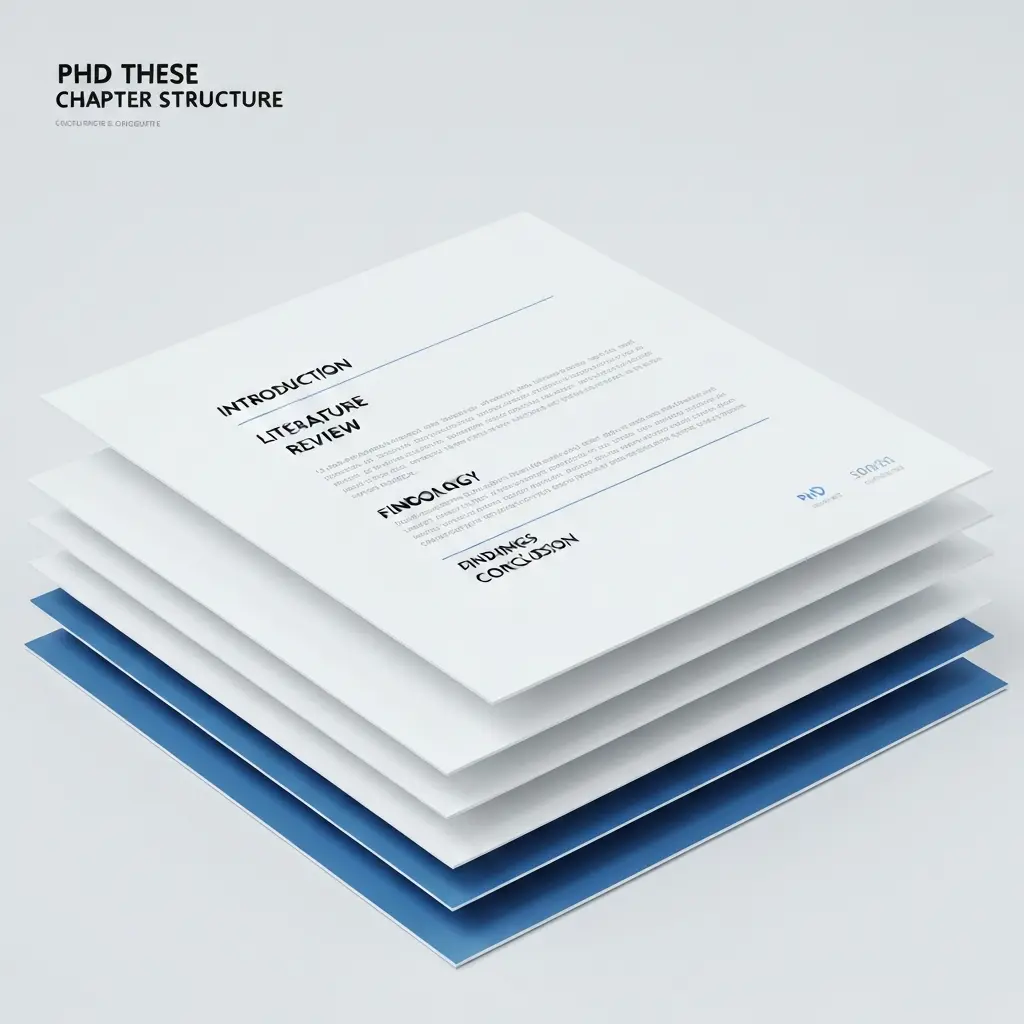
Understanding how to structure a PhD thesis step by step is one of the most important questions a doctoral candidate can ask — and one of the most consistently misunderstood. A PhD thesis is not simply a long essay. It is a sustained, formal argument that demonstrates original contribution to knowledge, executed through a logically organised sequence of chapters, each of which serves a distinct function in the overall scholarly architecture.
The stakes are high. Examiners do not just read a PhD thesis — they interrogate it. They look for coherence between the research questions, the methodology, the findings, and the contribution claimed. A strong structure makes that coherence visible; a weak structure conceals it, creating ambiguity about what your research actually established. In a viva, structural weakness is one of the most common sources of major correction requests.
This guide gives you the standard PhD thesis structure, explains the function of every component, provides word count guidance for each chapter, and flags the most common structural errors that examiners report in their feedback.
Before You Start: Know Your Institution’s Requirements
Before you write a single chapter, download your institution’s PhD thesis guidelines. Every university specifies formatting requirements (font, margin, line spacing, binding), word count limits, and — in some cases — structural requirements or approved variations. Some institutions also have discipline-specific norms that supersede the generic structure described here.
This guide describes the standard five-to-six chapter model used in most social sciences, humanities, and many STEM programmes. If your discipline uses a thesis-by-publication format, an integrated chapter model, or a laboratory science structure (with separate Results and Discussion chapters), the specific chapters differ — but the logic of each component remains the same.
Step 1: Front Matter
Front matter appears before Chapter 1. It is strictly ordered and each element serves a defined purpose.
Title Page
Your title page must include: the full title of the thesis, your full name, the degree being sought (Doctor of Philosophy), the name of your institution and department, and the year of submission. Some institutions also require the word count and a brief statement of originality on the title page. Follow your institution’s template exactly — this is not a page for creative expression.
Abstract
The abstract is a standalone summary of your entire thesis — typically 300–500 words. It should briefly describe your research problem, the gap you are addressing, your methodology, your main findings, and your contribution to knowledge. It is the most-read part of your thesis and the only part many readers will encounter. Write it last, after the thesis is complete. For a detailed guide, see our walkthrough on how to write an abstract for your thesis.
Acknowledgements
A brief section thanking supervisors, participants, funding bodies, and colleagues. Typically one page. Personal and warm in tone, but professional in register. Not a space for extensive personal narrative.
Table of Contents
Lists all chapters, sections, and subsections with corresponding page numbers. Include entries for all front matter that follows the table of contents, all body chapters and their major sections, and all back matter. Generate this automatically from heading styles in your word processor — manually typed tables of contents are an unnecessary source of error.
List of Figures / List of Tables
If your thesis contains figures or tables, include separate lists for each, showing item number, title, and page. Place these after the table of contents. Required when the thesis contains three or more figures or tables.
List of Abbreviations
Include if your thesis uses abbreviations or acronyms repeatedly. Define each abbreviation on its first use in the text as well as listing it here.
Step 2: Chapter 1 — Introduction
Typical word count: 4,000–8,000 words for a PhD thesis
Chapter 1 establishes the intellectual context and the scope of the thesis. It is not simply a preview of what follows — it is the chapter that persuades an examiner that your research question is significant and that your approach is coherent.
Key components: a hook that contextualises your topic broadly; background that provides the minimum necessary context; a literature gap statement that shows what is missing or contested; your rationale and significance; clearly stated aims, objectives, and research questions; a brief methodology overview; scope and delimitations; and a chapter outline.
For a full step-by-step guide to this chapter, see our detailed article on how to write a thesis introduction step by step.
Step 3: Chapter 2 — Literature Review
Typical word count: 8,000–15,000 words
Chapter 2 is your engagement with the scholarly field. It demonstrates that you have read widely, that you can critically evaluate existing research, and that you understand where the current state of knowledge leaves open questions that your thesis will address.
A strong literature review is organised thematically, not source-by-source. It synthesises — weaving multiple sources into coherent arguments — rather than summarising. It acknowledges theoretical tensions and methodological debates, not just consensus positions. And it ends with a clear statement of the gap your research fills.
For the full process, see our guide on how to do a literature review for your thesis.
Step 4: Chapter 3 — Methodology
Typical word count: 4,000–7,000 words
Chapter 3 explains and justifies every significant decision in your research design. It addresses your philosophical position, your research approach (inductive, deductive, or abductive), your strategy (case study, survey, experiment, etc.), your sampling, your data collection instruments, your analytical method, your ethical considerations, and your approach to validity and reliability.
The methodology chapter is written in past tense (for a completed thesis) and follows a clear logical progression: from philosophical assumptions through design decisions through specific procedures. Every choice must be justified with reference to the literature on research methods.
For detailed guidance, see our step-by-step article on how to write a research methodology chapter.
Step 5: Chapter 4 — Findings / Results
Typical word count: 8,000–15,000 words (varies significantly by discipline and method)
Chapter 4 presents what you found, without yet interpreting it in depth. In quantitative theses, this chapter presents descriptive and inferential statistics, typically supported by tables and figures. In qualitative theses, it presents thematic or other analytical findings, supported by data extracts (quotes, observations, document excerpts).
The key discipline: findings only. Do not mix findings and interpretation in the same paragraph. Save the “this means that…” language for the discussion chapter. This separation keeps your analysis auditable — examiners can distinguish between what your data shows and what you claim it means.
Use clear structural signposting throughout. Number and label all tables and figures. Each section of the findings chapter should correspond to one of your research questions or objectives, so the reader can track how each question is being answered.
Step 6: Chapter 5 — Discussion
Typical word count: 8,000–12,000 words
The discussion chapter is where you do your most sophisticated intellectual work. You interpret your findings, situate them in the context of the literature you reviewed in Chapter 2, explain unexpected results, and draw out the theoretical and practical implications of what you found.
Structure the discussion chapter so that it revisits your research questions in the same order they appeared in your introduction. For each finding, ask: Does this confirm, challenge, or refine existing theory? Why might it differ from (or align with) prior research? What mechanisms explain this pattern in the data?
Some disciplines (particularly in laboratory sciences and psychology) combine findings and discussion into a single chapter. If your discipline does this, follow suit — but maintain the logical separation between presentation of data and interpretation of data within the chapter.
Step 7: Chapter 6 — Conclusion
Typical word count: 3,000–6,000 words
The conclusion chapter is your opportunity to step back from the detail and answer the question your thesis set out to address. It should revisit your aims and objectives, summarise your key findings (without simply repeating the findings chapter), articulate your contribution to knowledge, acknowledge your limitations honestly, and propose directions for future research.
The contribution to knowledge section is the most critical part of the PhD conclusion. This is where you explicitly state what your thesis has added to the scholarly record — a new theoretical framework, an empirically tested model, a new methodological approach, a challenged assumption, or new evidence in an under-examined context. Be specific. “This study contributes to the literature on X” is not a contribution statement — it is a truism.
End the conclusion with a brief paragraph that returns to the opening of the introduction. This creates structural closure: you opened by establishing what was at stake, and you close by showing what has been achieved.
Step 8: Back Matter (References and Appendices)
Reference List
A complete, alphabetically ordered list of every source cited in the thesis. Format according to your discipline’s required citation style — APA 7th edition, Harvard, Chicago, or MLA. Every in-text citation must have a corresponding reference list entry, and every reference list entry must be cited at least once in the text. For APA formatting specifics, see our guide on how to cite sources in APA format step by step.
Appendices
Appendices contain material that supports the thesis but would disrupt the flow of the body chapters if included there: interview transcripts, survey instruments, data tables too large for the main text, ethics approval letters, participant information sheets, and supplementary analyses. Number appendices alphabetically (Appendix A, Appendix B) and reference them explicitly in the main text wherever relevant.
Word Count Guidance by Chapter
| Chapter | UK PhD (80–100k) | US PhD (60–80k) |
|---|---|---|
| Introduction | 6,000–8,000 | 5,000–7,000 |
| Literature Review | 10,000–15,000 | 8,000–12,000 |
| Methodology | 5,000–7,000 | 4,000–6,000 |
| Findings | 10,000–15,000 | 8,000–12,000 |
| Discussion | 10,000–12,000 | 7,000–10,000 |
| Conclusion | 4,000–6,000 | 3,000–5,000 |
These are approximations. Actual chapter lengths vary by discipline, the complexity of your research design, and the volume of your data. Qualitative studies often have longer findings and discussion chapters; quantitative studies with complex statistical models may have longer methodology chapters.
Discipline-Specific Variations
The model above is standard for social sciences, education, business, and many humanities disciplines. Other disciplines have important variations:
- Laboratory sciences (biology, chemistry, physics): Often use IMRaD format (Introduction, Methods, Results, and Discussion) with a separate discussion from results. The literature review may be shorter and integrated into the introduction.
- Thesis by publication: Used in some STEM and social science programmes. Body chapters are published or publishable papers, with a “kappa” (synthesis or umbrella chapter) framing the collection as a coherent research contribution.
- Creative practice PhDs: In arts and design programmes, a practical or creative work forms part of the thesis alongside a written exegesis.
- Law PhDs: May use doctrinal analysis rather than empirical research, with different chapter conventions for legal argumentation.
Always confirm with your supervisor which model your department expects before you commit to a structure. Restructuring a 70,000-word thesis after the first draft is possible but expensive in time.
Common Structural Mistakes
- Introduction that reads as a literature review. Background context and the gap analysis are different from a full literature review. Keep Chapter 1 focused on framing; let Chapter 2 do the depth.
- Literature review that is a catalogue. Summarising sources one by one without synthesis is the most common literature review failure. Organise by theme and argue throughout.
- Methodology that describes without justifying. Every methodological choice must be defended, not just named.
- Findings chapter that mixes data with interpretation. Present in findings; interpret in discussion. Mixing the two makes it impossible for examiners to evaluate your reasoning.
- Discussion that ignores the literature review. Your discussion should be in explicit conversation with the sources you reviewed in Chapter 2. If you are not citing them here, you have a structural problem.
- Conclusion that claims more than the evidence supports. Your contribution statement must be proportionate to what your research actually demonstrated.
- Inconsistency between chapters. Research questions stated in Chapter 1 must be answered in Chapters 4, 5, and 6. Aims stated in Chapter 1 must be addressed in Chapter 6. Examiners check this alignment explicitly.
Preparing for your viva is an important part of the final PhD process. Once your thesis is submitted, see our guide on how to prepare for your thesis defense. For the best tools to support your writing across all thesis chapters, see our comparison of best AI thesis writing tools in 2026.
If you are writing your PhD using Tesify Write, the platform’s chapter management features allow you to maintain cross-chapter consistency — tracking research questions from introduction through conclusion and flagging structural misalignments as you write. For Portuguese-speaking researchers, a localised version is available at tesify.pt.
Frequently Asked Questions
How many chapters should a PhD thesis have?
Most PhD theses have five to seven body chapters. The standard model includes six: introduction, literature review, methodology, findings, discussion, and conclusion. Some disciplines combine findings and discussion into one chapter, giving five. Laboratory sciences often use an IMRaD structure. Check your institution’s guidelines and discuss the structure with your supervisor before committing.
How long is a PhD thesis?
UK PhD theses are typically 80,000–100,000 words. US PhD dissertations tend to be 60,000–80,000 words. The humanities often allow longer theses; STEM disciplines often require shorter ones. Word count limits are set by your institution and are typically strictly enforced.
What is the difference between findings and discussion chapters?
The findings chapter presents what your data shows — without interpretation. The discussion chapter interprets those findings, situates them in the literature, explains unexpected results, and draws out implications. Keeping them separate makes your analysis auditable: examiners can evaluate whether your interpretations are justified by the data you have presented.
Do I write the thesis chapters in order?
Many experienced researchers recommend writing chapters in a non-linear order. A common sequence: first draft the methodology and findings (the most concrete parts), then write the literature review and discussion (which require the findings to be established), then write the introduction and conclusion last (which require the thesis to be complete to be written accurately).
What goes in the conclusion vs the discussion?
The discussion interprets specific findings in relation to the literature. The conclusion steps back from the findings to address the research aim as a whole, state the contribution to knowledge, acknowledge limitations, and recommend future research directions. The conclusion answers: “What did this thesis ultimately demonstrate and contribute?”
What should go in the abstract of a PhD thesis?
The abstract should cover: the research problem and its significance, the gap the research addresses, your methodology in brief, your main findings, and your contribution to knowledge. It should be 300–500 words and stand alone — a reader should understand the thesis from the abstract without reading anything else. Write it last, after all other chapters are complete.
Can I use AI tools to help structure my PhD thesis?
Yes, within your institution’s AI usage policy. Tools like Tesify Write can help you plan chapter structure, maintain consistency between your research questions and your analysis, and manage your reference list through Auto Bibliography. The intellectual work — original research, data collection, analysis, and argumentation — must remain yours. Always disclose AI assistance as required by your institution.
Structure and Write Your PhD Thesis with Tesify Write
Tesify Write is built for long-form academic writing. Plan your thesis structure, draft each chapter with a clear logical framework, track consistency between your research questions and your analysis, and let Auto Bibliography handle every citation. Whether you are at Chapter 1 or revising Chapter 6, Tesify keeps your thesis coherent.
Write your thesis with AI
Structure, draft, cite, and format your thesis faster with Tesify’s AI writing tools, automatic bibliography, and plagiarism checker. Free to start, no credit card required.






Leave a Reply