
How to Do Thematic Analysis Step by Step (Braun & Clarke’s 6 Phases, 2026)
You have finished collecting data — fifteen interview transcripts, or forty open-ended survey responses, or a stack of field notes — and now the harder question hits: what do you actually do with it? Thematic analysis is the answer most qualitative researchers reach for, and for good reason. It is flexible, transparent, and works across disciplines from psychology to education to public health. But “thematic analysis” means different things to different people, and doing it without a clear framework produces vague, unsupported themes that examiners flag in vivas immediately.
This guide walks you through how to do thematic analysis step by step using Braun & Clarke’s six-phase reflexive framework — the most widely cited version in academic research, first published in Qualitative Research in Psychology in 2006 and further developed in their 2022 Sage book. You will get a full worked example that runs through every phase, a decision fork for choosing between reflexive and codebook TA, practical software advice, and a template for writing it up in your methodology chapter.
What Is Thematic Analysis?
Thematic analysis is a qualitative method for identifying, analysing, and interpreting patterns of meaning — “themes” — across a dataset. Unlike content analysis, which counts frequency, or grounded theory, which aims to build new theory, thematic analysis focuses on capturing meaningful patterns in what participants say, write, or describe, then interpreting what those patterns reveal about the research question.
The foundational text is Braun and Clarke’s 2006 paper “Using thematic analysis in psychology” (Braun, V. & Clarke, V., Qualitative Research in Psychology, 3(2), 77–101), one of the most cited methodology papers in social science. Their 2022 book Thematic Analysis: A Practical Guide (Sage) expanded the reflexive approach and addressed common misunderstandings about how the method should be applied. The six-phase framework in both publications is the gold standard for academic thematic analysis in 2026.
Thematic analysis fits most naturally within an interpretivist or constructionist paradigm, though Braun and Clarke acknowledge it can be adapted across positions. If you are still deciding whether qualitative or quantitative methods best serve your question, the guide on qualitative versus quantitative research design covers that decision framework in detail.
Reflexive TA vs Codebook TA: Which Do You Need?
One of the most common confusions among dissertation students is treating “thematic analysis” as a single fixed method. Braun and Clarke distinguish between several TA traditions. The two most relevant for postgraduate research are reflexive TA and codebook TA:
| Feature | Reflexive TA | Codebook TA |
|---|---|---|
| Codebook / coding frame | None — codes emerge interpretively | Shared codebook, applied systematically |
| Typical user | Solo researchers, most dissertations | Research teams, multi-coder projects |
| Researcher role | Active co-constructor of meaning | Systematic applier of agreed codes |
| Inter-rater reliability | Not appropriate — contradicts the method’s epistemology | Expected — Krippendorff’s alpha or Cohen’s kappa |
| Epistemological home | Constructionist / interpretivist | Can span paradigms |
| Quality criteria | Reflexivity, trustworthiness, thick description | Consistency, reproducibility, reliability coefficients |
For most solo dissertation students, reflexive TA is the right choice. It does not require a second coder, it fits constructionist or interpretivist worldviews, and it is what most supervisors and examiners expect when students say “thematic analysis.” If your research involves a team of coders applying a shared frame — common in health services research or mixed-methods systematic content analysis — codebook TA is more appropriate, and you will need to calculate and report inter-rater reliability using ICC or Krippendorff’s alpha.
The rest of this guide focuses on reflexive TA, since it is the default for individual dissertation work.
Phase 1 — Familiarise Yourself with the Data
What you do: Read and re-read your entire dataset before coding anything. If you are working with interviews, this is also the phase where you transcribe — or thoroughly review — your recordings. You are not producing codes yet; you are immersing yourself in the material.
During familiarisation, write active notes alongside your reading: jot down impressions, recurring ideas, patterns that catch your attention, questions that emerge. These are pre-analytical observations, not formal codes. If your data is audio or video, Braun and Clarke recommend working from verbatim transcripts rather than summaries, because exact wording carries analytic weight. The guide on how to transcribe research interviews step by step covers verbatim versus intelligent verbatim styles, timestamps, and GDPR-compliant anonymisation in detail.
Common mistake: Skipping familiarisation to get to “real” analysis faster. This almost always produces superficial themes that describe what participants said rather than interpreting what it means — a distinction examiners notice immediately.
Phase 2 — Generate Initial Codes
What you do: Work systematically through your dataset, labelling every segment of data that seems relevant to your research question. A code is a short phrase that captures why a specific data segment is analytically interesting. In reflexive TA, you apply codes interpretively — there is no master list to follow, and no two researchers would code the data identically. That interpretive variation is a feature, not a flaw.
Practical principles for Phase 2:
- Code inclusively. When in doubt, code it. You can discard in Phase 4.
- One segment, multiple codes. A single sentence about “staring at the screen for eight hours and still feeling behind” might receive codes like technology fatigue, temporal anxiety, and productivity guilt simultaneously.
- Semantic versus latent coding. Semantic codes stay close to what was said; latent codes go deeper to underlying meaning or assumption. Most dissertations use a mix.
- Document your reasoning. A short marginal note alongside each code — “why this, why now” — supports the reflexivity in qualitative research that examiners expect throughout your analysis.
Phase 3 — Construct Candidate Themes
What you do: Review all your codes and begin sorting them into potential themes. A theme is not just a topic label — it captures something significant about the data in relation to your research question. Think of codes as raw material and themes as the analytical structure you are building from that material.
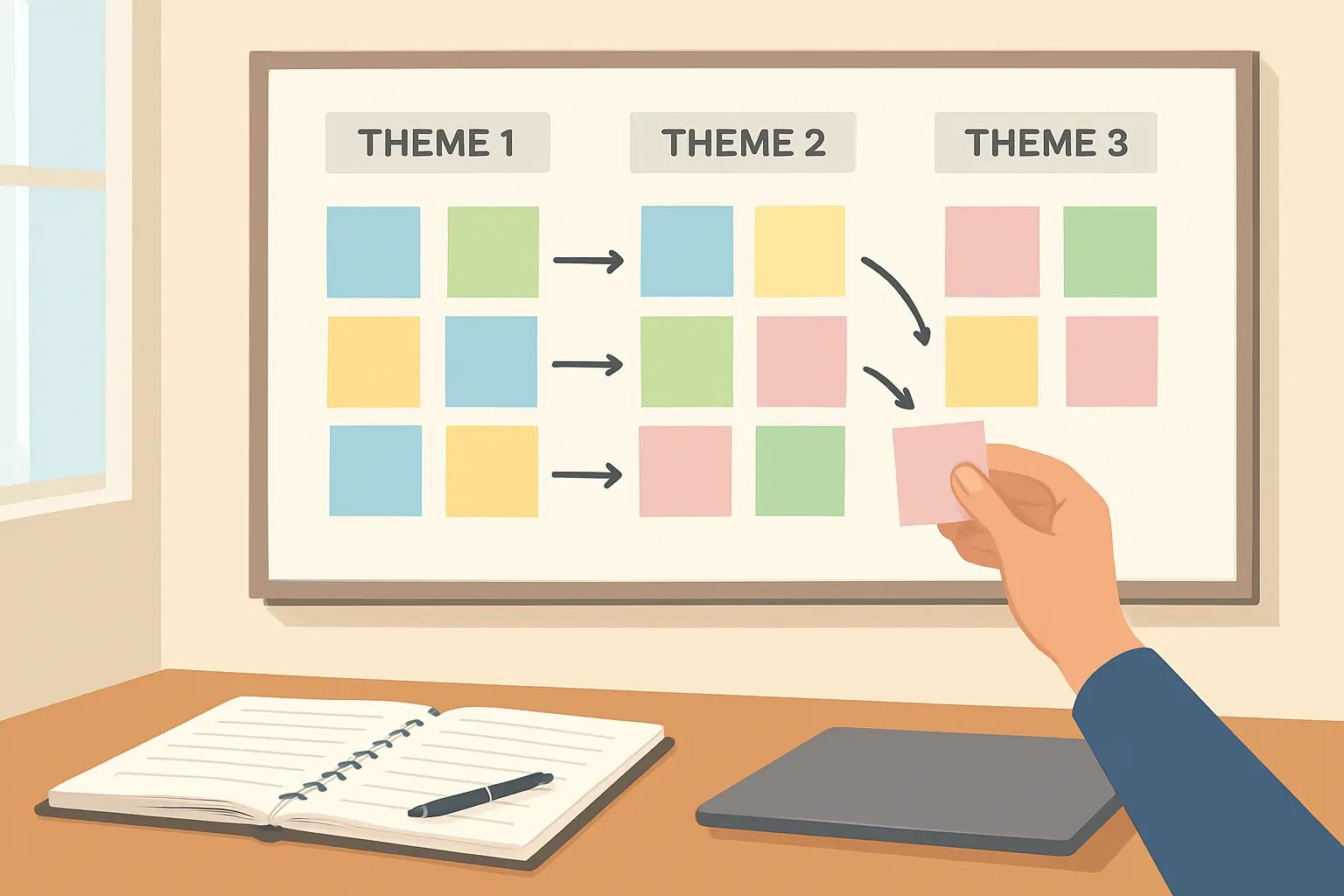
Many researchers find it useful to write each code on a sticky note (physical or digital) and move them around. Draw a preliminary thematic map: circles or boxes represent candidate themes, with codes clustered inside or around them. At this stage you may also identify sub-themes within broader themes, and you will almost certainly find codes that do not fit anywhere — set those aside. Do not force-fit codes into themes where they do not genuinely belong.
Common mistake: Creating themes that are simply topic lists (“Interview responses about technology”, “Comments about isolation”). Good themes have internal coherence and tell an interpretive story about the data. “Digital Infrastructure as a Source of Fragility” is a theme. “Technology problems” is a category.
Phase 4 — Review Themes
What you do: Test every candidate theme against two levels of evidence. First, re-read all the coded extracts within a theme and ask: do these extracts form a coherent pattern? If a theme contains contradictory or unrelated fragments, it needs splitting or refining. Second, re-read the full dataset and ask: does this theme genuinely reflect what is in the data as a whole, or are there significant segments you have not captured?
Phase 4 is where themes get merged (two themes are really one), split (one theme contains two distinct ideas), renamed, or dropped entirely. Update your thematic map after each cycle. It is normal to iterate through Phase 4 multiple times before settling on a final set of themes.
Quality signal: If you cannot find at least four distinct data extracts to support a theme independently, it likely lacks the evidential weight to stand on its own in a dissertation findings chapter.
Phase 5 — Define and Name Themes
What you do: Write a clear, precise definition — often called an essence statement — for each final theme. The name should be analytically evocative; the definition should explain what the theme captures and how it relates to your research question.
For each theme, draft a brief “theme narrative”: what is this theme about? What aspect of participants’ experience does it illuminate? What is the central interpretive claim? This theme narrative becomes the backbone of your analytical write-up in Phase 6.
Naming advice: Avoid generic labels like “Theme 1: Stress” in favour of analytically meaningful names that hint at the insight: “Hypervigilant Availability: the expectation of instant digital response as a new form of academic obligation.” Names can use participant language directly (in vivo naming) or researcher-generated conceptual language — both are acceptable, though the choice should be consistent and justified.
1. Technical Failure as Acute Stressor — Technology breakdowns created discrete, unforeseeable crisis moments that disrupted work and amplified anxiety.
2. Institutional Unpreparedness — Universities’ failure to anticipate and provide adequate digital support shifted problem-solving burden onto students.
3. Boundary Dissolution — Removal of physical campus transitions eroded students’ ability to segment study from personal life.
4. Social Thinning — Reduction of informal peer contact created cumulative isolation that impaired both wellbeing and academic progress.
Phase 6 — Write Up
What you do: Present your analysis as a coherent narrative. Each theme gets its own section in your findings chapter, typically with a heading, a theme narrative (the interpretive claim), supporting data extracts (quotes), and analytical commentary that links extracts to your claims and to the existing literature.
The critical distinction is between description and analysis. Description says what participants said. Analysis says what it means, why it matters, and how it connects to the research question and to scholarship. Examiners read findings chapters looking specifically for evidence of interpretive thinking — not a catalogue of summarised quotes.
Each quote should be introduced, not dropped in mid-paragraph. Use speaker identifiers (P3, Participant 7, or a pseudonym) and include enough surrounding context. After the quote, interpret it: what does it illustrate? Why is it relevant to the theme? How does it extend, confirm, or complicate what other participants said? Every quote needs a sentence of interpretation after it, not just before it.
Braun and Clarke recommend keeping the analytical write-up in your findings/analysis chapter and describing your analytical process in the methodology chapter — these are two separate tasks, and conflating them is a common structural error in dissertations.
Full Worked Example: Student Experiences of Remote Learning
The table below traces how one data segment moves through all six phases — from raw transcript text to published analysis — showing the transformation at each step.
| Phase | Example output |
|---|---|
| Raw data extract | “The Teams call dropped mid-supervision and I couldn’t get back in for twenty minutes. By the time I rejoined, she’d moved on and I just felt stupid.” |
| Phase 2 — Initial codes | technology failure during supervision; shame response to connectivity loss; feeling excluded from academic relationship; disrupted supervisory continuity |
| Phase 3 — Candidate theme | Digital Infrastructure as a Source of Fragility |
| Phase 4 — Refined theme | Technical Failure as Acute Stressor (split from Infrastructure theme after review) |
| Phase 5 — Theme definition | Technology breakdowns created discrete, unforeseeable crisis moments that disrupted supervisory relationships and amplified shame and self-doubt |
| Phase 6 — Written analysis | Participant 7’s account (“The Teams call dropped… I just felt stupid”) illustrates how connectivity failures compounded academic vulnerability, transforming a routine supervisory interaction into an experience of exclusion and shame — an affective consequence invisible to institutional IT metrics. |
Notice how the Phase 6 entry does not just paraphrase the quote — it names the mechanism (connectivity failure → exclusion → shame) and adds an interpretive observation (invisible to IT metrics) that the participant did not say directly. That interpretive layer is what distinguishes analysis from summary.
Software Options: Manual, NVivo, and MAXQDA
Thematic analysis does not require specialist software. Many rigorous dissertations are coded manually using Word comments, colour-coded printed transcripts, or spreadsheets. The right choice depends on your dataset size, your software familiarity, and the time you have available.
Manual coding (Word / Excel)
Best for: Smaller datasets (up to 8–10 transcripts), students new to QDAS software, projects under significant time pressure.
In Word: use the Comments function to label data segments; use Find & Replace to locate all instances of a code; build a separate table listing each code and the segments it covers. In Excel: use one worksheet per transcript, apply codes in an adjacent column, then sort the master code sheet by code name to review which segments cluster together.
NVivo
Best for: Medium-to-large datasets (10+ transcripts), research involving multiple data types (transcripts plus documents plus images), projects requiring a visual thematic map or query function.
NVivo’s Node system maps directly onto Phases 2 and 3 of Braun and Clarke’s framework — each Node is a code, and you organise Nodes into folders that represent candidate themes. The Node Matrix query lets you cross-tabulate codes against participant attributes (year of study, discipline) in Phase 4. The separate step-by-step guide on how to run thematic analysis in NVivo covers the full workflow including importing transcripts, creating a thematic map, running queries, and exporting a codebook.
MAXQDA and ATLAS.ti
Best for: Research teams, multilingual datasets, mixed-methods projects where qualitative codes need linking to quantitative variables. Before committing to a platform, the comparison of AI tools for qualitative coding — covering ATLAS.ti AI Assist, MAXQDA AI Themes, NVivo, Delve, and others — is worth reading, since AI-assisted code suggestion raises important reflexivity questions that you will need to address in your methodology if you use it.
How to Write Thematic Analysis in Your Methodology Chapter
The methodology chapter needs to do three things: name the specific approach and cite Braun & Clarke correctly, justify it as appropriate for your research question, and describe the process you actually followed. Examiners want to see that you could explain and reproduce what you did — not just name-drop the method.
A template paragraph structure for your methodology section:
- Identify the approach: “Data were analysed using reflexive thematic analysis (Braun & Clarke, 2006, 2022).”
- Justify the choice: “This approach was selected because it is flexible, compatible with a constructionist epistemology, and suited to answering the research question about lived experience rather than testing a pre-specified model.”
- Describe the process: “Analysis followed the six-phase process: familiarisation with data, generating initial codes, constructing candidate themes, reviewing themes, defining and naming themes, and producing the written analysis (Braun & Clarke, 2006). Coding was conducted inductively, without a pre-set codebook.”
- Address quality: “Trustworthiness was enhanced through reflexive journalling throughout analysis, member checking with two participants, and peer debriefing with the project supervisor.”
On positionality: Braun and Clarke expect researchers using reflexive TA to disclose their position relative to the topic and data. This is where your positionality statement becomes essential — contemporary examiners routinely ask about it in vivas, particularly in social science, health, and education dissertations.
On inter-rater reliability: If a supervisor or examiner asks why you did not calculate inter-rater reliability, the answer is principled: reflexive TA conceptualises codes as researcher constructions, not objective classifications that exist independently in the data. Applying reliability statistics would contradict the method’s epistemological basis. If you are using codebook TA in a multi-coder project and you do need reliability statistics, see the guide to ICC, Krippendorff’s alpha, and Bland-Altman for a full methods reference.
Structure your analysis write-up with Tesify
Tesify is an integrity-first AI assistant built for thesis and dissertation writing. It helps you structure your methodology and findings chapters, draft your analytical write-up around your themes, and run an originality self-check — so you submit with confidence rather than last-minute anxiety. Start free at Tesify.
Frequently Asked Questions
How many themes should thematic analysis produce?
Braun and Clarke do not specify a fixed number. Most dissertation-level thematic analyses produce between three and six themes. Fewer than three risks oversimplification; more than seven often means the analysis lacks focus or contains sub-themes that should be folded into broader ones. Each theme should have enough data to sustain an analytical narrative — typically a minimum of four or five distinct supporting extracts from different participants.
What is the difference between a theme and a code in thematic analysis?
A code is a label applied to a specific data segment — it is granular and close to the data. A theme is a higher-order pattern that groups multiple codes around a central interpretive idea. Codes like “technology dropped during supervision”, “platform inaccessible at deadline”, and “IT support unavailable” might cluster into a theme called “Technical Failure as Acute Stressor”. Themes carry analytic weight and make an interpretive claim; codes are the building blocks used to construct them.
Can I do thematic analysis on survey data, not just interviews?
Yes. Thematic analysis works with any text-based or visual qualitative data: open-ended survey responses, focus group transcripts, policy documents, social media posts, diary entries, or observation notes. The six phases apply across data types. With shorter survey responses, you may generate fewer codes per participant but can compensate with a larger sample size. Familiarisation becomes especially important with brief data — reading across all responses before coding gives you the holistic picture that individual responses alone cannot provide.
Is thematic analysis inductive or deductive?
Reflexive TA is primarily inductive — themes emerge from the data rather than being imposed by a pre-existing framework. However, all research involves some deductive element, because your research question already shapes what you attend to. Braun and Clarke describe reflexive TA as data-driven but acknowledge that pure induction is impossible since researchers always bring prior knowledge and theoretical assumptions. If you begin analysis with a specific theoretical lens, this is called theoretical or deductive TA, and you should say so explicitly in your methodology chapter.
How do I justify thematic analysis as rigorous in my dissertation?
Rigour in reflexive TA is demonstrated through trustworthiness criteria (Lincoln & Guba, 1985) rather than reliability measures. Specific strategies include: maintaining a reflexive journal throughout analysis; member checking by sharing preliminary findings with participants; peer debriefing with a colleague or supervisor; providing a full audit trail of your analytical decisions; and using thick description with sufficient data extracts so readers can evaluate your interpretations independently. Your positionality statement also contributes to methodological rigour by making your standpoint and potential influences explicit.
How long does thematic analysis take for a dissertation?
For a typical dissertation with 10–15 interview transcripts, allow two to four weeks for thorough thematic analysis. Phases 1 and 2 (familiarisation and coding) are the most time-intensive — careful coding can take one to two hours per transcript. Phases 3 and 4 (theme generation and review) take several days of iterative map revision. The write-up of analysis (Phase 6) is part of your findings chapter, which adds further time. Students who compress familiarisation to save time almost always produce weaker, less credible themes that examiners notice.
Write your thesis with AI
Structure, draft, cite, and format your thesis faster with Tesify’s AI writing tools, automatic bibliography, and plagiarism checker. Free to start, no credit card required.





Leave a Reply