

How to Do a Literature Review for Your Thesis in 2026
Understanding how to do a literature review for your thesis is one of the first real tests of doctoral and master’s-level research. Unlike an annotated bibliography or a book report, a literature review requires you to synthesise what scholars have found, identify where their conclusions converge and conflict, and build a rigorous argument for why your own research is necessary. It is, in short, where you prove that you belong in the scholarly conversation you are about to enter.
Students often underestimate the complexity of this chapter. They either summarise sources one by one — producing what supervisors call a “literature catalogue” — or attempt synthesis without a clear organisational framework and end up with a chapter that reads as a series of loosely connected points. This guide gives you a process that avoids both failure modes.
The following steps apply whether you are writing a standalone literature review or integrating one into the introduction of your thesis. The same logic governs both; the difference is only scale.
What a Literature Review Actually Is
A literature review is a critical evaluation and synthesis of existing scholarship on your research topic. It is not a summary of every paper you have read. Its purpose is to establish the intellectual context for your study, demonstrate your command of the field, identify where knowledge is incomplete or contested, and justify your research question by showing that it addresses a genuine gap.
There are several types of literature review. For most thesis writers, you will be conducting an integrative or narrative review — reading broadly, identifying themes, and constructing an argument. Systematic reviews (common in medicine and public health) follow a strict protocol with explicit inclusion criteria, search strategy reporting, and quality appraisal. Knowing which type your discipline expects will shape how you structure and document your process.
Step 1: Define Your Research Question and Scope
Before you search for a single source, write down your research question and the boundaries of your review. These boundaries — sometimes called your inclusion and exclusion criteria — determine which studies you will read and which you will set aside.
Typical boundaries include:
- Time period: Will you include all literature from 1990 to present, or only the last ten years?
- Geographic scope: Is this a global review or are you focused on a specific country or region?
- Language: Will you read only English-language sources, or include translated works?
- Study design: Are you reviewing only empirical studies, or also theoretical frameworks and grey literature?
- Discipline: Will you stay within your home discipline or conduct an interdisciplinary review?
Documenting your criteria at this stage protects you from mission creep — the phenomenon of endlessly expanding your reading list because you keep finding adjacent topics that seem relevant.
Step 2: Search Databases Systematically
Random Google Scholar searches are not a systematic literature search. A proper search uses Boolean operators, controlled vocabulary, and multiple databases. This is essential because different databases index different journals, and no single database covers the entire scholarly literature.
Core databases by discipline:
| Discipline | Primary Databases |
|---|---|
| Social Sciences | Web of Science, Scopus, SSRN, JSTOR |
| Medicine / Health | PubMed, MEDLINE, Cochrane Library, CINAHL |
| Humanities | JSTOR, MLA International Bibliography, Project MUSE |
| Engineering / CS | IEEE Xplore, ACM Digital Library, Scopus, arXiv |
| Business | Business Source Complete, ABI/INFORM, Scopus |
Use Boolean operators to build your search string:
- AND — narrows results (remote working AND knowledge transfer)
- OR — broadens results (remote working OR telework OR distributed work)
- NOT — excludes irrelevant results (knowledge AND transfer NOT technology transfer)
- Quotation marks — forces exact phrase search (“knowledge management”)
Run your search string in at least three databases. Export all results to a reference manager (Zotero, Mendeley, or EndNote) before you begin screening. This keeps your search reproducible, which matters if a reviewer asks you to justify your selection process.
Step 3: Screen and Select Sources
A thorough database search will typically return hundreds or thousands of results. Screening happens in two stages:
- Title and abstract screening: Read only the title and abstract. Apply your inclusion/exclusion criteria. Move anything that clearly does not meet the criteria to a separate excluded pile — do not delete it, because you may need to justify exclusions later.
- Full-text screening: For sources that pass the first screen, read the full text to confirm they meet your criteria and offer substantive engagement with your topic.
For a master’s literature review, 40–80 sources is typically appropriate. PhD reviews commonly engage with 100–200+ sources, though this varies significantly by discipline. Focus on quality and relevance over quantity — a tightly argued synthesis of 60 sources is more valuable than a superficial treatment of 150.
Step 4: Read Critically and Take Structured Notes
Critical reading means you do not accept an author’s conclusions at face value. You evaluate the quality of their evidence, the rigour of their methodology, and the logical validity of their argument. When you take notes, record not just what the source found but what it assumed, how it measured its variables, what it could not account for, and how it compares to other sources you have read.
A structured note-taking template for each source should include:
- Full bibliographic reference
- Research question or aim of the study
- Key theoretical frameworks used
- Methodology and sample
- Main findings
- Limitations acknowledged by the authors
- Your critical evaluation (strengths and weaknesses)
- How this source relates to your own research question
This investment pays dividends when you write. You will not need to re-read sources because all the information you need is already extracted and organised.
Step 5: Organise Sources by Theme, Not by Author
This is the step that separates a literature catalogue from a genuine literature review. Once you have read your sources, look for the themes, debates, and tensions that cut across them. Group sources by the idea they address, not by who wrote them.
Common organisational frameworks:
- Thematic: Organised by the key concepts or variables in your research question. This is the most common approach.
- Methodological: Organised by how the research was conducted — useful when method is itself a contested issue in your field.
- Chronological: Organised by when the research was conducted — useful when showing how thinking on a topic has evolved over time.
- Theoretical: Organised by competing theoretical frameworks — useful when your research takes a position in a theoretical debate.
Create a concept matrix or synthesis table before you write. List your themes across the top and your sources down the side. Mark which sources address which themes. This visual map becomes your outline.
Step 6: Write with Synthesis, Not Summary
Synthesis means weaving multiple sources together to build a point. Summary means reporting what one source said before moving to the next. Examiners are explicit about this distinction in their feedback.
Compare these two approaches to the same material:
Synthesis approach (use): “While autonomy gains are well-documented in remote work settings (Smith, 2019; Chen, 2020), these benefits appear to carry a social cost: both qualitative and quantitative studies have found higher levels of isolation (Jones, 2021; Patel et al., 2022) and a measurable decline in informal knowledge transfer (Brown and Lee, 2022; Williams, 2023), suggesting that individual performance gains may be offset by team-level knowledge deficits.”
Every paragraph in your literature review should begin with a topic sentence that asserts a point — not with an author’s name. Citations support your points; they do not make them.
Step 7: Articulate the Research Gap
Your literature review should end by crystallising the gap your research will address. By this point in the chapter, you have established what is known. Now you argue, with specificity, what remains unknown, underexplored, or contested — and why that matters.
Use the gap statement to create a direct bridge to your research question. The reader should feel that your study is the natural, logical next step given everything they have just read. This is not rhetoric — it is intellectual honesty about where your research fits in the landscape of what is already understood.
If your introduction chapter asks you to state the gap as well, coordinate the two carefully. The introduction gap statement should be brief; the literature review gap statement should be substantiated by the evidence you have just presented across the chapter.
For more on how to construct this bridge, see our guide on how to write a thesis introduction step by step.
Step 8: Format Your Citations Correctly
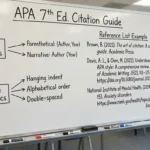
A literature review often contains more citations per page than any other chapter in the thesis. Errors accumulate fast. Whether your discipline uses APA 7th edition, Harvard, Chicago, or MLA, citation consistency is non-negotiable — examiners view frequent citation errors as a signal of insufficient attention to academic standards.
For a full breakdown of citation rules by source type, see our guide on how to cite sources in APA format step by step. Tesify’s Auto Bibliography feature can generate and format citations automatically as you write, significantly reducing the time spent on reference management.
Tools That Make Literature Reviews Faster
In 2026, the literature review process has been accelerated significantly by AI-assisted research tools. These do not replace critical reading, but they reduce the administrative overhead considerably.
| Tool | Use Case |
|---|---|
| Zotero / Mendeley | Reference management, citation generation, PDF annotation |
| Connected Papers / ResearchRabbit | Visualising citation networks to discover related literature |
| Elicit / Semantic Scholar | AI-assisted abstract screening and evidence extraction |
| Tesify Write + Auto Bibliography | Structured academic writing with integrated citation formatting |
For a comprehensive review of the AI tools available specifically for literature searching and synthesis, see our roundup of best AI literature review tools for researchers in 2026.
Common Mistakes and How to Avoid Them
- Summarising instead of synthesising. If each paragraph is about one source, you are writing a catalogue. Reorganise by theme.
- Omitting critical evaluation. A literature review is not just a report of findings — you must assess methodological quality and limitations.
- Over-relying on secondary sources. Cite primary sources wherever possible. Citing a summary of someone else’s work introduces interpretive errors.
- Ignoring conflicting evidence. If two studies found opposite results, discuss why — do not simply omit one.
- Poorly defined scope. Without clear inclusion criteria, your review will sprawl and reviewers cannot evaluate its completeness.
- Weak gap statement. Ending the chapter with “more research is needed” is not a gap statement — it is a truism. Be specific about what is missing and why it matters.
Writing a rigorous literature review is demanding, but it also gives you the deepest possible command of your field before you begin your own analysis. Use the process — not just as a chapter to complete, but as the intellectual foundation for everything that follows. For more support on structuring your thesis as a whole, see our overview of how to write a thesis in 2026.
Frequently Asked Questions
How many sources do I need for a thesis literature review?
For a master’s thesis, 40–80 well-chosen sources is generally appropriate. PhD literature reviews typically engage with 100–200+ sources, though this varies by discipline. Quality and relevance matter more than quantity — a tightly argued synthesis of fewer sources is stronger than a superficial treatment of many.
What databases should I use for a literature review?
Use at least three databases relevant to your discipline. Most fields use Scopus and Web of Science as core databases. Supplement with discipline-specific databases: PubMed for health sciences, IEEE Xplore for engineering, JSTOR for humanities, and SSRN for social sciences and economics.
What is the difference between a literature review and an annotated bibliography?
An annotated bibliography lists sources with a brief description of each. A literature review synthesises sources into a coherent argument, identifying themes, tensions, and gaps. A literature review has an argument; an annotated bibliography is a reference list with notes.
Should a literature review be organised chronologically or thematically?
Thematic organisation is generally preferred because it produces synthesis rather than a timeline. Use chronological organisation only when the evolution of thought over time is itself a key aspect of your argument — for example, when tracing how a concept has been theorised differently across decades.
How do I know when I have read enough for my literature review?
You have reached a point of theoretical saturation when new sources are no longer introducing new themes — you are seeing the same authors, arguments, and debates repeated. This typically signals that you have covered the core literature. Check that you have included foundational texts, recent publications from the last five years, and sources that represent both dominant and dissenting perspectives.
Can I include grey literature in my thesis literature review?
Yes, in many disciplines grey literature — government reports, policy documents, industry research, conference proceedings — adds valuable context. However, it should complement, not replace, peer-reviewed sources. Evaluate grey literature critically for bias, methodology, and credibility before including it.
Manage Your Literature Review with Tesify Write
Tesify Write helps academic writers organise sources, maintain citation consistency, and structure literature review chapters that examiners pass. The Auto Bibliography feature formats every reference automatically as you write — no manual checking, no missed sources.




Leave a Reply