
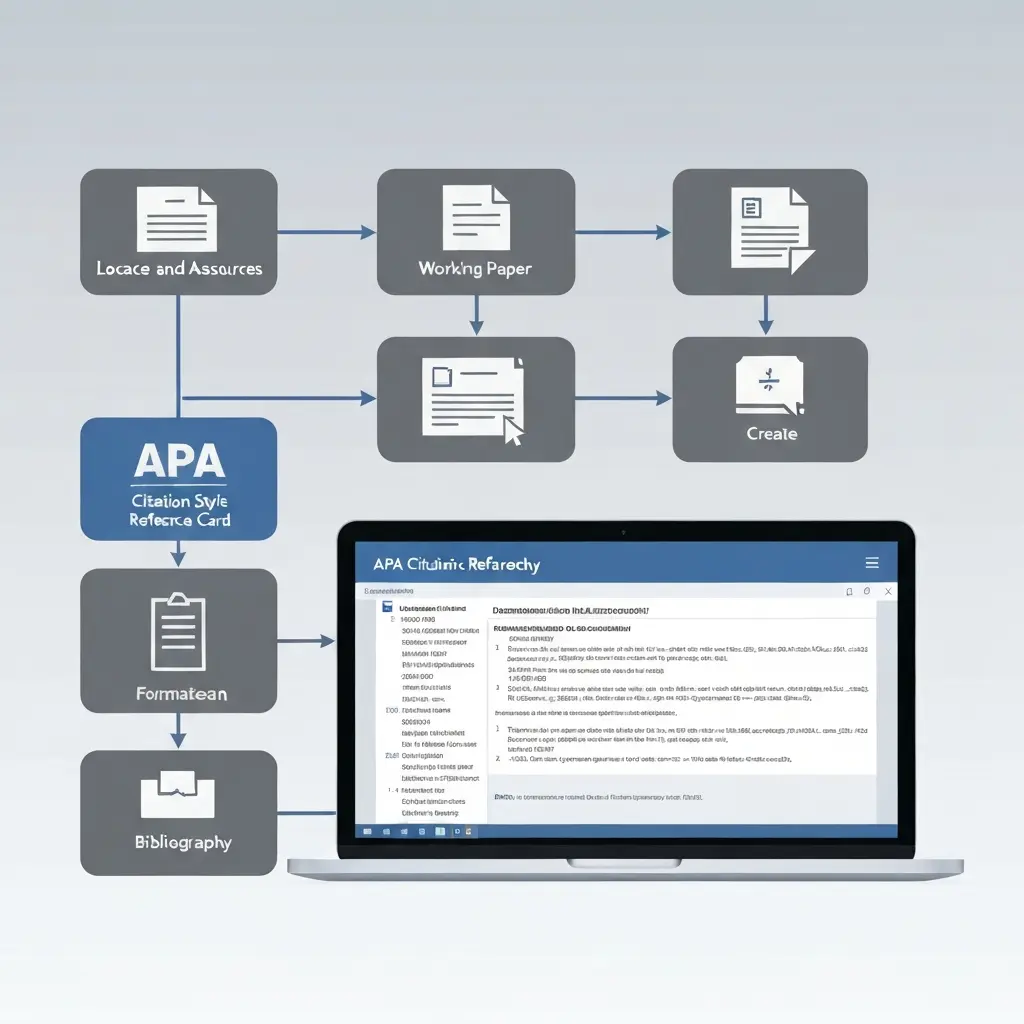
How to Cite Sources in APA Format Step by Step
Learning how to cite sources in APA format correctly is essential for any student writing in psychology, education, social sciences, or nursing. APA 7th edition — the current standard — updated several rules from the previous edition in 2019, and many students are still applying outdated 6th edition conventions. Incorrect citations can result in plagiarism flags and reduced marks, even when your underlying research is excellent.
This step-by-step guide covers everything you need: the APA author-date system, in-text citation formats for different numbers of authors, and reference list entries for every source type you are likely to cite in your thesis, dissertation, or academic paper. All examples follow APA 7th edition rules as required by Oxford, Cambridge, Harvard, MIT, Stanford, and most English-language universities worldwide.
Step 1: Understand the Author-Date System
APA format uses the author-date citation system. Every time you use information from a source — whether you quote it directly, paraphrase it, or summarise it — you include a brief in-text citation in parentheses. This citation points the reader to the full reference in your reference list at the end of the document.
The basic principle: the in-text citation and the reference list entry must correspond exactly. If your in-text citation says (Smith, 2023), your reference list must include an entry for Smith published in 2023. Any mismatch between in-text citations and reference list entries is a citation error.
Step 2: Write In-Text Citations Correctly
There are two ways to include an in-text citation in APA format: parenthetical citation and narrative citation.
Parenthetical Citation
The source information is placed in parentheses at the end of the relevant sentence or clause:
AI writing tools have transformed academic writing practices (Smith, 2023).
Narrative Citation
The author’s name is integrated into the sentence, with the year in parentheses immediately after the name:
Smith (2023) argued that AI writing tools have transformed academic writing practices.
Both forms are correct. Use narrative citations when you want to foreground the author (e.g., when their identity is relevant to the point you are making). Use parenthetical citations when the source is supporting evidence for your point rather than the focus of your sentence.
Step 3: Handle Multiple Authors
| Number of Authors | Parenthetical Form | Narrative Form |
|---|---|---|
| 1 author | (Smith, 2023) | Smith (2023) |
| 2 authors | (Smith & Jones, 2022) | Smith and Jones (2022) |
| 3+ authors | (Smith et al., 2021) | Smith et al. (2021) |
| Group/organisation | (World Health Organization, 2024) | World Health Organization (2024) |
| No author | (“Article Title,” 2023) | N/A — use parenthetical form |
Note that in parenthetical citations, two authors are joined by “&” while in narrative citations, they are joined by “and.”
Step 4: Cite Direct Quotations
When you copy an author’s exact words, you must include the page number (or paragraph number if no pages exist) in addition to the author and year.
Short Quotations (fewer than 40 words)
Include short quotations within your text, enclosed in quotation marks:
“AI writing tools have fundamentally altered the relationship between students and academic institutions” (Smith, 2023, p. 47).
Long Quotations (40 words or more)
For quotations of 40 words or more, use a block quote: start on a new line, indent the entire quotation 0.5 inch from the left margin, double-space, and do not use quotation marks. Place the citation after the final punctuation mark:
The emergence of AI writing tools in academic contexts has generated significant debate about the nature of authorship, intellectual contribution, and the fundamental purposes of academic assessment. Universities have been forced to reconsider their policies at speed, often without adequate empirical evidence about how these tools are actually being used by students. (Smith, 2023, p. 78)
Step 5: Format Your Reference List
The reference list appears at the end of your document on a new page. Key formatting requirements:
- Title: “References” — centred, bold (Level 1 heading)
- Double-spaced throughout
- Hanging indent: first line flush left, subsequent lines indented 0.5 inch
- Alphabetical order by first author’s surname
- All authors listed (up to 20; “…” then last author for 21+)
- DOIs as full hyperlinks: https://doi.org/xxxxxx
- No “Retrieved from” date for stable content
Step 6: Journal Articles
Basic Journal Article Format
Author, A. A., & Author, B. B. (Year). Title of article. Journal Name, Volume(Issue), First page–Last page. https://doi.org/xxxxx
Worked Example
Smith, J. A., Jones, B. C., & Brown, D. E. (2023). The impact of AI writing tools on postgraduate academic writing. Journal of Higher Education Research, 45(2), 112–134. https://doi.org/10.1000/jher.2023.045
Article Without DOI (with URL)
Williams, R. A. (2022). Academic integrity in the age of AI. University Teaching & Research, 18(4), 67–82. https://www.universitytea.edu/jrnl/45
Step 7: Books and Book Chapters
Whole Book
Author, A. A. (Year). Title of book. Publisher.
Book Example
Brown, T., & Davis, L. (2022). Academic writing in the digital age. Oxford University Press.
Chapter in an Edited Book
Author, A. A. (Year). Title of chapter. In E. E. Editor & F. F. Editor (Eds.), Title of book (pp. xx–xx). Publisher.
Book Chapter Example
Chen, L. (2021). Citation practices in postgraduate research. In M. Davis & S. Park (Eds.), Advances in academic research methodology (pp. 45–67). Cambridge University Press.
Step 8: Websites and Online Sources
Webpage Format
Author, A. A. (Year, Month Day). Title of webpage. Site Name. URL
Website Example
American Psychological Association. (2024). Generative AI guidance for students. https://apastyle.apa.org/generative-ai
No Author
Title of webpage. (Year, Month Day). Site Name. URL
APA style guide for students 2026. (2026, January 10). University Writing Centre. https://university.edu/writing/apa
Step 9: Other Source Types
Government Report
Department for Education. (2025). AI in higher education: Policy framework. UK Government. https://www.gov.uk/education/ai-policy
Conference Paper
Park, S., & Chen, L. (2025, September 3–5). AI tool adoption among postgraduate students in the UK [Paper presentation]. British Educational Research Association Annual Conference, Edinburgh, UK.
Thesis or Dissertation
Johnson, M. A. (2024). AI-assisted academic writing and university integrity policy: A mixed-methods study [Doctoral dissertation, University of Oxford]. Oxford University Research Archive. https://ora.ox.ac.uk/objects/uuid:xxxxx
Formatting all of these manually for a thesis with 100+ sources is extremely time-consuming. Tesify Auto Bibliography generates APA 7th edition references automatically from your verified sources, saving hours of formatting work and eliminating common citation errors. Tesify also serves students through dedicated platforms in France, Germany, Spain, and Portugal.
Frequently Asked Questions
How do you cite sources in APA format step by step?
Step 1: Use the author-date in-text citation format — (Author, Year) for paraphrasing, (Author, Year, p. X) for direct quotes. Step 2: For two authors use & in parenthetical and “and” in narrative. For three or more use “et al.” Step 3: Create a reference list at the end with hanging indent format, alphabetical order, and full DOI hyperlinks.
What is the APA format for a journal article?
Journal article format: Author, A. A., & Author, B. B. (Year). Title of article. Journal Name, Volume(Issue), pages. https://doi.org/xxxxx. Example: Smith, J. A. (2023). AI tools in academic writing. Journal of Educational Research, 45(2), 112–134. https://doi.org/10.1000/xyz123
How do you cite a source with no author in APA?
For sources with no identified author, use a shortened version of the title in your in-text citation. For articles and web pages (not books), use quotation marks: (“AI in Education,” 2023). In the reference list, the title moves to the author position. For the reference list entry, start with the italicised title of the source.
When do you use et al. in APA citations?
Use et al. in all APA in-text citations for sources with three or more authors, from the very first citation. Example: (Smith et al., 2022). In the reference list, list all authors up to 20 in full. For sources with 21 or more authors, list the first 19, then an ellipsis (…), then the last author.
How do you do a block quote in APA 7th edition?
For quotations of 40 words or more, use a block quote: start on a new line, indent the entire quotation 0.5 inch from the left margin, double-space, and do not use quotation marks. Place the parenthetical citation (Author, Year, p. X) after the final punctuation mark of the quotation, not inside it.
How do you cite a website in APA 7th edition?
Website format: Author, A. A. (Year, Month Day). Title of webpage. Site Name. URL. Do not include “Retrieved from” before the URL for stable web content. If the author and site name are the same organisation, include only one to avoid repetition. In-text: (Author, Year) or (Organisation, Year).
Do APA citations need a page number?
Page numbers are required in APA in-text citations only for direct quotations: (Smith, 2023, p. 47) or (Smith, 2023, pp. 47–48). For paraphrasing and summarising, page numbers are not required, though APA encourages including them to help readers locate specific information. For online sources without page numbers, use paragraph numbers: (Smith, 2023, para. 3).
How do you cite multiple sources in one APA citation?
When citing multiple sources in one parenthetical citation, list them alphabetically by first author surname, separated by semicolons: (Brown, 2020; Jones, 2022; Smith, 2021). The alphabetical order follows the same sequence as the reference list entries.
What is the difference between APA 6th and 7th edition citation format?
Key differences: APA 7th edition uses et al. for all three-or-more author citations (6th edition listed up to six authors before et al.). DOIs are presented as full hyperlinks (not “doi:”). Publisher location is removed from book references. Running head is not required for student papers. Up to 20 authors can be listed in the reference list (previously six).
Can I use a citation generator for APA format?
Yes — using citation generators for APA format is universally accepted. Tesify Auto Bibliography, Zotero, and EndNote all generate accurate APA 7th edition references. Always verify generated citations against the original source: common errors include missing DOIs, incorrect capitalisation, wrong author name formatting, and outdated 6th edition conventions. Never use AI chatbots like ChatGPT for citation generation — they frequently hallucinate non-existent references.
Format Your APA Citations Automatically
Stop formatting APA references by hand. Tesify Auto Bibliography generates perfect APA 7th edition citations and reference lists from your verified sources — saving hours of tedious formatting work.





Leave a Reply